A tattooed biker watched a man choke a baby in Walmart—then got arrested for saving her life. But the real nightmare was just beginning.
The Texas heat didn’t just sit on you—it hunted you. Even the asphalt in the Super-Mart parking lot looked like it was contemplating surrender, shimmering in waves that distorted reality itself.
Miller killed the engine on his Harley, feeling the vibration die out in his calloused hands, but the ringing in his ears stayed. It always stayed—a permanent souvenir from too many firefights in places most people couldn’t find on a map. He swung his leg over the bike, grimacing at the stiffness in his bad knee. Getting old is a privilege, they say. Sometimes it just feels like a slow payment plan for past sins, with interest compounding daily.
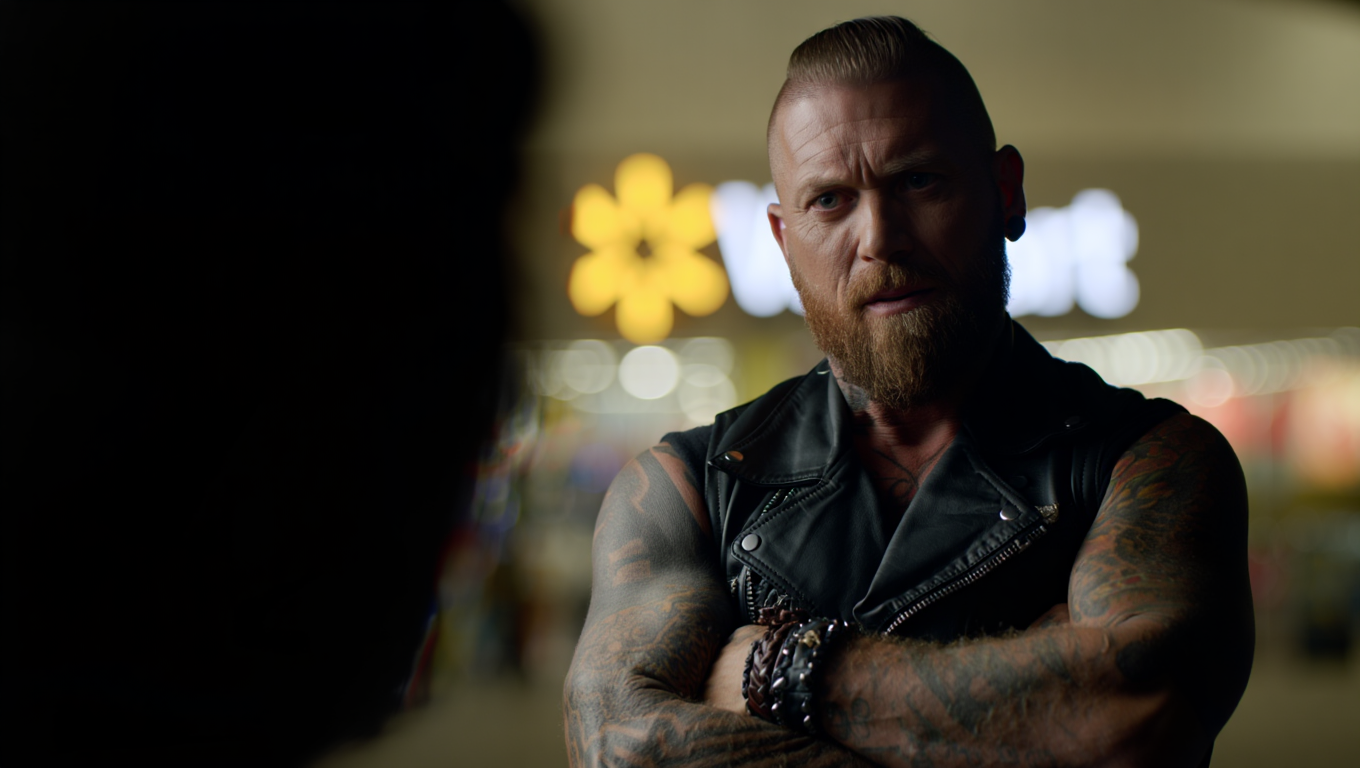
He adjusted his leather vest, feeling it stick to his back in the oppressive humidity. The leather was covered with patches that meant everything to him and nothing to the suburban soccer moms pushing carts full of organic kale and overpriced bottled water. “Sarge,” one patch read. “Medic,” said another. A few had dates—memorials to friends who didn’t make it back from the sandbox. People saw the skull patch and thought “gang.” They didn’t know it was a memorial unit, a promise to never forget the brothers who bled out in his arms.
Miller walked toward the automatic doors, his boots heavy on the concrete. People parted like the Red Sea, a phenomenon he’d grown accustomed to over the years. A young mother in yoga pants pulled her toddler closer, whispering something he couldn’t hear but could easily imagine. An old guy in a pink polo shirt stared at Miller’s tattoos—the sleeve of ink that told stories of Baghdad, Fallujah, and places that didn’t have names on any official map—then quickly studied his shoes when Miller’s eyes met his.
He didn’t blame them. In a world full of sheep, the wolf stands out, even if the wolf is just a retired Army medic trying to pick up motor oil and a case of cheap beer to get through another lonely Tuesday night.
The blast of air conditioning hit him like a blessing the second the automatic doors slid open with their familiar whoosh. After the suffocating heat outside, it felt holy, almost spiritual.
Miller grabbed a red plastic basket, the handle digging into his calloused palm, and headed for the automotive section. He had a mental list: motor oil for the Harley, maybe some brake fluid, beef jerky for the ride home, and that case of beer he’d been thinking about since noon.
The store was packed for a Tuesday afternoon—crying babies creating a symphony of misery, static-filled announcements over the intercom advertising sales nobody cared about, the constant beep-beep-beep of checkout scanners creating a rhythm that drilled into his skull.
It was too much noise. Too much sensory input. Miller’s head started doing that thing it did in crowds—scanning sectors, identifying exits, looking for threats that probably weren’t there. His therapist at the VA called it hypervigilance. Miller called it staying alive.
Relax, he told himself. You’re in a grocery store in suburban Texas, not Fallujah. Nobody is sniping you from the cereal aisle. The Fruit Loops aren’t IEDs. That soccer mom isn’t a combatant.
He focused on his breathing, using the technique the therapist had taught him. In for four. Hold for four. Out for four. Repeat until the world stops feeling like a combat zone.
He grabbed his motor oil—the good synthetic stuff because the Harley deserved better than bargain barrel garbage—and threw in a pack of teriyaki beef jerky. The jumbo size, because why not.
Miller was heading toward the registers, cutting through the baby aisle because it was usually empty and quiet, a shortcut that would save him from the chaos of the main thoroughfare.
Except today, it wasn’t empty.
There was a woman there, young, maybe late twenties but looking forty from exhaustion. She wore stained sweatpants and an oversized t-shirt, her hair pulled back in a messy bun that had given up hours ago. Her eyes had that specific glazed-over quality that only new parents know—the look of someone who hasn’t slept more than two consecutive hours in weeks, possibly months.
She was staring at the formula prices like they were written in alien hieroglyphs, her lips moving as she did mental math that clearly wasn’t adding up to anything good. Her hands trembled slightly as she held her phone, probably checking her bank balance and finding it wanting.
And in the cart seat, facing Miller, was a little girl. Maybe eighteen months old, with blonde curls that caught the fluorescent light like spun gold and big blue eyes that seemed to hold more awareness than a toddler should possess. She was kicking her little legs in pink light-up sneakers, the kind that flashed with every movement.
The little girl saw Miller—all six-foot-four, two hundred forty pounds of scarred, tattooed, leather-wrapped intimidation—and most kids would have burst into tears at the sight.
This one didn’t.
She just stared, curious, tilting her head like she was trying to figure him out.
Miller gave her a small nod, the kind of acknowledgment one human gives another.
She giggled, a pure sound of delight that cut through all the background noise.
That’s when the hair on the back of Miller’s neck stood up.
It was an instinct, a biological alarm system he’d earned the hard way in places where ignoring such warnings meant coming home in a flag-draped box. He felt eyes on him. Not the usual “look at the scary biker” eyes he’d grown immune to. These were different.
Predator eyes.
Miller stopped pretending to be interested in the display of diapers and used his peripheral vision to scan the area, a technique he’d perfected in urban combat zones where looking directly at a threat could get you killed.
There.
About ten feet away, near the baby wipes display, pretending to read the labels on a package of sensitive skin wipes.
Average height, maybe five-ten. Slim build, probably one-sixty soaking wet. Cargo shorts despite the fact that it was fall. A nondescript grey t-shirt that screamed “trying not to be noticed.” Baseball cap pulled low, obscuring most of his face. Sunglasses indoors, which was the first real red flag.
But it wasn’t what he was wearing that set off Miller’s alarms.
It was what he was doing.
He wasn’t looking at the wipes. He wasn’t looking at the exhausted mother digging through her purse.
He was locked on the kid with an intensity that made Miller’s blood run cold.
Miller knew that look. He’d seen it on jackals in the Iraqi desert, waiting for a wounded gazelle to stumble. He’d seen it on the faces of insurgents watching a convoy, calculating the perfect moment to detonate. It was a look of pure, hungry calculation—the look of a predator who had already decided the outcome and was just waiting for the right moment to strike.
The man in the cap took a step closer to the mother and child, his movement smooth and practiced, like he’d rehearsed this.
The mother didn’t notice. She was too busy digging in her purse, probably looking for a coupon or her phone or trying to find enough change to afford the formula her baby needed. She had turned her back on the cart for just a split second, her attention divided.
That’s all it takes. Miller knew that better than most. One second of inattention. One moment of distraction. That’s the window predators wait for.
The guy in the cap moved with purpose now, closing the gap between himself and the cart. His right hand twitched at his side, fingers flexing around something small concealed in his palm.
Miller’s combat instincts shifted into high gear. His heart rate slowed—a counterintuitive response his body had learned under fire. Time seemed to dilate, each second stretching into multiple frozen moments of clarity.
The man’s hand opened slightly, revealing the object. Something small, round, and colorful. Bright blue.
A candy? A toy from one of those twenty-five-cent machines near the entrance?
No. Miller’s eyes narrowed. It was hard, not soft. A marble? A high-bounce ball?
The man in the cap glanced around quickly—a practiced surveillance check—and in one fluid motion, he flicked his wrist.
The blue object arced through the air in a perfect parabola, landing with barely a sound on the plastic tray in front of the baby.
“Hey,” Miller started to say, dropping his basket and stepping forward.
But toddlers are fast, driven by instinct and curiosity. Before the word had fully left Miller’s mouth, before he could close half the distance, the little girl’s chubby hand had already grabbed the shiny blue ball.
And with the inevitability of gravity, it went straight into her mouth.
The man in the cap stepped in immediately, his timing too perfect to be coincidence. This wasn’t a good Samaritan rushing to help. His hand went for the cart handle, but his other hand was reaching for the kid’s arm—not her back, not to help dislodge the object.
He was positioning to grab and go, to create chaos and extract the target in the confusion.
But then everything changed.
The baby stopped making noise.
The happy leg-kicking ceased. Her eyes went wide—not with pain, but with the primal panic of an organism suddenly unable to perform its most basic function: breathing.
The giggling stopped.
She wasn’t coughing.
Miller knew the rule from his combat medic training: If they can cough, they can breathe. If they’re making noise, air is moving.
She wasn’t coughing. She wasn’t making any sound at all.
Her face transitioned from its healthy pink to a disturbing shade of red, then began tipping toward violet—the color of oxygen deprivation, the color of brain damage counting down in seconds.
Silence. Complete, terrible silence from a child who seconds ago had been the picture of animated life.
The mother turned back around, her hands finally emerging from her purse with a crumpled coupon and her phone.
“Okay, sweetie, I found the—”
She stopped mid-sentence. She saw her baby gasping, mouth open in a silent scream, no sound coming out, face darkening to a shade no parent should ever have to see.
“Lily?” the mother whispered, her voice small and broken. Panic froze her completely. She didn’t scream. She didn’t grab her child. She just stared, her brain unable to process the nightmare unfolding in front of her.
The guy in the cap lunged forward with practiced precision. “I’ve got her!” he announced loudly, playing the hero for any potential witnesses.
But Miller saw the truth. The man’s grip wasn’t going for the baby’s back to perform the Heimlich or back blows. His hand locked around her tiny wrist, and he was pulling—pulling her up and out of the cart seat, trying to separate her from the mother.
He wasn’t trying to dislodge the object. He was trying to separate the target from the herd while everyone was distracted by the medical emergency.
Red lights flashed in Miller’s brain like a fire alarm.
Code Blue. Airway obstruction. Hostile contact. Civilian in danger.
Miller didn’t make a conscious decision. There was no internal debate, no weighing of consequences. The soldier took over, bypassing twenty years of civilian conditioning in a microsecond. The retired medic Miller checked out, and the combat veteran who had saved lives under fire checked in.
He dropped his basket. The motor oil hit the floor with a heavy thud that nobody noticed in the developing chaos.
Miller covered the twenty feet between himself and the cart in two massive strides, his boots pounding the linoleum like thunder.
The guy in the cap saw him coming—two hundred forty pounds of leather and controlled rage bearing down on him like a freight train with a personal vendetta.
The man’s eyes went wide behind his sunglasses. He saw death coming and his survival instincts kicked in. He flinched, releasing the baby’s wrist and starting to step back.
But Miller didn’t stop. There was no time to stop and explain. No time for dialogue or negotiation.
The baby was turning blue. Every second was brain damage. Every second was permanent disability. Every second was death creeping closer.
Miller’s shoulder caught the man in the cap square in the chest. It wasn’t a punch. It was a calculated tackle designed to create separation and neutralize a threat. The man flew backward into the shelf behind him, his back slamming into metal with a sound like a car crash. A display of baby powder exploded on impact, white dust mushrooming into the air like a smoke grenade.
The mother finally found her voice. She screamed, “What are you doing?! GET AWAY FROM HER!”
Miller ignored her. He had maybe ninety seconds before permanent brain damage. He had maybe three minutes before death. Neither timeline allowed for explanations.
He reached into the cart, his scarred hands—hands that had performed battlefield surgery, hands that had held dying soldiers, hands that looked like they belonged to a monster—wrapping around the tiny girl with surprising gentleness.
But he couldn’t treat her there. The cart was in the way, the angle was wrong, and the mother was already grabbing at his arms, her maternal instincts overriding everything else. The creep in the cap was starting to recover, shaking off the impact.
Miller needed space. He needed the right angle. He needed gravity working with him, not against him.
He pulled the baby out of the cart seat in one smooth motion, supporting her head, cradling her against his chest.
“NO!” the mother shrieked, a sound that tore through the store like a siren, primal and devastating. “HE’S TAKING HER! SOMEBODY HELP! HE’S TAKING MY BABY!”
Miller didn’t look at her. He didn’t try to explain. He tucked the girl against his chest, one arm supporting her head and neck, and he pivoted on his heel.
And he ran.
“Stop him!” someone yelled from another aisle.
“Kidnapper!” another voice joined in.
“Call 911!”
Miller sprinted down the main aisle, his boots pounding the floor. The girl was limp in his arms, her tiny body growing heavier by the second as the oxygen deprivation took its toll. Her face was deep purple now, almost blue.
Come on, kid. Stay with me. Don’t you dare die on me.
He needed to get outside. He needed open air and space to work. If he stopped now, if he tried to perform the procedure here in the aisle, the mob forming behind him would tackle him. They’d pull the baby away. They’d beat him to death while she suffocated, convinced they were saving her from a monster.
He saw the automatic doors ahead, blessed salvation in glass and metal.
People were shouting, their voices blending into a cacophony of rage and fear. A security guard—couldn’t have been more than nineteen, probably making minimum wage and definitely not trained for this—stepped into the aisle, blocking Miller’s path. His eyes were wide, his hand hovering near the radio on his belt but not the weapon he wasn’t carrying.
“Sir! Stop right there!” His voice cracked on the command.
Miller didn’t slow down. He actually accelerated. “MOVE!” he roared, the command voice he’d perfected over years of leading men in combat, a voice that bypassed rational thought and triggered the hindbrain’s survival instinct to obey.
The kid guard dove out of the way like Miller was a linebacker and he was in the open field with no backup.
Miller hit the automatic doors at full speed. They weren’t opening fast enough, still sliding apart at their programmed leisurely pace. He lowered his shoulder and slammed through the gap, the glass panels rattling in their frames but not breaking, the metal frames groaning at the abuse.
The heat hit him like a physical wall, but he didn’t slow down.
He made it five steps onto the sidewalk, past the shopping cart return, before his combat-trained ears picked up the sound.
Sirens. Multiple units. Close. Too close.
Someone had already called 911. The response time was impossibly fast, which meant they’d probably been nearby on another call.
But Miller couldn’t stop. Couldn’t wait. The baby in his arms was dying.
He dropped to one knee on the scorching concrete, the heat burning through his jeans, but the pain was distant, irrelevant.
The baby was purple now, her lips turning blue-black, her eyes starting to roll back.
Miller flipped her over with practiced efficiency, laying her face-down along his forearm, her head positioned lower than her chest. Gravity was his ally now. Her tiny body looked impossibly fragile against his thick, tattooed forearm.
“Don’t you die on me,” he growled, a promise and a threat.
He used the heel of his other hand, positioning it between her shoulder blades. Back blows. The infant choking protocol. Five strikes, then reassess.
One. Nothing.
Two. Still nothing.
Three. The baby’s body jerked but the obstruction held.
Behind him, the store was erupting into chaos. He could hear running feet, angry voices, the building mob mentality.
“There he is!”
“Get him!”
“He’s killing her!”
“Somebody stop him!”
Miller shut it all out. The voices, the approaching sirens, the pounding feet. His entire world contracted to the dying child and the procedure.
Four.
Five.
Harder this time, walking the line between too gentle to work and hard enough to cause internal injuries. Better a bruised back than a dead kid. Better broken ribs than a funeral.
Nothing. The obstruction wasn’t moving.
Miller flipped her over onto his other arm with the speed of long practice, supporting her head, tilting it back slightly. He looked in her mouth, using his finger to sweep carefully.
He could see it. The blue rubber ball, lodged deep in her airway, completely blocking the passage. It was too far back to safely remove with his fingers—trying would just push it deeper.
It wasn’t moving with back blows alone.
He looked up for a split second, his combat awareness still tracking threats even while performing medical procedures.
Three men were charging him across the parking lot. Big guys, probably construction workers or blue-collar heroes who thought they were saving a child from a predator. One of them had grabbed a tire iron from his truck bed, holding it like a baseball bat.
They didn’t see a medic saving a life.
They saw a huge biker in a skull-covered leather vest bent over a limp, discolored child in a Walmart parking lot.
They were coming to kill him. And in their position, with their information, Miller might have done the same thing.
But right now, they were the threat preventing him from saving this baby.
And the baby still wasn’t breathing.
Miller had maybe thirty seconds before they reached him. Thirty seconds before the tire iron connected with his skull. Thirty seconds to save a life while his own was being measured in countdown.
He made a decision.
Abdominal thrusts. The Heimlich maneuver, modified for an infant. It was risky—could cause internal injuries, could damage her liver or spleen. But she was seconds from death. Seconds from permanent brain damage.
Risk versus benefit. Death was certain. Injury was possible.
Miller positioned his fist just below her sternum, his other hand supporting her back. He was on his knees on the concrete, hunched over her, using his body as a shield.
The first blow from the tire iron hit him right between the shoulder blades.
It felt like lightning made of solid steel, a thunderclap of agony that whited out his vision for a second. The air exploded from his lungs in a rush, and he tasted copper—blood from where he’d bitten his cheek.
“Get off her, you sick bastard!” the man with the tire iron screamed, rage and righteousness making him fearless.
Miller didn’t let go of the girl. Couldn’t. Not yet. Not until she was breathing.
He curled his body around her, turning his broad back to his attackers, becoming a human turtle shell protecting the only thing that mattered in this moment.
Don’t drop her. Don’t pass out. Don’t die until she’s breathing.
A boot caught him in the ribs. Something cracked—he felt it more than heard it, a grinding sensation deep in his torso. The pain was distant, muted by the adrenaline dumping into his system in quantities that would make a pharmaceutical company jealous.
“He’s choking her!” a woman shrieked from somewhere near the store entrance. “Oh my God, somebody stop him!”
They were right on top of him now, a circle of righteous fury forming around him. Three men who thought they were heroes, who would tell this story in bars for years—how they stopped a child predator in a parking lot. How they saved a baby.
They were going to beat him to death right here on the sun-baked concrete, convinced they were saving a life.
But Miller wasn’t done.
The girl in his arms was limp, her color fading from purple toward grey. He had seconds. Not minutes. Seconds.
With the mob literally raining blows on his back and head, with blood running into his eyes from a cut somewhere on his scalp, Miller positioned the heel of his hand one final time.
He used the ground for leverage, bracing his knee, putting his entire body weight behind it.
Come on, sweetheart. Come back.
He thrust upward. Hard. Harder than the textbooks said. Harder than was strictly safe.
It was violent. It had to be.
The little girl’s body jerked like she’d been shocked with a defibrillator.
And then, a sound. A wet, hacking cough.
Something flew out of her mouth, trailing saliva, tumbling through the air.
It hit the hot asphalt with a tiny, innocent sound.
Plink.
A blue rubber ball. Small, bouncy, exactly the kind you get from a quarter machine. Innocent-looking. Deadly in the wrong place.
For a split second that felt like eternity, time stopped.
The ball rolled a few inches across the pavement and stopped near Miller’s boot, coming to rest in a crack in the asphalt.
Then came the scream.
It wasn’t a scream of pain or fear. It was the scream of life itself, of oxygen filling lungs that had been starved, of a nervous system rebooting after nearly flatlin ing.
A loud, piercing, absolutely beautiful wail as her lungs filled with the hot Texas air.
She was crying. She was breathing. She was alive.
Miller slumped forward, his forehead coming to rest on the gritty, oil-stained pavement. Relief washed over him like a wave, momentarily stronger than the pain radiating from a dozen different injuries.
“Thank God,” he whispered, the words lost in the chaos around him.
The beating stopped.
The man with the tire iron froze mid-swing, his arm raised high, his face a mask of confusion transitioning to horror as his brain processed what his eyes were seeing.
He looked down. He saw the crying baby in the big man’s arms, her face transitioning from grey-purple back toward healthy pink. He saw the blue ball on the ground. He saw the blood trickling down the side of Miller’s head where his first swing had grazed the scalp.
He saw what he had done.
“She’s… she’s crying,” someone said, their voice trembling with the dawning realization of almost-catastrophe.
Miller didn’t look at them. Moving with infinite gentleness despite his injuries, he carefully rolled onto his side.
He placed the little girl on the ground, making sure she was clear of the vomit and the object she’d expelled, making sure she was stable and breathing. Her face was pink again, her chest rising and falling in beautiful, regular rhythm. She was furious, terrified, probably sore, but gloriously, magnificently alive.
“Don’t move!”
The command came from behind him, backed by the authority of sirens that had finally arrived.
Miller raised his hands slowly, carefully, making sure his movements couldn’t be misinterpreted. His ribs screamed in protest.
Two police cruisers screeched to a halt in the parking lot, boxing him in from two angles. Doors flew open with practiced speed. Weapons were drawn—service pistols catching the afternoon light.
“Get on the ground! Now! Face down! Hands where we can see them!”
Miller was already on the ground, his face pressed against pavement that smelled like old motor oil and sun-baked rubber, but he complied further anyway. He spread his arms out wide, crucifixion-style. He spread his legs. He didn’t resist. He didn’t try to explain.
You don’t explain to a gun barrel. You don’t argue with adrenaline-pumped cops who’ve just responded to a child abduction call. You comply and you survive, and you explain later when everyone’s heart rate is below 180.
“I’ve got the suspect secured!” an officer yelled, rushing over with handcuffs already in hand.
He dropped a knee into Miller’s already broken ribs—standard procedure to keep a suspect immobilized, but it didn’t make it hurt any less.
Miller grunted, biting his lip hard enough to draw blood to keep from crying out.
“Hands behind your back! Do it now!”
The cuffs clicked tight around his wrists. Too tight, metal biting into bone, cutting off circulation. Miller had been cuffed before—drunk and disorderly back in his wilder days, a bar fight that got out of hand—but it never stopped being a humiliating, dehumanizing experience.
They hauled him up roughly, and the world spun like a carnival ride. His vision greyed at the edges. Concussion, probably. Add it to the list.
That’s when the mother arrived.
She broke through the line of stunned shoppers who were still processing what they’d just witnessed, her face a mask of absolute terror and mother-bear protective rage.
“Lily!” she screamed.
She scooped up the crying child, her hands frantically checking for injuries, counting fingers and toes, looking for blood or bruises or any sign that her baby had been harmed.
“Oh my god, oh my god, baby, are you okay? Mommy’s here, mommy’s got you.”
Then she looked up at Miller, her eyes meeting his for the first time.
Her eyes weren’t filled with gratitude or relief or understanding.
They were filled with pure, unfiltered hatred. The kind of hatred only a mother who thinks someone tried to hurt her child can generate.
“He took her!” she screamed, pointing a shaking finger at Miller like he was a demon manifest. “He grabbed her out of my cart and ran! I saw him! He tried to kill her!”
The cop shoving Miller toward the cruiser tightened his grip on Miller’s arm, his fingers digging in hard enough to leave bruises. “You’re a sick piece of work, buddy,” he spat with genuine disgust.
Miller looked at the mother, and he wanted to tell her everything. He wanted to tell her about the man in the cap. He wanted to tell her about the blue ball, about the predator who had tried to take her child. He wanted to explain that he’d just saved her daughter’s life while taking a beating to do it.
But his jaw was locked tight, clenched against the pain radiating from his ribs. And honestly, he was too tired. Too hurt. Too defeated by the injustice of it all.
He looked down at the asphalt where the ball had landed, where the evidence of what really happened should be.
It was gone.
Miller’s blood ran ice cold despite the Texas heat.
He scanned the ground frantically, his eyes searching every crack and crevice. The vomit was there, a small pool of stomach contents and saliva. The scuff marks from the struggle were there, dark streaks on the concrete. His blood was there, drops of it forming a small constellation.
But the blue rubber ball—the evidence that the baby had been choking, the proof that Miller wasn’t just a maniac violently shaking an infant, the one piece of physical evidence that would corroborate his story—was missing.
Miller looked up, scanning past the police tape that was already being strung, past the crowd of gawkers filming everything on their phones, past the screaming mother clutching her baby.
And he saw him.
The man in the baseball cap.
He was standing by the shopping cart return, maybe thirty yards away, partially hidden behind a group of shocked shoppers. He wasn’t running anymore. He had shifted into blending mode, becoming just another concerned citizen watching the drama unfold.
He was holding a phone to his ear, talking to someone, but his eyes were locked on Miller with a cold, calculating gaze.
And in his other hand, casually playing with it like a child’s toy, rolling it between his fingers, was a small blue rubber ball.
Their eyes met across the parking lot.
The man in the cap didn’t smile. Didn’t gloat. He just gave Miller a small nod of acknowledgment, tipped his cap in a mockingly polite gesture, turned around with casual confidence, and walked calmly toward a beat-up sedan parked in the far corner of the lot.
“Hey!” Miller shouted, struggling against the officer holding him, pain forgotten in a surge of desperate urgency. “Hey! That guy! The one by the cart return! Stop him!”
The cop slammed Miller against the hood of the cruiser, the hot metal burning through his shirt. “Shut up! You have the right to remain silent, and I strongly suggest you use it!”
“You don’t understand!” Miller roared, the desperation finally breaking through his combat-trained composure. “That man! He put the ball in her mouth! He has the evidence! He’s getting away!”
“Yeah, yeah, tell it to the judge,” the cop spat, his voice dripping with contempt. “Scumbag.”
He shoved Miller’s head down and forced him into the backseat of the cruiser, the practiced motion of someone who’d done this a thousand times.
The door slammed shut with the finality of a coffin lid. The lock engaged with an electronic beep.
Miller was trapped in the cage, surrounded by the smell of old vinyl, sweat, fear, and the accumulated misery of everyone who’d ever sat in this seat before him.
Through the wire mesh partition and the scratched window, he watched the sedan pull out of the parking lot at a normal, unhurried pace. No squealing tires. No dramatic escape. Just a man leaving a grocery store on a Tuesday afternoon.
The mother was sobbing uncontrollably now, clutching her child to her chest while paramedics tried to check the baby’s vitals. The man with the tire iron was being patted on the back by other shoppers, congratulated for his bravery, celebrated as a hero who stopped a monster.
And Miller was the monster in the cage, bleeding onto vinyl seats, his broken ribs grinding with every breath.
But as the cruiser prepared to pull away, Miller saw something that gave him a sliver of hope.
The store manager was running out of the automatic doors, his tie flapping, his face pale and panicked. He was waving his arms frantically, trying to flag down the second police car.
He looked terrified. Desperate.
He was holding a tablet in his hand—probably connected to the store’s security system.
He ran up to the sergeant in charge, a grizzled veteran cop who looked like he’d seen everything. The manager was talking fast, gesturing wildly back at the store.
The sergeant shook his head, dismissive, probably thinking this was about shoplifting or some other trivial matter that could wait.
The manager did something risky then. He grabbed the sergeant’s arm—you don’t touch cops, everyone knows that—and shoved the tablet screen directly into the officer’s face, forcing him to look.
The sergeant’s jaw was working, chewing gum in that perpetual motion cops seemed to have. He looked at the screen, his expression bored.
Then his jaw stopped moving.
He froze completely, standing statue-still in the middle of the parking lot.
He watched the screen for five seconds. Then ten. Then fifteen, his face going through a series of expressions—confusion, understanding, shock, and finally, horror.
Then he looked up, his eyes tracking across the parking lot until they found the cruiser Miller was in.
His face had gone completely white, all the blood draining away like someone had opened a valve.
He tapped his radio, his lips moving fast, saying words Miller couldn’t hear but could imagine. “Hold that vehicle. We need to review something. Don’t move the suspect yet.”
But the cruiser Miller was in was already moving, the rookie cop behind the wheel either not hearing the radio call or not processing it in time.
They were pulling out of the parking lot, merging onto the access road that would take them to the highway, headed for the county lockup where Miller would be processed, photographed, and thrown in a cell to wait for whatever came next.
Miller leaned his head back against the seat and closed his eyes against the pain that was starting to break through his adrenaline shield. His ribs were a dull, grinding agony with every breath. His head throbbed where the tire iron had connected. His wrists were going numb from the too-tight cuffs.
But he knew what the sergeant had seen on that tablet.
The security footage would show everything. The man in the cap throwing the ball. The baby choking. Miller’s desperate run to save her. The truth.
But Miller also knew that the guy in the cap was gone now, disappeared into the sprawling suburban landscape of strip malls and subdivisions where a man in a baseball cap was invisible, unremarkable, impossible to find.
And guys like that—professionals who could choke a baby in a Walmart just to create a distraction, who could manipulate a situation with that level of precision—they don’t just disappear randomly. They don’t work alone. They regroup. They have backup plans and backup plans for their backup plans.
And if he was willing to essentially murder a baby in a public place just to create chaos and confusion, if that was his opening move… what was he really after? What was the endgame?
Miller looked down at his hands, still cuffed in his lap, and noticed something for the first time.
There was something stuck to the leather of his vest, caught in the stitching near his chest. He worked it free with his fingers, which was difficult with his hands cuffed, but he managed.
It was a sticker. A small, colorful label that must have been stuck to the baby’s clothing and transferred to him when he held her.
But it wasn’t a normal baby clothing label. It wasn’t a price tag or a size marker.
It was a barcode label, the kind used in laboratories and medical facilities.
Property of Bio-Gen Labs.
Subject 89.
Miller stared at it, his mind racing despite the concussion fog.
This wasn’t a random kidnapping attempt. This wasn’t some psycho targeting a random child at a grocery store.
The baby—Lily—was labeled. Tagged like livestock or a laboratory specimen.
Subject 89 implied there were at least 88 others. Maybe more.
Miller had just walked into the middle of something much bigger than a choking incident. He had disrupted some kind of operation, some kind of… harvest.
And they—whoever “they” were—weren’t going to just let him walk away with that knowledge.
They weren’t going to let the witness survive.
The cruiser merged onto the highway, headed toward the county jail, and Miller sat in the back with a barcode sticker hidden in his palm and the growing certainty that his nightmare was just beginning.