My neighbor’s daughter ran into my house crying at 11 PM… Then her father kicked down my door while I was calling 911.
I never thought I’d be the kind of person who gets involved in other people’s family drama. I’m a private guy—I keep to myself, go to work, come home, watch the game. That’s my routine. I’ve lived in this quiet suburban neighborhood for about eight years now, and in all that time, I’ve prided myself on being the kind of neighbor who minds his own business. I wave hello, I keep my lawn mowed, I don’t complain about noise or parking. That’s the extent of my community involvement.
But sometimes life throws you into situations where you don’t get to choose whether you’re involved or not. Sometimes a decision gets made for you in the span of about three seconds, and everything changes.
It was a Tuesday night in late September, around eleven o’clock. I remember it was Tuesday because I’d stayed up to watch the end of a baseball game—my team was in the playoffs, and I wasn’t about to miss it. The game had just ended, and I was feeling pretty good about the win. I was in my pajamas, brushing my teeth, getting ready to finally call it a night. I had an early meeting the next morning, some budget presentation I’d been dreading all week.
That’s when I heard the pounding.
Not knocking—pounding. The kind of desperate, frantic hammering on a door that makes your blood run cold. The kind that tells you something is very, very wrong. My first thought was that there was a fire, or maybe a car accident right outside my house. I grabbed my phone from the bathroom counter and headed to the front door, my heart already racing.
But I didn’t open it right away. Living alone, you learn to be cautious. I pulled up my security camera app—I’d installed a video doorbell about a year ago after a string of package thefts in the neighborhood. Best two hundred bucks I ever spent.
The camera showed my front porch, and what I saw made my stomach drop.
There she was—my neighbor’s daughter, Emma. She’s sixteen, a junior in high school, quiet kid. I’d seen her around the neighborhood since she was probably eight or nine years old. Always polite when she’d see me in the driveway, usually with her earbuds in, lost in her own teenage world. Sweet kid. Never any trouble.
But on my camera, she looked absolutely terrified. Her face was red and blotchy from crying, mascara running in dark streams down her cheeks. Her pink shirt was wrinkled and disheveled, like she’d been in some kind of struggle. She kept looking back over her shoulder toward her house next door, then turning back to pound on my door again with both fists.
I could hear her voice, muffled through the door: “Please! Please open the door! Please!”
I opened it immediately.
The moment that door swung open, Emma practically fell into my house. She stumbled past me into my living room, sobbing so hard she could barely stand. I’d never seen anyone so scared in my entire life. Her whole body was shaking.
“Emma, what’s going on?” I asked, closing the door behind her but keeping my hand on the knob, ready to lock it. “What happened? Are you hurt?”
She tried to speak, but she was hyperventilating, gasping for air between sobs. She wrapped her arms around herself protectively and backed up until she hit my couch, then collapsed onto it.
“Please,” she managed to choke out. “Please don’t let him get me. Please don’t make me go back.”
“Don’t let who get you? Emma, you need to tell me what’s happening.”
That’s when I heard it—the yelling from next door. Her father, Marcus. I could hear him even through my closed door and windows. His voice was loud, angry, slurred. I’d met Marcus plenty of times over the years. He seemed like an okay guy—worked in construction, kept his yard nice, always friendly when we’d chat by the mailboxes. Big guy, probably six-foot-four, built like someone who worked with his hands for a living. He loved his daughter, or at least that’s how it always seemed. I’d seen him at her soccer games, cheering in the stands.
But the voice I was hearing now wasn’t the calm, friendly neighbor I knew. This was rage, pure and unfiltered.
“EMMA! GET BACK HERE RIGHT NOW! YOU HEAR ME? RIGHT NOW!”
Emma flinched at the sound of his voice, curling up tighter on my couch. “He’s drunk,” she said, her voice small and broken. “He came home drunk and so angry. I don’t even know what I did wrong. He just started yelling at me about… about my grades, about my friends, about everything. And I tried to explain, I tried to tell him I didn’t do anything, but he wouldn’t listen.”
She pulled up the sleeve of her pink shirt, and that’s when I saw it—angry red marks on her upper arm, clear finger-shaped bruises already starting to form. Someone had grabbed her. Hard.
“He grabbed me,” Emma continued, fresh tears streaming down her face. “He grabbed my arm and he was screaming in my face, and his breath smelled like whiskey, and I was so scared. I thought he was going to… I don’t know what I thought. But I just ran. I ran out the back door and I came here because your light was on and I didn’t know where else to go.”
My hands were shaking as I looked at those bruises. This sweet kid, this quiet teenager who’d never done anything to anyone, had been hurt in her own home by someone who was supposed to protect her.
That’s when I made the decision. I pulled out my phone and dialed 911.
“This is 9-1-1, what’s your emergency?”
“Hi, yes, I need police at my address immediately. My neighbor’s daughter just ran into my house. She’s sixteen years old, she’s terrified, and she says her father is drunk and grabbed her. She has visible bruising on her arm. I need someone here now.”
The dispatcher was calm and professional, asking me questions, keeping me on the line. I gave her my address, gave her Emma’s address next door. I described what I’d seen, what Emma had told me. The dispatcher assured me that officers were being dispatched and would be there within minutes.
“Sir, I need you to stay on the line with me,” the dispatcher said. “Keep your doors locked. Do not engage with the father if he comes to your residence. Officers are three minutes away.”
Three minutes. That doesn’t sound like a long time until you’re standing in your living room with a terrified teenager, listening to an angry drunk man yelling next door, and waiting for help to arrive.
But I didn’t get three minutes.
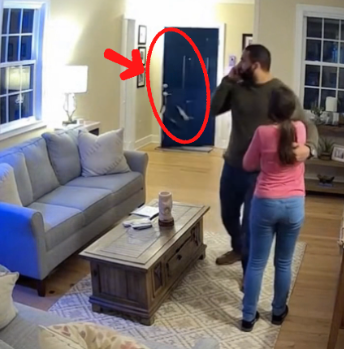
About ninety seconds after I hung up with dispatch, my security camera detected movement outside. I glanced at my phone screen, and my heart sank. Marcus was there, storming across his lawn toward my house. Even in the grainy night-vision footage, I could see the fury on his face. He wasn’t stumbling or weaving—if anything, the alcohol seemed to have given him a kind of focused rage.
“Emma, get behind the couch,” I said, trying to keep my voice calm. “Stay down and stay quiet.”
She looked at my phone screen and saw her father approaching. She let out a small, terrified whimper and immediately dove behind my couch, making herself as small as possible.
I positioned myself between the front door and where Emma was hiding. I’m not a small guy—I’m six-foot-two, about two hundred and twenty pounds, played linebacker in high school—but I’m also forty-seven years old with a bad knee from that same football career. I’m not a fighter. I’m an accountant who goes to the gym twice a week and considers mowing the lawn his primary form of exercise.
But I also knew, standing there in my living room, that I couldn’t let this man get to that girl.
The pounding started again, but this time it was different. Harder. More aggressive. I could feel my door rattling in its frame.
“OPEN THIS DOOR!” Marcus roared. “I KNOW SHE’S IN THERE! EMMA, GET OUT HERE NOW!”
“Mr. Marcus,” I called through the door, trying to sound calm and authoritative. “The police are on their way. You need to go home and cool off. We can sort this out when you’re sober.”
“YOU DON’T TELL ME WHAT TO DO!” he screamed back. “THAT’S MY DAUGHTER! GIVE HER TO ME!”
“I can’t do that. She’s scared, and she’s safe here. The police will be here in less than two minutes—”
That’s when it happened.
The sound was like an explosion. A tremendous CRACK as Marcus kicked my door with what must have been every ounce of strength in his two-hundred-and-fifty-pound frame. The deadbolt held—thank God I’d installed a good one—but the wooden door frame around it splintered. Chunks of wood flew into my entryway. The door swung partially open, hanging at an odd angle from the damaged frame.
And there he stood in my doorway, breathing hard, eyes wild and bloodshot, fists clenched at his sides. In that moment, he looked like a stranger. Not the friendly neighbor who’d helped me move my couch last year, not the proud dad at the soccer games. He looked dangerous.
Behind me, I could hear Emma sobbing quietly, trying to muffle the sound with her hands.
Everything in that moment seemed to slow down. I could hear my own heartbeat pounding in my ears. I could feel adrenaline dumping into my system, making my hands shake and my vision sharpen. Every instinct in my body was screaming at me to run, to get out of the way, to let him take his daughter and make this not my problem.
But I didn’t move.
Instead, I stepped forward, making myself bigger, squaring my shoulders, putting my body fully between Marcus and the spot where Emma was hiding. I pointed toward the door with one hand, keeping the other hand ready at my side.
“GET OUT OF MY HOUSE!” I roared, and I barely recognized my own voice. It was deeper, louder, more commanding than I knew I could be. “YOU DO NOT COME INTO MY HOME! THE POLICE ARE ON THEIR WAY! YOU NEED TO LEAVE RIGHT NOW!”
Marcus took a step inside, glass from my broken door frame crunching under his boot. His hands were shaking—whether from rage or alcohol or both, I couldn’t tell.
“She’s MY daughter!” he snarled, jabbing a finger in my direction. “You have no right to keep her from me! No right!”
“I HAVE EVERY RIGHT TO PROTECT SOMEONE IN MY HOME!” I shot back, my voice echoing through the house. “You just committed breaking and entering! You just destroyed my property! You need to leave NOW before you make this even worse for yourself!”
“Worse? You think this can get worse?” Marcus laughed, but there was no humor in it. “That’s my little girl in there. My baby. And you’re keeping her from me like I’m some kind of… some kind of criminal.”
“You grabbed her hard enough to bruise her,” I said, lowering my voice slightly but keeping it firm. “You came home drunk and violent. You scared her so badly she ran away from her own home to a neighbor she barely knows. You kicked in my door. Marcus, if you’re not a criminal right now, you’re about to become one if you take one more step.”
For a moment—just a moment—something flickered across his face. Recognition, maybe. A brief clarity cutting through the alcohol fog. He looked past me, trying to see where Emma was.
“Emma,” he called out, and his voice cracked. “Emma, baby, please. I’m sorry. I didn’t mean to scare you. I just… I just wanted to talk to you. About your grades. About that boy you’ve been seeing. I just wanted to talk.”
From behind the couch, Emma’s voice came out small and terrified: “You grabbed me, Dad! You hurt me! You were screaming in my face like you wanted to kill me!”
“I would never—” Marcus started, but I cut him off.
“But you did,” I said quietly. “You did hurt her. And now you need to face the consequences of that. The police are going to be here any second. If you leave now, walk out that door and wait on your lawn with your hands visible, maybe—maybe—you can keep this from destroying your entire life. But if you take one more step into my house, if you try to get to that girl, I will do whatever I have to do to stop you. And I promise you, that will not end well for either of us.”
We stood there in this terrible standoff, him just inside my broken doorway, me blocking his path to Emma. I could see him calculating, weighing his options. His fists were still clenched. His jaw was tight. He was a bigger man than me, younger and stronger, and if it came to a physical fight, I wasn’t sure I could win.
But I also knew I’d try. God help me, I’d try.
The sound of sirens in the distance broke the tension. They were faint at first, but growing louder. Marcus’s eyes widened as he heard them, as the reality of the situation started to penetrate through his rage and intoxication.
“Marcus,” I said, keeping my voice as calm as I could manage. “It’s over. The police are here. Step outside. Put your hands up. Don’t make this worse than it already is.”
For a long, terrible moment, he didn’t move. He just stood there, staring past me toward where his daughter was hiding, breathing hard. I could see the wheels turning in his head, could almost feel him wrestling with himself.
Then, slowly—so slowly—his shoulders sagged. The rage seemed to drain out of him all at once, leaving behind something that looked like despair. He took a step backward, out of my doorway, onto my porch.
“Emma,” he said, and now his voice was thick with tears. “Baby, I’m so sorry. I never meant to… I didn’t mean to hurt you. You have to believe me.”
But Emma didn’t respond. She stayed hidden behind my couch, crying quietly.
Marcus backed down my porch steps, and I watched through my broken doorway as he walked across my front lawn. The sirens were very close now, just a block or two away. He sat down heavily on my grass, put his hands on top of his head, and just… broke down. His whole body shook with sobs.
I stayed where I was, keeping myself between the door and Emma, until I saw the flashing red and blue lights illuminating my street. Three police cruisers pulled up, officers emerging quickly, hands on their weapons, assessing the scene.
They approached Marcus first, ordering him to stay seated, to keep his hands visible. He complied without resistance, and within thirty seconds they had him in handcuffs. I watched through my broken door as they lifted him to his feet and started walking him to one of the cruisers.
As they passed by my house, Marcus looked toward my door. Our eyes met. In that moment, I didn’t see rage anymore. I saw a broken man who’d just destroyed his relationship with his daughter, who’d just thrown away everything over a bottle of whiskey and unchecked anger. I saw regret and shame and horror at what he’d done.
Then they put him in the back of the car, and he was gone.
Two officers approached my house, hands still on their weapons until they could assess the situation. I called out through the broken door before they got too close.
“I’m the homeowner. I called 911. The girl is safe inside with me. I’m unarmed and I’m coming out slowly.”
I stepped through my broken doorway with my hands partially raised, trying to look as non-threatening as possible. One of the officers—a woman in her thirties with kind but alert eyes—approached me.
“Sir, are you injured?”
“No, ma’am. I’m fine. But Emma—the girl inside—she’s pretty shaken up.”
“Emma is the daughter?”
“Yes. She ran to my house about ten minutes ago. She was terrified. She has bruising on her arm from where he grabbed her.”
The officer nodded and spoke into her radio, requesting additional units and a crisis counselor. Then she turned back to me.
“Can we come inside and speak with her?”
“Of course. Emma,” I called back into the house. “The police are here. You’re safe. Can you come out?”
There was a long pause, then Emma slowly emerged from behind my couch. She looked so small, so fragile. Her face was tear-stained, her eyes red and swollen. The female officer immediately softened her posture, approaching Emma slowly and gently.
“Hi, Emma. I’m Officer Rodriguez. You’re safe now, okay? Can we sit down and talk about what happened tonight?”
Emma nodded mutely and sat back down on my couch. Officer Rodriguez sat beside her while another officer began photographing my broken door and taking my statement. I explained everything—Emma arriving at my door, my 911 call, Marcus kicking in the door, the standoff.
“Did he make physical contact with you?” the officer asked me.
“No. I told him to leave, and when he heard the sirens, he backed down and went outside.”
“That was smart. And very brave,” the officer said, making notes. “We’ll need to collect your security camera footage as evidence.”
“Of course. Whatever you need.”
While they worked, I watched Officer Rodriguez talking quietly with Emma. The officer asked to see the bruises, and Emma pulled up her sleeve again. The officer took photos, documenting everything. She asked Emma questions about what happened at her house, how long her father had been drinking, whether this had happened before.
That last question hit me hard. “Has he hurt you before?”
Emma’s answer was quiet, barely audible: “Not like this. But he’s been drinking more lately. Since he lost that big construction contract. He’s been so angry all the time.”
More officers arrived. A crisis counselor showed up, a calm woman in her fifties who sat with Emma and talked to her while the police continued their investigation. Someone from Child Protective Services was apparently being called.
They asked me if I knew how to reach Emma’s mother. I didn’t, but I knew she worked at the hospital—Emma had mentioned it once. The officers made some calls and tracked her down. She was working a night shift in the emergency room about twenty minutes away.
While we waited, I sat in my kitchen, giving Emma space to talk to the counselor. I felt strange—my adrenaline was crashing, leaving me shaky and exhausted. My broken door hung open, letting in the cool September night air. I could see neighbors standing on their porches, watching the police cars, whispering to each other.
About thirty minutes after the police arrived, a car screeched to a halt in front of my house. Emma’s mother—Jennifer—jumped out, not even bothering to close her door properly. She was still in her scrubs, her ID badge swinging from a lanyard around her neck.
“Where is she? Where’s Emma?” she called out frantically.
Officer Rodriguez met her at my door, speaking calmly, explaining what had happened. Jennifer’s face went through a series of emotions—confusion, shock, horror, and finally rage.
“He did WHAT?” she nearly screamed. “He grabbed her? He broke into this man’s house?”
The officer guided her inside, and the moment Jennifer saw Emma sitting on my couch, both of them dissolved into tears. Jennifer rushed to her daughter, wrapping her in a tight embrace, both of them sobbing. It was the kind of moment that felt too private to witness, but there was nowhere for me to go.
“I’m so sorry,” Jennifer kept saying. “I’m so, so sorry, baby. I didn’t know. I didn’t know he’d been drinking again. I didn’t know.”
After they’d had a moment, Jennifer turned to me. Her eyes were red, her face streaked with tears, but she looked at me with such gratitude that I had to look away.
“You saved my daughter,” she said. “If you hadn’t been here, if you hadn’t let her in, if you hadn’t stood up to Marcus…” She couldn’t finish the sentence.
“I just did what anyone would do,” I said, though we both knew that wasn’t quite true.
“No,” Jennifer said firmly. “Not everyone. Most people would have turned her away, told her it was a family matter, stayed out of it. You protected her. You stood between her and a man twice your size. You could have been hurt.”
I didn’t know what to say to that, so I just nodded.
The police wanted to take Emma to the hospital to have her injuries properly documented and photographed. Jennifer agreed immediately, and they left together in Jennifer’s car, followed by a police cruiser. Before they left, Emma came over to me.
“Thank you,” she said quietly. “Thank you for letting me in. Thank you for not making me go back.”
“You’re welcome, Emma. You stay safe, okay?”
She nodded and hugged me quickly, then left with her mother.
After they were gone, the police finished up their investigation of my property. They arrested Marcus on multiple charges—domestic violence, assault, breaking and entering, destruction of property, and being intoxicated in public. They told me I’d need to come down to the station the next day to give a formal statement and provide copies of my security camera footage.
A different officer approached me as they were wrapping up.
“You did good tonight,” he said. “A lot of people would have ignored that knock on the door. Pretended they didn’t hear it. You probably saved that girl from a much worse situation.”
“I hope so,” I said.
“You did. But be prepared—this is going to be a process. There’ll be statements, possibly a trial if he doesn’t take a plea deal. You might have to testify.”
“Whatever it takes.”
The officer nodded approvingly and handed me his card. “If you need anything, or if Marcus tries to contact you, you call me immediately. We’re going to request a restraining order, but sometimes people don’t respect those.”
After the police left, I was alone with my broken door. It was almost one in the morning. I was exhausted, but I knew I wasn’t going to sleep. I couldn’t leave my door like that, so I spent the next hour finding some boards in my garage and temporary fixing it as best I could. It wasn’t pretty, but at least it would keep people out until I could get it properly repaired.
I finally went to bed around three, but I just lay there, staring at the ceiling, replaying the whole night in my head. The sound of Emma pounding on my door. The terror in her eyes. The crack of my door frame splintering. Marcus’s rage-filled face. The standoff. The sirens. All of it playing on a loop.
The next morning, I called in sick to work. There was no way I was going to be able to focus on budget presentations. Instead, I went to the police station and spent two hours giving a formal statement, answering questions, providing all my security camera footage. They showed me photos of Emma’s injuries—the bruises on her arm had darkened overnight, looking even worse.
Later that afternoon, a detective called to update me. Marcus had been formally charged and was being held pending a bail hearing. Child Protective Services had opened an investigation. Jennifer and Emma were staying with Jennifer’s sister across town.
“What happens now?” I asked.
“That depends on a lot of factors,” the detective said. “The district attorney’s office will decide how to proceed based on the evidence and whether Marcus is willing to take a plea deal. Given that this is a first offense and he has no prior record, he might get offered a deal that includes mandatory treatment and counseling.”
Over the next few weeks, I learned more about the legal process than I ever wanted to know. I had to give statements to Child Protective Services, to the district attorney’s office, to the family court. My security camera footage became key evidence in the case.
Marcus’s attorney tried to paint me as someone who’d overreacted, who’d kept a father from his daughter. But the footage didn’t lie—it showed a terrified girl running from her home, and an angry man breaking into mine.
Marcus eventually took a plea deal. He pleaded guilty to reduced charges in exchange for two years of supervised probation, mandatory alcohol treatment, anger management courses, and a six-month restraining order keeping him away from both Emma and Jennifer. If he completed all the requirements, the charges would eventually be reduced on his record.
Jennifer filed for divorce about a month after that night. She and Emma moved to an apartment across town, and I helped them move some of their furniture. It was the least I could do.
Before they left the neighborhood for good, Emma came over with a letter she’d written. I still have it in my desk drawer. In it, she thanked me for being brave when she needed someone to be brave for her. She thanked me for not turning her away, for not telling her it was a family matter, for standing between her and her father that night. She wrote that I’d restored her faith that there were good men in the world, men who protect instead of harm. She said she hoped she could be as brave as I was someday.
I cried reading that letter. Still do, sometimes, when I take it out and read it again.
About six months later, I ran into Jennifer and Emma at the grocery store. Emma looked different—healthier, happier. She’d put on a little weight, which Jennifer told me had been a concern for a while. She smiled when she saw me, a genuine smile that reached her eyes.
“How’s school?” I asked.
“Good,” Emma said. “Really good actually. My grades are up. I made the honor roll last semester.”
“That’s wonderful. I’m proud of you.”
Jennifer gave me an update on Marcus. He was sober, attending all his mandated programs, working a new construction job. He was slowly, carefully trying to rebuild a relationship with Emma through supervised visits. It would be a long road, but at least he was trying.
“He wrote you a letter,” Jennifer said, pulling an envelope from her purse. “He asked me to give it to you if I ever saw you. You don’t have to read it if you don’t want to.”
I took the letter home and waited a few days before opening it. When I finally did, I found three pages of handwritten apology. Marcus wrote about that night, about how ashamed he was, how horrified he was by what he’d done. He apologized for breaking my door, for threatening me, for putting me in that position. He thanked me for protecting his daughter when he couldn’t be trusted to do it himself. He wrote about his sobriety, about facing what he’d become, about the long journey ahead.
He didn’t ask for forgiveness. He just wanted me to know he was sorry, and that he was trying to be better.
I never responded to that letter. I didn’t know what to say. But I kept it, along with Emma’s letter, in my desk drawer.
It’s been almost a year now since that Tuesday night. My door frame has been repaired—you can barely tell it was ever broken. Life has mostly returned to normal. I go to work, come home, watch the game. But I’m different now.
I’m more aware. More watchful. I notice things I didn’t notice before—raised voices from neighboring houses, kids who seem too quiet, cars that stay parked outside for too long. I’ve had conversations with other neighbors about watching out for each other, about paying attention, about not assuming everything is fine just because we want it to be.
I also installed additional security cameras. Not because I’m paranoid, but because I learned how valuable that footage was. It protected Emma, and it protected me from false accusations.
Sometimes, late at night, I think about what would have happened if I’d made a different choice. What if I’d looked at my camera, seen a crying teenager, and decided it wasn’t my problem? What if I’d cracked the door and told Emma to go home and work it out with her dad? What if I’d let Marcus take her when he broke into my house?
I don’t like thinking about those alternate timelines. They lead to dark places.
Instead, I think about Emma’s smile at the grocery store. I think about her honor roll achievement. I think about the fact that she’s healing, that she’s in therapy, that she’s building a life where she feels safe.
And I think about the choice I made that night—the choice to open my door, to call 911, to stand between a frightened girl and an angry man, even when I was terrified myself.
I’m not a hero. I’m just a guy who was home when someone needed help. But I learned something that night that I’ll never forget: Sometimes being a good neighbor means more than just keeping your lawn mowed and waving hello. Sometimes it means opening your door when someone is pounding on it at 11 PM. Sometimes it means standing your ground even when you’re scared. Sometimes it means being willing to have your door kicked in, to face down someone bigger and stronger than you, because someone needs protecting.
And if that moment comes again—and I hope it never does, but if it does—I hope I’ll have the courage to make the same choice.
The security camera footage from that night is still saved on my hard drive. I’ve only watched it a handful of times, but it’s there. A permanent record of the night I had to decide what kind of person I was going to be.
I chose to be the kind who protects. The kind who stands firm. The kind who doesn’t look away when someone needs help.
And I’d make that same choice again, broken door and all.