A little girl was kicked out of a birthday party for not being “close enough”… Then a biker showed up at the gate and everything changed.
They told the little girl to leave the birthday party quietly, as if embarrassment hurts less when you whisper it.
The backyard was full of color. Balloons tied to the fence. A long plastic table covered in cupcakes and paper plates. Children ran in circles, laughing, faces smeared with frosting and sunlight. Music played too loud for such a small space.
And in the middle of it all, a girl stood still.
Emily was eight years old. Too small for the folding chair she sat on. Her dress was clean but worn, the kind you wear because it’s the only nice one you own. She clutched a paper gift bag on her lap, fingers tightening around the thin handles. She hadn’t opened it yet. Her eyes kept drifting toward the cake—pink frosting, eight candles. Her friend Lily stood beside it, bouncing with excitement while adults raised their phones.
“Okay, everyone!” Lily’s mother called out. “Let’s gather around.”
Then she noticed Emily.
Her smile faltered—just for a moment. Long enough.
She walked over and leaned down, voice low, polite enough to sound harmless.
“Sweetie,” she said, “I think you should wait outside with the adults.”
Emily blinked. “I… I was invited.”
The woman straightened slightly. Her tone sharpened, though she kept smiling. “This is for close friends only.”
A few parents nearby went quiet. One glanced away. Another pretended to adjust a napkin.
Emily looked around, confused. “But Lily said—”
“I know,” the woman interrupted. “But this is a family thing.”
The music kept playing. Children kept laughing. Humiliation doesn’t stop the party. It just isolates one person inside it.
Emily slid off the chair slowly, gift bag brushing her knees. No one stopped her. She stepped toward the side gate, head down, trying not to cry.
That was when the sound cut through the music.
An engine. Low. Heavy. Close.
A motorcycle rolled to a stop outside the house. A man dismounted, helmet in hand, leather vest catching the light. A biker. And every adult noticed at the same time. The biker stood just beyond the gate, tall, broad-shouldered, tattoos visible beneath his sleeveless shirt. He looked completely out of place among pastel balloons and folding chairs.
Emily stopped when she saw him.
He noticed her immediately.
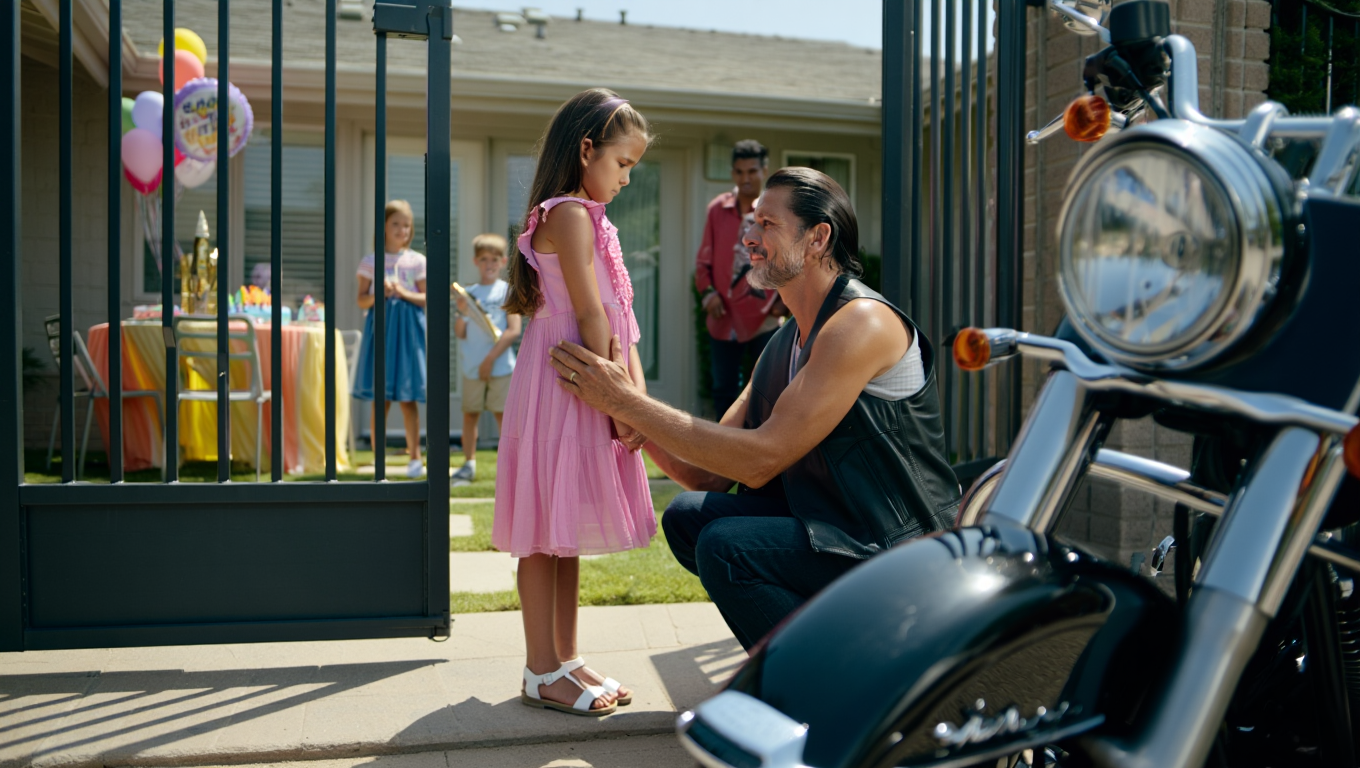
“Hey,” he said, crouching slightly to her level. His voice was calm. Careful. “You okay?”
She shook her head. “They said I shouldn’t be here.”
The biker frowned—not angrily, but with focus. He glanced past her into the yard, taking in the decorations, the cake, the adults pretending not to watch.
He stood and opened the gate.
“What’s going on?” he asked.
Lily’s mother stepped forward fast, smile tight. “This is a private party,” she said. “I don’t know who you are, but you need to stay outside.”
The biker didn’t raise his voice. “She’s a kid,” he said. “And she’s crying.”
“That’s not your concern,” the woman snapped. “Please leave.”
The biker looked down at Emily again. Her shoulders were shaking now.
“You invited her?” he asked.
The woman hesitated. Just enough. “I didn’t say that.”
Phones came out. Someone whispered, “This is getting uncomfortable.”
To the parents watching, it looked bad. A biker confronting a mother. At a child’s party.
“Sir,” a man said from the table, “you’re making people nervous.”
The biker stepped back half a pace, hands visible. “I’m not here to cause trouble.”
No one believed him.
“Call the police,” someone muttered.
Emily tugged lightly on his vest. “Please,” she whispered. “I’ll just go home.”
The biker’s jaw tightened. “No,” he said quietly. “You don’t have to walk away like that.”
The air thickened. Adults closed ranks. Children stopped laughing. The party had stalled.
The biker knelt again, right there by the gate.
“Hey,” he said softly to Emily. “Do you want to step outside for a minute?”
She nodded, wiping her face with her sleeve.
He took her hand—not gripping, not pulling. Just guiding.
And that’s when everything tipped.
“Don’t touch her,” Lily’s mother snapped. “You need to step back.”
The biker froze instantly and let go. “I didn’t mean—”
“This is inappropriate,” the woman said loudly now. “Someone call the police.”
Parents shifted. A man stepped forward protectively. Another pulled a phone to his ear.
Emily stood between them, small and shaking.
The biker straightened slowly, eyes never leaving the girl. “I’m taking her somewhere safe,” he said. “That’s all.”
“You don’t get to decide that,” the woman shot back.
The biker reached into his vest pocket.
Gasps rippled through the yard.
“Hey!” “What’s he doing?”
He pulled out his phone. Typed one short message. Then he said a single sentence—quiet, steady.
“I need you here.”
He slipped the phone back into his pocket and stood still. No threats. No explanations.
Emily looked up at him. “Am I in trouble?”
He shook his head. “No,” he said. “You didn’t do anything wrong.”
From down the street, another sound began to rise—soft at first, then unmistakable.
Engines. More than one.
Adults turned toward the noise. Conversations stopped mid-breath. The candles on the cake flickered in the sudden silence.
And no one knew yet who had just misjudged whom.
The engines didn’t arrive fast. They arrived on purpose.
One motorcycle turned the corner. Then another. Then three more, rolling slowly down the residential street like they had all agreed not to rush the moment. The music from the birthday speaker stuttered, then stopped. Someone turned it off without being asked.
Helmets came off. Sunglasses followed.
Men and women stepped down from their bikes—late thirties to early sixties, sleeveless vests, inked arms, calm posture. No shouting. No crowding. They stayed by the curb, respectful, controlled.
The biker who stood with Emily didn’t move toward them. He stayed where he was.
Lily’s mother swallowed. “What… what is this?” she asked, trying to laugh it off.
A woman from the group stepped forward just enough to be heard. “We were invited,” she said evenly.
“To a child’s party?” someone scoffed.
She nodded once. “Yes.”
Then she looked at Emily.
“Is this the birthday girl?” she asked gently.
Emily shook her head. “It’s Lily’s.”
The woman crouched, eye level. “And were you invited?”
Emily hesitated. Then nodded.
The silence that followed was heavier than the engines had been.
One of the fathers cleared his throat. Another parent lowered their phone, suddenly unsure why they were recording.
The original biker spoke again, voice steady but quiet. “She didn’t do anything wrong,” he said. “She was told to leave because she didn’t fit.”
“That’s not true,” Lily’s mother snapped too quickly.
The woman from the group didn’t argue. She turned to Lily’s mother and asked one question.
“Then why is she crying outside your gate?”
No one answered.
From the yard, Lily looked between the adults, confusion pulling at her smile. “Mom?” she asked softly. “Why can’t Emily stay?”
The candles on the cake burned lower.
Someone—no one remembered who—opened the gate wider.
Emily didn’t move yet.
The truth didn’t come out as a confession. It surfaced in fragments.
Emily lived with her grandmother. Her clothes were secondhand. Her mother worked weekends. She’d been invited because Lily asked for her—then quietly uninvited because appearances mattered more than explanations.
The biker wasn’t a stranger. He was Emily’s uncle. Her mother’s older brother. The one who picked her up from school when schedules fell apart. The one who taught her how to cross the street and how to sit quietly when adults disappointed her.
The bikers who arrived weren’t there to intimidate. They were family. And friends. And people who show up when a child is pushed aside and no one else wants to notice.
No one announced this. They didn’t need to.
Lily’s mother looked at Emily then—really looked—and something in her expression shifted. Not relief. Not pride. Recognition.
“I… I didn’t mean—” she started.
The biker raised a hand gently. “You already did,” he said. “Let’s not make it worse.”
He knelt in front of Emily again.
“Hey,” he said softly. “Do you still want cake?”
Emily nodded, hesitant.
He turned to Lily. “Mind if she helps you blow out the candles?”
Lily’s eyes lit up. “Yes!”
For a moment, no one moved.
Then Lily’s father cut a slice and handed Emily a plate. Someone pulled over a chair. Another child scooted to make space.
Emily sat. She didn’t smile right away. But when the candles were relit—two girls leaning in together—her shoulders relaxed just enough.
The bikers stayed by the curb. They didn’t join the party. They didn’t watch closely. They just stayed.
Later, when the sun dipped low and the guests thinned out, the biker walked Emily toward his motorcycle.
“Did I do something bad?” she asked quietly.
He shook his head. “No,” he said. “You learned something.”
“What?”
“That when people ask you to leave quietly,” he said, placing the helmet gently in her hands, “it’s okay to wait for someone who won’t.”
The engines started again, softer this time.