At my sister’s funeral, I overheard two men laughing in the back row… Their joke about her body made me realize I never really knew her at all.
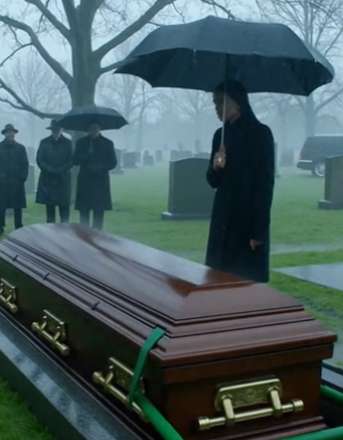
The rain came down in sheets the day we buried Sarah. I stood under a black umbrella, watching them lower the casket into the ground, and I couldn’t stop thinking about how little I actually knew my own sister.
We grew up in the same house in Tacoma, shared the same parents, the same Christmases, the same summer vacations to Lake Chelan. But somewhere around her sixteenth birthday, Sarah became a stranger. She started staying out late, coming home with money she wouldn’t explain, wearing clothes that seemed too expensive for a high school junior working at Dairy Queen.
Mom and Dad fought about it constantly. “She’s just going through a phase,” Mom would say, but Dad knew better. He could see it in her eyes—that hollow look, like she was already gone even when she was sitting right across from us at dinner.
I was only fourteen when Sarah dropped out of school. Seventeen when she moved out completely. Twenty when I stopped asking Mom if she’d heard from her.
The funeral was smaller than I expected. A handful of people I didn’t recognize, most of them keeping their distance, hovering near the edges like they didn’t belong. I assumed they were friends from her life—the life we weren’t part of.
That’s when I heard them.
Two men in cheap suits standing under a tree about twenty feet behind me. They thought they were being quiet, but their voices carried in the rain.
“Finally they’re together,” one of them said, and he actually laughed. A short, cruel bark of a laugh.
“Who?” the other one asked.
“Her legs.”
I felt something crack inside my chest. A rage so sudden and complete that my hands started shaking. I wanted to turn around, to scream at them, to make them feel even a fraction of the pain that joke caused. But I couldn’t move. I just stood there, frozen, as the reality of my sister’s life crashed over me like a wave.
Sarah hadn’t been living some mysterious, glamorous secret life. She’d been surviving. In the worst way possible.
The casket disappeared into the earth, and I realized I’d been crying without knowing it. Not for the sister I’d lost at the funeral—I’d lost her years ago. I was crying for the girl who used to braid my hair before school, who taught me how to ride a bike, who promised me we’d always be best friends.
I was crying because I never fought for her. None of us did.
After the service, I approached Mom. She looked smaller somehow, like grief had physically diminished her. Her eyes were red and swollen, her hands trembling as she clutched a tissue.
“Mom,” I said quietly. “Did you know? About Sarah?”
She looked at me for a long moment, and I saw the answer in her face before she spoke. “I suspected,” she whispered. “But I didn’t want to believe it. I kept thinking she’d come home. That one day she’d just walk through the door and be our Sarah again.”
Dad stood a few feet away, staring at the grave. He hadn’t said a word all day. When I touched his shoulder, he flinched like I’d burned him.
“I should have done more,” he said, his voice breaking. “I should have dragged her out of there. Should have called the police, hired a private investigator, something. Anything.”
But we all knew it wasn’t that simple. Sarah was an adult. She made her choices, even if those choices were made under circumstances none of us could fully understand.
I found the funeral director and asked about Sarah’s belongings. There wasn’t much. A duffel bag with some clothes, a few photos, and a journal. I took the journal home and didn’t open it for three days. When I finally did, my hands were shaking so badly I could barely turn the pages.
The entries started when she was sixteen. The first few were about a boy she’d met—older, charming, telling her she was beautiful, that she deserved better than our “boring middle-class life.” He had a car, money, plans. He made her feel special.
His name was Marcus. Twenty-four to her sixteen. He took her to nice restaurants, bought her jewelry, told her she was mature for her age. All the classic lines, I realized later. All the warning signs we’d been taught to watch for but somehow missed when it was happening in our own home.
Then the entries changed.
She wrote about the first time he hit her. She’d told him she wanted to go home, that she missed Mom and Dad. He’d backhanded her so hard she saw stars, then held her while she cried and apologized, saying he only got angry because he loved her so much, because the thought of losing her drove him crazy.
She wrote about the first time he took her to a hotel and told her to “be nice” to his friend. She’d refused. He’d locked her in the bathroom for six hours, no food, no water, until she agreed. She was seventeen.
She wrote about the first time she tried to leave. She’d made it to a bus station, had a ticket to Portland where a friend from school had moved. Marcus found her twenty minutes before the bus departed. He didn’t hit her that time. He just smiled, took her hand, and said, “Baby, you know I can’t let you go. You’re mine. You’ll always be mine.”
She wrote about the girls she met—other girls like her, trapped in the same nightmare. Girls with names like Crystal and Destiny and Angel, names they’d chosen because their real names belonged to people who no longer existed. Girls who’d started out just like her, trusting the wrong person, making one mistake that spiraled into a life they never imagined.
Crystal was from Spokane. Nineteen years old, a runaway who’d left an abusive home only to end up somewhere worse. She had a daughter she’d given up for adoption when she was fifteen. She carried a photo of the baby in her wallet, even though she knew she’d never see her again.
Destiny was twenty-three, worked the same streets as Sarah. She’d been a nursing student once, full scholarship to UW, the first in her family to go to college. Then her boyfriend got her hooked on pills to help her study for exams. When the prescription ran out, he had other options. Cheaper options. And when she couldn’t pay for those, he had a solution for that too.
Angel was the youngest, only fifteen. She’d been trafficked from California, didn’t even know what city she was in most days. She spoke broken English and cried every night for her mother. Sarah tried to protect her, tried to make sure the worst clients didn’t get to her. Sometimes it worked. Sometimes it didn’t.
Sarah wrote about the men. Hundreds of them over the years. She didn’t describe them in detail—I think it was too painful. But she noted patterns. The ones who were rough. The ones who seemed sad, ashamed, like they hated themselves as much as she’d learned to hate herself. The ones who tried to “save” her, who said they’d help her get out if she just did this one thing for them first. The ones who were cruel for the sake of cruelty.
She wrote about a regular client named David who came every Thursday at 3 PM. He was different, she said. Gentle. He talked to her like a person, asked about her day, brought her coffee the way she liked it. He told her about his wife, his kids, his job as an accountant. After six months, he offered to help her leave. He had a sister who ran a shelter, he said. He could get her in, no questions asked.
Sarah wanted to believe him. God, reading those entries, I could feel how desperately she wanted to believe that someone actually cared. But she’d been burned too many times. She thanked him but said no.
Two weeks later, David stopped coming. She never saw him again. She wrote, “Maybe he was telling the truth. Maybe I missed my chance. Or maybe he was just like all the rest, and I dodged a bullet. I’ll never know.”
She wrote about the drugs. She’d always sworn she’d never use, that she was different from the other girls. But after three years, the pain was too much. Physical pain from the violence, emotional pain from the trauma, existential pain from the sheer soul-crushing reality of her existence.
The first time she used, it was just to sleep. Just to quiet the screaming in her head for a few hours. Marcus was happy to provide. Anything to keep her compliant, dependent, trapped.
Within a year, she was using daily. Within two, she needed it just to function. The drugs became another chain, another reason she couldn’t leave.
She wrote about the times she almost got out. A social worker who’d given her a card and told her she could call anytime—Sarah lost the card two days later. A police raid where she’d been arrested and a kind officer had offered to connect her with resources—Marcus bailed her out before she could follow through. A regular client who’d offered to help her get clean—she was too ashamed to take him up on it.
She wrote about the time she called home. It was three in the morning, she was high and crying, and she just wanted to hear Mom’s voice. I answered instead. I was nineteen, home from college for the summer.
“Jess?” she’d said, her voice so small and broken.
“Sarah? Sarah, where are you? Are you okay?”
She was quiet for so long I thought she’d hung up. Then: “I’m sorry. I’m so sorry for everything.”
“Sarah, please, just tell me where you are. We can come get you. We can help you.”
“You can’t help me,” she said. “Nobody can. I’m too far gone.”
“That’s not true. Sarah, please—”
She hung up. I tried to call back, but the number was blocked. I told Mom and Dad the next morning. We filed a missing person’s report—again—but the police said the same thing they always said: she’s an adult, she called you, she’s clearly alive, there’s nothing we can do unless she asks for help.
Sarah wrote about that phone call in her journal. She wrote, “I almost told her. Almost asked her to come get me. But what would I even say? How do I explain what I’ve become? How do I look my little sister in the eye and tell her that I sell my body twenty times a day to men who see me as less than human? How do I tell her I’m a junkie who can’t go three hours without a fix? She deserves better than the truth. They all do.”
Reading that broke me. Because I would have come. In a heartbeat, I would have driven wherever she was, packed her in my car, and brought her home. It wouldn’t have been easy. It wouldn’t have fixed everything. But she would have been alive.
She wrote about her friends dying. Crystal overdosed when Sarah was twenty-two. They found her in a motel room, alone, three days dead before anyone noticed. There was no funeral. No obituary. Her family had disowned her years ago. The girls pooled their money to pay for cremation. Sarah kept some of Crystal’s ashes in a locket.
Destiny disappeared one night. Just gone. Sarah wrote, “I hope she got out. I hope she’s somewhere safe, living the life she deserved. But I know better. Girls like us don’t just disappear into happy endings.”
Angel was deported back to California after a raid. Sarah never heard from her again. She was seventeen by then. Sarah wrote, “I pray she made it home. I pray someone is taking care of her. I pray she got the childhood back that we stole from her.”
The entries became darker as the years went on. More desperate. More hopeless. She wrote about wanting to die, about planning it, about chickening out at the last minute because some small part of her still believed things could get better.
She wrote, “I’m twenty-six years old and I feel like I’ve lived a hundred years. I can’t remember the last time I looked in the mirror and recognized myself. I can’t remember the last time I felt anything other than numb or terrified. I can’t remember who I was before all this.”
But then, in the last few months of her life, something changed.
She met a woman named Patricia, a former escort who’d gotten out and now ran an underground railroad of sorts for women trying to escape the life. Patricia had resources, connections, safe houses. She’d helped dozens of women disappear and start over.
Patricia took an interest in Sarah. She saw something in her—maybe the same thing I remembered from our childhood. That spark. That determination. That stubborn refusal to completely give up, no matter how bad things got.
They met in secret. Patricia brought food, clean clothes, burner phones. She talked to Sarah about the program, about what life could look like on the other side. She didn’t sugarcoat it. It would be hard. Sarah would have to get clean, which meant withdrawal, cravings, months of physical and emotional agony. She’d have to testify against Marcus if she wanted to ensure he couldn’t come after her. She’d have to leave the city, change her name, cut ties with everyone and everything from her old life.
But she’d be free.
Sarah wrote, “Patricia told me something today that I can’t stop thinking about. She said, ‘Every day you’re alive, you have a choice. The choice might be between two terrible options, but it’s still a choice. You can choose to survive. You can choose to fight. You can choose to believe that you deserve better, even when everything in your life tells you otherwise.’ I want to choose. God, I want to choose so badly.”
The last entry was dated three days before she died.
“I’m getting out,” she wrote. “Patricia got me into a shelter three hours north. They have a medical detox program, therapy, job training, legal help. I’m terrified. I’m so terrified I can barely breathe. But I’m doing it. Tomorrow night, Patricia is picking me up at midnight. Marcus thinks I have a client. By the time he realizes I’m gone, I’ll be somewhere he can’t touch me. I’ll be free.
I keep thinking about Mom and Dad. About Jess. I want to call them so badly, but Patricia says I need to wait. I need to get clean first, get stable, make sure I’m really out before I drag them back into my mess. She’s right. But God, I miss them. I miss home. I miss the person I used to be.
I’m going to make it this time. I have to. Because if I don’t, I won’t survive another year of this. Tomorrow, everything changes. Tomorrow, I get my life back.”
She never made it to tomorrow.
The police report said she died of an overdose. They found her in the same motel where Crystal had died, same room even. The drugs in her system were laced with fentanyl—too much, the coroner said. Either a miscalculation or intentional. They couldn’t say which.
But I knew. Reading her journal, seeing how close she was to escaping, I knew it wasn’t an accident. Marcus had found out. Or suspected. Or decided he’d rather see her dead than free.
The autopsy revealed bruises, old and new. Fractured ribs that had healed wrong. Scars from cigarette burns. Evidence of chronic sexual trauma. The report was clinical, detached, just facts on a page. But each fact was a piece of my sister’s suffering, documented and filed away like it didn’t matter.
Marcus was questioned. He said he was her boyfriend, that he’d been trying to get her clean, that he was devastated by her death. He cried during the interview. The detective noted that he seemed genuinely distraught.
They never charged him. There wasn’t enough evidence, they said. These things are complicated, they said. Sometimes addicts just overdose, they said. It’s tragic, but it happens.
I wanted to scream. I wanted to take Sarah’s journal to the police station and make them read every single entry. I wanted to force them to see her as a person, not a statistic. Not just another dead prostitute.
But Patricia warned me against it. “They won’t care,” she said when I met her after the funeral. “I’ve seen this a hundred times. The system isn’t designed to help girls like Sarah. It’s designed to ignore them until they disappear. And when they do disappear, it’s designed to make it seem like it was their own fault.”
Patricia came to the funeral. She was the only one besides family who cried. After everyone left, she approached me.
“Your sister was special,” she said. “She had more strength than she knew. She was going to make it.”
“But she didn’t,” I said bitterly.
“No,” Patricia agreed. “But that doesn’t mean she failed. She fought every single day. That takes more courage than most people will ever understand.”
She handed me a business card. “If you ever want to help girls like Sarah, call me. We always need people.”
I kept that card. I carried it in my wallet for six months before I finally called.
Now, five years later, I work with Patricia’s organization. We help women escape trafficking, get clean, rebuild their lives. It’s hard work. Heartbreaking work. For every success story, there are three women who go back, or relapse, or disappear.
But every woman we save is Sarah. Every woman we pull out of that hell is the sister I couldn’t save, getting a second chance.
I still think about those two men at the funeral sometimes. Their cruel laughter, their casual cruelty, their reduction of my sister’s entire existence to a punchline.
But I think more about the women I’ve met through Patricia’s organization. Women who knew Sarah, who loved her, who were inspired by her strength even when she couldn’t see it herself.
I think about Maria, who Sarah helped escape six months before she died. Maria is a nurse now, working in a clinic that specializes in helping trafficking survivors. She named her daughter Sarah.
I think about Jasmine, who Sarah protected from violent clients, taking the worst of the abuse herself to spare a younger girl. Jasmine got out, got her GED, and now runs support groups for survivors.
I think about the girl who approached me at the vigil five years after Sarah’s death. The one who told me Sarah gave her the number for the shelter, told her she deserved better. That girl is in school now, studying social work, planning to dedicate her life to helping others the way Sarah helped her.
Sarah’s life wasn’t the punchline those men made it. It wasn’t a tragedy or a cautionary tale or a failure. It was a life that mattered. A life that saved others, even as she couldn’t save herself. A life that sparked change, inspired hope, and created ripples that continue to spread long after she’s gone.
Her legs aren’t what’s together now. It’s the lives she connected, the girls she inspired, the change she sparked even in death. It’s the shelter bed that bears her name, funded by donations Mom and Dad made in her memory. It’s the support group that meets every Tuesday night where women share their stories and find strength in knowing they’re not alone. It’s the legislation we fought for—Sarah’s Law—that increases penalties for traffickers and provides more resources for survivors.
I visit Sarah’s grave every year on her birthday. I bring strawberry ice cream—her favorite—and I tell her about the women we’ve helped. I tell her about the lives that are different because she existed. I tell her that she mattered.
And sometimes, when the wind is right, I swear I can hear her whisper back: “Thank you for remembering me. Not for what they made me, but for who I was. Who I always was, underneath everything.”
That’s the full story. That’s what those men will never understand. That’s what I’ll spend the rest of my life making sure the world knows.
Sarah wasn’t a prostitute who died. She was my sister who lived.