A wealthy businesswoman slapped a homeless veteran’s pizza off the table at a café… But she had no idea who was watching.
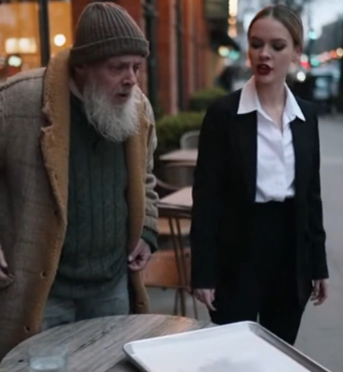
Marcus had been sitting at that corner table for exactly seven minutes when she appeared.
He’d found the pizza in a box on a nearby bench—still warm, barely touched, probably left behind by some generous soul or forgotten by a distracted student. For Marcus, it was a gift from heaven. He hadn’t eaten in two days.
The outdoor café was his usual spot on Thursday afternoons. The owner, Mr. Chen, never chased him away. Sometimes, when business was slow, Chen would even bring him a cup of coffee. “You were Army, right?” Chen had asked once, noticing the faded insignia on Marcus’s jacket. “Marines,” Marcus had corrected gently. “Three tours.” Chen had nodded with respect and never asked him to leave again.
But Chen wasn’t there that afternoon.
Marcus had just said a quiet prayer of thanks and lifted the first slice when her shadow fell across his table.
“Excuse me,” the woman’s voice was ice. “This is a paying establishment.”
Marcus looked up. She was young—maybe thirty-five—dressed in a suit that probably cost more than he used to make in a month. Her hair was pulled back so tight it seemed to stretch her face into a permanent sneer. Behind her, a group of similarly dressed professionals watched from a nearby table, their conversation paused.
“I’m not bothering anyone, ma’am,” Marcus said quietly, his voice hoarse from disuse. “I’ll be gone in a few minutes.”
“You’re bothering ME,” she snapped. “You’re ruining the ambiance. This is where professionals come to conduct business, not a soup kitchen for—” she waved her hand dismissively at his appearance, “—people like you.”
Marcus felt the familiar heat of shame creep up his neck. His clothes were dirty, yes. He smelled, probably. The last shower had been three days ago at the shelter, and there’d been a line. His beard was unkemmed, his hands stained and callused from sleeping rough.
“I understand,” he began, starting to stand. “I’ll just—”
But before he could finish, her hand shot out and slapped the pizza tray. The food went flying, landing face-down on the concrete with a wet slap that made everyone within twenty feet turn to look.
“Now get OUT,” she hissed, her face twisted with disgust.
The silence that followed was deafening.
Marcus stood slowly, his joints protesting. He didn’t look at the ruined food. Didn’t look at the woman. He’d learned long ago that fighting back only made things worse. He just wanted to leave with whatever dignity he had left.
“That was completely unnecessary.”
The new voice came from a table Marcus hadn’t noticed—tucked in the corner, partially hidden by a planter. A man in his sixties stood up, his salt-and-pepper hair perfectly groomed, his grey suit understated but clearly expensive. There was something about the way he carried himself that commanded attention.
The businesswoman turned, her expression shifting to something between annoyance and surprise. “I’m sorry, do you have a problem?”
“Yes, actually. I have a problem with cruelty disguised as standards.” The man walked forward calmly, his voice carrying across the café. “I have a problem with people who measure human worth by the price of their clothing.”
“Look, I don’t know who you think you are—” she began, but he cut her off.
“Robert Harrison. I’m the CEO of Meridian Consulting Group.” He paused, watching recognition dawn in her eyes. “And unless I’m mistaken, you’re Victoria Chen, senior analyst at Whitmore & Associates.”
Her face went pale. “Mr. Harrison, I—I didn’t realize—”
“Of course you didn’t. People rarely do.” He turned to Marcus, his expression softening. “Sir, would you do me the honor of joining me for lunch? A proper meal, not…” he glanced at the ruined pizza, “…salvaged scraps.”
Marcus opened his mouth to refuse—pride was one of the few things he had left—but something in the man’s eyes stopped him. Not pity. Respect.
“I’d be obliged,” Marcus said finally.
Harrison nodded and turned back to Victoria. “As for you, Ms. Chen, I believe we were scheduled to interview candidates from Whitmore & Associates next week for our new market expansion project. It’s a $40 million contract.” He paused. “I’ll be recommending we look elsewhere.”
“Wait—Mr. Harrison, please—” Victoria’s voice cracked with panic. “I was just—I didn’t mean—”
“You meant exactly what you did,” Harrison said coldly. “And now you’ll live with the consequences. I don’t do business with companies that employ people who lack basic human decency.”
He gestured for Marcus to follow him to his table. As they walked away, Victoria stood frozen, her face cycling through shock, anger, and growing horror as she realized what had just happened.
Over lunch—a real lunch, with soup and sandwiches and coffee that actually tasted like coffee—Marcus and Robert talked. Marcus learned that Robert had served too, Army, Vietnam era. That he’d started his company from nothing. That he volunteered at three different veterans’ organizations.
Robert learned that Marcus had been a decorated Marine, that he’d lost his family in a car accident while he was deployed, that the PTSD and survivor’s guilt had cost him everything—his career, his home, his purpose.
“I have a friend who runs a veteran’s transition program,” Robert said as they finished their meal. “Housing, counseling, job training. Would you be interested in talking to him?”
Marcus felt something stir in his chest that he hadn’t felt in years. Hope.
“Yes, sir,” he said. “I think I would.”
Three months later, Marcus stood in the lobby of Meridian Consulting Group, wearing a donated suit that actually fit, his beard trimmed, his eyes clear. He was there for his first day as a building services coordinator—a real job, with real pay, benefits, and dignity.
As he signed in at the security desk, he saw a familiar face reflected in the glass doors behind him. He turned.
Victoria Chen stood on the sidewalk outside, her expression hollow. She was carrying a box—the universal symbol of sudden unemployment. According to the news Robert had shared, Whitmore & Associates had terminated her after losing not just the Meridian contract, but three others. Word had spread quickly in their industry about what had happened.
Their eyes met through the glass. Marcus saw no satisfaction in the moment, no revenge. Just the recognition that actions have consequences, that cruelty always costs something, and that sometimes the universe has a way of balancing the scales.
He turned away and walked toward the elevators, toward his new life, toward the second chance he’d never stopped hoping for but had almost stopped believing could come.
Behind the glass, Victoria watched him go, finally understanding what she’d been too blind to see that day at the café: that every person she passed, no matter how they looked or where they sat, carried a story. And that the measure of her character wasn’t in how she treated those who could help her climb higher—but in how she treated those she thought were beneath her.
By the time she learned that lesson, it was already too late.
But for Marcus, standing in that elevator, watching the floors climb higher, it was just in time.