A female cop was overpowered by a violent suspect on the highway… But a random stranger jumped out of her car and saved her life.
Officer Sarah Mitchell had been a highway patrol officer for eight years, but nothing had prepared her for what happened on that scorching July evening along Interstate 40.
It started as a routine traffic stop. She’d pulled over a silver sedan for erratic driving—swerving between lanes, nearly clipping a minivan. When she approached the driver’s window, the man inside was agitated, sweating profusely, his hands trembling on the steering wheel.
“License and registration, please,” Sarah said, her hand instinctively resting near her sidearm.
The driver—later identified as Marcus Webb, 34—fumbled through his glove compartment. His eyes were wild, pupils dilated. Sarah had seen enough drug cases to recognize the signs immediately. When she asked him to step out of the vehicle, everything went sideways.
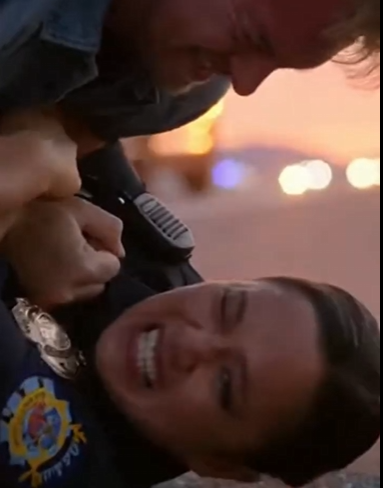
Webb exploded from the car with unexpected violence. He swung at Sarah, connecting with her shoulder and sending her stumbling backward. She recovered quickly, years of training kicking in, and attempted to restrain him. But Webb was in the grip of what investigators would later determine was a methamphetamine-fueled psychosis. His strength was superhuman, his desperation absolute.
They struggled on the dusty shoulder of the highway as cars whizzed past at seventy miles per hour. Sarah managed to get one handcuff on Webb’s left wrist, but he wrenched away, using the dangling cuff as a weapon, swinging it at her face. She dodged, barely, feeling the metal whistle past her cheek.
“Stop resisting! Get on the ground!” she shouted, her voice hoarse with exertion.
But Webb wasn’t hearing her. He was somewhere else entirely, fighting demons only he could see. He shoved Sarah hard, and she lost her footing, falling backward onto the gravel. Her radio clattered away, out of reach. Webb loomed over her, his face contorted with rage and terror.
That’s when Emma Rodriguez entered the scene.
Emma was driving home from her nursing shift at County General Hospital, exhausted from a twelve-hour day in the ICU. She’d seen the struggle from a quarter-mile away—the flashing lights, two figures grappling on the roadside. Her first instinct was to keep driving. Don’t get involved. Call 911. Let the professionals handle it.
But as she drew closer, she saw the officer on the ground, the suspect advancing toward her. Emma saw the desperation in the officer’s eyes, the way she was reaching for her weapon but couldn’t get a clear angle without endangering herself or bystanders.
Emma didn’t think. She just acted.
She yanked her steering wheel hard right, tires squealing as she pulled onto the shoulder fifty feet ahead of the struggle. She threw open her door and ran, her grey hospital sweatshirt flapping in the wind created by passing semis.
“Hey! Get away from her!” Emma screamed.
Webb turned, confused by this new threat. That moment of distraction was all Sarah needed. She swept his legs out from under him, sending him crashing to the pavement. But he was still fighting, still thrashing.
Emma didn’t hesitate. She threw herself into the fray, using her body weight to help pin Webb’s shoulders. She’d restrained combative patients before—confused dementia cases, withdrawal patients—but this was different. This was life or death.
“Hold his left arm!” Sarah gasped, struggling to control Webb’s right side.
Emma grabbed his wrist, pressing it flat against the hot asphalt. Her muscles burned with effort. Webb bucked and twisted beneath them, screaming incoherently about shadows and devils.
Together, the two women managed to get Webb face-down, his arms behind his back. Sarah finally, finally, clicked the second handcuff into place. The moment the restraints secured, Webb seemed to deflate, his energy spent, his body going limp.
Sarah rolled off him, gasping for breath. Emma did the same, her hands scraped raw from the pavement, her sweatshirt torn at the shoulder.
For a long moment, they just lay there on the side of the highway, chests heaving, the sunset painting the sky in shades of orange and purple above them. The surreal beauty of it contrasted sharply with the violence they’d just survived.
“Thank you,” Sarah finally managed, turning her head to look at the stranger who’d saved her life. “Thank you so much. I don’t… I don’t know what would have happened if you hadn’t stopped.”
Emma sat up slowly, wiping sweat from her forehead. “Are you okay? Did he hurt you?”
“I’m fine. I’m fine because of you.” Sarah’s voice cracked with emotion. “What’s your name?”
“Emma Rodriguez. I’m a nurse at County General.”
Sarah laughed, a sound edged with hysteria and relief. “Of course you are. Of course you’re someone who runs toward danger instead of away from it.”
In the distance, sirens wailed—backup finally arriving. Sarah had managed to trigger her emergency button during the initial struggle, but it had taken time for units to reach their remote location on the highway.
Three patrol cars screamed onto the shoulder, officers jumping out with weapons drawn. Sarah waved them down, shouting that the situation was under control. Paramedics pulled up moments later, checking both women for injuries while other officers secured Webb in the back of a cruiser.
Webb would later be charged with assault on a police officer, resisting arrest, DUI, and possession of methamphetamine. He’d face significant prison time. But that night, as the adrenaline began to fade and the reality of what had happened set in, Sarah and Emma stood together in the flashing red and blue lights, two women who’d been strangers five minutes ago and were now bound by something unbreakable.
“I need your contact information,” Sarah said, pulling out her phone with shaking hands. “For the report. And because… because I want to take you to dinner. To say thank you properly.”
Emma smiled, tired but genuine. “I’d like that.”
Over the following weeks, their friendship blossomed. Sarah nominated Emma for a civilian commendation, which she received at a ceremony attended by the mayor and police chief. The local news ran the story, and Emma became a minor celebrity, though she insisted she’d just done what anyone would do.
“But that’s the thing,” Sarah told her over coffee one Saturday morning, a month after the incident. “Most people wouldn’t. Most people would drive past. You didn’t. You saw someone who needed help, and you acted. That’s heroism.”
Emma stirred her latte, considering this. “I saw you,” she said finally. “I saw another woman in trouble, and I couldn’t live with myself if I’d just driven away. We have to look out for each other, you know?”
Sarah nodded, her throat tight with gratitude. The incident had changed her in subtle ways. She was more cautious now, called for backup sooner, took fewer risks. But she was also more hopeful. Because if a random stranger would risk her life to help her, then maybe the world wasn’t as dark as it sometimes seemed during long highway patrol shifts.
The two women stayed in touch, their friendship deepening over time. Emma’s teenage daughter, Sofia, started talking about becoming a police officer, inspired by Sarah’s dedication and her mother’s bravery. Sarah’s son, Michael, struggling in school with algebra and chemistry, found a patient tutor in Emma, who had a gift for explaining complex medical and scientific concepts in simple terms.
The months turned into years. Sarah and Emma became fixtures in each other’s lives, attending family barbecues, celebrating birthdays, supporting each other through difficult times. When Sarah’s marriage hit a rough patch, Emma was there with wine and wisdom. When Emma’s mother was diagnosed with breast cancer, Sarah organized a fundraiser that brought the entire police department together.
Their bond became legendary within both the police force and the hospital where Emma worked. People called them “the highway sisters,” a nickname that always made them smile. They’d met under the worst circumstances imaginable, but they’d forged something beautiful from that terror.
Three years after the incident, Sofia Rodriguez graduated from the police academy. The ceremony was held on a crisp autumn morning, the kind of day where the sky is impossibly blue and the air smells of possibility. Sarah sat in the front row next to Emma, watching with pride as the young woman she’d mentored took her oath.
Sofia had shadowed Sarah for months during her training, learning not just the technical aspects of police work but the emotional intelligence required to de-escalate situations, to see people at their worst and still treat them with dignity. She’d inherited her mother’s compassion and combined it with a fierce determination to make her community safer.
“I can’t believe this is happening,” Emma whispered, dabbing at her eyes with a tissue. “My baby girl, a police officer.”
“She’s going to be amazing,” Sarah whispered back. “Just like her mother.”
The ceremony proceeded with speeches from the police chief and the mayor. But the moment that brought everyone to tears came when the academy director called Sofia to the podium for a special recognition.
“Officer Rodriguez,” he said, his voice carrying across the auditorium, “has requested that we honor two women who exemplify the spirit of service and courage that we hope to instill in every graduate. Three years ago, on Interstate 40, her mother Emma Rodriguez and Officer Sarah Mitchell demonstrated what it means to protect and serve, even at great personal risk. Sofia has asked them to join her on stage.”
Sarah and Emma looked at each other in shock. This wasn’t in the program. But Sofia was beckoning them forward, tears streaming down her face. They walked to the stage on shaky legs, overwhelmed by the applause that erupted from the audience.
Sofia embraced them both, then turned to address the crowd. “These two women taught me everything I know about courage,” she said, her voice strong despite her tears. “My mom taught me that when someone needs help, you don’t hesitate. You act. And Officer Mitchell taught me that being a police officer isn’t about power or authority—it’s about service, about being there for people on the worst days of their lives.”
She paused, composing herself. “That day on the highway could have ended in tragedy. But because my mom chose to stop, because she chose to run toward danger instead of away from it, Officer Mitchell is here today. And because Officer Mitchell has spent the last three years mentoring me, teaching me, believing in me, I’m standing here as a police officer, ready to serve my community.”
The applause was thunderous. Sarah and Emma stood on that stage, arms around each other and around Sofia, and felt the weight of everything that had led to this moment. Every choice, every act of kindness, every moment of courage had built toward this.
After the ceremony, as families mingled and took photos, Sarah pulled Emma aside. “Do you ever think about what would have happened if you’d driven past that day?”
Emma was quiet for a moment, watching Sofia pose for pictures with her fellow graduates. “Every single day,” she said finally. “I think about all the things that had to align perfectly for me to be there. If I’d left work five minutes earlier or later. If I’d taken the back roads. If I’d been too scared to stop.”
“But you did stop,” Sarah said. “And you weren’t too scared. And that’s made all the difference.”
They stood together in the sunshine, two women whose lives had intersected in a moment of crisis and had remained intertwined ever since. The friendship they’d forged had created ripples that extended far beyond themselves—to their children, their colleagues, their community.
Sofia approached them, still in her crisp new uniform, her badge gleaming in the sunlight. “Thank you,” she said simply. “Both of you. For everything.”
“Thank you for making us so proud,” Emma replied, pulling her daughter into a hug.
Sarah’s phone buzzed. It was a text from her son Michael: “Just got accepted to medical school! Emma’s tutoring paid off!” She showed the message to Emma, who squealed with delight.
“See?” Emma said. “It all comes full circle. You helped raise my daughter to be a police officer. I helped your son become a doctor. We’re not just friends, Sarah. We’re family.”
Sarah felt her eyes fill with tears for what felt like the hundredth time that day. “Yeah,” she said, her voice thick with emotion. “We really are.”
The years continued to pass. Sarah eventually made sergeant, then lieutenant. Emma became the head nurse in the ICU, known for her exceptional skill in handling the most critical cases. Their families celebrated holidays together, vacationed together, supported each other through every triumph and tragedy.
Sofia proved to be an exceptional police officer, just as everyone had predicted. She had a gift for connecting with people, for de-escalating tense situations before they turned violent. More than once, Sarah watched her young protégé handle a difficult call with grace and compassion, and she felt a surge of pride that rivaled what she felt for her own children.
Michael, now Dr. Michael Mitchell, completed his residency in emergency medicine and returned to their hometown to work at County General Hospital—the same hospital where Emma had worked for over two decades. The first time he scrubbed in on a critical case with Emma as the lead nurse, they both felt the beautiful symmetry of it all.
Ten years after the highway incident, the local news station decided to do a “where are they now” feature. The reporter, a young woman named Jessica Chen, interviewed Sarah, Emma, Sofia, and Michael, weaving together their interconnected stories.
“What started as a moment of crisis became a legacy of service,” Jessica said in her closing remarks. “Officer Sarah Mitchell and Nurse Emma Rodriguez didn’t just save each other that day on Interstate 40. They saved a whole generation of first responders who have been inspired by their courage and their friendship.”
The segment went viral, shared millions of times across social media. People from all over the country wrote to Sarah and Emma, sharing their own stories of strangers who’d helped them, of moments when someone chose to get involved instead of driving past.
One letter particularly moved them. It was from a college student named Marcus Webb Jr.
“You don’t know me,” the letter began, “but ten years ago, your actions changed my life. My father was the man you arrested that day on the highway. He was high on meth, out of control, a danger to himself and everyone around him. Because of what happened, because he was arrested and charged, he was forced into a treatment program. He got sober. He got his life back. And he became the father I’d always needed but never had.
“My dad died last year from liver disease—the damage from his years of addiction caught up with him. But before he died, he had seven years clean. Seven years where he coached my little league team, attended my high school graduation, taught me how to be a good man. Seven years I wouldn’t have had if you hadn’t stopped him that day.
“He made me promise to write to you, to tell you that your courage didn’t just save Officer Mitchell’s life. It saved his life too. And mine. Thank you for being brave enough to do what needed to be done.”
Sarah and Emma read the letter together, sitting on Emma’s back porch on a warm summer evening, and they wept. They’d never thought about Marcus Webb beyond his arrest and prosecution. They’d never considered that his story might have a redemptive ending.
“We changed his life,” Emma said softly. “Not just by stopping him, but by giving him a chance to get better.”
Sarah nodded, unable to speak past the lump in her throat. This was the part of police work that civilians rarely saw—the long-term impact of a single intervention, the lives that could be redirected toward healing instead of destruction.
They framed the letter and hung it in Sarah’s office at the police station, a reminder that even the most violent, chaotic moments could contain seeds of hope and redemption.
As the fifteenth anniversary of the highway incident approached, Sarah and Emma decided to do something special. They organized a community event focused on citizen involvement in public safety—teaching people when and how to safely intervene in emergencies, connecting neighbors with first responders, building the kind of community resilience that had saved Sarah’s life that day.
Sofia helped coordinate the police department’s involvement. Michael recruited doctors and nurses from County General to teach basic first aid and CPR. The event drew over a thousand people, all eager to learn how they could make a difference in moments of crisis.
Standing on the stage, looking out at the sea of faces, Sarah felt a profound sense of gratitude. Fifteen years ago, she’d been certain she was going to die on that highway shoulder. But Emma had stopped. Emma had acted. And from that single moment of bravery, an entire legacy had grown.
“I want to tell you about the day I learned what true heroism looks like,” Sarah began, and she told the story once again—the struggle, the fear, the moment Emma appeared like an angel in a grey sweatshirt.
When she finished, Emma joined her on stage. “I didn’t feel like a hero that day,” Emma said. “I felt terrified. But I also felt like I didn’t have a choice. When someone needs help, you help. It’s that simple.”
“But it’s not simple for most people,” Sarah interjected. “Most people would have driven past. Emma’s courage was exceptional, and it changed everything—not just for me, but for our families, our community, everyone touched by the ripple effects of her decision to stop.”
The crowd erupted in applause. Parents hugged their children. First responders shook hands with civilians. And in that moment, Sarah and Emma saw their vision realized—a community committed to looking out for one another, to running toward danger instead of away from it, to being the person who stops instead of driving past.
That night, after the event ended and the crowds dispersed, Sarah and Emma drove out to Interstate 40. They parked on the shoulder, not far from where everything had happened fifteen years ago. The sun was setting, painting the sky in the same oranges and purples that had witnessed their first meeting.
“Do you have any regrets?” Sarah asked, staring out at the highway where cars continued to rush past, oblivious to the significance of this spot.
Emma thought for a long moment. “Only one,” she said finally. “I regret that I ever hesitated, even for a second, before stopping. If I could do it over, I’d slam on the brakes the moment I saw you struggling. I wouldn’t waste a single second doubting myself.”
Sarah reached over and squeezed Emma’s hand. “You got there in time. That’s all that matters.”
They sat in comfortable silence, watching the sun sink lower on the horizon. Fifteen years of friendship, of family, of impact that extended far beyond what either of them could have imagined. All because one woman chose to be brave.
“We should probably go,” Emma said eventually. “Sofia’s making dinner, and she gets cranky if we’re late.”
Sarah laughed. “When did our kids become the ones taking care of us?”
“When we got old,” Emma replied with a grin. “Come on, old friend. Let’s go home.”
They drove away from that sacred stretch of highway, leaving behind the ghosts of who they’d been that July evening—a terrified officer and an exhausted nurse who’d become something more in the crucible of crisis. They’d become sisters, partners in a mission that continued to this day, living proof that one moment of courage could echo across decades.
The legacy lived on. In Sofia, who approached every call with compassion and bravery. In Michael, who treated every patient as if they were the most important person in the world. In the hundreds of community members who’d learned to recognize when intervention was needed and who’d committed to being the person who stopped instead of driving past.
And most of all, in the unbreakable bond between two women who’d met under the worst circumstances and had built something beautiful from the wreckage. They’d proven that heroism wasn’t about being fearless—it was about being afraid and acting anyway. It was about seeing someone who needed help and choosing, in that critical moment, to be the help they needed.
Fifteen years later, the story continued. And it would continue long after Sarah and Emma were gone, carried forward by everyone they’d inspired, everyone they’d touched, everyone who’d heard their story and decided to be a little braver, a little kinder, a little more willing to stop when someone needed help.
Because in the end, that’s what heroes do. They show up. They act. They change the world one brave choice at a time. And sometimes, if you’re very lucky, they become your family forever.