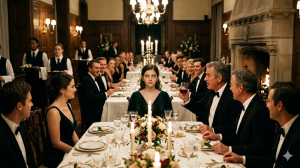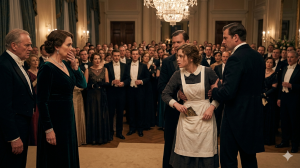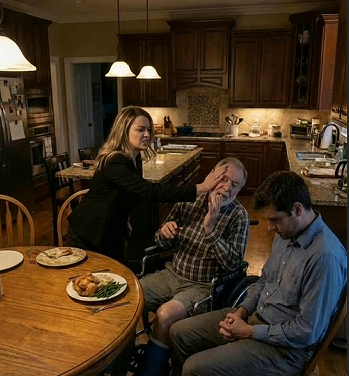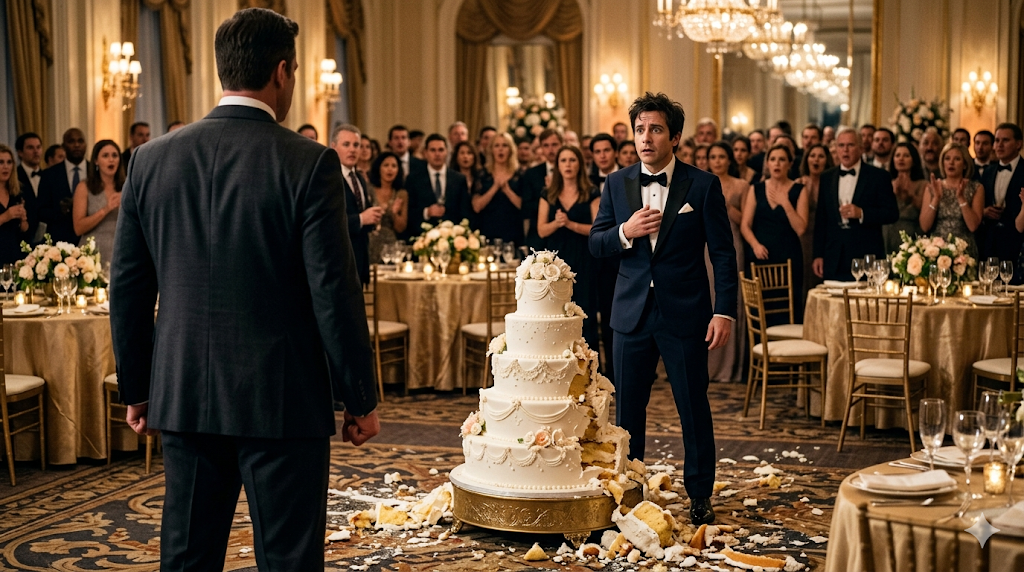

The wedding was supposed to be the happiest day of the Hargrove family. White tablecloths. Golden lights strung through the rafters like a net of stars. A five-tier cake that took three days to build. And in the middle of all that careful beauty, my son Eli sat on the marble floor, sobbing so hard his whole body shook — frosting smeared across his tuxedo, crumbled cake in his hair, the high-tech leg brace on his left knee clicking faintly as he trembled.
I heard it from across the room. Not the fall — the laughter.
Eli had been navigating the reception hall with the quiet, determined care he always uses. Eight years old and already a veteran of twelve surgeries. He knows exactly how far to step. Exactly when to hold the railing. He is more careful with his own body than most adults ever are with anything. But the floor near the dessert table was slick from an unnoticed spill, and when his brace caught the edge of the buffet cart, the whole tier of the display cake came down with him.
And Marcus Bellew laughed.
He stood there in a pressed suit, champagne in hand, watching my son struggle to push himself upright through a wreckage of fondant and white sponge cake. He didn’t move to help. He didn’t call anyone over. He just looked at Eli on the floor the way some men look at things they consider beneath them — with amusement, and with something colder underneath it.
“Watch where you’re going, kid,” he said. A few people around him smiled nervously. No one moved.
I was already moving.
By the time I crossed the room, my heart was pounding so hard it felt like a second person walking inside my chest. I didn’t run — Eli hates when I run toward him in public. It makes him feel like a crisis. So I walked fast and I dropped to my knees on that frosting-covered floor and I pulled him into me, his wet face against my collar, his small hands gripping my jacket like I might disappear if he let go.
“Hey,” I whispered into his hair. “Hey, buddy. I got you. I’m right here.”
He was trying to stop crying and making it worse. His breath came in those jagged little hiccups kids get when they’ve been humiliated in public and are fighting every instinct to disappear. I held the back of his head and let him get it out. Around us, the music had softened. A few guests had noticed. Someone had finally started moving toward us with napkins.
But not Marcus Bellew. He was still standing there. Still watching. Still with that slight curve at the corner of his mouth.
I stayed with Eli until I felt his breathing slow. Until his grip on my jacket relaxed, just slightly. I said his name twice, quietly, and asked if he was hurt. He shook his head no. He was embarrassed and shaken, but not physically hurt. I told him he was brave. I told him the floor was wet and it could have happened to anyone. I told him the truth: that I was proud of him every single day, for things that had nothing to do with walking.
Then I stood up.
I’m not a tall man. I’m not someone who fills a room with physical size. But I’ve been told, by people who know me well, that there is something in my face when I am genuinely furious that is very different from ordinary anger. Something that doesn’t raise its voice. Something that doesn’t need to.
I turned toward Marcus Bellew and walked to him slowly, and I watched his smirk begin to falter about halfway through those steps.
I stopped close enough that only he could hear me. I didn’t raise my voice. I didn’t touch him. I looked at him the way you look at something you’ve already made a decision about.
“My son,” I said, “has had more courage in any one of his surgeries than you have accumulated in your entire life. He fell. You laughed. And now I need you to think very carefully about whether this is a night you want to be remembered for, because I have a very long memory, and so does every person in this room who just watched what you did.”
Bellew said nothing. His jaw shifted. His champagne hand tightened.
“You will apologize to him,” I said. “Not to me. To him. And you will do it before you leave tonight, or I will make sure that every professional relationship you have in this city hears exactly who you showed yourself to be in the last four minutes. I don’t bluff. Ask anyone here.”
I turned and went back to Eli.
He had been helped to a chair by then. Someone had brought him a glass of water and a clean napkin and was crouched next to him with the particular gentleness people use around children they don’t know. Eli was still flushed, but he was composed — sitting straight, brace adjusted, already working on recovering his dignity the way he always does. My kid has more dignity in him than rooms full of grown adults.
Twenty minutes later, I was standing beside Eli when Marcus Bellew appeared.
He looked smaller somehow. He crouched down — which took visible effort, the kind that suggests a man unaccustomed to being in this position — and looked Eli in the eye.
“I’m sorry,” he said. “That was wrong of me. I should have helped.”
Eli looked at him for a long moment. Eight years old. Already knowing exactly what an insincere apology sounds like, and weighing whether to accept this one anyway.
“Okay,” Eli said. Simple. Quiet. Completely unbothered.
Bellew stood and walked away without looking at me.
I sat next to my son and we watched the rest of the wedding from that corner — the dancing, the toasts, the pieces of repaired cake that someone had salvaged onto new plates. Eli ate two pieces and said the frosting was better than the actual cake. He made me try some. He was right.
At the end of the night, driving home, he was quiet for a while. Then he asked me what I’d said to that man.
I thought about it. “I told him to apologize,” I said.
Eli looked out the window. “Did you scare him?”
I glanced over at him. “Maybe a little.”
He nodded, satisfied. “Good,” he said.
Then he fell asleep in the passenger seat before we reached the highway, one hand still holding a napkin-wrapped piece of wedding cake he’d asked to take home for tomorrow.
I drove the rest of the way in the dark, thinking about all the things I would do for that kid. All the rooms I would walk into. All the floors I would kneel on. All the men I would stare down — quietly, without raising my voice — for as long as I have breath to do it.
It’s not even a question. It’s just the job. It’s just what you do when someone is yours.