
The morning had started quietly enough.
Maya sat cross-legged on the living room floor, her swollen belly resting between her knees as she sorted through a box of baby clothes — tiny onesies, soft socks, a knitted yellow hat someone had gifted at the shower last week. The sunlight fell in long gold strips across the hardwood, and for a moment, everything felt almost perfect.
Almost.
She heard the key in the lock before she heard the footsteps.
Then came the voice.
“You’re still here.”
Maya didn’t turn around immediately. She had learned, over eight months of marriage to Daniel, that turning around too quickly in response to Margaret’s voice was its own kind of provocation. So she breathed — slowly, deliberately, the way the midwife had taught her — and then she looked up.
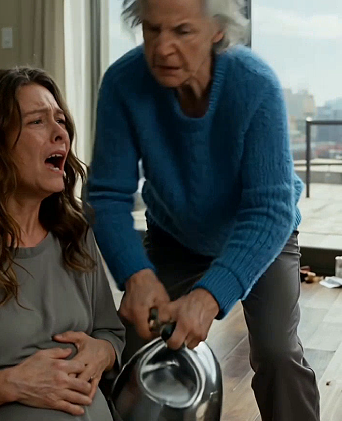
Margaret stood in the doorway of the living room, still wearing her coat, a heavy clothes iron dangling from her right hand. She must have come straight from the laundry room. Or she had planned this. With Margaret, you could never be entirely sure.
“Good morning,” Maya said carefully.
“Don’t.” Margaret’s voice was low and clipped. “Don’t do that. Don’t smile at me like I’m a guest in my own son’s house.”
“Margaret, Daniel isn’t home yet. If you’d like to wait—”
“I don’t want to wait.” She stepped forward. “I’ve been waiting. Eight months. Watching you ruin everything. Watching you trap my son with this—” Her eyes dropped to Maya’s stomach with something that wasn’t grief and wasn’t love. It was something colder. “This mistake.”
Maya’s hand moved instinctively to her belly. “Please don’t call her that.”
“Her.” Margaret almost laughed. “You don’t even know. You don’t know anything about this family. Where we came from. What Daniel was going to be before you came along and—”
“Margaret.” Maya’s voice was steady now, steadier than she felt. “I love your son. I love this baby. I’m not going anywhere.”
Something shifted in Margaret’s face then. A curtain dropping. A decision made.
She raised the iron.
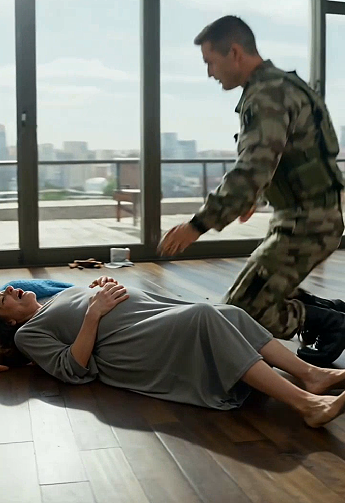
Maya saw it happen in a kind of terrible slow motion — the arm lifting, the iron swinging upward, the morning light catching the flat metal surface — and she scrambled backward on instinct, but her center of gravity was wrong, all wrong, and she couldn’t get her feet under her, and she went down hard onto the floor, one arm thrown up to shield her face, the other wrapped around her stomach.
The iron came down in a sweeping arc and grazed her forearm.
The pain was bright and immediate.
“Stop!” Maya screamed. “Stop — please — the baby—”
But Margaret grabbed a fistful of her hair and wrenched her head back, and Maya’s scream became something animal and raw, her fingers clawing at the floor, every muscle in her body clenched around the small life inside her as if she could protect it through sheer will alone.
She thought: Daniel. Where are you. Please.
She thought: Not her. Don’t let her be hurt. Not her.
She thought nothing else — because the front door exploded open.
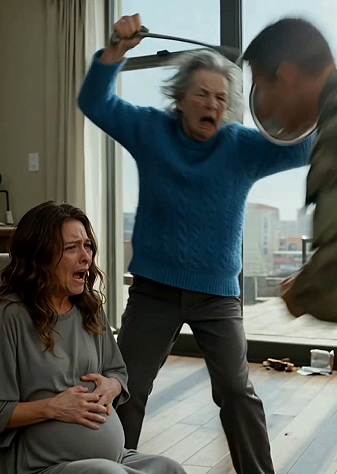
The sound came first: boots on hardwood, fast and deliberate, the particular thunder of someone who has been trained to move through dangerous spaces without hesitation. Maya registered it in the periphery of her terror — a shape, large and uniformed, camouflage fabric blurring at the edges of her vision — and then the shape became motion, became force, became a flying side-kick that connected with Margaret’s torso with a sound like a door slamming in a windstorm.
Margaret’s grip on Maya’s hair released instantly.
The iron clattered across the floor.
And then there was a crash — a loud, graceless tumble — as Margaret hit the far wall and slid down it, landing in a heap on the other side of the room, gasping.
Silence.
Two seconds of absolute silence.
Then Maya was sobbing — she hadn’t even realized she’d started — deep, shuddering sobs that she couldn’t control, one arm still wrapped around her stomach, her whole body trembling against the floor.
And then he was there. Beside her. Down on one knee.
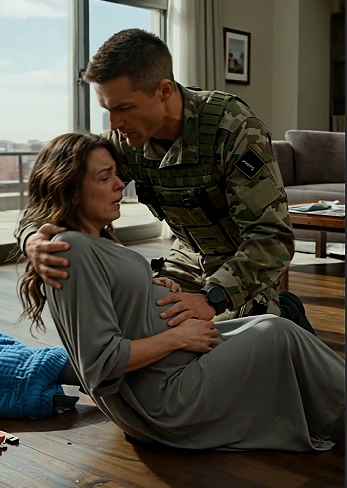
“Maya.” His voice was low, close, careful. His hand — large, warm, still smelling faintly of fuel and aircraft and long distance — came to rest on her shoulder. Not grabbing. Not pulling. Just there. Present. Solid. “Maya, look at me. I’ve got you. You’re okay. Is the baby — are you—”
She looked up.
Daniel’s face was close to hers, and she understood in that moment that she had never truly registered the cost of his absence until she saw what his return looked like. His jaw was set. His eyes were red at the edges. He was still wearing his full camouflage fatigues — he hadn’t even stopped to change, hadn’t gone to the base, hadn’t done anything except come here, directly, as if some frequency she couldn’t hear had broadcast her distress signal across nine time zones and he had simply followed it home.
“She—” Maya tried to find words. “She had the iron. She grabbed—”
“I know.” His hand moved from her shoulder to her cheek, tilting her face gently, checking her. “I know. I’m here. I should have been here. I’m so sorry I wasn’t here.”
Across the room, Margaret had pulled herself upright against the wall. She was holding her ribs. Her expression had shifted completely — the cold certainty was gone, replaced by something that might have been shock, might have been shame, might have been the first moment of genuine reckoning she’d had in years. She stared at her son.
“Daniel—”
“Don’t.” He didn’t raise his voice. He didn’t need to. “Don’t say anything right now.”
He turned back to Maya, and his voice shifted — became the voice he used only for her, the quiet one, the one she’d heard on scratchy satellite calls at two in the morning when she couldn’t sleep and he couldn’t either.
“Can you stand? Can I help you up?”
“I think so.” She took his hand. “The baby’s moving. She’s — I can feel her. She’s okay, I think she’s okay.”
He helped her to her feet slowly, carefully, keeping one arm around her the whole time, and she let herself lean into him — let herself use all the weight she’d been carrying alone for eight months, the fear, the exhaustion, the loneliness, the particular specific ache of loving someone who spends their life somewhere dangerous.
She pressed her face against his chest.
He held her.
“I put in for a reassignment,” he murmured into her hair. “Before I got on the plane. I’m not leaving again. Not until she’s born. Not for a long time.”
Maya didn’t say anything.
She didn’t need to.
Outside, a car alarm started and stopped somewhere down the street. A bird was singing in the oak tree by the window. The morning light was still falling golden and clean across the hardwood floor, across the scattered baby clothes, across the small yellow knitted hat.
Somewhere in the room, the iron lay cooling on the floor.
And for the first time in months, Maya let herself breathe.
Three weeks later, at 4:47 in the morning, their daughter arrived.
She was loud and furious and absolutely perfect.
Daniel cut the cord with shaking hands and held her against his chest, still in his worn cotton t-shirt, eyes streaming in a way he didn’t try to hide, and Maya watched him become someone new — watched the soldier and the son and the husband fold into one more thing: father.
They named her Elena.
She had Daniel’s ears and Maya’s stubbornness and a set of lungs that the nurse described, diplomatically, as “very impressive.”
Margaret sent a card. A single card, unsigned except for a name. No explanation. No apology that would ever be adequate, no words that could reach across what she had done in that sunlit room on that ordinary morning.
But Maya kept the card.
Not out of forgiveness — that would come slowly, incompletely, the way all real forgiveness does, not as a single moment but as a long series of small decisions. She kept it because it was the first evidence she had ever seen that Margaret was capable of softness, however small, however late.
And because Elena deserved a world in which she believed people could change.
Maya intended to raise a daughter who believed that.
Starting today.
Starting now, in this hospital room, with her husband’s arms around her and her daughter’s weight in her hands and the whole long uncertain beautiful rest of their lives stretched out ahead.