
The reservation had been made under a false name.
Maya knew that the moment she walked through the gilded doors of Aurum — the most exclusive restaurant in the city — she was already trespassing in someone else’s world. The chandeliers dripped with crystal. The tablecloths were pressed to a razor’s edge. Men in tuxedos laughed at nothing in particular, the way only men with inherited money could. Women in gowns that cost more than Maya’s mother’s hospital bills tilted their chins toward each other and whispered.
She was wearing the only white button-down she owned.
The maître d’ had looked at her the way people look at a smudge on a mirror — not with hatred, exactly, but with the quiet offense of something being out of place. She had shown him the printed reservation. He had let her through, barely.
Maya had chosen a table near the back. She clutched the brown envelope in her lap beneath the tablecloth, her fingers tracing the sealed edge over and over like a rosary bead. Inside it was everything. Everything she had spent four years finding. Everything that woman had buried.
That woman.
Vivienne Alcott.
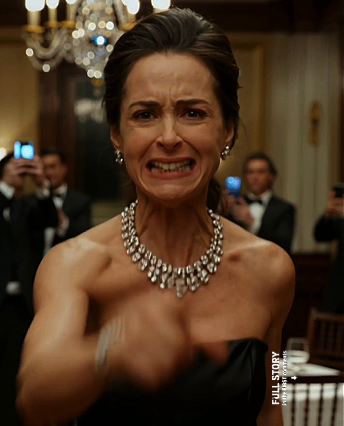
Maya spotted her the moment she sat down — impossible not to. Vivienne commanded a room the way a chandelier does: by existing at the center of it and refusing to acknowledge how much light she consumed. She was seated at the largest table, surrounded by investors and city officials, draped in a black strapless gown and diamonds that caught every photon in the room. She was laughing at something. She was always laughing at something.
She hadn’t noticed Maya yet.
That was fine. Maya wasn’t ready. She pressed her palm flat against the envelope and breathed.
Her plan was simple: wait until Vivienne was alone, approach her quietly, show her what was inside, and give her a choice. That was all. No drama. No scene. She’d rehearsed it a hundred times in the mirror of her studio apartment, in the sterile waiting rooms of lawyers who wouldn’t take her case, in the parking lot of the courthouse the day the judge ruled against her family.
She’d been rehearsing for four years.
But Vivienne Alcott had not survived sixty years by being careless. She had a gift — a predator’s instinct for disruption in her ecosystem. Somewhere between the appetizer and the entrée, her pale eyes swept across the dining room with practiced ease, cataloguing, assessing, dismissing—
And stopped.
Maya watched the recognition move across Vivienne’s face like a storm front rolling in. The smile didn’t die immediately. It curdled first — sweetness souring into something cold and deliberate. Vivienne set down her wine glass with the precise, unhurried motion of a woman who had never once acted out of panic. She said something to the man beside her. He nodded. She rose.
Maya’s hands tightened on the envelope.
Vivienne crossed the dining room like she owned it — because she did, technically. Aurum was one of eleven restaurants under the Alcott Hospitality Group. Every step was slow, measured, and absolute. The surrounding guests tracked her movement without quite knowing why, the way animals register a shift in barometric pressure.
She stopped at Maya’s table.
For a moment, nothing. Just the clink of silverware elsewhere, the murmur of other conversations, the soft orchestral music playing beneath it all.
Then Vivienne placed both hands flat on the white tablecloth and leaned forward, and when she spoke, her voice was velvet over broken glass.
“You have thirty seconds to stand up and walk out of this building before I have you removed.” Her eyes dropped to the envelope. “Whatever you think you have — it means nothing. It will always mean nothing. Because I will make sure of it.”
Maya’s mouth was dry. She had rehearsed this part too.
“Mrs. Alcott,” she began, “my mother worked for your company for twenty-two years. When she got sick, you—”
“Twenty seconds.”
“—you had her quietly let go so you wouldn’t have to cover her treatment under the company plan. She died last spring. Eleven months after her diagnosis. If you had just—”
Vivienne straightened to her full height. Her voice, when it came, was no longer velvet. It was a blade.
“GET OUT OF MY RESTAURANT.”
She slammed both hands on the table — the crack of it silencing the nearest four tables like a gunshot. A wine glass tipped. A server froze mid-step.
“RIGHT NOW!”
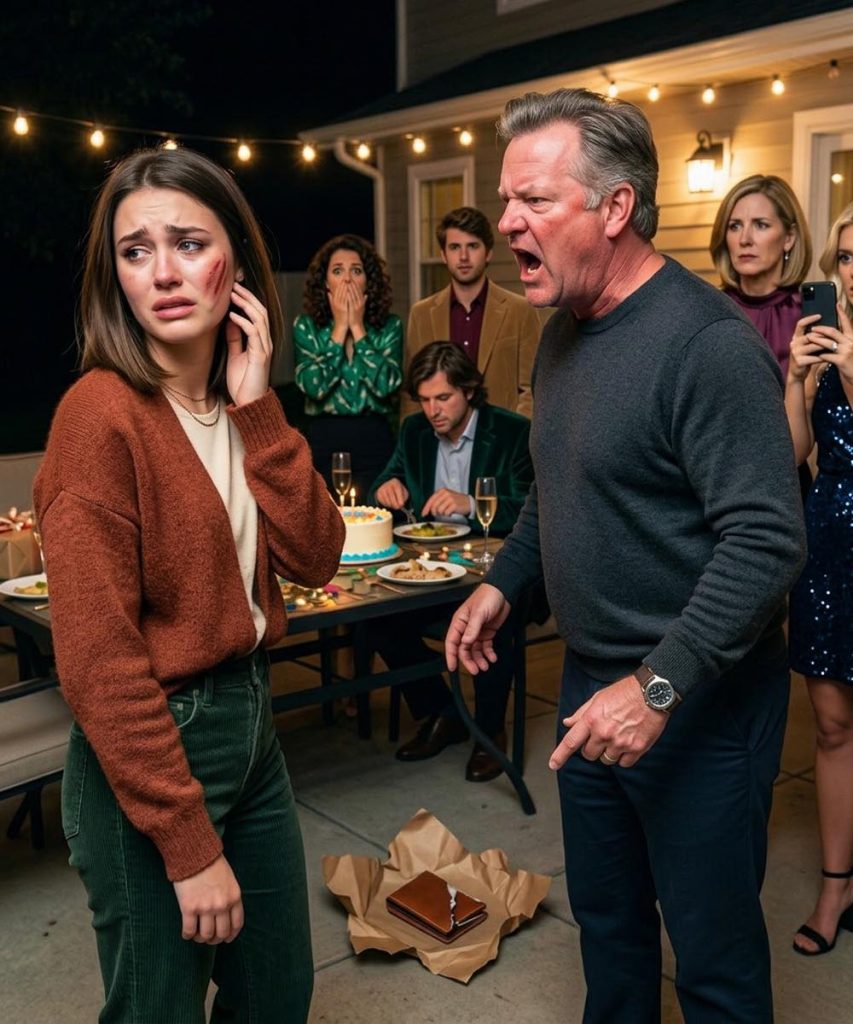
She pointed directly at Maya, finger extended, arm rigid, and for a moment she was magnificent in her fury — a woman so accustomed to winning that losing felt like a physical insult to her body. Around her, guests reached instinctively for their phones. Screens lit up. Recording lights blinked on.
Maya didn’t move.
She should have moved. She knew she should have moved. But something was happening inside her skull — a pressure, building behind her eyes, sudden and nauseating and wrong in a way she couldn’t name. She had been having the headaches for three weeks. The doctor she couldn’t afford had told her it was stress. Grief. She had believed him because it was easier.
The pressure crested.
And then something warm ran down her face.
She thought at first that she was crying — some humiliating, involuntary collapse of composure — and she pressed her hand to her cheek and looked down at her fingers and saw red.
Dark. Viscous. Red.
Not tears.
The room tilted. She heard someone gasp — close, then farther away, like a ripple moving outward. The phone lights that had been filming Vivienne’s outburst swung toward her. Vivienne herself went still, the rage on her face dissolving into something that might, in another person, have been called fear.
Maya touched her face again. Both cheeks. The warmth was spreading, streaking down to her jaw, dripping from her chin onto the white tablecloth, blooming into the fabric like ink into paper.
She was aware, in a distant and almost academic way, that she should probably be more frightened than she was.
But she had the envelope. She still had the envelope.
She pressed it harder against her chest — both arms now, crossed over it, protective — and she raised her eyes to Vivienne Alcott and she did not look away. Not because she was brave. Because she had come too far and paid too much and her mother had died in a hospital bed with a tube in her arm and a woman in a black dress and diamonds had been eating at a table like this one when it happened.
The blood ran and she held the envelope and she did not look away.
That was when he appeared.
She hadn’t noticed him before — he’d been at the bar, or near it, a tall man in a black suit with the kind of face that looked like it had seen things and chosen not to talk about them. He materialized at the edge of her table with the quiet urgency of someone who knew what a crisis looked like before everyone else caught up. His eyes moved fast: the blood on her face, the envelope at her chest, the frozen crowd, Vivienne.
He crouched slightly, bringing his face level with hers, and when he spoke his voice was low enough that only she could hear it beneath the rising murmur of the room.
“What is that?”
He was looking at the envelope.
Maya looked at him. She looked at the blood on her own hands. She looked past him at Vivienne Alcott, who had not moved, whose diamonds were still catching the chandelier light, whose face was the face of a woman watching a variable she had not accounted for.
Maya’s vision was beginning to blur at the edges. The pressure behind her eyes had not lessened. Somewhere behind her a woman was saying call an ambulance, call an ambulance, someone call—
She looked back at the man in the black suit.
And then, because she had rehearsed this too — not this exactly, not this specific version, but the essential shape of it, the moment when you have to trust someone or lose everything — she held the envelope out to him.
“Don’t let her take it,” Maya said. Her voice was steadier than she had any right to. “Whatever happens. Don’t let her take it.”
He took it.
Vivienne moved then — a single step forward, one hand extended — and the man stood to his full height and turned, and something in how he stood made her stop.
The paramedics arrived nine minutes later.
Maya spent four days in the hospital. A burst blood vessel behind her left eye, they said — triggered, probably, by months of compounding stress and a specific kind of grief that lives in the body long after the mind thinks it has processed everything. She was lucky. She was very lucky. Another location, another angle, and the outcome might have been entirely different.
On the morning of the fourth day, the man in the black suit came to her room.
He set the brown envelope on her bedside table. Beside it, he placed a business card.
“My name is Daniel Reeves,” he said. “I’m an investigative journalist. I’ve been watching Vivienne Alcott for two years.” He paused. “I think what’s in that envelope is what I’ve been missing.”
Maya looked at the card. She looked at the envelope. She looked at the window, where the morning was gray and ordinary and her mother was still gone.
“Will it matter?” she asked. “Will it actually matter this time?”
Daniel Reeves looked at her for a long moment.
“I think,” he said carefully, “that it will matter very much.”
The envelope contained thirty-seven documents. Termination letters. Internal memos. Emails between Vivienne and her head of HR discussing specific employees — by name, by diagnosis, by projected cost to the company. It was not Maya’s mother alone. It was forty-one people over nine years. Forty-one people let go quietly, efficiently, and ruthlessly at the moment their medical needs became inconvenient to the bottom line.
The story ran six weeks later.
Vivienne Alcott did not eat at Aurum the night it published. She did not eat anywhere public for quite some time after that.
Maya watched the news from her studio apartment, her laptop balanced on her knees, a cup of tea going cold on the table beside her mother’s photograph.
She did not feel triumphant. She hadn’t expected to.
But she felt, for the first time in four years, that something had been placed back where it belonged.
She picked up her tea. She looked at the photograph.
“Okay, Mom,” she said quietly.
Outside, the city went on.