
My daughter-in-law slapped me across the face for cooking a simple meal while my son watched in cowardly silence… But the person who walked through the door to save me was the last one I expected.
Part I: The Rust and the Bone
My name is Robert Hayes. I’m sixty-two years old, and for forty of those years, my identity was etched into the grease under my fingernails and the calluses on my palms. I was a master mechanic in a small Ohio town where people still shook hands to seal a deal. I lived by a simple code: you fix what’s broken, you protect what’s yours, and you never, ever ask for a handout.
When my wife, Carol, passed away four years ago, the silence in our house became a physical weight. I filled it with the clinking of wrenches and the hum of a local auto shop where I worked part-time. I didn’t need much—just a steady engine to tune and the knowledge that my son, Ethan, was thriving in the big city.
Then came the rain. It was a Tuesday, the kind of gray morning that makes your joints ache before you even get out of bed. I was headed out the door, carrying a box of Carol’s old photo albums to the garage to sort through them. My foot hit a patch of slick moss on the porch step. I felt the world tilt. In a split-second decision, I hugged the box to my chest to save the pictures. My left leg took the full, awkward force of the fall.
The sound was like a dry branch snapping in a winter forest. Crr-ack.
The diagnosis was a complex fracture of the tibia. Pins, plates, and a fiberglass prison from ankle to thigh. The doctor’s orders were a death sentence to a man like me: “Zero weight-bearing for eight to ten weeks, Mr. Hayes. If you trip again, you might never walk without a limp.”
Part II: The Golden Cage
Ethan flew down the next day. He looked successful—expensive suit, polished shoes—but his eyes were tired. He insisted, with a fervor that bordered on desperation, that I move into the guest suite of his new suburban home.
“Dad, you can’t even get to the bathroom by yourself in that old house,” he argued. “Lauren and I have plenty of room. She’s already set up the first-floor guest wing. Please. Do it for my peace of mind.”
I relented. When I arrived, Lauren was the picture of the perfect daughter-in-law. She greeted me with a hug that smelled of expensive lilies and ushered me into a room that looked like it belonged in a magazine. “We’re family, Robert,” she whispered, patting my hand. “You just focus on healing. Let us take care of you for a change.”
For the first week, I felt like royalty. But as a mechanic, I know that a shiny coat of paint can hide a rusted-out frame.
The shift began in the second week. It started with the “theatrics.” If I dropped a crutch, Lauren would freeze in the middle of whatever she was doing, let out a jagged, exhausted sigh, and walk slowly toward me like she was approaching a crime scene. She wouldn’t ask if I was okay; she would just snatch the crutch up and lean it against the wall with a force that felt like a slap.
Then came the verbal papercuts. “Robert, did you use the guest towels again? The decorative ones?” or “Ethan, your father’s physical therapy schedule is really cutting into my Pilates block. Do you think he can just… skip a session?”
Ethan would just nod, his shoulders hunching a little lower each day. My son, who I had raised to be a pillar of strength, was turning into a shadow. He spent his evenings staring at his phone, his thumb scrolling endlessly, while Lauren directed a constant stream of low-level complaints at the back of his head.
Part III: The Kitchen Battlefield
The idleness was killing me. I felt like a parasite. To prove I wasn’t useless, I decided to cook dinner on a Thursday. I spent two hours maneuvering my wheelchair and crutches, searing chicken breasts and steaming fresh green beans. My leg throbbed with a dull, rhythmic heat, but I felt a flicker of the old Robert Hayes—the man who provided.
When they walked through the door at 6:30 PM, the air tension was already at a breaking point. Lauren had lost a client that day; I could tell by the way she gripped her designer handbag.
She sat down, took one bite of the rice, and spat it back onto the plate.
“This is dry. It’s chalky. It’s disgusting,” she hissed.
“I’m sorry, Lauren. I’m out of practice,” I said, trying to keep my voice steady.
“No, Robert. You’re not out of practice. You’re just selfish,” she said, her voice rising to a shriek. “You sit here all day, taking up space, making our house smell like a hospital, and you can’t even follow a simple recipe? Do you have any idea how much work I do to keep this life afloat while you play house?”
Ethan didn’t look up. He was staring at a grain of rice on the tablecloth as if it were the most interesting thing in the world.
“Lauren, that’s enough,” I said firmly.
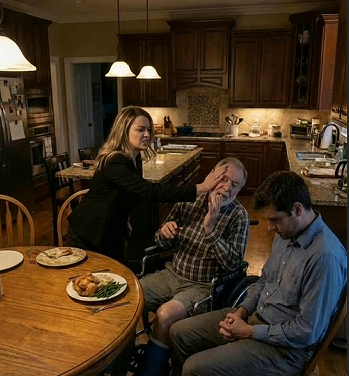
That was the spark. She lunged across the corner of the table. The slap was so fast I didn’t see it coming. My head snapped to the left. The sting was immediate, a blinding white heat that radiated through my jaw.
I didn’t cry out. I just sat there, my hand trembling as I touched my cheek. I looked at my son. Ethan, help me.
But Ethan stayed silent. He looked like a man who had been hollowed out from the inside.
Part IV: The Return of the Matriarch
The click of the front door lock sounded like a gunshot in the silence.
Diane Mercer, Lauren’s mother, walked in. She was a woman of sharp angles and sharper intellect—a retired judge who didn’t tolerate nonsense. She saw the chipped plate. She saw Lauren’s chest heaving with rage. And she saw my face, where a bright red handprint was beginning to bloom.
“What,” Diane said, dropping her keys on the console, “is happening in this kitchen?”
Lauren’s transformation was instantaneous. The rage vanished, replaced by a stuttering, wide-eyed panic. “Mom! You’re early! We… Robert just had an accident. He tripped and hit his face on the cabinet.”
Diane didn’t even look at her daughter. She walked straight to me, tilted my chin up with a firm hand, and examined the mark. Then she looked at the cabinet—which was three feet away from where I was sitting.
“Lauren,” Diane said, her voice dropping to a terrifyingly calm register. “I spent thirty years on the bench. I know what a cabinet bruise looks like. And I know what a handprint looks like.”
She turned to Ethan. “Ethan. Did your wife just strike your father?”
My son’s silence was the loudest thing I’ve ever heard. He looked at Lauren, who was giving him a look of pure, predatory warning. Then he looked at me. He saw the shame in my eyes—the shame of a father who had been reduced to this.
“Yes,” Ethan whispered. “She did.”
Part V: Breaking the Cycle
The explosion that followed wasn’t from Lauren—it was from Diane. She didn’t scream; she dismantled. She laid bare the years of emotional abuse she had watched her daughter inflict on Ethan. She spoke of “narcissistic cycles” and “cowardly complicity.”
“You are my daughter,” Diane said to Lauren, “but I will not be an accomplice to your cruelty. Robert is a good man. And you,” she turned to Ethan, “are losing your soul one silent day at a time.”
That was the moment the “weakling” died. Ethan stood up. He didn’t yell. He just walked to the guest room, grabbed my duffel bag, and started packing.
“Where are you going?” Lauren screamed, her voice cracking. “You can’t leave! This is our house!”
“No, Lauren,” Ethan said, his voice finally carrying the weight of the man I’d raised. “This is a crime scene. And I’m finally leaving the witness stand.”
We left that night. As Diane drove us toward her home, where I would spend the rest of my recovery in actual peace, I looked at Ethan in the backseat. He was leaning his head against the window, watching the streetlights pass. He looked exhausted, but for the first time in years, he looked free.
I realized then that my broken leg hadn’t been a tragedy. It had been the crowbar needed to pry my son out of a cage he didn’t even know he was in. The healing of my bone would take weeks, but the healing of our family? That had just begun.