
A man in worn shoes walked into a bank and was mocked by the arrogant manager who bet double his balance he had nothing… But when the “poor customer” revealed his ID badge, the entire lobby gasped.
The fluorescent lights of Riverstone National Bank hummed softly overhead, casting everything in that sterile, corporate glow that made even genuine smiles look manufactured. The lobby gleamed—polished marble floors reflected advertisements promising financial security, leather chairs sat perfectly arranged, and every surface sparkled with the kind of cleanliness that suggested more about image than care.
Into this pristine world walked a man who didn’t match the aesthetic.
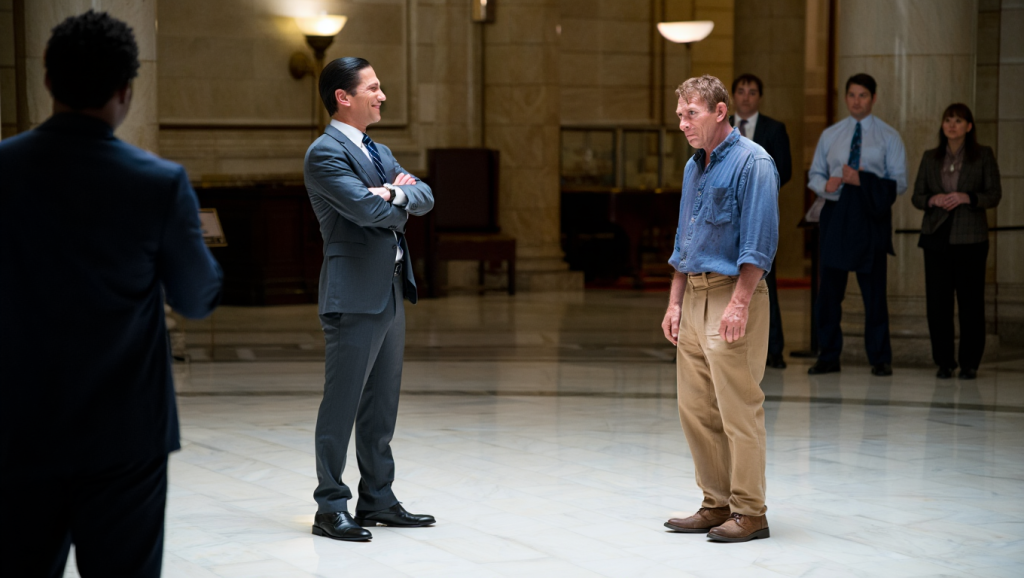
Arturo Medina moved with deliberate slowness, each step measured not by hesitation but by purpose. His button-down shirt was clean, pressed carefully at home rather than by professional hands. His shoes told a story of sidewalks and bus stops, worn smooth at the heels from real life rather than executive parking garages. His hair was combed neatly, his face freshly shaved, but exhaustion lived in the lines around his eyes—the kind that comes from carrying burdens invisible to those who’ve never had to bear them.
He looked, in every way, ordinary. And in a place like this, ordinary meant invisible.
The bank’s morning customers barely registered his presence. An elderly woman in pearls clutched her designer handbag closer as he passed. Two young professionals in sharp suits glanced up from their phones, assessed him in a millisecond, and returned to their screens. A family with small children shifted slightly away. Behind the teller windows, employees maintained their practiced efficiency, greeting customers with smiles that never quite reached their eyes, reciting scripts polished smooth by repetition.
Arturo took a numbered ticket from the dispenser.
Number 47.
He found a seat near the window and waited, hands folded in his lap, watching the world move around him as if he weren’t really there.
From his glass-enclosed office overlooking the lobby, Sebastián Rojas noticed him immediately.
Sebastián was everything the bank wanted to project—his suit was custom-tailored, his tie perfectly dimpled, his hair styled with product that cost more than some people’s weekly groceries. At thirty-eight, he’d climbed the corporate ladder through a combination of ambition and an almost theatrical understanding of authority. His employees called him “exacting.” His peers called him “ambitious.” Those who worked under him daily had other words, spoken only in whispers during cigarette breaks.
To Sebastián, the bank was a kingdom, and he was its prince. Customers were subjects who should feel grateful for his attention. Authority wasn’t earned through service—it was performed through appearance, maintained through distance, and reinforced through subtle demonstrations of power.
And this morning, looking at Arturo Medina sitting quietly in his lobby, Sebastián felt his carefully constructed order disrupted.
“Number 47.”
The electronic voice echoed through the lobby. Arturo stood slowly, straightened his shirt, and approached the teller window. The young woman behind the counter—Maria, according to her name tag—offered him a tired but genuine smile.
“Good morning, sir. How can I help you today?”
Before Arturo could respond, Sebastián emerged from his office. His approach was deliberate, his shoes clicking against the marble with a rhythm that announced importance. He positioned himself beside Maria’s station, one hand resting on the counter in a gesture that claimed ownership of the interaction.
“Yes,” Sebastián said, his voice carrying across the quiet lobby. “What brings you in today?”
The question wasn’t a greeting—it was a challenge dressed in professional courtesy.
Arturo met his gaze calmly. “I’d like to make a withdrawal, please.”
Something flickered across Sebastián’s face—amusement mixed with disdain. He glanced at Arturo’s worn shoes, his modest shirt, his calloused hands. A laugh escaped him, sharp and cutting.
It wasn’t the sound of joy. It was the sound of judgment wrapped in mockery.
Several customers looked up. Maria’s smile faltered. The security guard near the door shifted uncomfortably.
“A withdrawal,” Sebastián repeated, as if the words themselves were absurd. He turned slightly, addressing the lobby as much as Arturo. “Of course. Though I have to wonder…” He paused for effect, his smile widening. “If you even have a balance worth withdrawing.”
Silence descended like a heavy curtain.
Arturo’s expression didn’t change, but something profound happened in his eyes—not anger, but a deep, weary recognition. He’d seen this before. He’d felt this before. The sting of being judged by appearance, of having his dignity questioned by those who measured worth in designer labels and luxury cars.
Sebastián, emboldened by the audience and confident in his superiority, made his fatal mistake.
“Tell you what,” he said, his voice dripping with condescension. “If you actually have a balance—any balance at all—I’ll personally double whatever you’re trying to withdraw. How’s that for customer service?”
A few nervous chuckles rippled through the lobby. Maria looked down at her keyboard. The elderly woman with the pearls shook her head slightly, whether in disapproval of Sebastián or Arturo wasn’t clear.
Arturo stood very still. When he finally spoke, his voice was soft but carried clearly.
“I expected no less,” he said quietly. “From someone who judges books by their covers.”
The response caught Sebastián off-guard. He’d expected embarrassment, maybe anger, perhaps a quick retreat. Instead, Arturo reached into his pocket with unhurried precision.
He didn’t pull out a worn wallet.
He didn’t produce a basic debit card.
Instead, he withdrew something that caught the light—a metal identification badge, substantial and official, with the bank’s emblem engraved into its surface. Attached to it was a lanyard that had clearly seen years of use.
He placed it carefully on the counter.
Maria picked it up with trembling hands. Her eyes widened as she read the inscription. She scanned it through the system, her movements mechanical as shock overtook professionalism.
The computer screen flickered.
Loaded.
Refreshed.
The color drained from her face as if someone had pulled a plug.
“Oh my God,” she whispered, the words barely audible.
Sebastián leaned forward, his confidence still intact, certain this was some elaborate mistake or perhaps a counterfeit badge. “What is it?”
Maria turned the screen toward him, her hand shaking.
The title displayed there in bold letters was unmistakable:
ARTURO MEDINA
OWNER & EXECUTIVE DIRECTOR
RIVERSTONE NATIONAL BANK – ALL BRANCHES
The lobby erupted in whispers. Shock waves rippled through the carefully maintained corporate calm. The elderly woman gasped audibly. The young professionals’ heads snapped up from their phones. A businessman who’d been waiting for a loan appointment stood frozen, his briefcase halfway to the floor.
Sebastián’s face underwent a rapid transformation—from smug confidence to confusion to dawning horror. His mouth opened, closed, opened again. No words came.
“There… there must be some mistake,” he finally stammered, his voice cracking. “This can’t be—”
“There is no mistake,” Maria said softly, her professionalism reasserting itself through the shock. “I’ve verified it three times. This is Mr. Arturo Medina. He’s… he’s the owner. Of everything.”
Arturo stood calmly, his weathered hands resting on the counter. He looked at Sebastián with an expression that held no triumph, no vindication—only profound sadness.
“Do you still question whether I have a balance?” he asked quietly.
Sebastián’s world collapsed in that moment. Not because of the authority he’d challenged—though that was catastrophic enough—but because he suddenly understood the trap he’d built for himself. Every word he’d spoken, every dismissive glance, every assumption had been witnessed not just by customers but by the one person who could see through the bank’s polished facade to its rotten core.
“Sir, I—” Sebastián’s voice broke. “I didn’t know who you were. I didn’t—”
Arturo held up a gentle hand, stopping him. He glanced around the lobby, at the customers frozen in various states of shock and embarrassment, at the employees pretending not to watch while desperately trying to hear every word.
“May I have everyone’s attention, please?”
The request was spoken softly, but something in his tone commanded absolute silence. Conversations stopped mid-sentence. The lobby became a theater, and Arturo its reluctant performer.
He didn’t raise his voice. He didn’t need to.
“I came here this morning dressed exactly like this on purpose,” Arturo began, his words measured and clear. “I wanted to see something. I needed to understand how someone who doesn’t look wealthy would be treated in my own bank. Someone with worn shoes instead of Italian leather. Someone in a shirt pressed at home instead of at the dry cleaners. Someone asking for a simple withdrawal instead of discussing investment portfolios.”
He paused, letting the words settle.
“I wanted to see if dignity was a service we provided to everyone… or just to those who looked like they could afford it.”
Sebastián’s face had gone from red to white to a sickly gray. Sweat beaded on his forehead despite the air conditioning. But Arturo wasn’t looking at him anymore—he was looking at everyone.
“Every person who walks through these doors,” Arturo continued, his voice gaining strength, “carries a story. The elderly woman worried about her pension. The young family trying to save for their first home. The immigrant worker sending money back to his parents. The student opening her first checking account. The veteran trying to understand his benefits.”
A woman near the back of the lobby pressed a tissue to her eyes. A man in a maintenance uniform, who’d been emptying trash bins, stood frozen with his cart.
“A bank doesn’t just protect money,” Arturo said. “A bank protects trust. And trust is built on one simple foundation—respect. Not respect for wealth or status or appearance. Respect for humanity. For dignity. For the courage it takes to walk through these doors and ask for help.”
He turned finally to Sebastián, who looked as if he wanted the marble floor to open and swallow him whole.
“Mr. Rojas,” Arturo said, his tone still measured but edged with steel, “how long have you worked here?”
“Seven years, sir,” Sebastián managed, his voice barely above a whisper.
“And in those seven years, how many people do you think you’ve treated the way you treated me this morning?”
Silence.
“How many elderly customers have you rushed because they moved too slowly? How many working-class families have you spoken to with that same condescending tone? How many times have you let someone’s appearance dictate the quality of service they received?”
Sebastián’s mouth worked soundlessly. Tears formed in his eyes—whether from shame or fear of consequences wasn’t clear.
“I didn’t know,” he finally choked out. “I didn’t know it was you.”
Arturo’s expression softened, but his words cut deeper than any anger could have.
“That’s exactly the problem, Mr. Rojas. It shouldn’t matter that it was me. The man you mocked this morning could have been a retired teacher living on Social Security. A construction worker depositing his paycheck. A single father trying to cash a check to buy his daughter birthday presents. Would any of them have deserved the humiliation you offered so freely?”
The question hung in the air like an indictment.
“Dignity,” Arturo said softly, “is not something people have to earn through wealth or status. It’s something they possess simply by being human. And in a place like this—a place that holds people’s life savings, their dreams, their security—treating every person with dignity isn’t just good customer service. It’s a moral obligation.”
He glanced around the lobby one more time.
“I want everyone here to know something. If you’ve ever felt dismissed, overlooked, or disrespected in this bank or any of our branches, I’m sorry. That ends today. This institution was built to serve communities, not to gatekeep them. To support dreams, not to crush them. To uplift people, not to remind them of their place.”
Maria, the teller, was crying openly now. So were several customers. Even the security guard looked affected, his jaw tight with emotion.
Arturo picked up his badge, looking at it for a long moment before meeting Sebastián’s eyes one final time.
“As for you, Mr. Rojas—we’ll discuss your future here in my office. Upstairs. Now.”
The walk to the elevator was the longest of Sebastián’s life. Every eye in the lobby followed them. Some faces showed sympathy. Others showed satisfaction at seeing arrogance humbled. Most simply showed shock at witnessing something raw and real in a place usually so carefully scripted.
In the elevator, Arturo finally allowed his exhaustion to show. He leaned against the wall, suddenly looking every one of his sixty-three years.
“Do you know what the hardest part of wealth is, Mr. Rojas?” he asked quietly.
Sebastián shook his head, unable to speak.
“It’s knowing that you’ll never again be treated like a regular person. Every interaction becomes transactional. Every kindness feels calculated. You start to wonder—do they respect me, or do they respect my money? Do they see me, or do they see what I can do for them?”
The elevator doors opened to the executive floor.
“That’s why I dressed this way,” Arturo continued as they walked down the hallway. “Because for one morning, I wanted to be invisible again. I wanted to be judged not by my title but by my humanity. And I wanted to see if the bank I built still remembered the people it was meant to serve.”
They entered Arturo’s office—a modest space by executive standards, with family photos on the desk and community awards on the walls instead of the usual corporate trophies.
Arturo sat down heavily, suddenly looking very old and very tired.
“Pull up Mr. Rojas’s file,” he said to his assistant through the intercom. “And the customer service reports for his branch for the past two years.”
What they found was damning.
Seventeen formal complaints. Forty-three informal concerns flagged by other employees. Patterns of dismissive behavior toward elderly customers, impatience with non-English speakers, visible irritation with working-class clients. Multiple instances of employees feeling pressured to prioritize “high-value” customers over others.
One complaint, from three months earlier, was particularly telling. An elderly woman reported that Sebastián had loudly questioned whether she was “in the right place” when she came to inquire about a reverse mortgage, suggesting she try the check-cashing store down the street instead.
Arturo read each one, his expression growing darker.
“You built a culture of cruelty,” he said finally, looking up at Sebastián. “Maybe not physical cruelty. Maybe not obvious cruelty. But the kind that erodes dignity quietly, one interaction at a time. The kind that makes people feel small for needing help. The kind that turns a bank into a place people dread instead of trust.”
“Sir, I can change,” Sebastián pleaded. “I can do better. Please, I have a family, a mortgage—”
“So did the people you humiliated,” Arturo interrupted gently. “So does the retired teacher. So does the construction worker. So does the single father. They have families and mortgages and dreams too. But you treated their struggles as inconveniences instead of the reason this bank exists.”
He stood, walking to the window that overlooked the city.
“I started this bank forty years ago with one thousand dollars and a dream,” Arturo said softly. “I knew what it felt like to be turned away. To be told I wasn’t good enough, didn’t look right, didn’t belong. I built Riverstone to be different. To be the kind of place where everyone—everyone—felt welcome and respected.”
He turned back to Sebastián.
“But somewhere along the way, as we grew, as we became successful, we forgot. We started hiring people who saw banking as business instead of service. Who measured success in profit margins instead of lives improved. Who treated customers like transactions instead of human beings.”
Arturo sat back down, suddenly looking defeated.
“Mr. Rojas, I’m going to do something that might seem harsh. But I want you to understand that it’s not about punishment. It’s about protection—protecting every person who walks into our banks trusting us with their livelihood.”
He paused, letting the weight of the moment settle.
“Effective immediately, you’re terminated from Riverstone National Bank. You’ll receive two months’ severance—more than generous considering the circumstances—and a neutral reference that confirms your employment dates but nothing more.”
Sebastián crumpled, tears flowing freely now. “Please,” he whispered. “Please, I can change. I will change.”
“I hope you do,” Arturo said with genuine compassion. “I truly hope this moment teaches you something that no amount of success could teach you—that dignity is not something you grant to people who earn it through wealth or status. It’s something you recognize in every human being you encounter, regardless of how they look or what they have.”
He stood, extending his hand.
“I’m not angry at you, Mr. Rojas. I’m disappointed. Not just in you, but in myself for not seeing this sooner. For building something beautiful and then not protecting it carefully enough. That’s my failure as much as yours.”
They shook hands—Sebastián’s trembling, Arturo’s steady.
“There’s one more thing,” Arturo added as Sebastián reached the door. “When you leave here today, I want you to spend some time thinking about something. Every person you dismissed, every customer you made feel small—they remembered. They carried that feeling home with them. It changed how they saw themselves, even if just for a moment. That’s the real cost of your behavior. Not the bank’s reputation. Not your job. But the pieces of confidence and dignity you chipped away from people who were already struggling.”
After Sebastián left, Arturo sat alone in his office for a long time. Through the window, he could see the city—millions of people, each carrying their own burdens, their own dreams, their own struggles.
His assistant knocked softly. “Sir? There’s someone from the lobby who’d like to speak with you.”
“Send them in,” Arturo said, straightening in his chair.
An elderly woman entered—the same one who’d clutched her purse when he walked in that morning. She moved slowly, using a cane, her hands trembling slightly.
“Mr. Medina,” she said softly, “I wanted to thank you.”
“Ma’am, there’s no need—”
“Please,” she interrupted gently. “Let me speak. I’ve been coming to this bank for fifteen years. And for the past three years, since that man became manager, I’ve dreaded every visit. The way he looked at me, like I was wasting his time. The way he spoke to me, like I was stupid for not understanding the new online systems. The way he made me feel… invisible.”
Her voice cracked.
“Today, watching you stand there in your modest clothes, being treated the way he treated me so many times—and then seeing who you really were—it felt like justice. Not revenge. Justice. Like someone finally saw us. Finally understood.”
She reached into her purse and pulled out a tissue, dabbing her eyes.
“My husband and I saved our whole lives. We have a modest nest egg—not millions, but enough to feel secure. Or we did, until every bank visit became an exercise in humiliation. We were thinking of moving our money somewhere else, somewhere we’d be treated like people instead of burdens.”
She looked directly at Arturo.
“But today, you reminded me why we chose Riverstone in the first place. Because somewhere in there, beneath all the corporate polish, was still the heart of the man who built it. Someone who remembered what it felt like to be overlooked.”
Arturo stood, his own eyes glistening.
“Thank you for telling me,” he said softly. “And I’m sorry. I’m so sorry you were made to feel that way.”
“It’s not your fault,” she said. “You can’t be everywhere. But you were where it mattered today. And word will spread. People will hear about this. And maybe—maybe it’ll remind everyone that banks are supposed to serve people, not sort them.”
After she left, Arturo made a decision.
That afternoon, he called an emergency meeting of all branch managers across the entire Riverstone network—forty-three branches spanning three states. He didn’t use video conference. He required them to come in person.
In the bank’s main conference room, forty-two managers sat nervously, wondering what crisis had prompted this unprecedented gathering. The empty chair where Sebastián should have sat spoke volumes.
Arturo stood before them in the same modest shirt and worn shoes he’d worn that morning.
“I want to tell you about what happened today,” he began. “And I want you to listen—really listen—because this is about more than one manager’s mistake. It’s about what we’ve become and what we need to remember.”
He told them everything. Every detail of his morning. Every word of Sebastián’s mockery. Every feeling of humiliation. Every revelation.
The room sat in stunned silence.
“I founded this bank forty years ago,” Arturo continued, his voice steady but emotional, “because I knew what it felt like to be turned away. I was a twenty-three-year-old immigrant with broken English and big dreams. I had a business plan and five hundred dollars saved from two jobs. And I walked into nine different banks asking for a loan. Do you know what happened at every single one?”
He paused, letting the question hang.
“They laughed. Not politely. Not professionally. They laughed. They judged me by my accent, my clothes, my background. They saw someone who didn’t belong in their marble lobbies. They saw risk instead of potential. They saw difference instead of determination.”
His voice strengthened.
“Bank number ten took a chance on me. A loan officer named Margaret Chen spent three hours reviewing my business plan. She saw past my appearance and heard my dream. That thousand-dollar loan changed my life. It didn’t just give me capital—it gave me dignity. It told me I was worth investing in.”
He looked around the room at faces ranging from ashamed to inspired.
“I built Riverstone to be like bank number ten. To be the place that gave people chances. That saw potential instead of appearance. That treated every customer—every single customer—with the respect and dignity that Margaret Chen showed me.”
He picked up a folder from the table.
“But we’ve lost our way. I have here customer service reports from the past year. Pattern after pattern of behavior that suggests we’ve become banks one through nine. Places where people are judged by their clothes, their cars, their account balances. Places where dignity is rationed based on wealth.”
He looked directly at the managers.
“That ends today. Here’s what’s going to change, effective immediately:
“One: Every branch will implement mystery shopper programs, but not the kind that checks efficiency. The kind that checks compassion. We’ll hire people to come in looking like they don’t belong—like I did this morning—and we’ll see how they’re treated.
“Two: Employee evaluations will be reweighted. Sixty percent will be based on customer satisfaction and community impact. Forty percent on traditional metrics. If you can’t serve people with dignity, you can’t work here regardless of how many accounts you open.
“Three: Every manager—including me—will spend one day each quarter working as a front-line employee. Answering phones. Meeting with customers. Sitting in the lobby. If you’re going to lead these branches, you need to remember what it feels like to serve.
“Four: We’re establishing a community advisory board at every branch. Real customers—elderly folks, working families, immigrants, students—who will tell us honestly how we’re doing and where we’re failing.
“Five: Any employee who demonstrates the kind of behavior Mr. Rojas showed this morning will be immediately terminated. No warnings. No second chances. Because every instance of that behavior doesn’t just hurt one customer—it sends a message about who we are as an institution.”
The room remained silent, but heads were nodding.
“I know some of you are thinking this is idealistic,” Arturo continued. “That in modern banking, you have to focus on profit margins and high-value customers. That treating everyone equally isn’t efficient or sustainable.”
He smiled sadly.
“I’m here to tell you that’s a lie we tell ourselves to justify cruelty. Riverstone is profitable. We’re successful. We’re growing. And we’ve done it while maintaining values that put people first. The two things aren’t mutually exclusive—unless you let them be.”
He walked slowly around the table, making eye contact with each manager.
“When you go back to your branches tomorrow, I want you to look at your lobby. Really look at it. Is it welcoming or intimidating? Warm or cold? Does it say ‘everyone belongs here’ or does it say ‘prove yourself first’?”
“Look at your staff. Are they trained to serve or to filter? To welcome or to gatekeep? To see customers as people or as accounts?”
“Look in the mirror. Are you leading with compassion or with arrogance? Are you building trust or maintaining distance? Are you serving your community or managing a business?”
He returned to the front of the room.
“I built this bank to be different. To be better. To remember that behind every account number is a human being with dreams and struggles and dignity. If we can’t do that—if we can’t treat every person who walks through our doors with basic respect and kindness—then we don’t deserve to exist.”
He paused, emotion thick in his voice.
“Margaret Chen died three years ago. I went to her funeral. I stood among her family and friends and told them how she changed my life. Not with a large loan or special treatment, but with simple dignity. With seeing me as worthy of respect despite my appearance. With believing in my potential despite my circumstances.”
His voice broke slightly.
“Every day, each of you has the power to be someone’s Margaret Chen. To be the person who looks past appearance to see potential. Who treats struggle with compassion instead of contempt. Who reminds someone that they matter, that they’re worthy, that they belong.”
He straightened, his composure returning.
“Or you can be the nine banks that turned me away. That laughed at my dreams. That made me feel small and worthless and unwelcome.”
He looked around the room one final time.
“The choice is yours. But if you choose the latter, you won’t be doing it at Riverstone National Bank.”
The meeting ended in silence. Some managers left looking shaken. Others looked inspired. A few looked relieved, as if they’d been waiting for permission to lead with heart instead of just head.
That evening, Arturo returned to the lobby where everything had started. He sat in the same chair, watched the same customers come and go. But something had shifted. Word had spread—through staff, through customers, through the mysterious network of community gossip.
People looked at him differently. Some approached to thank him. Others simply nodded respect. A few took pictures, though he gently discouraged it.
“Mr. Medina?”
He looked up to see a young man, perhaps twenty-five, wearing a fast-food uniform. His name tag read “Carlos.”
“I heard what happened this morning,” Carlos said nervously. “I just… I wanted you to know it mattered. I’ve been saving for two years to start a food truck business. I have a business plan and fifteen hundred dollars. And I’ve been too scared to come in and ask about a small business loan because I thought… I thought people would laugh at me. Would say I’m too young, too inexperienced, not serious enough.”
His voice grew stronger.
“But after today, after hearing what you did, how you stood up for people like me—I’m coming back tomorrow. I’m going to walk in here and ask for that meeting. Because if the owner of the bank can be judged by his worn shoes, and still demand respect, then maybe I can too.”
Arturo stood, extending his hand.
“Carlos, I’ll meet with you personally. Tomorrow, ten AM. Bring your business plan and your dreams. We’ll talk about both.”
Carlos’s eyes widened. “Really? You’d do that?”
“That’s exactly why I built this bank,” Arturo said gently. “For people like you. For people like I was. For people who need someone to believe in them before they can fully believe in themselves.”
As Carlos left, practically floating, Arturo felt something he hadn’t felt in years—hope. Not for profit margins or expansion plans, but for the simple idea that perhaps, maybe, they could get back to what mattered.
His phone buzzed. A message from his assistant: “Sir, local news picked up the story. Six news outlets requesting interviews.”
Arturo sighed. He didn’t want publicity. Didn’t want to be celebrated for basic decency. But maybe—maybe this story reaching beyond this lobby would remind other institutions, other leaders, other people that dignity isn’t a luxury to be earned but a right to be honored.
A woman approached him—middle-aged, wearing hospital scrubs, looking exhausted from a long shift.
“Excuse me,” she said softly. “Are you Mr. Medina?”
“I am,” he replied gently.
“I’m a nurse,” she explained. “I work doubles most weeks. I came in here six months ago to ask about refinancing my student loans. That manager—the one from today—he made me feel so small. Told me I should have ‘made better choices’ instead of going into nursing. Said there wasn’t much he could do for someone with my ‘financial situation.'”
Her voice trembled with old hurt and new anger.
“I left crying. I felt ashamed of my degree, of my job, of myself. I’ve been avoiding banks ever since, just letting the loans pile up because I couldn’t face that feeling again.”
She looked directly at Arturo.
“But today, someone sent me a video of what happened this morning. And I realized it wasn’t my fault. It wasn’t my degree or my job or my worth. It was his cruelty. His arrogance. His failure to see that nurses matter just as much as lawyers, that service work has dignity, that not everyone measures success by their bank balance.”
Tears streamed down her face.
“Thank you,” she whispered. “Thank you for seeing us. For remembering us. For standing in worn shoes so you could feel what we feel every day.”
Arturo took her hand gently.
“What’s your name?”
“Jennifer. Jennifer Morales.”
“Jennifer, I want you to come back tomorrow. Ask for Maria at window three—she’ll expect you. We’re going to review your student loans together and see what we can do. Not because of what happened today, but because that’s what we should have done six months ago. That’s what we should do for everyone.”
Jennifer nodded, unable to speak through her tears, and walked away touching her heart as if she’d been given something precious.
As the sun set and the bank prepared to close, Arturo sat in that lobby a while longer. He thought about journeys—his own from that first humiliating bank visit to this moment of revelation. He thought about Margaret Chen and the simple gift of dignity she’d given a young immigrant. He thought about Sebastián and hoped his humiliation today would transform into wisdom tomorrow. He thought about Jennifer and Carlos and the elderly woman and all the invisible people who moved through the world carrying their struggles with quiet grace.
And he made himself a promise.
He would never forget again. Never let success insulate him from reality. Never let corporate polish obscure human need. Never let efficiency replace empathy.
He would keep coming back to this lobby, in modest clothes and worn shoes, reminding himself and everyone else that banks exist to serve people—not sort them.
As he stood to leave, Maria approached him.
“Mr. Medina?” she said softly. “What you did today… it changed something. I’ve worked here for four years, and I’ve never seen people look at this place the way they looked at it today. Like it was theirs. Like they belonged.”
She smiled through tears.
“That’s what it should feel like, isn’t it? Like everyone belongs?”
Arturo put a gentle hand on her shoulder.
“That’s exactly what it should feel like. And that’s what we’re going to make sure it does feel like, every day, for every person.”
He walked toward the door, then turned back one more time.
The lobby sat empty now, lights dimming, another day ending. But something had changed. Something invisible but profound. The marble still gleamed. The chairs still sat in perfect rows. The advertisements still promised security and trust.
But now, maybe, those promises would mean something real.
Because dignity, Arturo had learned long ago and remembered today, isn’t something you buy or earn or achieve.
It’s something you recognize. Something you honor. Something you give freely to every human being you encounter, regardless of their worn shoes or modest shirts or exhausted faces.
It’s the one thing that costs nothing but reveals everything.
And in a world that so often measured worth by wealth, remembering that simple truth was revolutionary.
As Arturo stepped into the evening air, he felt lighter than he had in years. Not because he’d exposed arrogance or dispensed justice, but because he’d been reminded of why he started this journey in the first place.
To build a place where everyone—everyone—could walk through the doors and feel worthy.
Tomorrow, that work would continue.
Tonight, he could rest knowing it had begun again.