World #2 Iga Swiatek faced Elena Rybakina in a high-stakes Australian Open quarterfinal… But the calm Kazak dismantled the champion’s dreams in straight sets.
The Australian summer sun blazed over Melbourne Park on what would become one of the most compelling quarterfinal matches of the 2026 Australian Open. As the Rod Laver Arena filled with eager spectators, two of tennis’s most formidable champions prepared for battle—a clash that promised fireworks, drama, and the kind of tennis that would be remembered for years to come.
Elena Rybakina, the statuesque powerhouse from Kazakhstan, stepped onto the iconic blue court with her trademark calm demeanor. Standing at 6 feet tall, she moved with the grace of a ballet dancer and the precision of a surgeon. Across the net stood Iga Swiatek, the fiery Polish champion and world number two, whose intensity and passion had carried her to multiple Grand Slam titles. Their contrasting personas set the stage for a psychological battle as much as a physical one.
The pre-match atmosphere crackled with anticipation. Commentators Nick Kyrgios and former champion Jelena Dokic settled into their broadcast positions, noting the stark differences between these two elite athletes. “It’s fascinating,” Kyrgios observed, “the way they carry themselves couldn’t be more different. The intensity from Swiatek, and yet from Rybakina, that seemingly laconic nature.”
As the warm-up concluded, both players understood what was at stake. For Rybakina, this match represented another step in her remarkable comeback journey. She had struggled through injuries and personal turmoil the previous year, watching her ranking slip outside the top ten. But something had shifted during the Asian swing last fall. Her game had clicked back into place, and she’d been building momentum ever since, riding an eight-match winning streak against top-ten opponents.
For Swiatek, the stakes were even higher. The champion of Roland Garros, the US Open, and Wimbledon, she had come to Melbourne with one burning ambition—to complete the career Grand Slam. Standing in the semifinals here in 2022 and 2025, she’d never broken through to the final. This was her moment, her opportunity to join the exclusive club of players who had conquered all four major championships. The pressure was immense, perhaps more than she realized.
The coin toss completed, the match began. Swiatek elected to receive, a tactical decision that would soon be questioned. From the first game, it was clear that nerves were affecting both players, but in different ways. Rybakina’s first serve percentage started alarmingly low—just one of five first serves found the mark in her opening service game. Her motion seemed hesitant, the ball toss slightly off, the rhythm not quite there.
But Swiatek couldn’t capitalize. Standing a meter behind the baseline—her traditional return position—she found herself unable to handle the sheer pace and kick on Rybakina’s second serve. Even when the Kazak missed her first delivery, the second serve came at her with vicious spin, bouncing high and pushing her back even further. Swiatek’s coach, Wim Fissette, called out from the player’s box: “You need to move position! Step in!”
The advice highlighted a crucial tactical battle unfolding. For years, Swiatek had been somewhat rigid in her return positioning, standing in the same spot regardless of her opponent. It had cost her in previous matches against Rybakina, particularly their epic encounter at the 2024 French Open, where she’d squandered a commanding lead. Fissette had worked with her to be more flexible, to adjust based on the server’s weapons, but old habits die hard, especially under pressure.
Game one went to Swiatek, but it was anything but convincing. Rybakina sprayed errors, her forehand—usually a weapon of mass destruction—finding the net or sailing long. The opening games were scrappy, tense, both players feeling each other out while battling their own demons.
Then came the turning point of the first set. In game three, with Swiatek serving at 2-1, everything changed. Rybakina stepped inside the baseline on second serve returns, taking the ball early and driving it back with interest. Her backhand, one of the purest strokes in women’s tennis, began to find its range. She painted the lines with cross-court backhands that barely cleared the net, the ball skidding low through the court.
Swiatek’s anxiety became visible. Her ball toss on serve grew inconsistent. Her feet, usually so quick and decisive, seemed heavy, hesitant. When she did manage to get into rallies, she rushed—taking massive cuts at balls that required more patience, trying to end points too quickly against an opponent who thrived in extended exchanges.
“You have time,” Fissette called out during the changeover. “More time than you think. Stay light on your feet.”
But the message wasn’t sinking in. Rybakina broke serve to love, a devastating display of return power and baseline dominance. The scoreboard read 3-1, and the momentum had decisively shifted.
What followed was a masterclass in controlled aggression from the Kazak. Her serve, which had started so poorly, suddenly clicked into gear. The ball toss rose higher, her shoulder rotation became more fluid, and aces began to flow. One particular serve in game five—a wide slider to Swiatek’s backhand side—drew an audible gasp from the crowd. At 185 kilometers per hour, it curved away from the Polish star, who could only watch it paint the outside edge of the service box.
Swiatek’s frustration mounted. Between points, she could be seen muttering to herself, shaking her head. Her team tried to offer encouragement, but the words seemed to bounce off an invisible wall of stress. The weight of expectation—the career Grand Slam, the ranking, the legacy—it all bore down on her shoulders.
The tennis itself was breathtaking when both players found their rhythm. Long baseline exchanges showcased their contrasting styles—Swiatek’s heavy, looping forehands that climbed high over the net versus Rybakina’s flat, penetrating groundstrokes that barely cleared the tape. The sound of the ball off Rybakina’s racket was different, a sharper crack that signaled the extra pace she generated.
At 5-4, serving to stay in the set, Swiatek faced her moment of truth. The game started poorly—a double fault, followed by a tentative second serve that Rybakina demolished for a forehand winner. At 0-30, the crowd sensed blood. Set point loomed large.
Swiatek dug deep. A big first serve down the T. An ace out wide. Suddenly it was 30-30, and she had arrested the slide. The next point featured a 15-shot rally, both players trading heavy blows from the baseline. Swiatek directed traffic brilliantly, moving Rybakina from corner to corner, finally drawing a forehand error. 40-30. One point from holding.
But champions find a way to raise their level when it matters most, and Rybakina did exactly that. She crushed a backhand return that handcuffed Swiatek, forcing a weak reply. The Kazak stepped forward and unleashed a forehand winner that clipped the sideline—called out initially, but Hawkeye confirmed it was in by mere millimeters. Deuce.
The tension was suffocating. Swiatek’s first serve sailed long. Her second delivery, though struck with conviction, sat up in Rybakina’s hitting zone. The return came back with venom. Swiatek scrambled, retrieved, but her defensive slice landed short. Rybakina pounced, driving a forehand down the line that Swiatek reached but could only net. Set point Rybakina.
For a moment, time seemed suspended. Swiatek bounced the ball at the baseline, once, twice, three times. She tossed it up for the serve, then caught it, not ready. The crowd fell silent. She served again, this time committing to the motion. The ball found the center of the service box, but without pace, without placement. Rybakina had all day to set up her return. She chose the backhand down the line, her favorite pattern, and executed it perfectly. The ball kissed the baseline, and Swiatek’s desperate lunge came up empty.
Set to Rybakina, 7-5, after 59 minutes of grueling tennis.
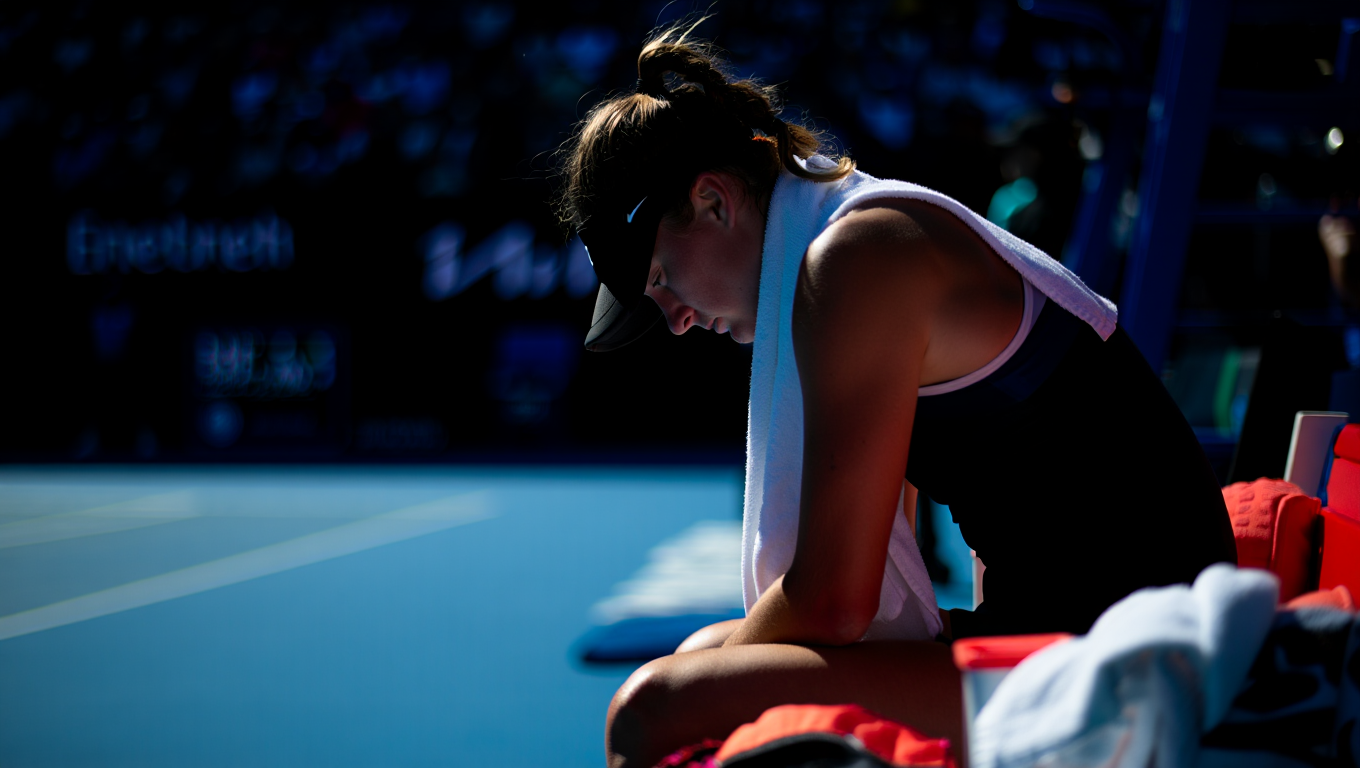
As they sat for the changeover, the body language told two completely different stories. Rybakina sat motionless, a statue of calm, sipping water methodically. Her face betrayed nothing—no joy, no relief, no emotion whatsoever. The “Ice Queen” nickname had never seemed more appropriate.
Swiatek, meanwhile, changed her entire outfit—shirt, skirt, everything. She was drenched in sweat despite the moderate temperatures. Her team surrounded her with advice, towels, encouragement. Coach Fissette pulled out an iPad, showing her statistics, patterns, areas to improve. Physical trainer Maciej Ryszczuk offered tactical suggestions. Sports psychologist Daria Abramowicz tried to reset her mental state.
“Don’t panic,” Fissette said firmly. “Game by game. Point by point. You’re doing good things; just trust the process.”
But panic was exactly what had gripped Swiatek. She had experienced this before—against Danielle Collins here in 2025, against Madison Keys in 2022. There was something about the big hitters at the Australian Open that disrupted her rhythm, that made her feel rushed, that triggered her anxiety.
The second set began, and any hope of a Swiatek comeback evaporated quickly. Rybakina had found her groove, and it was a beautiful thing to witness. Her first serve percentage jumped to 73%, each delivery a guided missile. She served five aces in the opening three games of the second set alone. The variety was stunning—wide slices, body serves with kick, flat bombs down the T. Swiatek couldn’t read the patterns, couldn’t anticipate, couldn’t get into any kind of return rhythm.
At the baseline, Rybakina was equally dominant. Her forehand, which had misfired early, now hummed with precision. She hit winners from impossible positions—sliding wide to reach a ball, somehow generating enough racket head speed to drill a forehand cross-court winner. Her backhand down the line became a weapon of choice, targeting Swiatek’s forehand and keeping it low, preventing the Polish star from loading up with her preferred heavy topspin.
The scoreboard told a brutal story: 3-0, then 4-0, then 5-0. Swiatek managed to hold serve in game six, a small victory that felt hollow given the circumstances. At 5-1, Rybakina served for the match.
The crowd, initially partisan toward the entertaining and emotional Swiatek, had been won over by Rybakina’s shot-making brilliance. Appreciative applause followed her winners. Even in Australia, far from Kazakhstan, she was earning respect with every strike of the ball.
Serving at 30-15, Rybakina unleashed her ninth ace of the match—a serve so pure, so perfectly placed, that Swiatek didn’t even move. Match point. The entire stadium held its breath.
Swiatek managed to return the first serve, but it landed short. Rybakina stepped forward and hammered a forehand approach down the line. Swiatek tracked it down, throwing up a defensive lob. For a moment, it looked like it might land deep, might give her a reprieve. But Rybakina had read it perfectly, backpedaling smoothly, setting up for the overhead. She crushed it, the ball rocketing into the open court.
Game. Set. Match. Rybakina.
7-5, 6-1 in one hour and thirty-five minutes.
The victory was comprehensive, commanding, and utterly convincing. Rybakina had produced 26 winners against just 19 unforced errors—a phenomenal ratio that spoke to her controlled aggression. Swiatek, by contrast, managed only 10 winners while committing 23 unforced errors. The statistics painted a clear picture of domination.
As they met at the net, Rybakina’s expression remained neutral, almost serene. Swiatek forced a smile, offering genuine congratulations despite the crushing disappointment. As she walked to her chair to pack her bags, the reality sank in—another year without the Australian Open title, another year with the career Grand Slam remaining incomplete.
Rybakina’s on-court interview with Casey Dellacqua was characteristically understated. “I’m just trying to stay aggressive and play free,” she said, her voice calm and measured. “The serve is really helping me.” No fist pumps, no dramatic celebrations, just quiet satisfaction.
When asked about her demeanor, about the apparent lack of emotion, Rybakina smiled slightly. “It’s just my character,” she explained. “I’m trying not to show too much frustration if something is not going well. I’m pretty calm off the court too—of course, I can be fun with close people.”
The victory extended Rybakina’s incredible streak to nine consecutive wins over top-ten opponents, a run that had begun during the Asian swing the previous fall. She was back, fully back, to the level that had seen her win Wimbledon in 2022. The injuries had healed, the personal issues that had disrupted her 2024 season had been resolved, and now she was playing the best tennis of her life at exactly the right moment.
For Swiatek, the loss would sting for a long time. She had come to Melbourne with such high hopes, such clear ambitions. The preparation had been thorough, the form in the lead-up tournaments had been strong. But when it mattered most, against the biggest hitter in the draw, the old demons had resurfaced. The anxiety, the rushing, the inability to trust her game under extreme pressure—it had all come flooding back.
In the press conference later, Swiatek was gracious in defeat. “She played amazing tennis, especially in the second set,” she admitted. “I couldn’t find my rhythm on the first serve, and when you give someone like Elena too many looks at your second serve, she’s going to make you pay. Credit to her—she was the better player today.”
But privately, with her team, the questions would be harder. Why did this keep happening at the Australian Open? Why did the big hitters cause her so much trouble here when she handled them fine in Paris or New York? Was it the court speed? The heat? The time of year? Or was it something deeper, something psychological that needed to be addressed?
Meanwhile, Rybakina moved on to prepare for her semifinal, which would come just one day later against either Amanda Anisimova or Jessica Pegula. Her routine between matches was famously boring, as she’d admitted in the interview—recovery work, film study, strategy sessions with coach Stefano Vukov, and rest. Nothing glamorous, nothing exciting, just the professional discipline of an elite athlete.
The tennis world took notice of Rybakina’s resurgence. Analysts pointed out that when she was healthy and confident, she might be the most dangerous player in women’s tennis. Her serve rivaled any man’s in terms of technique and efficiency. Her groundstrokes could overpower anyone. She had improved her movement, her fitness, her mental resilience. The complete package was emerging.
As the sun set over Melbourne Park that evening, the Australian Open had lost one of its biggest stars, but gained a new favorite. Rybakina’s path to the final was opening up. If she could maintain this level, if she could stay calm and free and aggressive, another Grand Slam title was well within reach.
The ice queen had returned to her throne, and the rest of the draw had been put on notice. Elena Rybakina was playing championship tennis again, and she wasn’t going to be easy to stop.