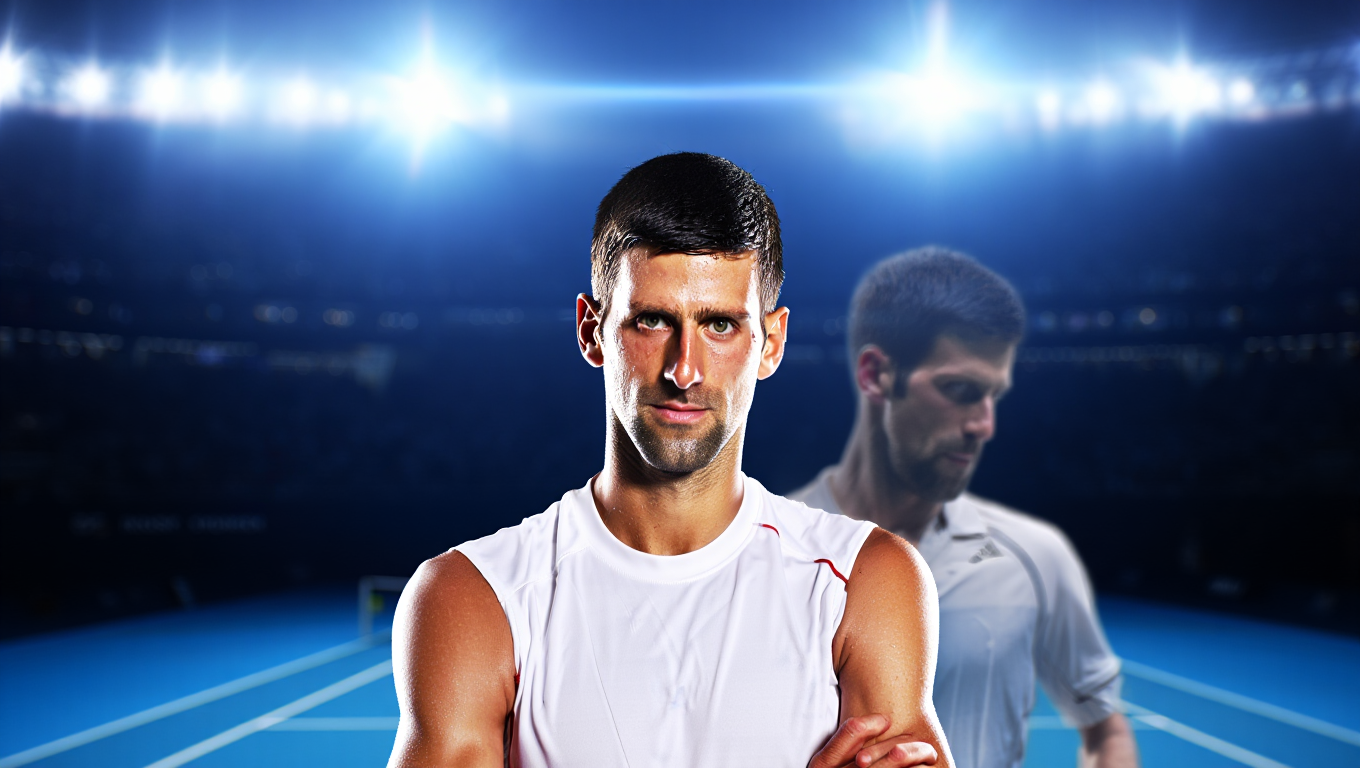
When Djokovic first stepped onto the Australian Open court, his future rivals were still in diapers… Now at 37, he’s battling players who weren’t even born when his legend began.
The year was 2005. A young Serbian player with fire in his eyes and dreams too big for his 17-year-old frame stepped onto the hallowed courts of Melbourne Park for the first time. His name was Novak Djokovic, and the Australian Open would become the stage where his legend would be written, rewritten, and immortalized.
That same year, somewhere in Italy, a three-year-old boy named Jannik Sinner was just learning to hold a tennis racket. In Spain, Carlos Alcaraz was barely one year old, still taking his first wobbly steps. They had no idea that the teenager competing in Melbourne would one day become the mountain they would have to climb.
Twenty-one years later, the story has come full circle in the most extraordinary way imaginable.
Now 37 years old, Djokovic stands on the same courts where it all began, but this time facing opponents who are young enough to be his children. The same player who once looked up at champions like Federer and Nadal now finds himself as the elder statesman, the living legend, facing a new generation hungry to dethrone him.
But what makes Djokovic truly exceptional isn’t just his longevity or his record-breaking Grand Slam titles. It’s the character he displays both on and off the court.
I’ve been watching tennis for decades. I’ve witnessed the rise and fall of countless champions. Some were gracious in victory and dignified in defeat. Others were arrogant, aggressive, and overbearing—players who let their egos overshadow their talent. I’ve seen players like Alcaraz, whose cockiness sometimes crosses the line from confidence into disrespect.
But Djokovic? He’s different.
Despite being arguably the greatest player to ever hold a racket, despite holding more Grand Slam titles than anyone in history, despite breaking nearly every record in the sport, Novak Djokovic carries himself with a humility that’s rare in the world of elite athletics.
Watch him after every match—win or lose. He gives respect to every opponent who steps onto the other side of the net. He acknowledges their effort, their skill, their humanity. I have never heard him badmouth another player, trash-talk an opponent, or publicly criticize controversial tennis officials, even when he had every right to do so.
And believe me, he’s had plenty of reasons.
Remember the 2020 US Open? Djokovic accidentally hit a line judge with a ball during a moment of frustration. It was clearly unintentional, a reflexive action that had unfortunate consequences. He was defaulted from the tournament—a harsh but technically correct decision according to the rules. Lesser players would have ranted, complained, blamed everyone but themselves. Djokovic? He accepted responsibility, apologized sincerely, and moved forward with grace.
He’s been penalized for minor, unintentional on-court mistakes that other players might have gotten away with. He’s faced officials who acted irrationally and erroneously, making decisions that cost him crucial points, games, even matches. And yet, he chose not to demonize them. He chose not to create drama or controversy. He simply played on, let his tennis do the talking, and maintained his dignity.
That’s the mark of true greatness—not just excellence in your craft, but excellence in your character.
As I watch him prepare for yet another Australian Open final, I’m struck by the sheer improbability of what we’re witnessing. This is a man who has been competing at the highest level for over two decades. A man who has won this tournament so many times that Melbourne Park might as well be his second home. A man who, by all conventional wisdom, should be retired by now, enjoying his wealth and legacy.
Instead, he’s still here. Still competing. Still winning. Still pushing himself to heights that defy age, logic, and the natural order of sports.
The young guns are coming for him—Sinner with his powerful baseline game, Alcaraz with his explosive athleticism. They represent the future of tennis, and that future is undeniably bright. But they’re learning what everyone who has faced Djokovic learns eventually: talent alone isn’t enough. Skill alone isn’t enough. You need mental fortitude, strategic brilliance, and an unbreakable will to win.
And nobody has those qualities in greater abundance than Novak Djokovic.
When I think about what makes him special, I think about the complete package he represents. Yes, his forehand is a weapon. Yes, his return of serve is the best the sport has ever seen. Yes, his defensive skills are superhuman. But what truly sets him apart is what you can’t measure with statistics.
It’s the respect he shows to ball boys and ball girls. It’s the way he learns a few words in every language of every country he visits. It’s the charitable work he does quietly, without fanfare. It’s the way he’s spoken out for lower-ranked players who struggle financially, using his platform to advocate for those without a voice.
It’s the way he’s remained humble despite achieving what no one else has achieved.
As this Australian Open unfolds, I find myself marveling at the poetry of it all. The tournament where his journey began might very well be where his most impressive chapters are still being written. While Sinner was learning to walk and Alcaraz was in his crib, Djokovic was already dreaming of these moments.
And now, all these years later, he’s making those dreams continue to come true.
Some people talk about his age as if it’s a weakness. They say he’s past his prime, that it’s time for him to step aside for the younger generation. But those people don’t understand what Djokovic has understood all along: greatness isn’t just about physical prowess. It’s about mental toughness, strategic intelligence, experience, and the ability to evolve.
Djokovic has evolved more than any player I’ve ever seen. He’s adapted his game, his training, his diet, his mental approach. He’s studied his opponents like a chess grandmaster. He’s turned his body into a finely tuned machine that defies the normal aging process. And most importantly, he’s maintained the hunger that drives all great champions.
That hunger is what separates the good from the great, the great from the legendary.
Watching him compete against Sinner and Alcaraz isn’t just a tennis match—it’s a masterclass in longevity, perseverance, and excellence. It’s a reminder that age is just a number when you have the right mindset. It’s proof that dedication and discipline can overcome what nature takes away.
But beyond all the accolades and records, what I admire most about Djokovic is the way he’s remained true to himself. In a sport often dominated by egos and controversies, he’s been a beacon of sportsmanship and class. He’s shown that you can be fiercely competitive without being cruel, that you can pursue greatness without sacrificing your humanity.
So as I watch him prepare for another final, another chance to add to his legacy, I’m filled with admiration and gratitude. Gratitude that we’ve been able to witness his career, to see history being made in real-time, to watch a master at work.
Novak, I wish you all the best. You’ve done this many times before, and I know you can do it again. Win or lose, you’ve already won in the ways that matter most. You’ve shown us what true greatness looks like—not just in talent and trophies, but in character and humility.
That is the greatness of Novak Djokovic.
And that greatness will endure long after the final point is played, long after the last trophy is lifted, long after the crowds have gone home. Because what he’s built isn’t just a legacy of victories—it’s a legacy of excellence, respect, and unwavering class.
Here’s to the kid who arrived in Melbourne at 17 with nothing but dreams, who stayed humble as those dreams came true, and who continues to inspire us all with every match he plays.
The courts where it all began are waiting. And so is history.