She was one point away from winning the championship when the ball girl collapsed… She dropped her racket and sprinted across the court, abandoning everything.
The stadium pulsed with 15,000 heartbeats, all synchronized to the rhythm of a match that had stretched past three hours. Championship point. The kind of moment athletes dream about in childhood bedrooms, holding hairbrushes like trophies.
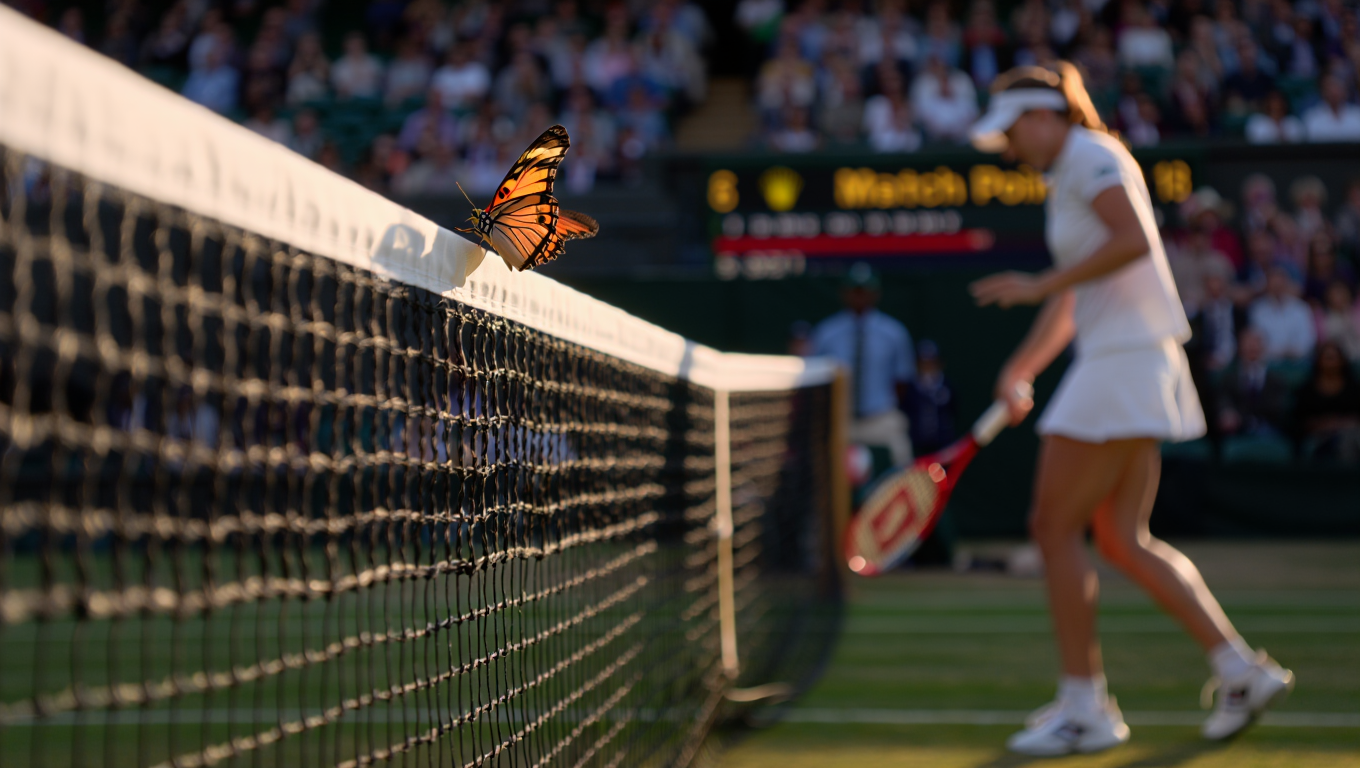
Maria Castellanos stood at the baseline, her pink kit darkened with sweat, her legs screaming with lactic acid. One more point. Just one. The scoreboard glowed: 7-6, 5-7, 6-5. Her serve. Her moment. Her destiny wrapped in bright yellow felt and traveling at 110 miles per hour.
The ball girl stationed near the umpire’s chair was seventeen. Her name was Sophie Chen, a local volunteer who’d dreamed of this assignment for months. She’d been standing in the relentless afternoon sun for nearly four hours, perfectly still, perfectly professional. Nobody noticed when her vision started swimming. Nobody saw when her fingertips went cold despite the 95-degree heat.
Maria bounced the ball once. Twice. She always bounced it three times.
On the third bounce, Sophie’s knees buckled.
The sound wasn’t dramatic—just a soft collapse, like fabric falling. But Maria saw it. Peripheral vision, the kind athletes develop after years of tracking balls traveling faster than thought. That flicker of movement that didn’t belong.
The ball left her hand on the toss.
And stayed there, suspended, as her brain made a calculation faster than any serve she’d ever hit.
Points or person. Trophy or truth. Champion or human.
The ball hit the court with a hollow bounce. The crowd gasped—confusion first, then concern as Maria was already moving. She dropped her racket mid-toss. Didn’t set it down. Dropped it. The clatter echoed through suddenly silent speakers.
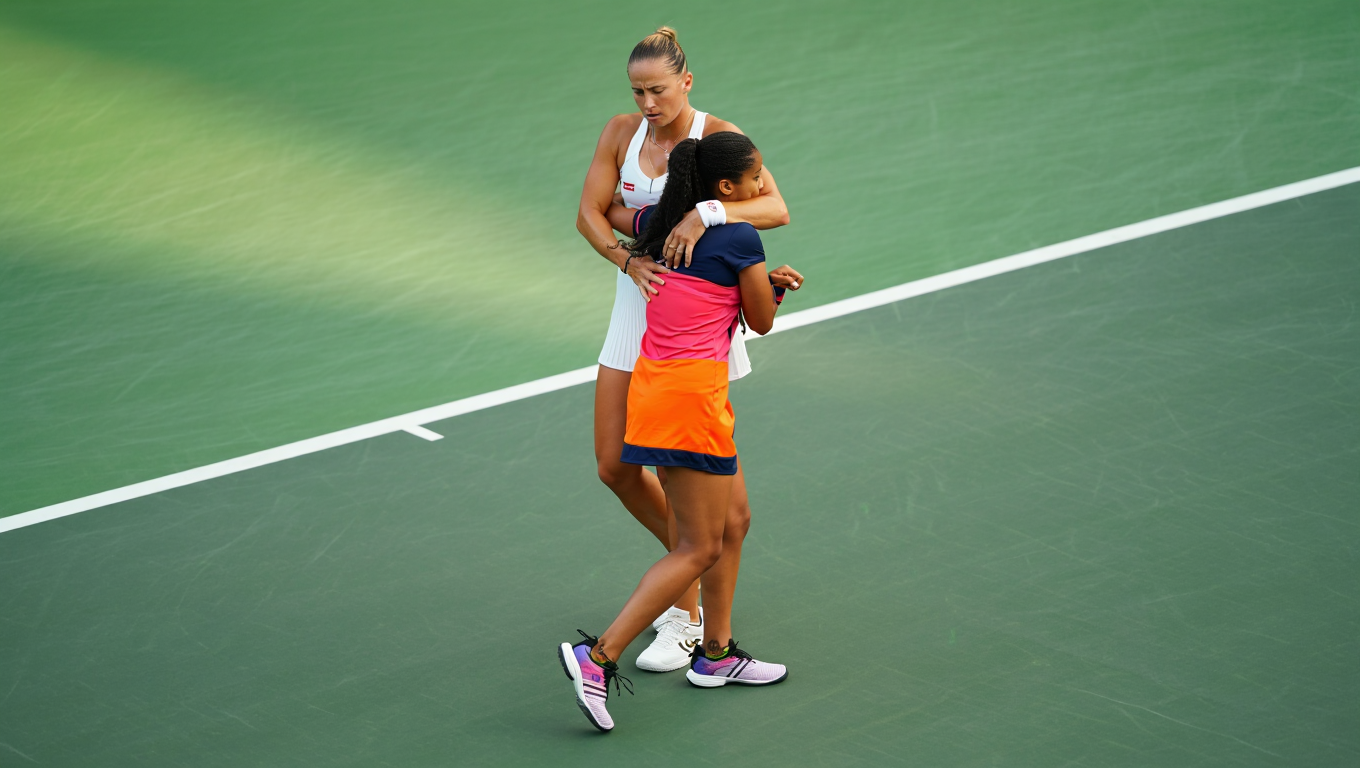
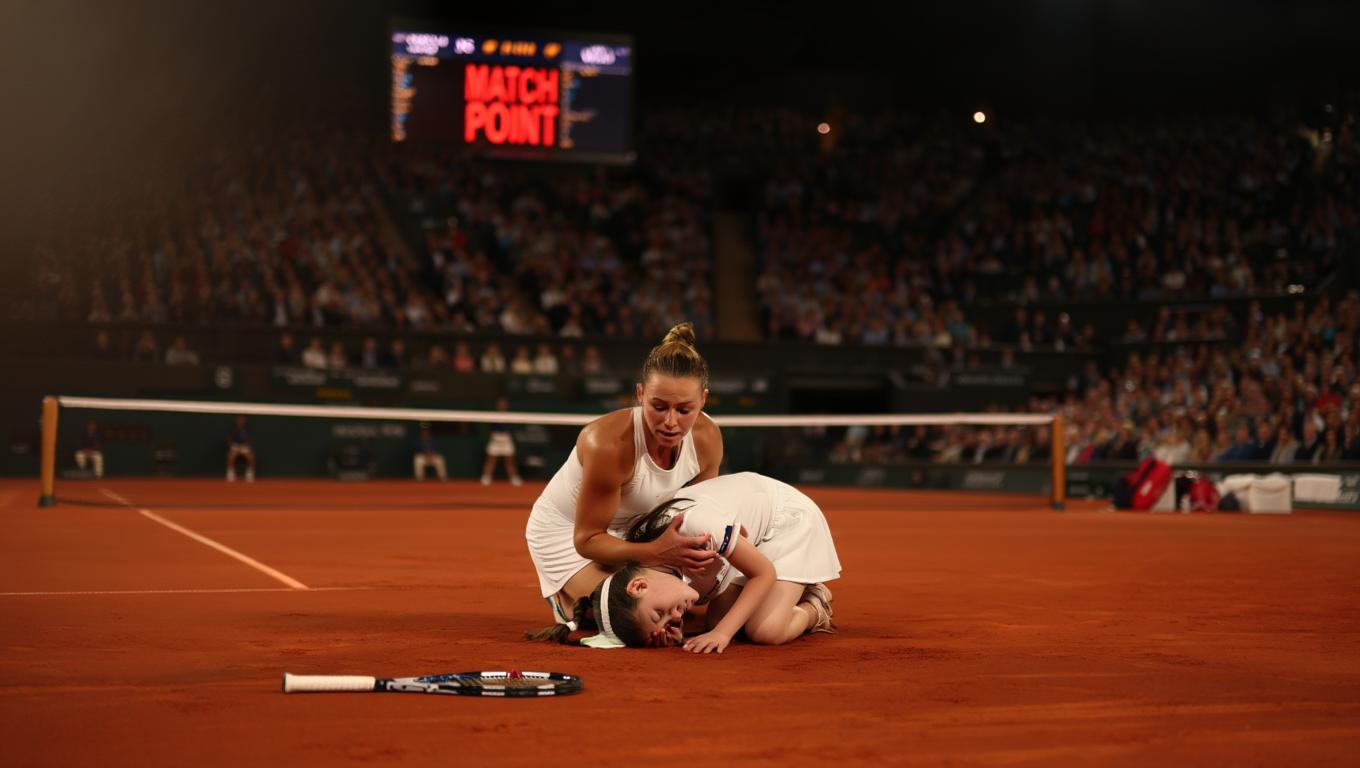
Her shoes squeaked against the blue surface as she sprinted, past the service line, past the net, past the umpire who was fumbling with his microphone. She slid to her knees beside Sophie like she was diving for a drop shot—muscle memory meeting moral imperative.
“Hey, hey, I’ve got you.” Maria’s voice was steady, years of pressure training kicking in. She positioned herself between Sophie and the sun, creating shade with her body. Her hand found the girl’s pulse—fast, thready, but there. “Don’t move. Help’s coming.”
Sophie’s eyes fluttered. “The match… I’m sorry… I ruined—”
“Shh. You didn’t ruin anything.” Maria’s thumb gently brushed the girl’s forehead. “Nothing is more important than you being okay. Nothing.”
The stadium had gone sepulchral. Fifteen thousand people holding their breath for a different reason now.
Maria’s opponent, Katarina Volkov, appeared on Maria’s side of the net, kneeling opposite her. Their rivalry had been fierce, tabloid-worthy, filled with on-court glares and press conference tension. But Katarina’s hand joined Maria’s, steadying Sophie’s shoulder.
“Medical is coming,” Katarina said quietly. “Dehydration?”
“I think so.” Maria looked up, saw the concern in her rival’s eyes, and something shifted. The invisible wall between them crumbled in an instant.
The medical team arrived within ninety seconds—though it felt like ninety years to Maria, whose entire body was still coiled with championship adrenaline that had nowhere to go. They had IV fluids, ice packs, and calm professional voices.
As they worked, Maria stayed exactly where she was. Kneeling. Waiting. Whispering reassurances to a teenager she’d never met and might never see again.
Sophie’s color started returning. Her breathing steadied. The lead medic gave a thumbs-up to the umpire, who’d been hovering uselessly with his headset.
“She’ll be fine,” the medic told Maria. “Dehydration and heat exhaustion. You probably saved her from something worse.”
Maria nodded, but didn’t move until Sophie was on the stretcher, until she saw the girl’s parents rushing down from the stands, until Sophie managed a weak smile and mouthed “thank you.”
Only then did Maria stand.
Her knees were scraped from the slide. Her hands were shaking—not from nerves, but from the crash of abandoned adrenaline. She walked back to the baseline like she was moving through water.
The umpire’s voice crackled over the speakers: “Time violation, Miss Castellanos. Warning.”
The crowd erupted—not in cheers, but in outrage on her behalf. How dare he? How dare he penalize humanity?
But Maria raised her hand, silencing them. She nodded to the umpire. Rules were rules. She’d made her choice. She’d make it again.
She picked up her racket. Looked across the net at Katarina, who was back in position, but whose eyes held something that looked like respect. Maybe even admiration.
“Ready?” the umpire asked.
Maria bounced the ball. Once. Twice. Three times.
The serve was perfect—123 miles per hour, painted on the outside corner. Unreturnable. The ball kicked up chalk dust like a small explosion.
“Game, set, match, Castellanos.”
But as the stadium exploded, as her team rushed the court, as champagne waited somewhere in a locker room, Maria looked first toward the tunnel where Sophie had been taken.
The trophy ceremony was a blur. Questions from reporters were deflected with grace. “The match doesn’t matter. What matters is that young woman is safe.”
But that night, in her hotel room, Maria’s phone wouldn’t stop buzzing. Not with congratulations. With something else.
The video had gone viral. Not the match point. The moment before. The dropped ball. The sprint. The kneel. The choice.
Thirty million views in six hours.
Comments in seventeen languages, all saying variations of the same thing: “This is what a champion looks like.”
A message came through from an unknown number: “Hi, this is Sophie. They’re releasing me tomorrow. I just wanted to say thank you. Not just for helping me. For showing me that there are things bigger than winning.”
Maria stared at those words for a long time.
She’d won championships before. She’d win more. Trophies gathered dust. Records got broken. Sponsors moved on.
But choosing to be human when the world was watching you be superhuman?
That was the kind of victory that didn’t fit in a case.
That was the kind of victory that changed what victory meant.
Three months later, Maria started a foundation: Athletes for First Aid, training sports professionals in emergency response. Sophie Chen was at the launch, healthy, smiling, wearing a pink shirt that matched the kit from that day.
When reporters asked Maria about her legacy, she didn’t mention her ranking or her titles.
She said: “I hope people remember that I dropped the ball. And I hope they understand why.”
Because in the end, the greatest serve of Maria Castellanos’s career wasn’t the one that won the championship.
It was the one she never hit.