A cop slapped a homeless veteran in front of everyone… But when a biker stepped forward and pulled out his old badge, the entire station went silent.
The fluorescent lights hummed in the police station lobby like a swarm of angry wasps. Henry stood at the front desk, clutching a frayed Army-issue blanket against his chest, his voice barely above a whisper.
“I just need my discharge papers back, Officer. They’re all I got left.”
The officer’s patience, already worn thin by a double shift and too much coffee, snapped like a dry twig. He leaned forward across the desk and slapped Henry hard across the face. The crack echoed through the room like a gunshot. Conversations died mid-sentence. Phones stopped ringing. Henry stumbled backward, hand flying to his reddening cheek, eyes filling with tears of humiliation and shock.
Across the lobby, a biker in worn leather and road dust froze mid-sentence at the counter. His jaw clenched so hard his teeth ached. The pen he’d been holding slipped from his fingers and clattered to the linoleum floor, rolling away unnoticed.
He didn’t run. He didn’t shout. He walked. Each boot strike deliberate, heavy, final—the sound of a man who’d made a choice and wouldn’t be turned away from it.
Officers at nearby desks shifted nervously in their chairs. Hands moved instinctively toward radios. The receptionist’s fingers hovered over the panic button. The entire room held its breath, waiting for violence, expecting chaos.
The biker stopped directly between the officer and Henry. He set his scratched helmet on the desk with a dull thud that somehow carried more weight than words.
“That’s enough.”
The officer scoffed, trying to reclaim authority through volume. “Step back. This doesn’t concern you, citizen.”
“It does when I see someone being hurt for no reason.” The biker’s voice was quiet, controlled, dangerous in its calmness.
Tension crackled through the air like electricity before a storm. Another officer stepped forward from the side, hand raised in what was meant to be a calming gesture. “Hey, easy now. Let’s all take a breath here.”
The officer who’d struck Henry straightened to his full height, hand drifting to his belt where his taser hung like a promise. “You threatening a police officer?”
“No,” the biker said quietly, eyes never leaving the man’s face. “I’m stopping you.”
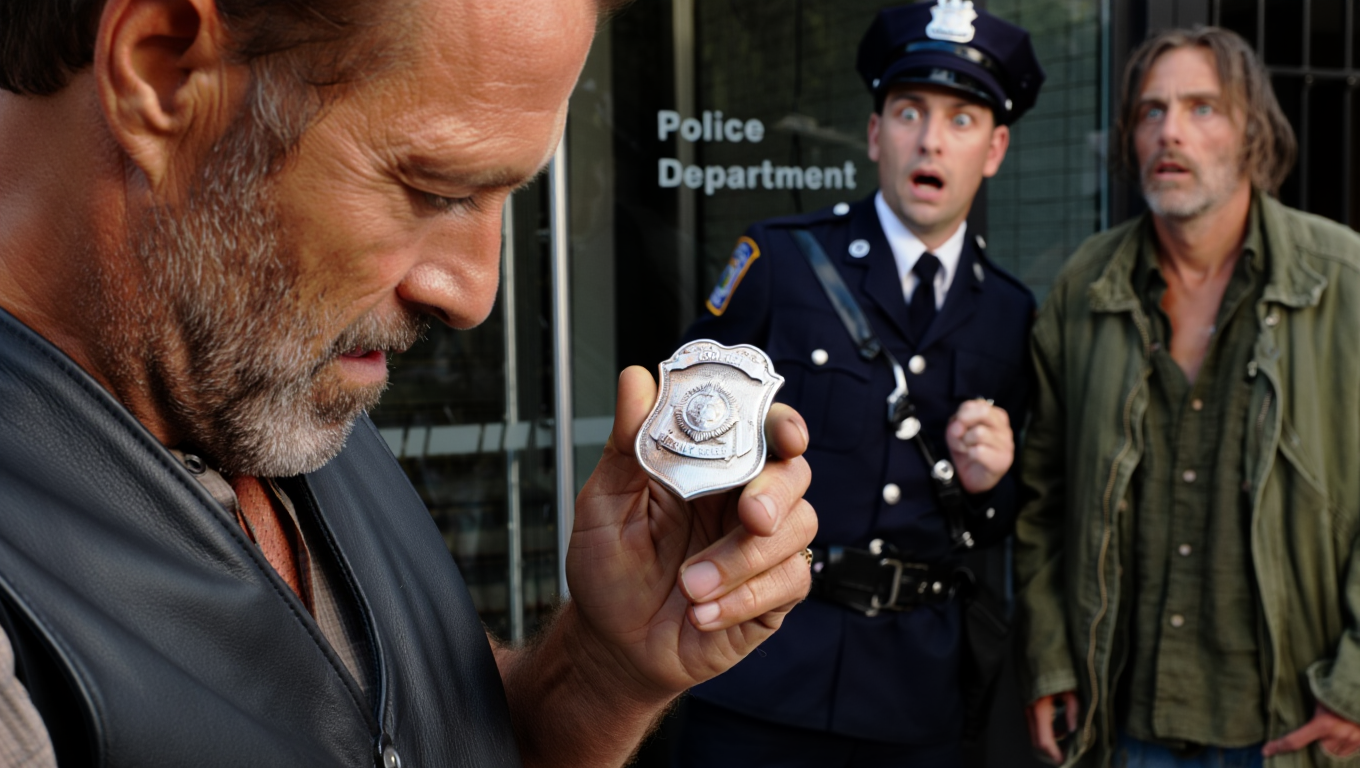
Several officers around the room stiffened, muscles tensing, as the biker reached slowly into his leather jacket. A collective intake of breath—then he pulled out folded papers, holding them up with steady hands for everyone to see.
“I used to stand where you’re standing,” he said, voice carrying across the silent lobby. “I know the power you carry. I know the weight of that badge. And I know what happens when you forget what it’s for.”
He unfolded the documents one by one, deliberately, like a prosecutor presenting evidence. A commendation letter with the department’s seal. An honorable discharge notice. A photograph—him, younger, clean-cut, in full police uniform, surrounded by fellow officers at a graduation ceremony, all of them smiling like they believed they could change the world.
Murmurs spread through the room like wildfire. Recognition dawned on a few faces—the older officers who’d been around long enough to remember. The cocky officer’s confidence cracked visibly, his face paling.
“That doesn’t mean anything now,” he muttered weakly, but his voice had lost its edge.
“It means everything,” the biker replied. “It means I know exactly what you just did. And what it cost him.”
The biker knelt beside Henry, and the room watched in stunned silence as this rough-looking man—all leather and scars and road miles—lowered himself to eye level with the homeless veteran. Not in dominance. Not in pity. In respect.
He pulled out a water bottle from his jacket and unscrewed the cap. “Here. Take a breath. You’re safe now.”
Henry’s hands trembled violently as he accepted it, drops splashing onto his threadbare jacket. “Thank you,” he whispered, meeting the biker’s eyes for the first time since the slap, finding in them something he’d almost forgotten existed—genuine human kindness.
The biker stood and faced the room, addressing not just the officers but everyone there—the civilians, the complainants, the witnesses who’d pretend they hadn’t seen if no one held them accountable.
“His name is Henry,” he said clearly. “He served this country. Two tours in Afghanistan. Came home different—nightmares that won’t stop, panic attacks in crowds, nowhere safe to land.” He paused, letting the words sink in. “He didn’t lose his worth when he lost his address. He didn’t stop being human when he couldn’t afford rent.”
A senior sergeant emerged from the back offices, drawn by the commotion. He stepped forward, examining the documents the biker had laid out on the desk. His jaw tightened as he read, recognition and something like shame crossing his weathered features.
The officer who’d struck Henry tried to interrupt, voice desperate now. “Sarge, this guy was causing a disturbance, refusing to leave—”
“Enough,” the sergeant snapped, not even looking at him.
The biker continued, his voice steady but carrying the weight of lived experience. “This uniform doesn’t give us permission to humiliate people. It doesn’t make us better than anyone. It gives us responsibility. To protect. To serve. To see the humanity in everyone we encounter. Every single one of you knows that. You took an oath.”
Phone cameras clicked on around the lobby. Modern accountability. The truth hung in the air, undeniable, witnessed, recorded.
Henry wiped his eyes with the back of his hand, shoulders shaking. The biker’s hand settled on his shoulder, steady and sure, an anchor in a storm.
The sergeant exhaled slowly, years of experience and hard lessons compressed into that single breath. He looked from the biker to Henry, then to the officer who’d thrown the slap, and his expression hardened into something carved from granite.
“Officer Daniels, step aside from the desk.”
The words landed like a gavel ending a trial.
“What? Sir, with all due respect—”
“Now.”
Color drained from Officer Daniels’ face like water from a sink. Under dozens of watchful eyes, civilian and fellow officer alike, he moved away from the desk, his hands shaking slightly.
The sergeant turned to another officer, a younger woman who’d been watching with barely concealed horror. “Rodriguez, call Internal Affairs. Get them down here immediately. And get medical to check on Mr. Henry.”
A gasp rippled through the lobby. Accountability. Public. Witnessed. Undeniable. Real.
The biker helped Henry to his feet, one arm supporting him as he swayed slightly. “You’re okay now. You’re not alone anymore. I promise you that.”
Henry nodded, clutching the water bottle like a lifeline, like proof that this was actually happening. “Didn’t think anyone would care,” he admitted, voice breaking. “Haven’t mattered to nobody in so long.”
“I do,” the biker said simply. “And I know people who can help. Real help. Not promises—actual help.”
The sergeant approached them, extending his hand to the biker. After a pause, measuring the man’s sincerity, the biker shook it firmly.
“For what it’s worth,” the sergeant said quietly, meant only for the biker’s ears but carrying in the silent room, “you did the right thing today. Reminded us what we’re supposed to be.”
“So can you,” the biker replied, holding his gaze. “So can every officer here. It’s not too late.”
Together, the biker and Henry walked toward the exit. Officers stood silent along their path, forced to sit with what they’d witnessed, with their own complicity in a culture that had allowed this to happen. Some looked ashamed. Others angry. A few looked thoughtful, like maybe something had shifted.
Outside, late afternoon sunlight warmed Henry’s face for the first time in weeks—really felt it, really registered warmth and light and the possibility of something better. The biker made three calls right there on the sidewalk, pacing while Henry sat on a bench, still clutching that water bottle.
First call: a veterans’ shelter run by a former Marine. Second: a legal aid office that specialized in VA benefits. Third: a buddy from his police days who now ran a halfway house with a heart for second chances.
“Got a spot opening next week,” the voice on the phone said. “Can he wait that long? Place to stay until then?”
The biker looked at Henry, who was sitting straighter now, hope replacing shame in his eyes for the first time in months. The sunset caught his face, and for just a moment, you could see the soldier he’d been—the man who’d believed in something bigger than himself.
“He’s waited long enough,” the biker said firmly. “I’ll cover a motel room until then. The clean one on Fifth, where Jake works the desk. He’s good people.”
Henry’s eyes welled up, tears cutting clean tracks through the grime on his face. “You don’t have to do this. You don’t even know me.”
“I know enough,” the biker said, clipping his phone to his belt. “And even if I didn’t—you deserve dignity. You deserve help. That’s not something you have to earn. It’s something you get for being human.”
Inside the station, Officer Daniels sat in an interrogation room, the same kind he’d used to break suspects, his badge and gun already surrendered and sealed in evidence bags. The cameras in the lobby hadn’t stopped recording. The witnesses hadn’t stopped talking. Word was already spreading through the department’s internal channels, the video already shared in group chats, impossible to contain or spin.
By evening, the story had spread through three precincts. By morning, it had reached the local news. Henry had a bed in the veterans’ shelter, three hot meals waiting, and an appointment with the VA scheduled for Tuesday. Officer Daniels faced immediate suspension pending a formal investigation, with termination looking increasingly inevitable.
The biker never asked for recognition. Refused interview requests. Turned down the news crews that found him at his garage two days later. He’d simply done what the badge had once taught him, what he’d believed in before the job had worn him down and he’d walked away—protect those who couldn’t protect themselves. Serve with honor. See people, really see them.
Henry stood in the doorway of his temporary room that first night, clean clothes folded on the bed like a promise, walls around him for the first time in eight months. He pressed his palm to the window, watching traffic lights change in the distance, the rhythm of a world that had a place for him again.
He wasn’t invisible anymore. Someone had seen him. Someone had cared enough to stand between him and cruelty. Someone had reminded him that he still mattered.
And Officer Daniels? He learned the hardest lesson of all—power without compassion isn’t strength. Authority without empathy isn’t justice. It’s just cruelty with a uniform, violence with a badge, abuse with the law’s permission. And eventually, inevitably, it costs you everything.
Three weeks later, Henry got his first paycheck from a construction job the biker had helped him find. He bought a phone card and called the number written on a piece of paper he’d kept in his pocket every day since that afternoon in the station.
“Wanted you to know,” Henry said when the biker answered. “I got the job. Start permanent next week. Got a room in a boarding house. It’s small, but it’s mine.”
There was a pause on the other end, then: “I’m proud of you, Henry. You did this. You fought your way back.”
“Couldn’t have without you stepping up that day.”
“Maybe,” the biker said. “But you’re the one who kept going. That’s all you, brother.”
Justice had been served, witnessed by everyone in that lobby and thousands more who’d seen the video online. The slap had consequences. The defense had results. And Henry finally had something he’d lost years ago, something more valuable than money or housing or even safety.
He had hope.
And in a world that had tried so hard to convince him he was worthless, hope was everything.