A Black female detective was pulled over on her way to work… The officer demanded her ID until she revealed her badge.
Detective Maya Richardson had been on the force for twelve years. Twelve years of proving herself, of working twice as hard, of earning the respect of her colleagues one case at a time. But on that gray Tuesday morning, as rain drummed against her windshield, none of it seemed to matter.
The red and blue lights flashed in her rearview mirror at 7:43 AM. She was three blocks from the precinct, dressed in her pressed green suit—the one she’d bought to celebrate her promotion to Homicide. Her badge sat in her purse on the passenger seat, her service weapon secured in its holster beneath her blazer.
She pulled over, hands already moving to the steering wheel at ten and two, a habit born not from the academy but from a lifetime of knowing that survival sometimes meant making yourself as non-threatening as possible.
Officer Marcus Chen approached her window, young and eager, his hand resting near his weapon. “License and registration.”
“Good morning, Officer,” Maya said carefully, her voice steady despite the tightness in her chest. “May I ask what I’m being stopped for?”
“Your taillight is out. License and registration, please.”
Maya’s taillight wasn’t out. She’d checked it yesterday, the same way she checked it every day, because she knew. She’d always known.
“I’m going to reach for my purse,” she said slowly, watching his hand tense. “My license is inside.”
As she retrieved her wallet, something inside her cracked. Twelve years. Twelve years of running toward danger while others ran away. Twelve years of closing cases, of bringing justice to victims, of standing shoulder to shoulder with officers just like this one. And here she was, being treated like a suspect on a Tuesday morning three blocks from home.
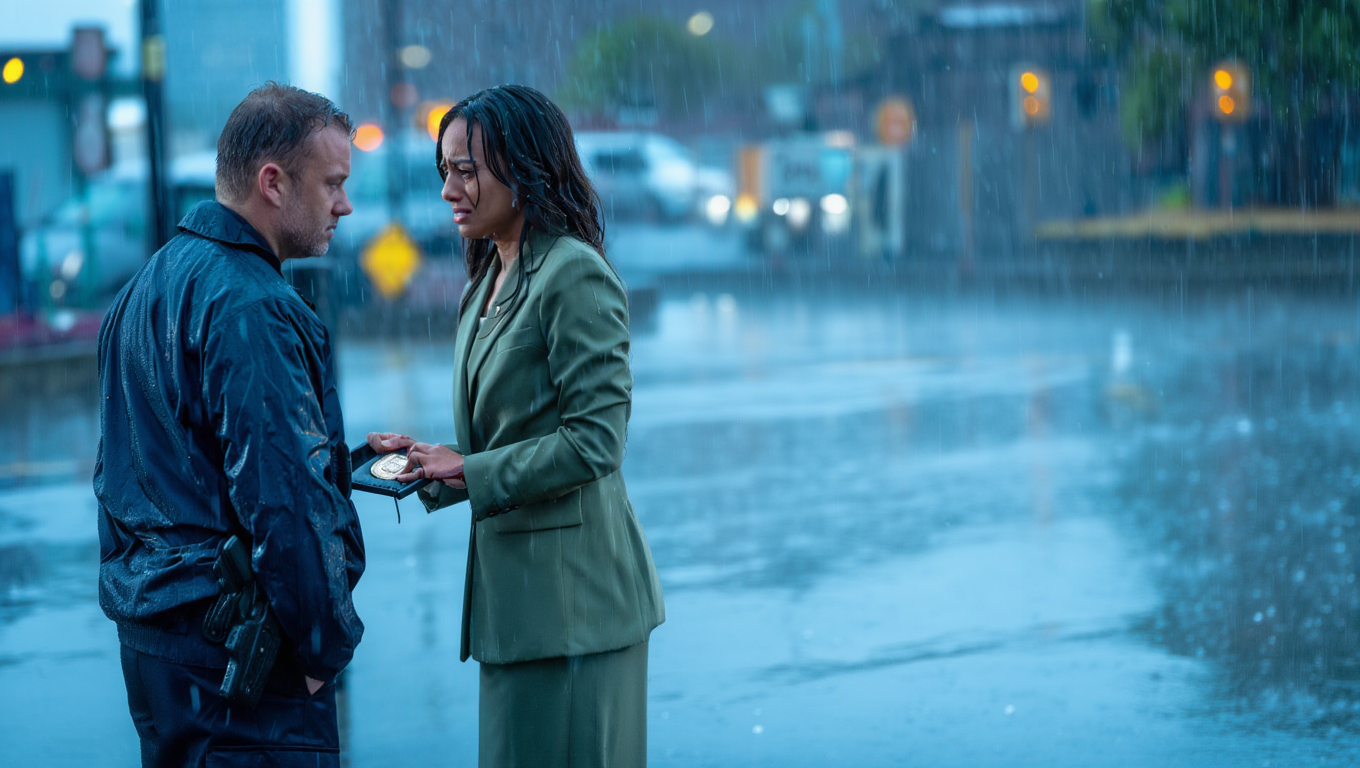
Her hands shook as she pulled out her detective’s badge instead of her license.
The gold shield caught the gray morning light, rain-speckled and official. Officer Chen’s face transformed—shock, then recognition, then something worse: shame.
“Detective, I—”
But Maya couldn’t hear his apology through the roaring in her ears. Tears she’d held back for twelve years suddenly burned hot down her cheeks. Not tears of anger, though anger was there, simmering beneath everything else. These were tears of exhaustion, of betrayal, of the soul-deep weariness that comes from fighting a battle that never ends.
“I was on my way to work,” she said, her voice breaking. “To the same precinct where you probably trained. To the same building where I’ve given twelve years of my life.”
Chen stepped back, his own eyes glistening. “Ma’am, I’m so sorry. I didn’t—”
“Didn’t what?” Maya’s hands trembled around the badge. “Didn’t think a Black woman in a nice car at 7 AM could be a detective? Didn’t consider that maybe I was one of you?”
The silence stretched between them, broken only by the rain and the occasional swish of passing cars. Maya could see her reflection in the side mirror—mascara running, the careful professional mask she wore every day completely shattered.
She thought of her daughter, Zara, only eight years old, who wanted to be just like Mommy when she grew up. She thought of the conversations she’d have to have, the warnings she’d have to give, the fear she’d have to instill to keep her child safe. She thought of the young girls in the community programs she volunteered for, the ones who looked at her badge with hope in their eyes, believing that the system could work for them too.
And she thought of every time she’d defended the badge, every time she’d stood up in community meetings and said, “We’re not all like that. We’re trying to change things from the inside.”
“Do you know what this feels like?” Maya asked, her voice barely above a whisper. “To dedicate your life to protecting people, only to realize that in their eyes—in your eyes—I’m still just a threat? Still just someone who doesn’t belong in this neighborhood, in this car, in this uniform?”
Officer Chen looked down at his boots, water pooling around them. “No, ma’am. I don’t.”
Maya wiped her eyes with the back of her hand, smearing her carefully applied makeup. “My taillight isn’t out.”
“I know,” he admitted quietly.
The words hung in the air between them, a confession that carried the weight of every pretextual stop, every “routine” check, every time someone who looked like Maya had been pulled over for the crime of existing in the wrong place at the wrong time.
Maya took a shaky breath and put her badge back in her purse. Her hands were still trembling, but she forced them to steady. She’d learned how to compartmentalize, how to lock away the hurt and keep moving. It was a survival skill, perfected over years of microaggressions, of being passed over for promotions, of having to prove herself again and again.
“I’m going to drive away now,” she said, her voice hollow. “And you’re going to go back to your patrol car. And tomorrow, we might end up working the same crime scene, backing each other up, trusting each other with our lives. Because that’s what the job requires.”
“Detective Richardson—”
She held up a hand. “But let me tell you something, Officer Chen. Every time you put on that uniform, you carry the weight of every interaction like this one. Every time you approach a car, you’re not just representing yourself—you’re representing every officer who came before you, every policy, every history, every scar this community carries. And right now, looking at you, I see a young cop who made a choice. The question is, what choice will you make tomorrow? And the day after that?”
She didn’t wait for his answer. She rolled up her window and pulled back into traffic, her hands white-knuckled on the steering wheel.
When Maya walked into the precinct fifteen minutes later, she went straight to the bathroom. She locked herself in a stall and let herself break down completely, shoulders shaking with silent sobs. The tears came in waves—for herself, for every person of color who’d ever been stopped, searched, and suspected, for her daughter, for the dream of what the badge was supposed to represent versus the reality of what it often meant.
After ten minutes, she stood up, washed her face, and reapplied her makeup. In the mirror, she saw a woman who’d been worn down but not broken, bent but not defeated. She straightened her green suit jacket, touched the badge clipped to her belt, and walked out.
Her partner, Detective James O’Brien, looked up as she approached their desks. A white man in his fifties, Jim had been on the force for thirty years. He took one look at her face and his expression shifted.
“What happened?”
Maya sat down heavily in her chair, the vinyl squeaking beneath her. “Got pulled over three blocks away. Taillight that wasn’t actually out.”
Jim’s jaw tightened. He didn’t need her to explain further. They’d worked together for seven years—long enough for him to understand what that meant, long enough for him to have witnessed the casual racism that Maya navigated every day.
“Did you report it?”
Maya laughed, a bitter sound. “Report it to who, Jim? To Captain Morrison, who’ll say it was just a misunderstanding? To Internal Affairs, who’ll bury it in paperwork and make my life hell? To the union, who’ll close ranks and protect their own?”
“I’ll go with you,” Jim offered. “I’ll corroborate—”
“You weren’t there.” Maya pulled out the case file they’d been working on—a homicide in the Riverside district, a young woman found in an alley. “And I have work to do. People depending on me to find justice for them. That doesn’t stop because I’m tired.”
But it did stop, at least for that morning. Maya stared at the case file, the words blurring together. She couldn’t concentrate, couldn’t focus, couldn’t summon the analytical precision that made her good at her job.
Around noon, Captain Sarah Morrison called her into the office. A Black woman in her late fifties, Morrison had climbed the ranks through decades of persistence and excellence. She’d been Maya’s mentor, her advocate, the one who’d pushed for her promotion.
“Heard about this morning,” Morrison said without preamble.
Maya shouldn’t have been surprised. News traveled fast in a precinct, especially when it involved one of their own.
“It’s fine,” Maya said automatically.
“It’s not fine.” Morrison leaned back in her chair, studying Maya with sharp, knowing eyes. “And you don’t have to pretend it is. Not with me.”
The kindness in her voice nearly undid Maya’s carefully reconstructed composure. “What do you want me to say, Captain? That I’m furious? That I’m hurt? That after twelve years, I still feel like I’m on the outside looking in?”
“I want you to say what you need to say. And then I want you to take the rest of the day off.”
“I can’t—”
“That’s an order, Detective.” Morrison’s voice softened. “You think you’re the only one who’s been through this? You think I don’t know what it feels like to wear this badge while carrying the weight of every assumption, every stereotype, every time someone looks at you and sees a threat instead of a protector?”
Maya’s eyes burned again. “How do you do it? How do you keep showing up?”
Morrison was quiet for a long moment. “Because if we don’t, who will? If we don’t stay and fight to change this system from the inside, who’s going to protect our communities? Who’s going to stand up for the next girl who wants to believe that justice applies to her too?”
“I’m so tired,” Maya whispered.
“I know. God, I know.” Morrison stood and walked around her desk, placing a hand on Maya’s shoulder. “But you don’t have to carry this alone. That’s what I’m here for. That’s what Jim’s here for. That’s what this badge is supposed to mean—that we look out for each other.”
Maya nodded, not trusting herself to speak.
“Go home,” Morrison said gently. “Hug your daughter. Cry if you need to. Scream if you want to. And tomorrow, if you’re ready, come back and we’ll keep fighting. Together.”
Maya drove home through streets that suddenly felt unfamiliar, hyperaware of every police car, every patrol, every potential interaction that could go wrong. She thought about Officer Chen, probably writing up his report, probably feeling guilty. She wondered if that guilt would translate into change or if it would just fade into the background noise of his career.
When she pulled into her driveway, Zara was playing in the front yard with her grandmother, Maya’s mother Ruth. The little girl’s face lit up when she saw her mother home early.
“Mommy! You’re home!”
Maya caught her daughter in a fierce hug, breathing in the scent of her strawberry shampoo and childhood innocence. Over Zara’s shoulder, she met her mother’s eyes and saw understanding there—Ruth had raised Maya in a different era, but the fears had been the same.
That night, after Zara was asleep, Maya sat on her back porch with a cup of tea growing cold in her hands. Her phone buzzed—a text from Jim checking in, another from Morrison with resources for counseling, a voicemail from the union representative she hadn’t called back.
And at the bottom, a message from an unknown number: “Detective Richardson, this is Officer Chen. I know an apology isn’t enough, but I wanted you to know that I’ve requested additional training on implicit bias and community policing. What happened today was wrong, and I’m going to do better. You deserve better.”
Maya stared at the message for a long time. It didn’t erase the hurt, didn’t undo the damage, didn’t solve the systemic issues that had led to that moment on a rainy street. But it was something. A small crack in the wall, a tiny step toward change.
She thought about her response for several minutes before typing: “Thank you for the message. The real test isn’t what you say today—it’s what you do tomorrow and every day after. We’re all watching.”
As she hit send, Maya realized that she’d made a choice too. She could have walked away from the badge, could have let this morning be the final straw. But instead, she was choosing to stay, to fight, to believe that change was possible even when every part of her was exhausted.
She thought of Captain Morrison’s words: “If we don’t, who will?”
The next morning, Maya put on her green suit again, pinned her badge to her belt, and drove to work. Her hands didn’t shake. When she saw Officer Chen at a coffee shop near the precinct, he nodded respectfully, and she nodded back. It wasn’t forgiveness—not yet, maybe not ever. But it was acknowledgment. It was a beginning.
At her desk, Jim had left a note: “I see you. I’ve got your back. Always.”
Maya picked up the case file for their homicide investigation. A young Black woman named Tasha Williams, found in an alley, her family waiting for answers, for justice, for someone to care enough to find the truth.
This was why she stayed. Not for the officers who couldn’t see her humanity, not for the system that was broken, but for Tasha, for Zara, for every person who needed someone to stand between them and danger, who needed to believe that justice was more than just a word.
Maya opened the file and got to work. The rain had stopped, and weak sunlight filtered through the precinct windows. She was tired, hurt, and angry. But she was also still here, still fighting, still believing that the badge could mean something better.
And maybe, one day at a time, one choice at a time, one Officer Chen at a time, it would.