A manager destroyed a homeless man’s pizza in front of everyone… But when he stood up and removed his rags, her face went white.
It was supposed to be just another Tuesday shift at Marino’s Pizzeria.
Sarah had been working there for three years, saving every tip to pay for her nursing degree. At 23, she’d seen enough of life to know that kindness costs nothing, even when you have nothing to give.
That’s why when the elderly homeless man shuffled through the door that afternoon, trembling and clutching a small handful of crumpled bills, she didn’t hesitate.
“Please,” he whispered, his voice raw from the cold. “Just… just a slice. Anything.”
The other customers turned away. Some wrinkled their noses. One mother pulled her child closer, as if poverty were contagious.
But Sarah saw something different. She saw her own grandfather, who’d lived on the streets for two years after the factory closed. She saw dignity buried beneath dirt and desperation.
“Sit down, sir,” she said gently, guiding him to a corner booth. “I’ll bring you something hot.”
She didn’t bring him a slice. She brought him a whole pepperoni pizza, fresh from the oven, cheese still bubbling. She used her own money to pay for it, money she’d been saving for textbooks.
The man’s eyes filled with tears. He clasped his weathered hands together and bowed his head in prayer, his lips moving silently. Sarah felt her own throat tighten.
That’s when Margaret stormed out from the back office.
Margaret Chen had been the restaurant manager for five years, and in that time, she’d perfected the art of cruelty disguised as professionalism. She ran Marino’s like a military operation—no waste, no charity, no exceptions.
“What the hell is this?” Margaret’s voice cut through the quiet restaurant like a knife.
Sarah turned, her heart sinking. “Margaret, I—”
“You’re giving away food? To… to him?” Margaret’s face twisted with disgust as she glared at the homeless man, who’d frozen mid-prayer. “Do you have any idea what this does to our image? We’re not a soup kitchen!”
“I paid for it myself,” Sarah said quietly, trying to keep her voice steady. “With my own money.”
“I don’t care if you mortgaged your house for it!” Margaret snapped. She marched over to the table, her black heels clicking sharply against the tile floor. “This is a respectable establishment. We don’t serve people who look like they just crawled out of a dumpster.”
Before Sarah could react, Margaret grabbed the pizza with both hands and yanked it off the table. The homeless man flinched, pulling his hands back as if he’d been struck.
“Margaret, please—” Sarah reached out, but it was too late.
Margaret threw the pizza onto the floor. It landed with a wet slap, cheese and pepperoni scattering across the tiles. Then, deliberately, she lifted her foot and stomped on it with her heel, grinding it into the ground.
The restaurant went silent. Even the kitchen staff had stopped working, frozen in the doorway.
Sarah’s eyes burned with tears. “How could you—”
“How could I?” Margaret whirled on her. “How could you think it was okay to bring this… this vagrant into my restaurant? You’re fired. Get your things and get out.”
The homeless man stood slowly, his entire body shaking. Sarah moved toward him, wanting to apologize, wanting to help, but he held up one trembling hand.
“It’s okay,” he said, his voice suddenly stronger, clearer. “It’s okay, Sarah. You showed me exactly what I needed to see.”
And then, in one fluid motion, he reached up and peeled away what everyone now realized was a incredibly realistic mask and wig. Beneath the makeup and prosthetics stood a man in his early fifties, with sharp eyes and silver hair.
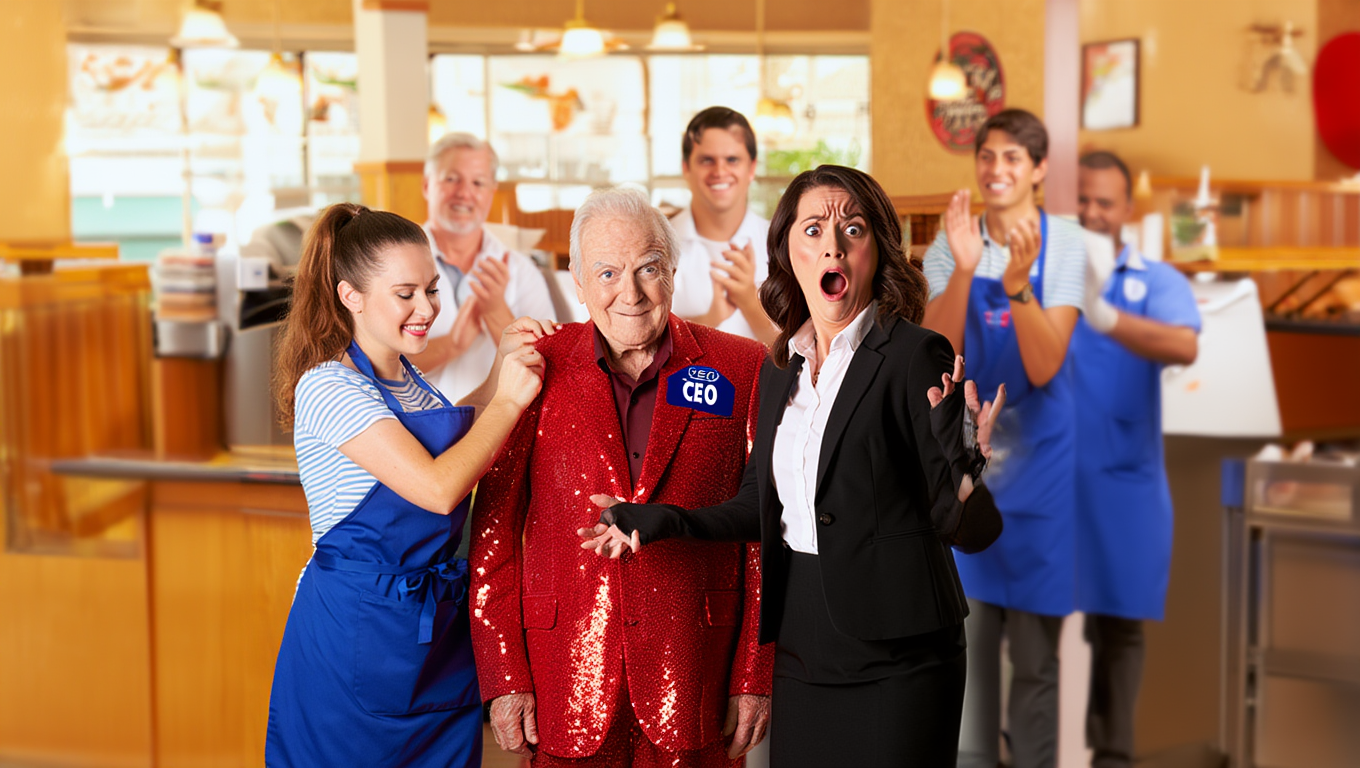
He shrugged off the tattered coat. Underneath, he wore a brilliant red sequined suit that caught the light like fire. On his lapel was a name tag: RICHARD MARINO – CEO, MARINO’S RESTAURANT GROUP.
Margaret’s face drained of all color. Her mouth opened and closed, but no sound came out.
“My grandfather started this restaurant sixty years ago,” Richard said, his voice filling the room. “He came to this country with nothing. He knew what it meant to be hungry, to be invisible, to be treated like you didn’t matter.”
He looked around the restaurant—at the staff huddled in the kitchen doorway, at the customers who’d turned away from a suffering human being, at the pizza ground into the floor.
“When he died, he made me promise something. He made me promise that no one would ever leave one of our restaurants hungry. That we would treat every single person who walked through our doors with dignity and respect.” He turned to Margaret, who’d begun to shake. “You just violated everything this company stands for.”
“Mr. Marino, I—I didn’t know—” Margaret stammered.
“You didn’t know it was me,” Richard said coldly. “But you knew it was a human being. A person who was hungry and cold and desperate. And your response was to humiliate him. To destroy his food. To crush whatever dignity he had left.”
He unpinned the manager’s badge from Margaret’s jacket. She didn’t resist, standing frozen in shock and horror.
Then Richard turned to Sarah, who was crying openly now, overwhelmed by everything that had just happened.
“Sarah,” he said gently, and his voice was kind now, the way it had been when he’d first shuffled through the door. “I’ve been watching the reports from this location for months. Complaints about management. High turnover. Staff afraid to speak up. So I decided to see for myself.”
He held out Margaret’s badge. “I visited five of our locations today. You’re the only person who treated me like a human being. The only one who saw past the costume to the person underneath.”
Sarah took the badge with trembling hands. “Sir, I… I don’t understand.”
“You’re the new manager,” Richard said. “Effective immediately. And your first task is to implement a new policy: every night, any unsold food goes to the local shelters. No exceptions. If my grandfather could feed people when he had almost nothing, we can do it when we have everything.”
The kitchen staff began to applaud. Slowly, some of the customers joined in. Sarah looked down at the badge in her hands, then up at Richard, then over at Margaret, who stood paralyzed, her entire world crumbling around her.
“As for you,” Richard said to Margaret, “you’re terminated. Security will escort you out and you’ll receive your final paycheck by mail. I’m also filing a formal complaint with the labor board about your treatment of staff. Several employees have already come forward with evidence of workplace harassment.”
Margaret’s face crumpled. “Please, Mr. Marino, I have a mortgage, I have—”
“You have consequences,” Richard said flatly. “Same as everyone else. You should have thought about that before you decided cruelty was an acceptable management strategy.”
Security arrived—they’d been waiting outside, part of Richard’s planned reveal—and escorted Margaret out. She left in tears, her career and reputation in ruins.
After she was gone, Richard addressed the entire restaurant.
“I know some of you turned away when you saw a homeless man walk in. I know some of you judged him, feared him, wanted him gone. I’m not here to shame you for that—we’re all products of a society that teaches us to look away from suffering. But I am here to challenge you to do better. To see people. To recognize that any one of us could be one missed paycheck, one medical emergency, one tragedy away from being in his shoes.”
He looked at Sarah, who was still clutching the manager’s badge, tears streaming down her face.
“And I’m here to tell you that people like Sarah—people who choose kindness even when it costs them something, even when no one’s watching, even when they have every reason not to—those are the people who change the world. Those are the people I want representing my company.”
The applause grew louder. Sarah couldn’t stop crying, overwhelmed by the sudden reversal of fortune, by the validation of every kind choice she’d ever made.
Richard pulled out his phone and made a call. “Yes, it’s me. I need you to process an immediate salary adjustment for Sarah Martinez. New manager rate, plus a $10,000 signing bonus. And set up a meeting with our scholarship committee—she’s going to nursing school, and we’re going to help her get there.”
Sarah’s legs nearly gave out. “Mr. Marino, I don’t know what to say…”
“Say you’ll help me build the kind of company my grandfather dreamed of,” Richard said. “Say you’ll treat every person who walks through these doors the way you treated me today. Say you’ll hire people who value kindness over profit, dignity over efficiency.”
“I will,” Sarah whispered. “I promise I will.”
Richard nodded, satisfied. Then he looked down at the destroyed pizza on the floor, cheese and pepperoni ground into the tiles.
“Now,” he said with a slight smile, “I believe I was promised a hot meal. And I’m still hungry. Think we could get another one of those pizzas?”
Sarah laughed through her tears and practically ran to the kitchen, calling out the order. The staff, energized by what they’d witnessed, jumped into action.
As Richard sat down in the same booth where he’d prayed over his first pizza, he pulled out a small photograph from his pocket. It showed a young man in an old-fashioned suit, standing in front of the original Marino’s Pizzeria in 1965. His grandfather, on opening day, wearing the same expression of hope and determination that Richard now saw in Sarah’s eyes.
“We’re still keeping the promise, Papa,” Richard whispered to the photograph. “We’re still feeding people. We’re still choosing kindness.”
Sarah brought him a fresh pizza, this one even bigger than the first. She’d added extra toppings, including the specialty ingredients usually reserved for the premium menu.
“On the house,” she said with a smile. “Manager’s privilege.”
Richard laughed—a real laugh, warm and genuine. “Then I guess I better enjoy it while I can. Something tells me you’re going to run this place so well that I’ll be completely unnecessary.”
As Sarah returned to work, already mentally restructuring the staff schedule and planning new training protocols focused on compassion and customer dignity, Richard took his first bite of pizza.
It tasted like victory. Like justice. Like the vindication of every person who’d ever chosen to be kind when cruelty would have been easier.
Outside, Margaret sat in her car, crying into her steering wheel, her career in shambles. She’d learned a brutal lesson: that how you treat people when you think no one important is watching reveals exactly who you are.
And inside Marino’s Pizzeria, a new era began—one built on the radical notion that every person deserves to be fed, to be seen, to be treated with basic human dignity.
Sarah pinned her new manager’s badge to her apron, wiped away the last of her tears, and got back to work. She had a restaurant to run, policies to change, and a promise to keep.
The pizza on the floor was eventually cleaned up, but its lesson remained: Kindness costs nothing, but its value is immeasurable. And cruelty, no matter how small it seems in the moment, always comes with a price.