A tennis star collapsed mid-match at a major tournament… But what her opponent did next left the entire stadium in tears.
The Australian Open quarterfinal was supposed to be the match of Emma Chen’s career. After years of grinding through smaller tournaments, battling injuries, and watching her peers rise while she stayed in the shadows, she’d finally broken through. At twenty-eight—considered late in tennis years—she’d made it to her first Grand Slam quarterfinal.
Her opponent was Katarina Volkov, the world number three. A powerhouse from Russia with a serve that could break records and a reputation for being ice-cold on court. They’d never played before, but Emma had watched her matches, studied her patterns, prepared for this moment like her life depended on it.
Because in many ways, it did.
The first set went to a tiebreak. Emma fought for every point, her legs burning as she chased down shots that should have been winners. The Melbourne crowd, always hungry for an underdog story, roared for her. She could feel their energy lifting her, pushing her beyond what she thought possible.
She won the tiebreak 9-7.
The second set started with both players holding serve, the tension building with each game. Emma was up 3-2, about to serve, when it happened. She planted her right foot to change direction on a wide forehand, and something in her knee gave way with a sound she would never forget—a pop that echoed through her body before the pain even registered.
She collapsed.
The court tilted beneath her as she hit the ground, her racket clattering away. For a moment, there was only the shocked silence of fifteen thousand people holding their breath. Then the pain arrived—white-hot, consuming, the kind that made her vision blur and her stomach turn.
Medical officials rushed onto the court. Emma knew immediately it was bad. ACL, maybe worse. She’d seen enough injuries in her career to recognize the signs. Tears streamed down her face, but they weren’t just from the physical pain. They were from watching her dream die in real-time, from knowing that at twenty-eight, this kind of injury could end everything.
The medical team assessed her quickly. “We need to get you off the court,” one of them said gently. “Can you put any weight on it?”
Emma tried. The moment she shifted even slightly, agony shot through her leg and she cried out. “I can’t,” she gasped. “I can’t move it.”
They would need a wheelchair. But her right leg needed to stay elevated, stable, completely immobile. The slightest wrong movement could make the injury worse. The medical officials looked at each other, trying to figure out the logistics.
That’s when Katarina appeared beside them.
Emma looked up through her tears at her opponent—this woman she’d been battling for the last hour and a half, this competitor who had every reason to simply wait on the other side of the court for the medical timeout to end or the match to be called.
“Tell me what you need,” Katarina said, kneeling beside Emma. Her accent was thick, her face intense with focus.
“We need to get her into the wheelchair, but her right leg—” one of the medical officials started.
“I understand,” Katarina interrupted. “I help.”
She positioned herself at Emma’s injured side, her strong hands gentle as they prepared to lift. “You tell me if I hurt you,” she said directly to Emma. “Even small hurt, you tell me.”
Emma nodded, unable to speak past the lump in her throat.
Together, the four of them coordinated the transfer. Katarina took responsibility for Emma’s injured leg, cradling it with a care that seemed impossible from someone known for her aggressive playing style. She didn’t just lift—she supported, adjusted, communicated with the medical team, made sure every movement was smooth and controlled.
“Little higher,” one of the officials said. “Good, good. Now slowly to the right.”
Katarina moved in perfect sync with them, her focus absolute. Emma watched her face—this fierce competitor transformed into something else entirely. There was no camera-ready sympathy, no performative kindness. Just pure, genuine concern and a determination to prevent any additional pain.
They got Emma into the specialized sports wheelchair, her leg carefully elevated and secured. Katarina stepped back, her yellow dress dark with sweat from both the match and the exertion of helping. She touched Emma’s shoulder gently.
“You played beautiful today,” she said quietly. “Really beautiful.”
Emma broke down completely then. The crowd, which had been holding its collective breath, erupted in applause—not for a winner, but for this moment of humanity that transcended competition.
As they began to wheel Emma toward the sidelines, Katarina walked alongside the wheelchair for several steps, her hand remaining on Emma’s shoulder. “You come back from this,” she said firmly. “I know you will. And we play again.”
“That’s a promise?” Emma managed through her tears.
“Promise.” Katarina squeezed her shoulder once more, then stepped back to let the medical team continue.
The match was called. Katarina advanced to the semifinals by injury retirement. But as she returned to her chair to collect her things, the applause continued—louder, longer, more powerful than any she’d received for her tennis accomplishments. She looked confused for a moment, then raised her hand to the crowd in acknowledgment.
In the medical room later, as doctors confirmed Emma’s worst fears—torn ACL, eight to twelve months of recovery—she watched the replay on the television mounted in the corner. The camera had caught everything: her collapse, her tears, and then Katarina’s immediate response.
But what the broadcast cameras hadn’t fully captured was visible in the close-up photos that were already spreading across social media: the expression on Katarina’s face as she’d helped lift Emma. There was no calculation there, no awareness of being watched. Just one athlete seeing another in pain and responding with absolute compassion.
Emma’s phone, held by her coach, began buzzing incessantly. Messages poured in—from other players, from coaches, from fans around the world. But the one that made her cry again came from an unknown number with a Russian country code:
“Surgery goes good, you work hard, you come back strong. I wait for our match. —KV”
The road ahead would be brutal. Emma knew that. Months of surgery and rehabilitation, of watching other players compete in tournaments she should be in, of wondering if she could ever return to her previous level. She was twenty-eight. She would be twenty-nine before she touched a racket again in competition.
But every time doubt crept in during those long months, she would remember: the feeling of being lifted by someone who could have been her rival but chose to be her ally, the promise of a future match, the proof that even in the most competitive environment in the world, humanity could still break through.
Six months into her recovery, grinding through painful physical therapy sessions, Emma received a package. Inside was a photo—the moment of her being helped into the wheelchair, signed by Katarina with a simple message: “Getting closer. Keep working. —K”
Emma hung it on the wall of her training facility where she could see it every day.
Eleven months after her injury, Emma Chen stepped back onto a professional tennis court for a first-round qualifying match at a small tournament in Charleston. Her knee held. She won. It was just one match, just the first round of qualifying, but she was back.
And fourteen months after that quarterfinal in Melbourne, she received a text from that same Russian number: “I see you are in ranking for Australian Open main draw. Good. I am seeded 2. Maybe we meet again. —K”
Emma smiled as she typed her response: “I’ll be ready this time.”
Two days later, Katarina replied: “I know you will. See you in Melbourne.”
The story had come full circle. The match that ended in heartbreak had become the foundation for something unexpected—not just Emma’s comeback, but a friendship forged in the most difficult moment of her career. When they finally did face each other again in Melbourne—in the third round this time, both having fought through their early matches—the handshake at the net before the match lasted longer than usual.
“Thank you,” Emma said. “For everything.”
Katarina nodded. “Now we play tennis.”
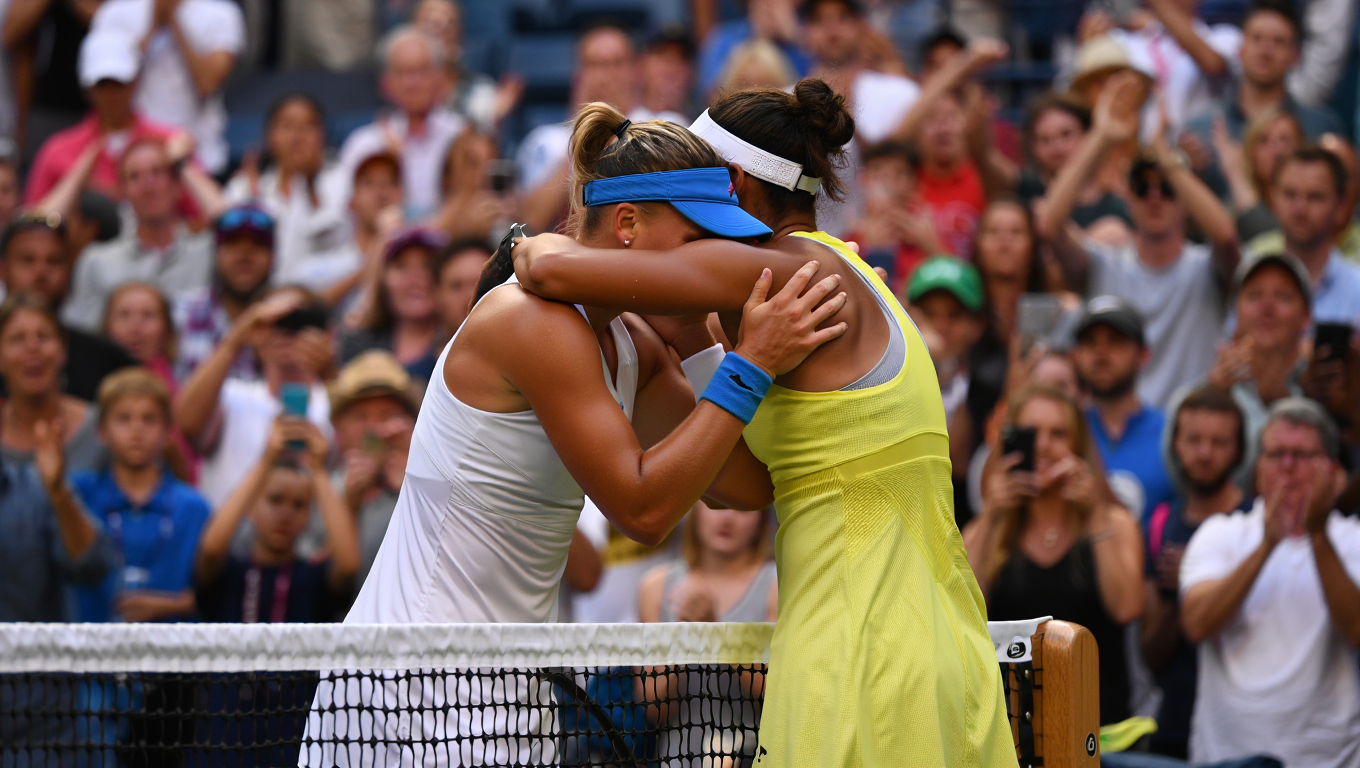
And they did. Katarina won in three tough sets, but after match point, she didn’t just shake hands. She hugged Emma at the net, long and genuine, while the crowd gave them both a standing ovation.
Because sometimes the most important victories in sports have nothing to do with the scoreboard. Sometimes they’re about the moments that remind us that beneath the competition, beneath the rankings and the pressure and the glory, we’re all just human beings trying to navigate this world together.
And sometimes, the most powerful thing one competitor can do for another is simply to be there when it matters most—to lift them up, to support them, to promise them that this isn’t the end, just a difficult chapter in a story that’s still being written.
Emma’s story didn’t end with an injury. It was just beginning. And Katarina had helped her see that.