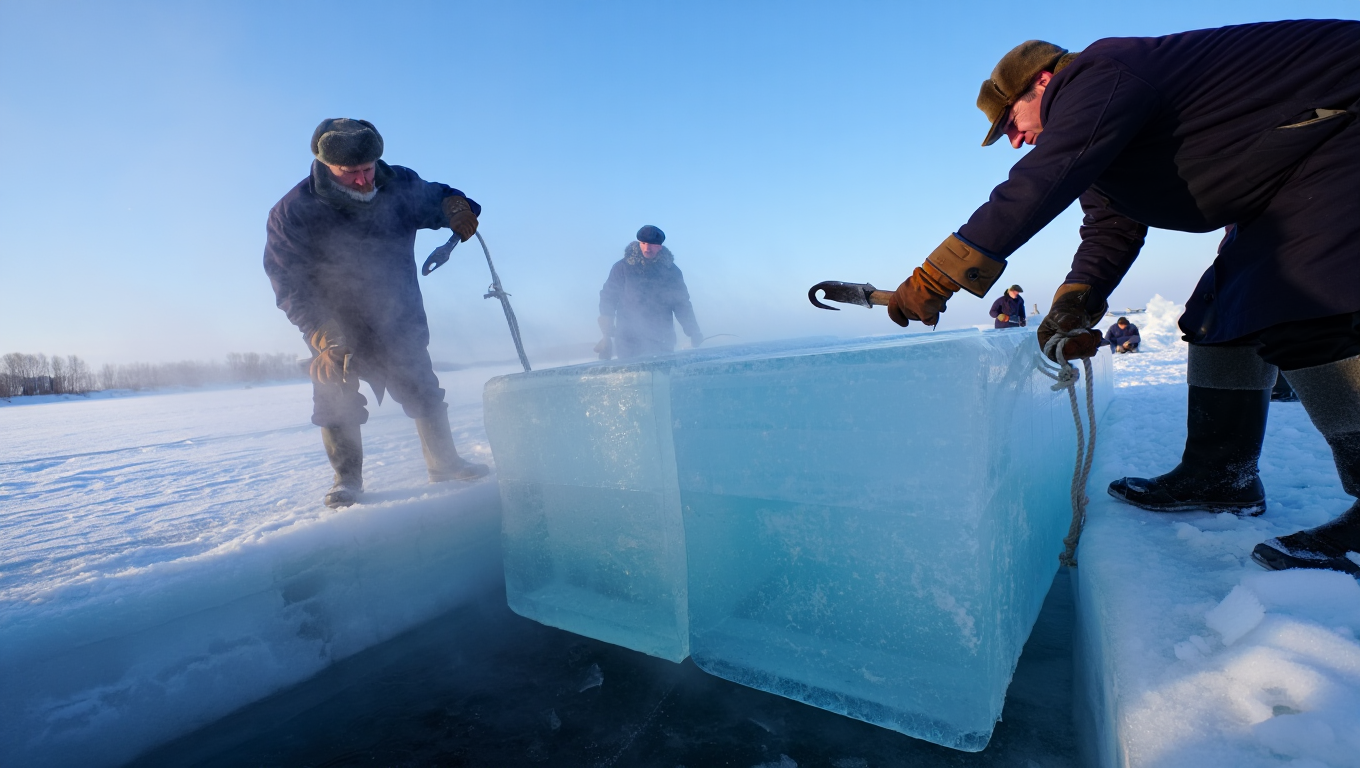
They’re cutting frozen rivers into perfect blocks worth thousands… But what they build with them will melt in 90 days.
Every winter, when temperatures plummet to -30°C in Harbin, China, something extraordinary happens on the frozen Songhua River. What looks like an industrial demolition site is actually the beginning of the world’s largest ice and snow festival—a temporary kingdom that exists for only three months before vanishing forever.
Chen Wei has been an ice harvester for fifteen years. At 4 AM, long before the sun rises, he and his crew arrive at the river armed with massive circular saws that can cut through ice nearly a meter thick. “The ice has to be perfect,” he explains, his breath creating clouds in the frigid air. “Too thin, and it won’t support the structures. Too thick with impurities, and it won’t have that crystal-clear quality we need.”
The operation is staggering in scale. Each block weighs approximately 500 kilograms—over half a ton of pure, translucent ice. Specialized excavators with custom-designed claws lift them from the black water like ancient monoliths being unearthed. The blocks are so clear you can read through them, each one a frozen window into the river below.
“People don’t realize what goes into this,” says Liu Mei, the site supervisor, watching as another truck loaded with twenty blocks rumbles away toward the city. “We harvest over 180,000 cubic meters of ice every season. That’s enough to fill seventy Olympic swimming pools.”
But here’s what makes it heartbreaking and beautiful at the same time: every single structure built from this ice—the towering castles, the illuminated sculptures, the massive buildings you can walk through—will completely melt by late February. Hundreds of workers will spend six weeks constructing an entire city of ice, millions of visitors will walk through it in wonder, and then spring will come and erase it all.
The blocks are transported to Harbin’s Ice and Snow World, where master sculptors from around the globe transform them into architectural marvels. They carve replicas of the Forbidden City, create full-scale Buddhist temples, build functioning ice bars and restaurants. LED lights are frozen into the structures, making them glow in impossible colors against the night sky.
“My son asked me once why we build something that won’t last,” Chen says, guiding another block through the channel with his metal pole. “I told him that’s exactly why it’s special. Nothing this beautiful can stay forever. That’s what makes people travel across the world to see it.”
The economics are staggering too. Each block of ice that costs about $15 to harvest and transport will become part of structures that generate over $40 million in tourism revenue. But the workers don’t talk about money. They talk about legacy, about being part of something that exists in photographs and memories long after the last drop of meltwater has returned to the river.
The most dangerous part isn’t the cutting—it’s the extraction. Workers must constantly monitor the ice channels to prevent them from refreezing and trapping the blocks. The water temperature is just above freezing, and falling in means hypothermia within minutes. Every member of the crew is cross-trained in cold-water rescue.
As the sun finally breaks over the horizon, turning the ice fields into a landscape of blinding white and brilliant blue, Chen takes a moment to rest. His gloves are frozen stiff, his face is wind-burned, and his body aches from the cold. But when asked if he’d do anything else, he laughs.
“In April, when the festival is over and the ice has melted, people ask me what I do for work. I tell them I build castles. They never believe me until I show them the photos.” He pauses, looking out at the systematic destruction of the frozen river that will, paradoxically, create something magnificent. “How many people can say their work is literally frozen in time?”
The harvesting will continue for another three weeks. Then the real work begins—the transformation of these industrial blocks into a winter wonderland that exists for one brief, shining moment before returning to water. It’s the most temporary art form on Earth, and that’s exactly what makes it eternal.