The referee dropped the puck… and 30 seconds later, every player on both teams was throwing punches. What started as a routine face-off turned into the most violent night in hockey history.
Nobody saw it coming. Not the fans. Not the coaches. Not even the players themselves.
It was supposed to be just another Tuesday night game between the Detroit Enforcers and the Boston Blades. Playoff implications, sure, but nothing out of the ordinary. The kind of mid-March matchup that could go either way, decided by a lucky bounce or a goalie standing on his head.
Marcus “The Hammer” Davidson had been with Detroit for eight seasons. He’d seen his share of scrums, dropped the gloves more times than he could count, taken his five-minute majors like a professional. But he’d never seen anything like what was about to unfold.
It started in the second period, tied 2-2.
Boston’s rookie sensation, Tyler Chen, had been running his mouth all game. Twenty years old, fresh off a record-breaking college season, and convinced he was God’s gift to hockey. He’d already scored both of Boston’s goals, celebrating each one like he’d won the Stanley Cup.
“You’re done, old man,” Chen chirped at Davidson during a stoppage. “Retirement home’s calling.”
Davidson ignored him. He’d heard worse from better players.
But then Chen made his mistake.
On the next shift, Chen came in hot on Detroit’s goalie, Jimmy “The Wall” Patterson. The puck was already covered, the whistle blown, but Chen drove his stick into Patterson’s mask anyway. Not hard enough to injure, but hard enough to disrespect.
And in hockey, disrespect is currency.
Patterson shoved Chen. Chen shoved back. Then Davidson skated over, grabbed Chen by the jersey, and said six words that would change everything: “You just made a big mistake.”
Chen laughed. “What are you gonna do, grandpa?”
Davidson dropped his gloves.
Chen dropped his.
The benches erupted.
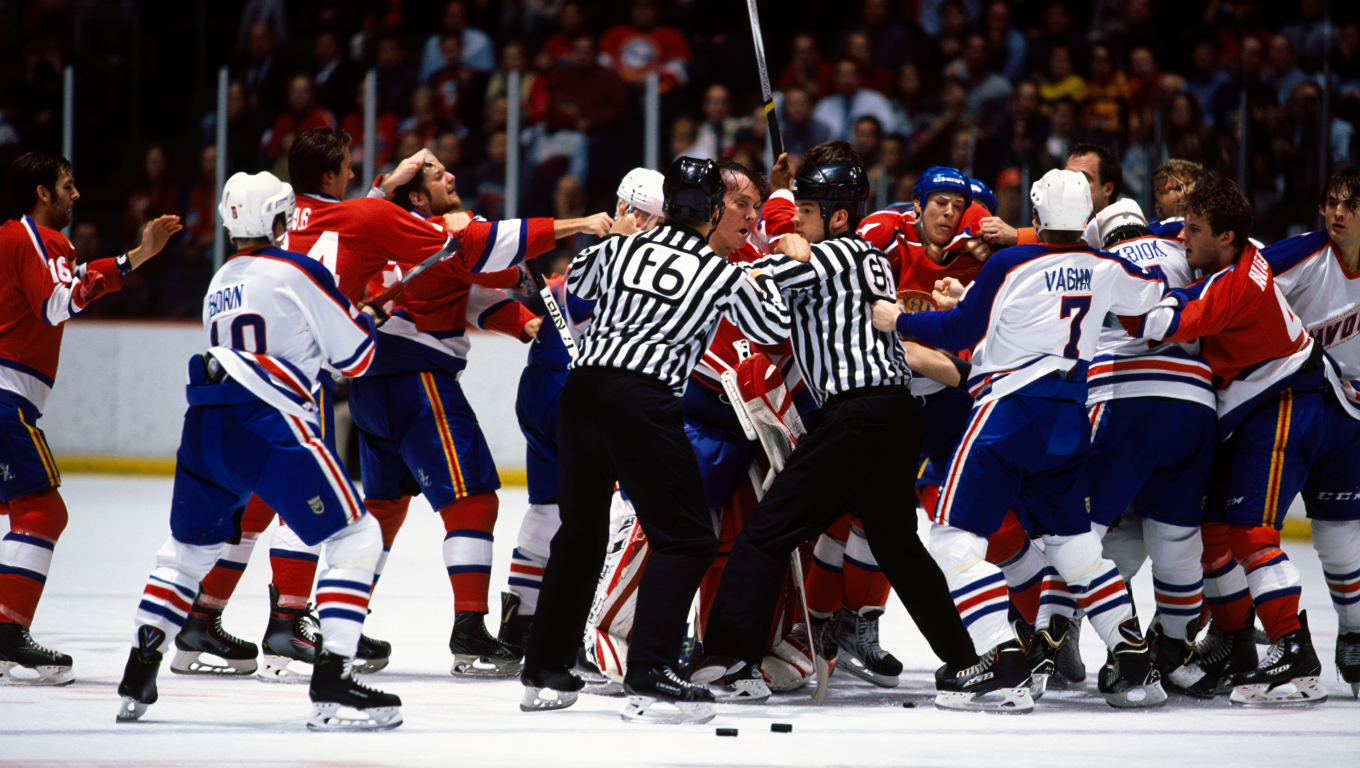
What happened next wasn’t a fight—it was chaos incarnate. Players poured over the boards from both sides like soldiers storming a beach. Within seconds, all twelve skaters on the ice were paired off, throwing haymakers, wrestling, grappling. Then the backup players joined. Then the backup goalies.
Gloves littered the ice like autumn leaves. Sticks clattered and slid in every direction. The crowd was on its feet, screaming, phones out, capturing every second of the mayhem.
Referee Mike Thompson blew his whistle until his lungs burned, but it was useless. The sound was swallowed by the roar of the crowd and the grunts of fighting men. His fellow officials tried to pull players apart, only to get caught in the crossfire themselves.
Davidson and Chen were at the center of it all, locked in a brutal exchange. Chen was younger, faster, but Davidson had thirty pounds on him and a decade of experience. He got Chen in a headlock, drove him down to the ice, and that’s when things escalated further.
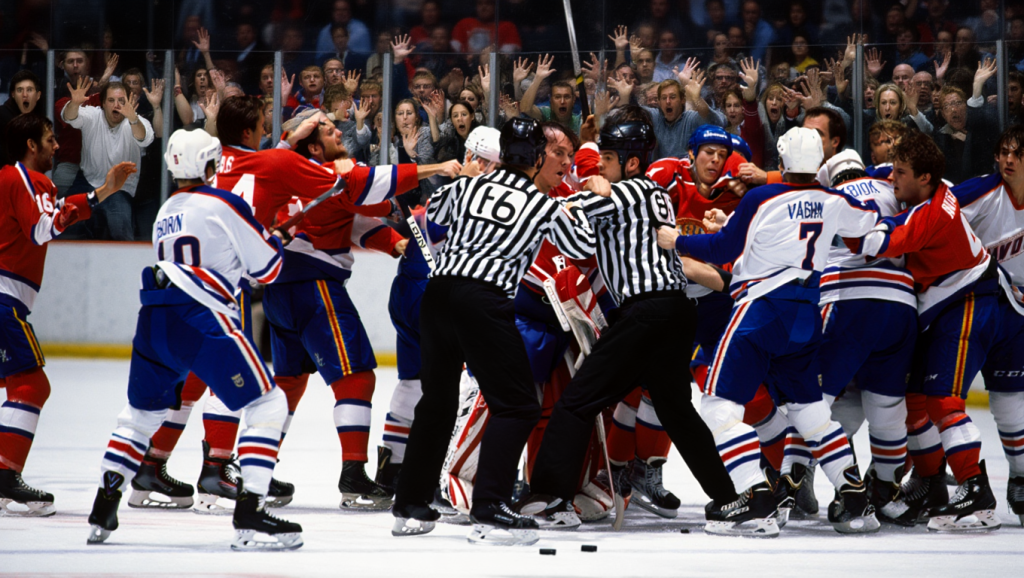
Boston’s captain, Sean O’Malley, saw his rookie going down and charged at Davidson from behind. He grabbed Davidson’s jersey, yanked him backward, and suddenly Davidson was fighting two guys at once. Detroit’s enforcer, “Big Rick” Kowalski, saw what was happening and launched himself at O’Malley like a missile.
The ice became a battlefield. Players slipped on the shavings, lost their balance, scrambled back to their feet. Blood mixed with melted ice. Someone’s helmet went flying and struck the boards with a thunderous crack.
In the stands, a father covered his young son’s eyes. A woman screamed. A group of college kids cheered like they were at a Roman coliseum.
And still, the brawl raged on.
Detroit’s coach, veteran bench boss Tony Marchetti, just stood there with his arms crossed. He’d been in the league for forty years—as a player, assistant coach, and now head coach. He’d seen bench-clearers before, but nothing like this. This was biblical.
Boston’s coach was screaming at the officials, demanding they restore order, threatening lawsuits and suspensions. But his players weren’t listening. They were too busy trying to survive.
Thompson, the head referee, finally managed to separate Davidson and Chen. He pointed both of them toward their respective penalty boxes, but neither moved. They just stood there, chests heaving, staring each other down across the ice.
“You’re done in this league,” Chen spat through a split lip.
Davidson smiled, blood on his teeth. “Kid, I’ll be here long after you’re forgotten.”
It took eleven minutes to clear the ice. Eleven minutes of pulling players apart, collecting equipment, checking for injuries, reviewing footage. When it was all over, the penalty sheet looked like a phone book. Game misconducts for six players. Majors for twelve more. Minors for everyone else.
The game was delayed forty-three minutes. When play finally resumed, both benches were depleted. Detroit won 4-3 in overtime, but nobody cared about the score.
The highlight reels went viral within hours. ESPN played it on loop. Sports Illustrated called it “The Brawl That Broke Hockey.” Twitter exploded with takes—some calling it a disgrace, others celebrating it as old-school justice.
The league suspended ten players, including Davidson and Chen. Davidson got eight games. Chen got twelve, plus a $50,000 fine for instigating.
But here’s what nobody talks about.
Three days after the brawl, Davidson got a text from an unknown number.
“Respect. You earned it. —TC”
Tyler Chen.
Davidson stared at the message for a long time. Then he typed back: “See you in eight games, kid.”
And he did.
When Davidson returned from suspension, Detroit played Boston again. First shift, Davidson skated past Chen during warm-ups.
Chen nodded.
Davidson nodded back.
And that was it. No words. No gloves dropped. Just two warriors who’d been through battle together and came out the other side with mutual respect.
The game was clean. Physical, intense, but clean.
Detroit won 5-2. Chen scored once. Davidson got an assist.
After the final buzzer, as the players lined up for handshakes, Davidson and Chen met at center ice.
“You’re tougher than I thought, old man,” Chen said quietly.
Davidson grinned. “You’re smarter than I thought, kid.”
They shook hands.
The cameras caught it. The moment went viral too, but for different reasons. People called it classy. Honorable. The right way to move on.
But Davidson knew the truth.
Hockey wasn’t just about fighting or winning or statistics. It was about respect. Earning it. Giving it. Understanding that every player on the ice, no matter how much you hated them in the moment, was going through the same grind, the same pain, the same dream.
That brawl changed both of their careers.
Chen matured overnight. He stopped running his mouth, started playing smarter, became one of the league’s most respected young stars.
Davidson played three more seasons before retiring. In his final game, Chen was in the opposing lineup. After the last buzzer, Chen skated over and handed Davidson his stick.
“For everything you taught me,” Chen said.
Davidson took it, nodded, and skated off the ice for the last time.
Years later, when Chen won his first Stanley Cup, he was asked in the post-game interview what moment in his career meant the most to him.
He didn’t hesitate.
“The night I fought Marcus Davidson. That’s when I learned what hockey really is.”
The reporter was confused. “A brawl taught you about hockey?”
Chen smiled. “No. What happened after the brawl taught me about hockey. And about being a man.”
Davidson watched the interview from his living room, surrounded by his grandkids.
He raised his beer to the TV screen.
“Atta boy, kid. Atta boy.”