We found a rusty bathtub in a “crazy old man’s” yard. Then my K9 started digging frantically—and the steel handle beneath it turned from the inside.
It was supposed to be a routine sweep. Another dead end in a case that had gone cold three months ago—a missing person report filed by a frantic wife, a trail that led nowhere, and a community that had already moved on to the next tragedy.
We were searching the property of Arthur Finch, a recluse who lived on the outskirts of town. You know the type—the “crazy old man” everyone whispers about but nobody really knows. The guy kids dare each other to approach on Halloween. His yard was a graveyard of rusted cars, rotting wood, and forgotten machinery, nature slowly reclaiming what he’d abandoned.
My partner on this search wasn’t Sarah—it was Buster, my Belgian Malinois. Five years together. Five years of trust built on training, intuition, and an unspoken bond that goes deeper than words. Buster is trained in cadaver detection. He finds what we hope not to find. He’s never wrong.
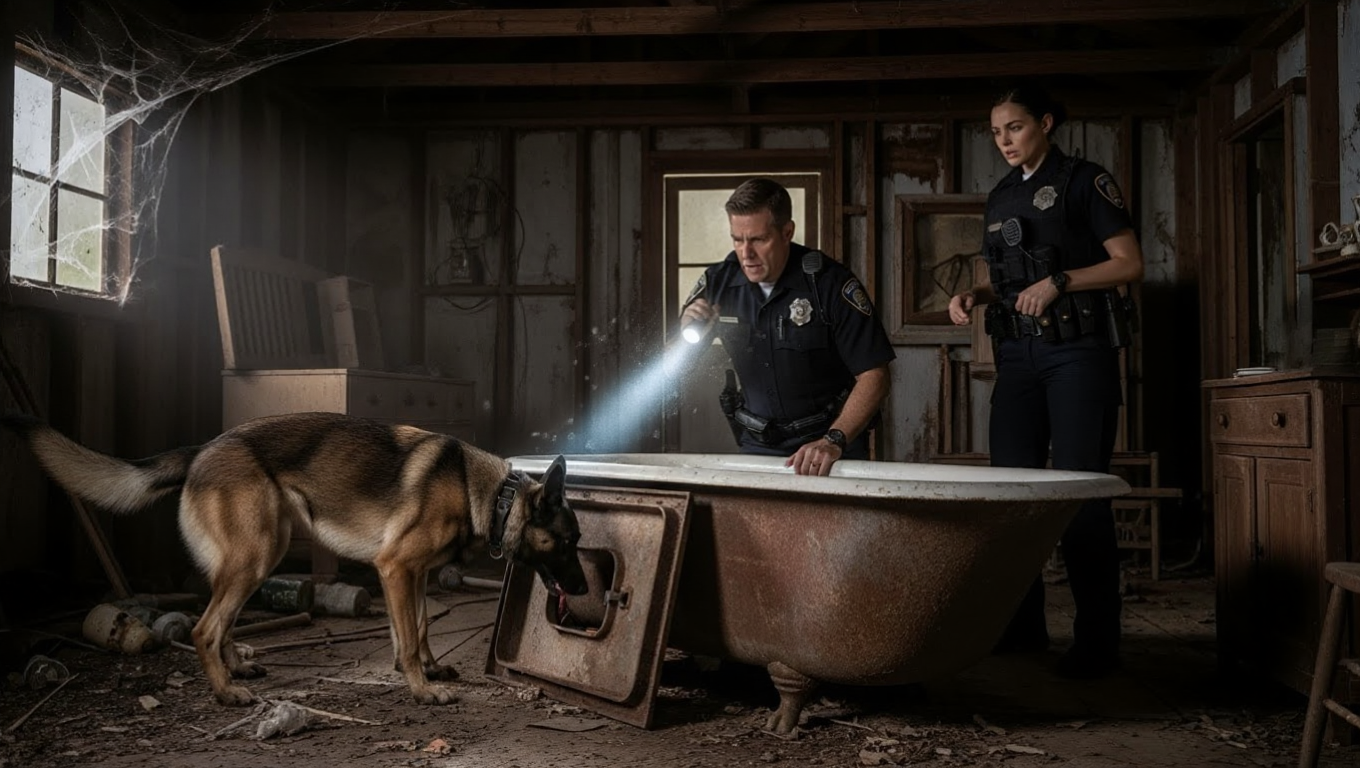
When he locked onto an overturned, rusted bathtub sitting in the middle of a clearing about fifty yards into the woods behind Finch’s property, my stomach dropped. It wasn’t the tub itself—it was the way Buster reacted. He wasn’t just alerting. He was frantic, clawing at the iron with his paws, teeth scraping against rust, whining in a pitch I’d never heard from him before.
“Buster, leave it!” I commanded, pulling on the lead.
He wouldn’t budge. He looked back at me, and I’ll never forget what I saw in his eyes. Not the focused determination of a working dog. Not aggression or excitement. It was fear. Raw, primal fear. In five years, I had never seen him afraid.
I radioed for Sarah, my human partner. “I need you at my location. Now.”
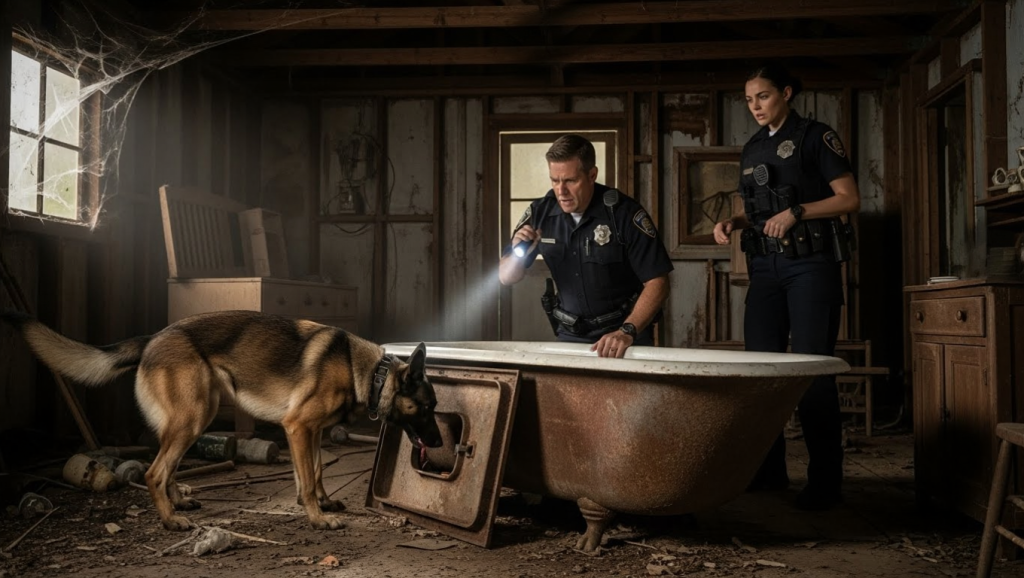
She arrived within minutes, took one look at Buster, and didn’t ask questions. “Help me move this thing,” I said.
The bathtub was heavier than it looked—solid cast iron, probably from the 1940s. It took both of us heaving with everything we had to tip it onto its side and roll it away. The moment we did, the smell hit us. Wet earth. Decay. Something organic and wrong.
I expected to find a shallow grave. I expected bones, fabric, some grim confirmation of what we’d been searching for.
What I didn’t expect was the steel handle.
It was embedded in the ground where the bathtub had been, attached to what looked like a hatch or door. The metal was newer than the tub—brushed steel, out of place among the rust and rot. Sarah and I exchanged glances. Buster had backed up ten feet and was whining, ears flat against his head.
“What the hell is this?” Sarah whispered.
I crouched down, pulling my flashlight from my belt. “Some kind of… bunker? Storm shelter?”
“Out here? In the middle of nowhere?”
I reached for the handle. My hand was inches away when it moved.
Not from me. From below.
The handle turned—slowly, deliberately—from the inside.
Sarah’s hand went to her sidearm. Mine did the same. We both stepped back, weapons drawn, adrenaline flooding every nerve. The hatch began to lift, hinges groaning from disuse. A sliver of darkness appeared, and then a hand—pale, filthy, trembling—emerged from the gap.
“Please,” a voice rasped from below. Female. Weak. “Please help me.”
My training took over. “Police! Show me your hands! Both hands!”
The hatch opened wider, and a woman crawled out—mid-thirties, emaciated, covered in dirt and what looked like dried blood. Her clothes were torn, her hair matted. She collapsed onto the ground, sobbing.
Sarah was already calling for backup and medical. I holstered my weapon and knelt beside the woman. “You’re safe now. What’s your name?”
“Rebecca,” she choked out. “Rebecca Marsh.”
The name hit me like a freight train. Rebecca Marsh. The missing person from three months ago. The case that had gone cold. The woman we’d been searching for.
“How long have you been down there?” I asked, though I wasn’t sure I wanted the answer.
“I don’t… I don’t know. Months. He kept me… he kept others…”
Others.
Sarah and I looked at each other, then at the open hatch. I shined my flashlight down into the darkness. A ladder descended about twelve feet into a concrete chamber. The smell was overwhelming now—human waste, decay, fear.
“How many others?” I asked Rebecca gently.
She was shaking violently. “Three. Three others. Two are… two are gone. But Jenny. Jenny’s still down there. She’s hurt. She needs help.”
I didn’t hesitate. “Sarah, stay with her. I’m going down.”
“Wait for backup—”
“There’s someone alive down there.” I was already descending the ladder.
The chamber was approximately ten by fifteen feet, lit by a single battery-powered lantern. Chains hung from the walls. There were buckets, blankets, food wrappers. And in the corner, curled into a ball, was another woman—younger, maybe early twenties, barely conscious.
I radioed my position and findings, then moved to the girl. “Jenny? My name is Officer Dawson. I’m here to help you.”
She didn’t respond, but she was breathing. That was enough.
Backup arrived within ten minutes—paramedics, more officers, forensic teams. Both women were rushed to the hospital. Arthur Finch was arrested trying to flee through the woods. In his truck, they found maps, photos, and a journal detailing everything.
Rebecca Marsh survived. So did Jenny Chen, a college student who’d been missing for six weeks. The other two victims were found buried on the property two days later.
Finch is awaiting trial. He’ll never see daylight as a free man again.
But here’s what stays with me: Buster knew. He knew there was someone alive down there. Cadaver dogs are trained to find the dead, but Buster sensed something else—something human, something suffering, something that needed to be found.
After that day, I looked at him differently. Not as a tool or a partner in the traditional sense, but as something more. He saved two lives that day. And when I look into his eyes now, I don’t see a trained animal. I see a soul that understands things we can’t.
I recommended him for a commendation. The department agreed. But more than any medal, I make sure he gets an extra steak every week. It’s the least I can do for the dog who looked evil in the face—and didn’t blink.