I bought 40 acres of “worthless” forest land for $12,000… Then I found a fully operational underground bunker hidden inside a tree stump.
The real estate agent called it “unbuildable wilderness” — forty acres of dense Pacific Northwest forest that had been on the market for three years. No roads, no utilities, no cell service. Just moss-covered trees, fog, and silence. Everyone thought I was insane for spending my entire savings on land I couldn’t even legally put a house on.
I didn’t care. After two decades working in Seattle’s tech scene, living in cramped apartments where I could hear my neighbors’ arguments through paper-thin walls, I craved isolation. I wanted a place where I could disappear on weekends, even if it was just to camp in a tent and listen to the rain.
The first time I hiked onto the property, I almost turned back. The forest was so thick that GPS barely worked. Massive Douglas firs blocked out the sky, their roots creating treacherous obstacles every few feet. Sword ferns grew waist-high, concealing the uneven ground. It took me two hours to reach what I thought was the center of my land — a small clearing where an ancient tree had fallen decades ago, leaving behind a massive, rotting stump.
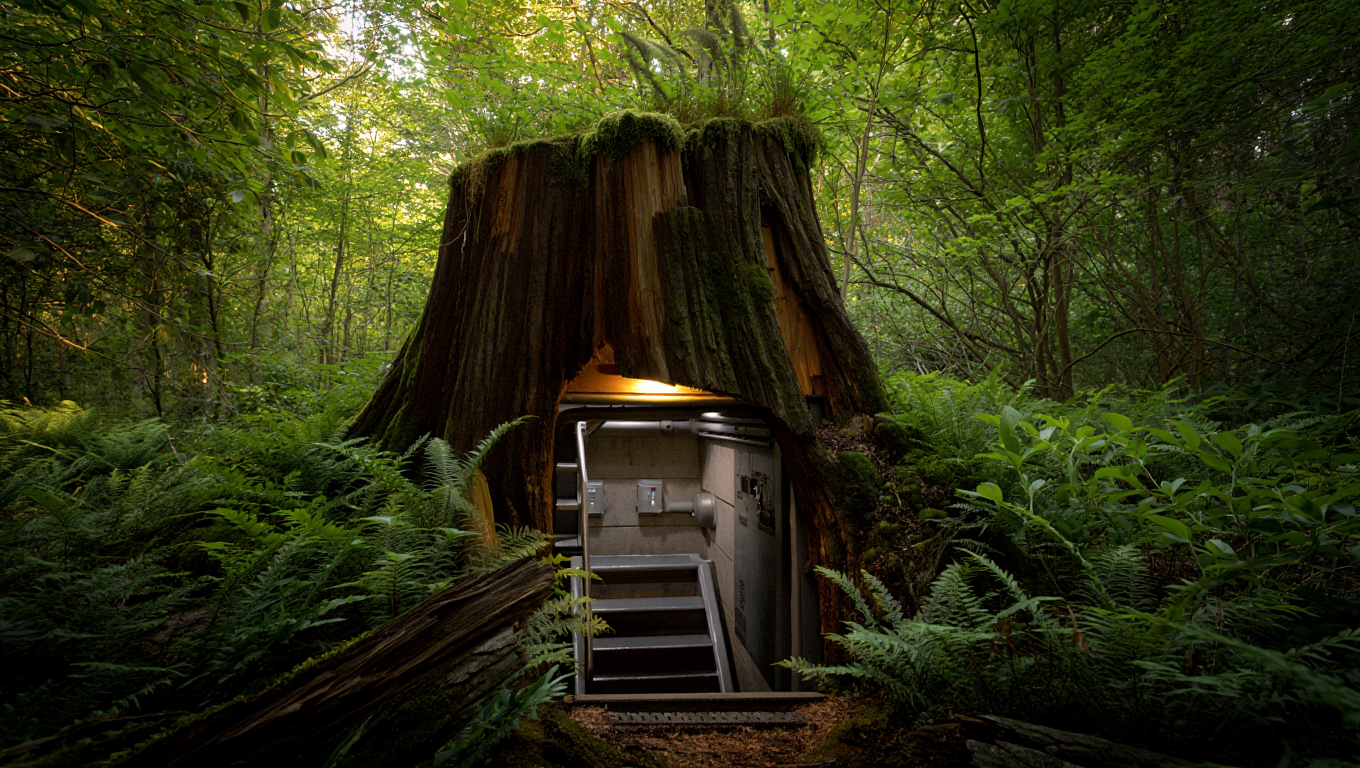
I sat on that stump to catch my breath and eat a protein bar. That’s when I noticed something odd. The bark on one side looked… different. Newer. Like it had been carefully replaced.
My hand found a small indentation, and when I pressed it, a section of bark swung inward on hidden hinges.
My heart hammered as I pulled out my phone’s flashlight and peered inside. A ladder descended into darkness. Someone had built something here. Recently.
Every logical part of my brain screamed to call the police. This could be anything — a drug operation, a smuggling route, a serial killer’s lair. But curiosity won. I tested the first rung. Solid. I began to climb down.
The ladder dropped about fifteen feet into a narrow tunnel. The walls were earth and exposed roots, but reinforced with heavy timber beams every few feet. Someone had done serious engineering work. The tunnel stretched forward into darkness, sloping gently downward.
I should have gone back. I should have called someone. Instead, I walked.
After about fifty feet, the tunnel opened into a small anteroom. And that’s when everything changed.
A steel door stood before me. Real, industrial-grade security — the kind you’d see in a bank vault. Next to it, mounted on the wall, was a modern keypad and what looked like a biometric scanner.
I tried the handle. Locked, obviously.
But then I noticed something else. A small envelope, yellowed with age, tucked into a gap between the door frame and the earth wall. My name was written on it.
My hands shook as I opened it.
“To the new owner — If you’re reading this, I’m either dead or finally decided to trust my daughter’s judgment and moved to Arizona like she’s been begging me to do. Code is 081558. Welcome to what I couldn’t tell anyone about for forty years. — Robert Hayward, July 2019”

Robert Hayward. I’d seen that name on the property deed. The previous owner who’d died six months before the land went on the market. His daughter had handled the sale, seemed eager to get rid of it quickly.
I punched in the code. The keypad beeped. Something heavy clunked inside the door mechanism. I pulled the handle.
The door swung open, and lights flickered on automatically.
I stepped into another world.
The bunker was massive — easily two thousand square feet, spread across multiple rooms carved from the earth and reinforced with concrete and steel. The main living area featured a full kitchen, a dining table, comfortable furniture that looked straight out of the 1980s, and shelves lined with hundreds of books. Fluorescent lights hummed overhead, powered by — I would later discover — a combination of a hidden solar panel array on the forest floor above, disguised to look like natural clearings, and a backup generator system.
There was a bedroom with a real bed, military-style but comfortable-looking. A bathroom with a composting toilet and a water system connected to an underground cistern that collected rainwater through hidden pipes in the tree roots above. A workshop area with tools, a ham radio setup, and filing cabinets full of… I didn’t even know where to start.
But what struck me most was how lived-in it felt. This wasn’t a doomsday prepper’s panic room thrown together in a weekend. This was someone’s secret second home, built with care and maintained for decades.
I found a journal on the nightstand. Robert Hayward’s journal.
I sat on the bed and started reading.
Robert had been a civil engineer for the Army Corps of Engineers. In 1979, at the height of Cold War paranoia, he’d bought this land with money inherited from his parents. He was terrified of nuclear war. He believed it was inevitable. So he did what any skilled engineer with resources and determination would do — he built a survival bunker, using his professional expertise to make it structurally sound and virtually undetectable.
He’d spent three years building it, working mostly at night and on weekends, telling his wife he was on extended work trips. He’d hauled materials in piece by piece, using an old logging road that had long since been reclaimed by the forest. He’d studied the terrain, found a natural depression that made excavation easier, and designed the entrance inside the stump of a tree that had already been dead for years.
The bunker was his secret. Not even his wife knew. He’d planned to bring her here if the bombs ever fell.
But the bombs never fell. The Cold War ended. His wife died of cancer in 1995, never knowing about the thousands of hours her husband had spent preparing for a catastrophe that never came.
And Robert kept maintaining the bunker. It became his escape. A place where he could be alone with his thoughts, away from a world that had changed too much, too fast. He upgraded it over the years — added the solar panels in the 2000s, improved the water filtration, installed the modern security system in 2015.
His daughter thought he went fishing. His friends thought he went hiking. No one suspected that Robert Hayward, retired engineer and widower, spent his weekends living in a Cold War bunker he’d built with his own hands forty years earlier.
The last journal entry was dated June 2019, a month before the letter.
“Getting too old for the ladder. Knees can’t take it anymore. Sarah wants me to move in with her in Phoenix. Maybe it’s time. Maybe I should finally let go of this place. But I can’t bring myself to tell her about it. She’d think I wasted my life on paranoid fantasies. Maybe I did. But this place kept me sane after Margaret died. It gave me purpose. I hope whoever buys the land finds it someday. I hope they understand.”
I sat in that bunker for hours, just absorbing it all.
Here was a fully functional underground home, completely off-grid, invisible from the surface. It had everything — power, water, food storage areas still stocked with sealed provisions, climate control that kept it at a steady sixty-five degrees year-round. The air circulation system was brilliant, using passive thermal dynamics and hidden vents disguised as animal burrows to pull fresh air down while venting stale air up through the root systems of surrounding trees.
Over the following weeks, I explored every inch of it. I found Robert’s meticulously organized maintenance logs, his blueprints, his supply inventories. I found photo albums showing the construction process — a younger Robert, covered in mud, grinning at the camera he’d set up on a timer. I found letters he’d written but never sent, pouring out his fears and hopes and loneliness.
I also found that the bunker was in perfect working order. Everything functioned. The only things that needed updating were some of the food supplies and the generator fuel, which had started to degrade.
I made a decision then. I would honor Robert’s work by maintaining what he’d built. And I would use it.
I spent months carefully improving and modernizing the bunker while respecting its original design. I added a small hydroponics setup in one of the storage rooms. I updated the communications equipment and, with some creative antenna work, managed to get a weak internet connection using a satellite link. I installed a small server rack for remote work. I brought down a better mattress, new clothes, supplies.
The bunker became my sanctuary.
I didn’t tell anyone. Not my family, not my friends, not my coworkers. As far as they knew, I owned forty acres of worthless forest that I occasionally visited for “camping and meditation.” They thought it was a mid-life crisis purchase I’d eventually regret.
But several weekends a month, I would drive the two hours from Seattle, hike through the fog-shrouded forest, climb down through the tree stump, and disappear into Robert Hayward’s underground world.
I worked from the bunker sometimes, using my satellite internet to video conference with colleagues who had no idea I was calling in from thirty feet underground. I read Robert’s books. I listened to the absolute silence that only comes from being wrapped in earth and concrete. I felt the stress of modern life melting away.
I started to understand why Robert had kept coming back, even after the threat he’d built it for never materialized. It wasn’t about nuclear war. It was about having a place that was entirely your own, where the chaos of the world above couldn’t reach you. A place where you controlled everything — the temperature, the light, the noise, the company. A place where you could exist without performance, without explanation, without apology.
One night, sitting in the bunker during a particularly brutal Pacific storm, I realized that the rain hammering the forest above was completely inaudible down here. The world could be ending up there, and I’d never know. That should have been terrifying.
Instead, it was the most peaceful I’d felt in years.
I’ve owned the property for eighteen months now. The bunker is my secret, just as it was Robert’s. I’ve added my own touches — better lighting, a small library of my own books, a coffee station that would make any Seattle tech worker weep with joy. But mostly, I’ve kept it as Robert left it, a monument to one man’s need for control in an uncontrollable world.
Sometimes I wonder what would have happened if Robert had told people about it. Would they have understood? Or would they have labeled him paranoid, eccentric, wasteful?
I think he knew the answer. That’s why it stayed secret.
I’ve started keeping my own journal down here, adding to the record Robert began forty years ago. Maybe someday, decades from now, someone else will buy this land. Maybe they’ll find the entrance. Maybe they’ll read both our stories and understand.
Or maybe the forest will reclaim everything eventually, and the bunker will become just another secret the earth keeps.
Either way, I’m grateful. Grateful to Robert for building it. Grateful to his daughter for selling the land without knowing what it contained. Grateful for the accident of timing that led me to that real estate listing on a day when I was desperate enough to consider buying forty acres of “worthless” forest.
Because it turns out that sometimes the most valuable things are the ones no one else can see.
Last weekend, I brought down a plaque I’d made. I mounted it in the entrance tunnel, right where you’d see it coming down the ladder.
“The Hayward Bunker. Built 1979-1982. Maintained 1982-2019 by Robert Hayward. 2023-Present by its current guardian. May it always be a refuge for those who need to disappear.”
I think Robert would have approved.