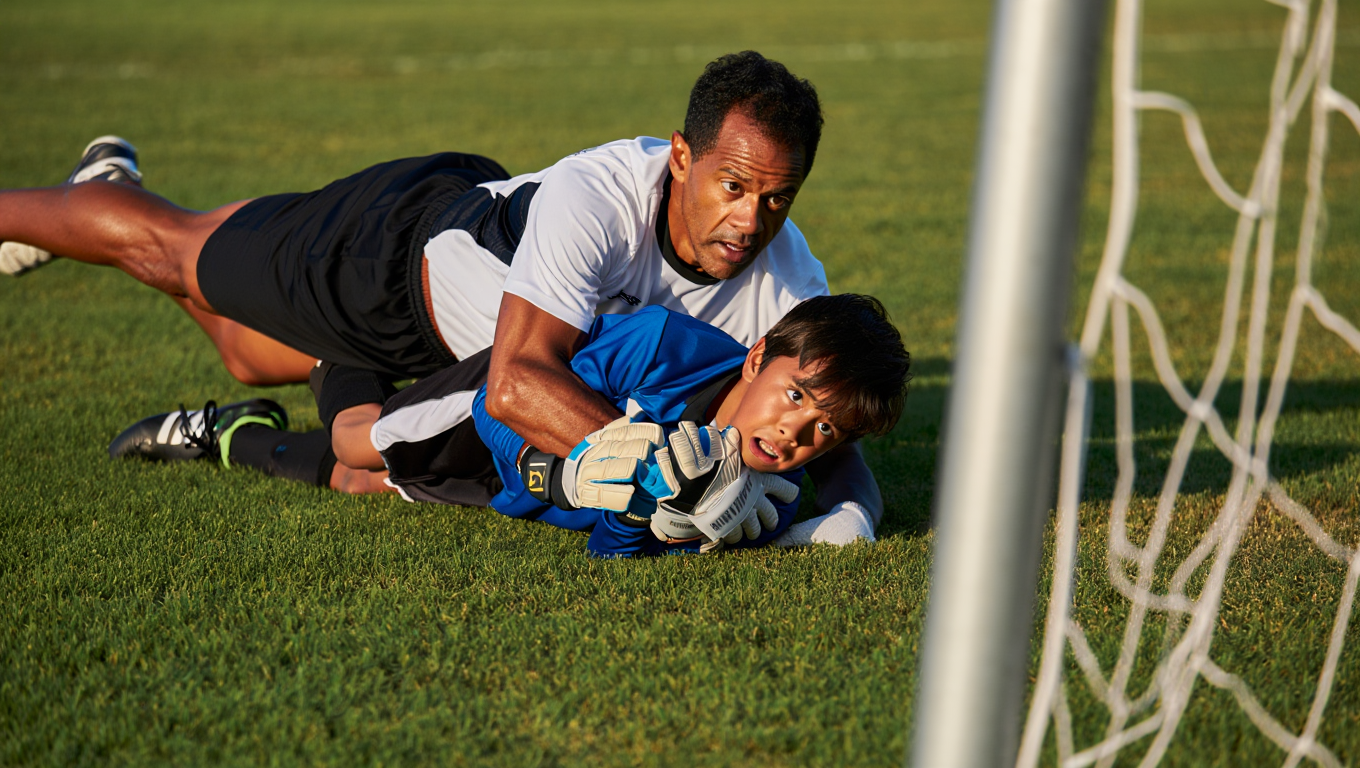
A soccer goalpost came crashing down on a 12-year-old goalkeeper during practice… But a coach’s split-second decision saved his life.
It was supposed to be just another Tuesday practice. The kind where parents sat in folding chairs along the sideline, scrolling through their phones while their kids ran drills. The kind where Coach Martinez would blow his whistle, crack a few jokes, and send everyone home with scraped knees and grass-stained jerseys.
But November 14th wasn’t just another Tuesday.
The wind had been picking up all afternoon—one of those unpredictable late-autumn gusts that turned dry leaves into tiny tornados across the field. Coach Martinez had noticed it during warm-ups, the way the corner flags were whipping horizontal, the way the soccer balls didn’t roll straight anymore. He’d made a mental note to check the goals after practice, maybe add some sandbags to the bases like he’d been meaning to do for weeks.
Twelve-year-old Danny Reeves was in goal, his favorite position. He loved being the last line of defense, loved the weight of responsibility on his shoulders. His gloves were too big—hand-me-downs from his older brother—and his hair stuck out from under his cap in every direction. He was focused on the drill, watching Coach Rodriguez demonstrate proper diving technique to the other kids near midfield.
That’s when Coach Martinez saw it.
The eight-foot-tall metal goalpost, weighing nearly two hundred pounds, had begun to lean. Just slightly at first—so subtle that most people wouldn’t have noticed. But Martinez had been coaching youth soccer for seventeen years. He knew what an unsecured goal looked like when the wind caught it just wrong.
Danny had his back turned, shouting encouragement to his teammates. He had no idea.
The goal tipped further. Forty-five degrees. Then sixty.
Martinez didn’t think. His body moved before his brain caught up. He was forty-two years old, twenty pounds overweight, with a bad knee from his own soccer days. None of that mattered. He sprinted across thirty yards of field faster than he’d moved in a decade, his whistle bouncing against his chest, his clipboard flying from his hand.
Parents looked up from their phones. Other coaches stopped mid-sentence. Time seemed to slow and accelerate simultaneously.
The goalpost was at eighty degrees now, gravity pulling it down with increasing force. The crossbar—that heavy metal beam—was falling directly toward Danny’s head. If it hit him, it would be catastrophic. Kids had died from accidents like this. Martinez knew the statistics. He’d seen the safety videos. He’d always promised himself it would never happen on his watch.
Ten feet away. Five feet.
Martinez launched himself forward, arms extended upward. His hands caught the top crossbar just as it reached the point of no return. The weight was enormous—far heavier than he’d anticipated. His shoulders screamed in protest. His feet slid in the grass. But he held on.
“DANNY! MOVE!” he roared.
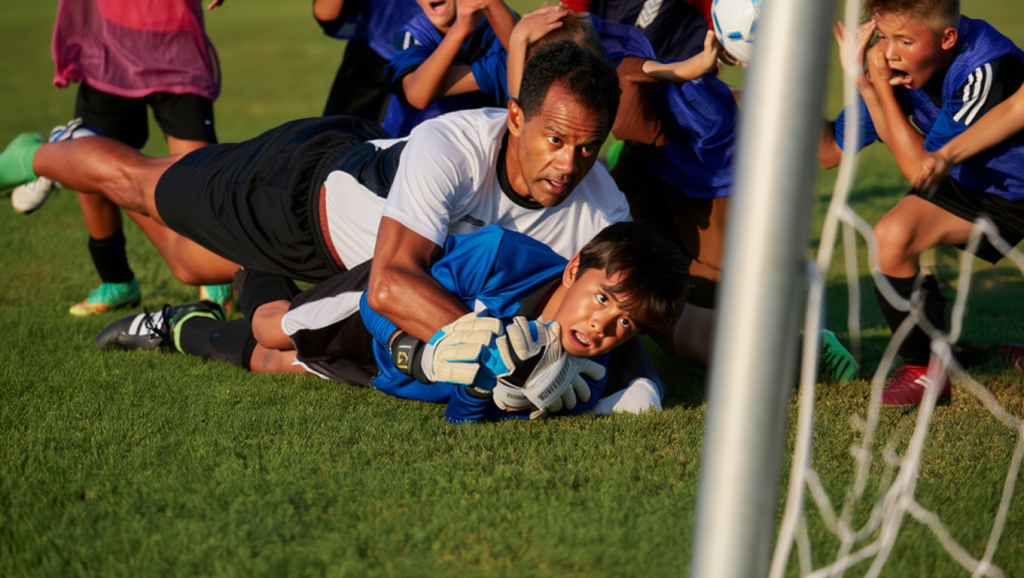
The boy spun around, eyes wide with confusion, then terror. He saw his coach, red-faced and straining, holding up two hundred pounds of metal that was still trying to fall. Danny scrambled backward, tripping over his own feet, landing hard on his tailbone but safely out of the way.
Other coaches rushed over. Parents dropped their phones and ran onto the field. Together, they helped Martinez push the goal back upright, then laid it flat on the ground until it could be properly secured.
For a moment, nobody spoke. The only sound was Martinez gasping for breath, hands on his knees, his entire body shaking from the adrenaline dump.
Then Danny’s mother broke through the crowd. She didn’t say anything—just wrapped Martinez in a hug so tight he could barely breathe. Her face was buried in his shoulder, and he could feel her whole body trembling. When she finally pulled back, her eyes were red and streaming with tears.
“You saved my son’s life,” she whispered. “You saved my baby’s life.”
Martinez shook his head, still trying to catch his breath. “Just… doing my job.”
But it wasn’t just his job. It was instinct. It was love for these kids who trusted him every Tuesday and Thursday. It was the promise every coach makes but prays they’ll never have to keep—to put themselves between danger and the children in their care.
Danny stood off to the side, pale and quiet. He was in shock, Martinez realized. The kid didn’t fully understand how close he’d come. Maybe that was better. Maybe someday he’d look back and understand. Or maybe he’d just remember it as “that time the goal almost fell over.”
The practice ended early that day. Parents pulled their kids close, whispering that they loved them. The other coaches shook Martinez’s hand, clapped him on the back, called him a hero. He deflected every compliment, insisted anyone would have done the same.
But they all knew the truth. In that split-second decision, in that desperate sprint across the field, Martinez had been the difference between a normal Tuesday and an unspeakable tragedy.
That night, Danny’s father called. He was a man of few words, a construction worker with calloused hands and a gruff voice. But on the phone, his voice cracked.
“I don’t know how to thank you,” he said. “I don’t have the words. But if you ever need anything—anything at all—you call me. You understand? Day or night. I owe you everything.”
Martinez sat in his living room, the phone pressed to his ear, his own eyes starting to burn. “Take care of that kid,” he said quietly. “That’s all the thanks I need. Danny’s a good boy. Special kid.”
“He is,” Danny’s father agreed. “And he almost—” The man couldn’t finish the sentence. He didn’t have to.
The next practice, every goalpost on the field was anchored with sandbags, stakes, and safety straps. The league sent out an emergency memo about proper equipment securing. Local news picked up the story—”Coach’s Quick Thinking Prevents Tragedy on Youth Soccer Field”—though Martinez refused all interview requests.
But the biggest change was in Danny. The boy who’d been saved came to practice with a new glove—a right-hand glove, one size too big, which he presented to Martinez with a hand-written note.
“To Coach Martinez. You caught the goal so I could keep playing. Now you have a glove too. Thank you for being the best coach ever. Love, Danny.”
Martinez kept that glove in his office. On hard days, when coaching felt like a thankless grind of carpools and referee arguments and budget meetings, he’d look at it and remember why he was really there.
Not for the wins. Not for the glory. But for the Dannys of the world—kids who showed up every week with too-big gloves and grass-stained knees and dreams of making the perfect save. Kids who trusted adults to keep them safe. Kids who deserved coaches willing to run headfirst into danger without a second thought.
Because in the end, that’s what coaching really is. It’s not about strategy or skill development or championship trophies. It’s about being the person who sprints across the field when everyone else is frozen. It’s about putting yourself between the falling weight and the child who doesn’t see it coming.
It’s about being there in the moment that matters most.
And on that windy Tuesday in November, Coach Martinez was exactly where he needed to be—right place, right time, right man. Some people call it luck. Some call it fate. Martinez called it Tuesday.
Just another day on the job. Just another promise kept. Just another reason why, despite everything, he’d keep showing up to that field, whistle around his neck, ready to catch whatever came falling down.