Category Archives: USA Storytime

Millionaire Fires Wife After Cleaner Reveals What Was In The Trash


The cleaner noticed the millionaire’s mother fell ill every time she drank the daughter-in-law’s “special” tea… But the hidden ingredient she discovered in the trash exposed a secret worth killing for.


Rain hammered against the windows of the mansion on Beacon Crest Drive, demanding entry. Inside, the silence was heavy, the kind that money buys to suffocate the noise of real life. At six sharp, Lucia slipped in through the service entrance, shaking the Connecticut storm from her worn coat.

Lucia was forty-three, invisible, and efficient. To the Kessler family, she was part of the furniture—essential but unnoticed. She knew which floorboards creaked and exactly how the sunlight hit the expensive Persian rugs at noon. But mostly, she knew the people.

Trevor Kessler, the tech mogul owner, was a man who solved complex algorithms but couldn’t solve the equation of his own unhappy home. He loved his mother, Dolores, with a fierce, protective loyalty. Dolores, seventy-two and kind-hearted, had moved in six months ago. She was a woman of earth and flour, a stark contrast to the sterile luxury of the mansion. She treated Lucia like a cousin, asking about her children, Mateo and Camila, and slipping her homemade cornbread when no one was looking.

Then there was Felicity. Trevor’s wife. A woman composed of sharp angles, expensive perfume, and a smile that never quite reached her eyes. Felicity treated the air she breathed as if she owned the patent for it. She viewed Dolores not as a mother-in-law, but as an intrusion—a stain on her perfect aesthetic.

That morning, the tension in the house was palpable. Lucia found Dolores in her bedroom, pale and trembling.

“My head,” Dolores whispered, clutching Lucia’s hand. Her skin felt clammy. “It feels like stones in my stomach, Lucia.”

Lucia arranged the pillows, her heart hammering. This was the fourth time this week. The doctors were baffled, citing age, stress, or a late-onset vertigo. But Lucia had grown up in a village where you learned to read signs, not charts.

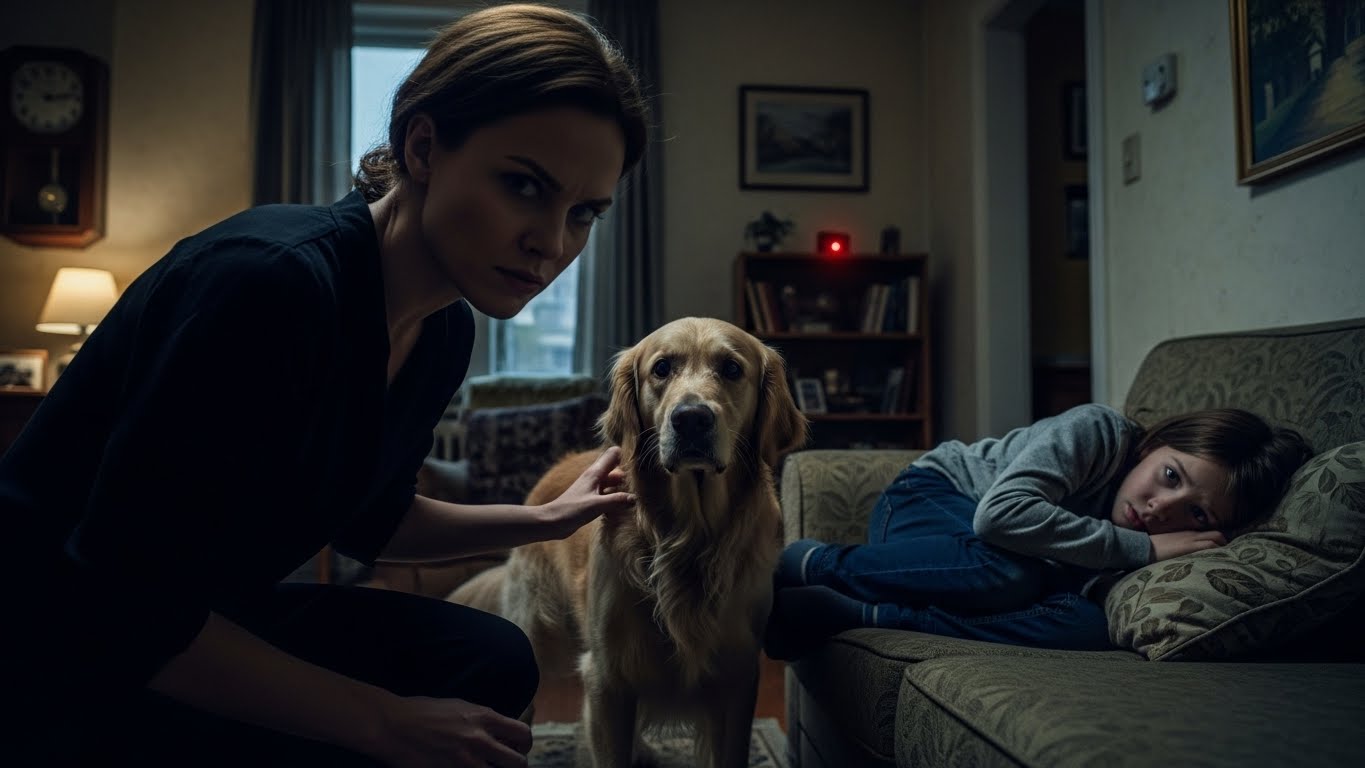
The pattern was undeniable. Dolores only got this sick after the afternoon tea. The “Special Blend” that Felicity insisted on preparing herself. “An ancient herbal remedy,” Felicity called it. “For vitality.”

Lucia left the room and headed for the kitchen. As she passed the hallway, she nearly collided with Felicity.

“How is she?” Felicity asked. Her voice was smooth, lacking any real concern.

“Worse,” Lucia said, keeping her head down. “She can barely lift her head.”

“Pity,” Felicity sighed, checking her diamond watch. “Old age is a thief. I’ll make her tea earlier today. Maybe that will help settle her.”

Lucia saw it then—a micro-expression. A flicker of satisfaction that vanished as quickly as it appeared. A chill went down Lucia’s spine that had nothing to do with the rain outside.

Lucia went to the laundry room, her mind racing. She needed proof. She couldn’t just accuse the lady of the house; she’d be fired and blacklisted before she finished the sentence.

She waited until Felicity went to her pilates session. The house was empty save for Dolores sleeping upstairs. Lucia went to the kitchen. The trash had been emptied, but not the recycling. She dug through the bin, past the sparkling water bottles and imported wine.

At the bottom, hidden inside a folded empty cereal box, was a small blister pack. It wasn’t herbs. It wasn’t vitamins. It was a prescription sheet, punched empty. Lucia squinted at the label, her English good but not medical. She pulled out her phone and snapped a picture, sending it to her niece, who was a nursing student.

What is this? she texted.

Three minutes later, the phone buzzed. That’s a heavy-duty beta-blocker, Tía. Dangerous if you don’t have heart problems. Overdose causes nausea, dizziness, heart failure… death if kept up.

Lucia’s hand flew to her mouth. Dolores had low blood pressure naturally. This wasn’t tea; it was a slow execution.

The front door slammed. Felicity was back early.

“Lucia!” Felicity’s voice rang out. “Boil the water. Trevor is coming home early for lunch, and I want Mother to join us. I’m making the tea now.”

Panic seized Lucia. If Dolores drank another cup in her weakened state, her heart might not take it.

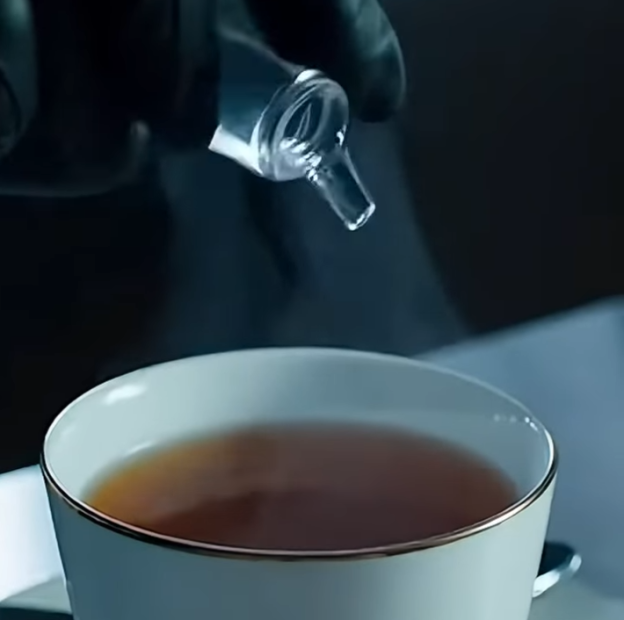
Lucia stood in the kitchen doorway. Felicity was at the island, her back turned. She was crushing something with a mortar and pestle—blue pills turning into fine dust. She swept the powder into the teapot and covered it with loose tea leaves.

“Almost ready,” Felicity hummed.

Trevor walked in moments later, shaking a wet umbrella. “Smells good in here,” he said, kissing Felicity on the cheek. “How’s Mom?”

“Struggling,” Felicity said with a sad pout. “I made her the special tea. Why don’t you take it up to her? She loves it when you visit.”

Trevor took the tray. “You’re an angel, Felicity. Thank you for taking care of her.”

He turned to leave.

“Wait!”

The word tore out of Lucia’s throat before she could stop it. Both Trevor and Felicity froze. Lucia never spoke out of turn.

“Lucia?” Trevor frowned. “Is something wrong?”

Lucia’s hands trembled. She stepped forward, ignoring Felicity’s glare that could cut glass. “Mr. Trevor. Please. Don’t give her that.”

“Excuse me?” Felicity laughed, a sharp, brittle sound. “Lucia, go back to cleaning the floors.”

“No,” Lucia said, her voice shaking but gaining strength. She looked at Trevor. “Sir. Every time your mother drinks that tea, she almost dies. It is not herbs.”

“How dare you,” Felicity hissed, stepping between Lucia and Trevor. “Trevor, she’s clearly having a mental break. I want her out of this house. Now.”

Trevor looked between the two women. The devoted wife and the loyal cleaner. “Lucia, those are serious accusations.”

“Look in the pot,” Lucia pleaded. “Look at the powder. It is blue. Tea is not blue.”

“It’s blueberry extract!” Felicity shouted, her face flushing red. “Trevor, take the tea upstairs!”

Trevor looked at the tray. He looked at his wife’s desperate, angry face. Then he looked at Lucia, whose eyes were filled with tears of fear.

Trevor set the tray down on the counter.

“If it’s blueberry extract,” Trevor said quietly, “then it won’t hurt to taste it.”

The room went dead silent. The only sound was the rain lashing the glass.

“What?” Felicity whispered.

“Drink a cup, Felicity,” Trevor said, his voice hardening. “Show Lucia she’s wrong. Drink it, and I’ll fire her on the spot and give you a vacation in Paris.”

Felicity stared at the steaming cup. Her hands began to shake. She reached for it, but her hand recoiled as if the porcelain were red hot.

“I… I have an allergy,” she stammered.

“To blueberries?” Trevor asked. “You ate them in your yogurt this morning.”

He took a step toward her. “Drink the tea, Felicity.”

She backed away until she hit the refrigerator. The facade crumbled. She burst into tears, knocking the teapot to the floor. It shattered, splattering the blue-tinged liquid across the white marble.

“I just wanted her gone!” Felicity screamed, her face twisted and ugly. “She’s a leech, Trevor! She’s spending our inheritance, living in our house, breathing our air! She was never going to leave!”

Trevor looked at his wife as if looking at a stranger. The silence that followed was louder than the storm outside.

Two hours later, the police led Felicity away. The lab results from the tea dregs confirmed lethal amounts of prescription medication.

Lucia sat in the kitchen, trembling as the adrenaline faded. Trevor walked in. He looked ten years older than he had that morning. He sat on the stool opposite her and took her rough, work-worn hands in his.

“You saved her,” he said, his voice cracking. “You saved both of us. How can I ever repay you?”

Lucia looked up, her eyes dry now. “Just take care of your mother, Sir. She is the only gold in this house.”

Trevor kept his word. Felicity went to prison for attempted murder. Dolores recovered, slowly but surely, with Lucia by her side. And though Lucia remained the cleaner, she was no longer invisible. She was the guardian of the house, the one who saw the truth when everyone else was blinded by the shine of gold.

She Thought She Was Alone In The House… Until She Read These Letters


She returned to her childhood home to settle her father’s estate… But a frozen letter found beneath the floorboards revealed he never actually left.

FULL STORY:


The wind howled through the skeletal branches of the ancient oaks surrounding the Miller estate, a sound like a choir of the grieving. Elara stood on the porch, her breath hitching in the frigid mountain air. The house was a monument to silence, its gray siding peeling like dead skin under a muted winter sky. It had been twenty years since she last stepped foot inside—twenty years since her father, Elias, had supposedly walked out into a blizzard and vanished, leaving her and her mother, Martha, to rot in the isolation of the peaks.

The interior smelled of cedar, damp wool, and the peculiar, sharp scent of ancient dust. Elara moved through the rooms with a handheld flashlight, the beam cutting through the gloom. The furniture was draped in white sheets, looking like a gathering of ghosts in the shallow depth of field. Her mother was upstairs, or so the hospice nurse had said—lost in the fog of dementia, waiting for an end that felt decades overdue.

As Elara began the grim task of sorting through her father’s study, the floorboards groaned under her weight. A loose plank caught the edge of her boot. Prying it up, she expected to find nothing but insulation and mouse droppings. Instead, she found a tin box, rusted shut by the humidity of a thousand storms.

Inside was a stack of letters, all addressed to her, but never sent. The ink was faded, the handwriting frantic.

“Elara,” the first letter began, dated three days after his disappearance. “I am not in the woods. I am in the cellar. She has locked the heavy door from the outside. If you are reading this, she has finally let the winter take me. Do not trust the garden. Do not trust the silence.”

The temperature in the room seemed to drop ten degrees. Elara’s heart hammered against her ribs like a trapped bird. She looked toward the hallway, where the door to the cellar stood—a heavy, oak monstrosity she had been told was “broken” for two decades.

She descended the stairs, her flashlight flickering. The air grew heavier, tasting of earth and copper. At the bottom, the beam landed on a wall that didn’t match the rest of the foundation. It was newer stone, crudely laid. Behind it, a rhythmic scratching sound began—soft, persistent, like fingernails on rock.

“Dad?” she whispered, her voice cracking.

From the shadows behind her, a floorboard creaked. Elara spun around. Her mother stood at the top of the stairs, her frame skeletal, her eyes unnervingly clear in the dramatic light of the hallway. Martha wasn’t wearing her hospice gown; she was wearing the heavy wool coat she had worn the night Elias “disappeared.”

“He always was a loud sleeper, Elara,” Martha said, her voice a terrifyingly calm melodic trill. “I thought the stone would drown him out. But some secrets, like the winter, just won’t stay buried.”

Martha began to descend, a heavy iron key glinting in her hand. Elara backed away, her heel hitting the new stone wall. The scratching from inside the wall grew louder, more frantic. The realization shattered her: her father hadn’t died twenty years ago. He had been kept, a prisoner of her mother’s madness, fed through a gap in the stone, living in a tomb of silence while Elara grew up thinking she was abandoned.

“You’re late for dinner, dear,” Martha whispered, reaching the bottom step.

Elara realized then that the “muted” colors of her childhood weren’t just the weather—they were the shadows of a house built on a living grave. As Martha lunged with surprising strength, Elara had to choose: run into the blizzard outside, or tear down the wall to face the monster her father had become in the dark.

Billionaire Goes To Evict Tenant — What He Finds Inside Will Break Your Heart


He went to evict a penniless tenant for three months of unpaid rent… But when he saw the seven-year-old’s blood-stained hands, the billionaire realized he was the one who owed a debt.

FULL STORY:


Julián Castañeda was a man built of cold numbers and iron-clad contracts. To him, the world was a ledger; you were either an asset or a liability. As he slammed the door of his matte-black SUV, the humidity of the city’s slums clung to his bespoke Italian suit like a layer of filth. He was here at the decaying apartment complex on Calle Norte for one reason: efficiency.

Three months of silence. Three months of skipped payments. Apartment 4B was a smudge on his quarterly report, and Julián didn’t like smudges.

The hallway smelled of damp concrete and desperation. Flickering fluorescent lights hummed a nervous rhythm, casting long, twitching shadows over the water-stained floors. He reached the door and delivered a knock that wasn’t a request—it was a demand.

When the door creaked open, Julián had a speech prepared about legal obligations and immediate vacation. But the words died in his throat.

Standing there was Valeria. She was no taller than his waist, with eyes that seemed to have seen decades more than her seven years of life. Her hair was a tangled nest, and her blouse was a mosaic of colorful thread and dust. In her small, trembling hand, she clutched a needle.

“I’m looking for your mother,” Julián said, his voice dropping an octave, the predatory edge suddenly dulled.

The girl didn’t speak. She simply stepped back, inviting him into a reality he didn’t know existed within the zip codes he owned. The apartment was a tomb of industry. On the central table sat an ancient, hand-cranked sewing machine. Scraps of cheap polyester and silk were piled high, and a half-finished dress lay beneath the presser foot.

Then, Julián saw her hands.

The tips of her fingers were a map of tiny red punctures. Some were old and scabbed; others were fresh, weeping small beads of crimson onto the white fabric she was working on. She wasn’t just playing; she was producing. She was a one-child factory.

“Where is Teresa?” he asked, his heart performing a slow, heavy thud against his ribs.

“Hospital,” Valeria whispered. The word was so fragile it seemed like it might shatter. “The medicine was expensive. She said… she said the rent had to wait. But I’m finishing the orders. I can pay you. Please.”

She scurried to the table and picked up a crumpled envelope. With shaking fingers, she pulled out a stack of small, dirty bills—singles and fives, likely gathered from neighbors or local markets where she’d sold her labor. It was nowhere near the amount owed, but it represented a lifetime of toil for a child.

Julián looked at the money, then at the mattress on the floor, and finally at the stack of empty medicine boxes by the wall. He was a man who owned skyscrapers, yet he felt smaller than the child standing before him. He realized that while he was calculating interest rates, this girl was calculating how many stitches it took to keep a roof over her head.

He didn’t take the money. Instead, he reached into his pocket and placed several hundred-dollar bills on the table—more than the rent, more than the value of the sewing machine.

Valeria didn’t cry. She didn’t thank him. She simply looked at the money with a haunting, professional detachment, then sat back down at the machine. She had a deadline. She had a mother to save.

Julián walked out, but the coldness he’d arrived with stayed behind in that room. That night, in his penthouse overlooking the shimmering lights of the city, he couldn’t sleep. The silence of his luxury felt deafening. Every time he closed his eyes, he saw the needle rising and falling, and the red stains on the white fabric.

At 5:00 AM, he was at a wholesale market. He filled his SUV with crates of fresh fruit, protein, milk, and soft blankets. He bought a modern, electric sewing machine—the best money could buy—and a mountain of high-quality fabrics.

When he returned to 4B, the door was already ajar. Valeria was asleep at the table, her head resting on a pile of scraps, her finger still hooked near the needle.

“Valeria,” he said softly, shaking her shoulder.

She woke with a start, her eyes darting to the door as if expecting the police. When she saw him, her gaze moved to the bags of food.

“I brought some things,” Julián said, feeling an unfamiliar lump in his throat. “And I called the hospital. Your mother’s bills are covered. She’s coming home tomorrow.”

For the first time, the mask of the “little worker” broke. Valeria’s lip trembled. She looked at the food, then at Julián, and finally at her own battered hands.

“Why?” she asked.

Julián knelt on the dirty floor, unheeding of his expensive trousers. He took her small, scarred hands in his. “Because I forgot that people live inside my numbers,” he whispered. “And because no one should have to bleed just to belong somewhere.”

He didn’t just pay the rent. He turned the building into a co-op, renovated the units, and established a foundation for the children of Calle Norte. But the greatest change was within himself. Every month, Julián returns to Apartment 4B—not to collect a check, but to sit at the table, share a meal with Teresa and Valeria, and remind himself that the most valuable things in life are the ones you can’t put a price on.

He Let The Bully Humiliate Him, But The Ending Is Legendary


The school bully dumped scalding coffee over the new kid’s head while the whole cafeteria laughed… But he didn’t realize a hidden lens was capturing the end of his legacy.

FULL STORY:


I walked through the doors of Oakridge High on a Tuesday morning, backpack slung over one shoulder, already tagged with a nickname I didn’t choose: “Fresh Meat.” They whispered it in the hallways and laughed it at lunch tables. I was the new transfer, the quiet one, the easy target. My name is Jacob Daniels. I’m fifteen years old, and I’ve spent ten of those years training under Master Chen in the art of Taekwondo. But nobody here knew that, and I intended to keep it that way.

“Your power is not for proving yourself,” Master Chen had told me the day before I moved. “It is for protecting the peace. Only a weak man seeks a fight to feel strong.”

I remembered those words when Leo Thorne, the undisputed king of Oakridge High, tripped me in the hallway on Wednesday. I remembered them on Thursday when he threw my notebook into the girl’s restroom. And I gripped them like a lifeline on Friday, in the middle of a crowded cafeteria, when I felt the steam rising from the cup of black coffee in his hand.

Leo was six-foot-two, a varsity linebacker with a smile that never reached his eyes. He stood over my table, surrounded by his “court” of sycophants. “Hey, Fresh Meat,” he sneered, his voice booming so everyone could hear. “I heard you were feeling a little cold. Thought I’d help you warm up.”

The room went silent. I didn’t look up from my book. I felt the heat before the liquid even touched me. He tilted the cup slowly, a deliberate, agonizing pour. The dark, hot liquid soaked into my hair, dripped down my forehead, and ruined my shirt. The cafeteria erupted in a mix of gasps and cruel laughter.

I sat perfectly still. My fists were clenched under the table, my knuckles white. I could have ended him in three seconds. A spinning hook kick to the temple, a palm strike to the solar plexus—he would have been on the floor before he could blink. But I breathed through the heat. I let the coffee drip onto the floor. I didn’t give him the satisfaction of a reaction.

“What’s the matter?” Leo mocked, leaning down until his breath smelled of peppermint and malice. “Not going to do anything? You’re even more pathetic than you look.”

He walked away, chest puffed out, basking in the glory of his latest “victory.” Little did he know, I wasn’t the only one watching.

What Leo didn’t realize was that my father wasn’t just a “transfer worker.” He was a private security consultant specializing in institutional Reform. For weeks, the school board had been receiving anonymous tips about a “culture of silence” and systemic bullying at Oakridge, but Leo’s father was the head of the PTA and a major donor. He had the administration in his pocket. Evidence always “disappeared.”

But they couldn’t make this disappear.

That morning, I had walked into school wearing a standard-looking button on my flannel shirt. It wasn’t a button. It was a 4K high-definition pinhole camera with a live feed directly to a cloud server managed by an independent legal firm. And it wasn’t just me. Three other “targets” in the school were wearing them too. We were the “Ghost Network.”

The coffee incident was the final nail in the coffin. The footage didn’t just capture the assault; it captured the teachers in the corner who looked away. It captured the principal walking past and laughing under his breath. It captured the systematic humiliation that Leo Thorne had built his kingdom on.

That evening, the video went live—not on social media for likes, but on the screens of a special school board hearing that Leo’s father couldn’t influence.

On Monday morning, I walked through the doors of Oakridge High again. The atmosphere was different. The silence wasn’t born of fear, but of shock. Leo Thorne wasn’t at his usual table. His locker was being emptied by a janitor. He had been expelled, and his father was facing a massive lawsuit for his role in suppressing previous reports of violence. The principal’s office was occupied by an interim director from the district office.

As I sat down at my usual table, a girl who had been bullied for months sat down across from me. She looked at my clean shirt and then at my eyes.

“You didn’t fight back,” she whispered.

“I didn’t have to,” I replied softly.

I took a sip of my own water, remembering Master Chen’s final lesson: The greatest warrior is the one who wins without ever drawing his sword. The reign of terror was over, and I hadn’t even had to throw a single punch.

Man Checks Lottery Ticket on Christmas Morning and COLLAPSES


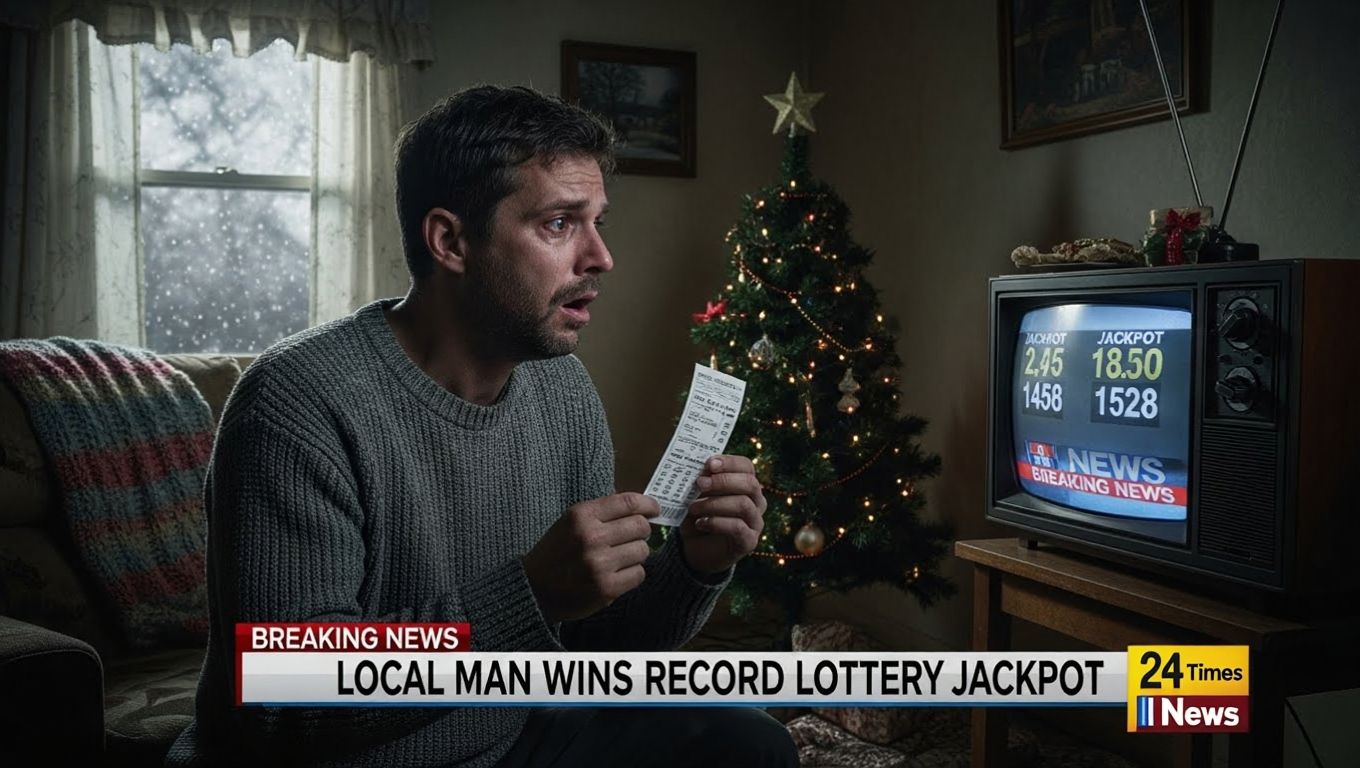
He spent his last $20 on a lottery ticket while his family struggled to keep the heat on for Christmas… But when the numbers rolled in, he realized his life had just become a national headline.


The wind in Arkansas cuts different in December. It doesn’t just blow; it bites, finding its way through the cracks in the window frames and the seams of worn-out coats. For Elias Thorne, a 54-year-old diesel mechanic in a town you’d miss if you blinked, the cold was the least of his worries. The stack of envelopes on the kitchen counter—specifically the red-stamped ones—was the real storm.

It was Christmas Eve. The house smelled faintly of cinnamon and pine, a valiant effort by his wife, Martha, to mask the scent of old drywall and anxiety. Elias sat in his truck in the driveway, staring at the steering wheel, his grease-stained hands trembling slightly. He had just finished a double shift, and his bank account balance was sitting at $42.18.

He had promised his grandson a bike. Not a fancy one, just something with two wheels and a chain that stayed on. He didn’t have the money. He didn’t have the money for the bike, or the heating oil refill, or the property tax hike that the county had so graciously mailed out three days prior.

He pulled the crumpled receipt from his pocket. Earlier that evening, in a moment of desperate, reckless superstition, he had stopped at the Sunoco on Route 65. He’d bought a gallon of milk, a loaf of bread, and with his last twenty-dollar bill, a Powerball ticket.

“Jackpot’s $1.8 billion, Elias,” the clerk, Old Man Miller, had wheezed. “Somebody’s gotta win it. Might as well be a sinner like you.”

Elias had laughed, a dry, humorless sound. He wasn’t a gambler. He was a worker. But desperation makes men do strange things.

He walked inside. The warmth of the house hit him, along with the sound of the TV. Martha was sitting on the sagging beige sofa, knitting a scarf that would likely be a gift for someone tomorrow.

“You look beat, Eli,” she said softly, not looking up. She knew. She always knew when the money was tight, which was always.

“Long day,” he grunted, hanging his coat. “Got the milk.”

They ate a quiet dinner of stew. The silence between them wasn’t angry; it was the heavy, comfortable silence of two people who had weathered thirty years of storms together and were just too tired to talk about the rain.

Christmas morning broke gray and slushy. The grandkids arrived at 9:00 AM, a whirlwind of energy that temporarily displaced the gloom. Elias watched them tear into the small, practical gifts they’d managed to scrape together. Socks, art supplies, a few plastic trucks. No bike. The twinge in his chest felt like a heart attack, but it was just shame.

Around noon, while the family was distracted by a movie, Elias retreated to the garage. He needed a cigarette, though he’d quit ten years ago. He settled for the solitude. He pulled out his phone. The drawing had happened last night, but he hadn’t had the heart to look.

He uncrumpled the ticket.
05 – 12 – 24 – 31 – 48. Powerball: 13.

He opened the lottery app. His connection was slow, the little wheel spinning like a mockery of his patience. Finally, the numbers popped up.

Winning Numbers:
05 – 12 – 24 – 31 – 48.
Powerball: 13.

Elias stared. He blinked. He wiped the screen with his thumb, smearing a bit of oil on the glass. He looked again.

The air in the garage suddenly felt very thin. The sounds of the house—the TV, the kids laughing—faded into a high-pitched ringing in his ears. He looked at the ticket. He looked at the phone.

Matches: 5 + PB.
Prize Amount: JACKPOT.
Estimated Cash Value: $1.817 Billion.

“No,” he whispered. His voice sounded like it belonged to someone else. “No, that’s… that’s a misprint.”

He refreshed the page. Same numbers. He went to a news site.
BREAKING: Single winning ticket for $1.8 Billion Powerball sold in Arkansas.

Elias sat down on an overturned bucket. The world tilted. $1.8 billion. It was a number so large it didn’t mean money anymore; it meant gravity. It meant nations. It meant he could buy the factory he worked at, fire his boss, and turn the building into a giant indoor park for his grandkids.

He couldn’t breathe. He stood up, knees buckling, and grabbed the workbench for support. He had to tell Martha. But how? How do you tell someone that the war is over? That the struggle that defined your entire adult life has just evaporated?

He walked back into the house. He looked like a ghost.

“Eli?” Martha asked, looking up from the kitchen table where she was counting out crackers for a tray. “You okay? You look pale.”

Elias walked over to her. He took the cracker box out of her hands and set it down.

“Martha,” he croaked.

“What? Is it the truck? Did the transmission go?” Her eyes instantly filled with the reflex of worry.

“No,” he said. He reached into his pocket and pulled out the slip of paper. He laid it on the table, smoothing it out with a trembling hand. Then he placed his phone next to it.

“Look.”

“I don’t have my readers, Eli, what is it?”

“Just look, Martha. Please.”

She squinted, leaning in. She looked at the phone. Then the ticket. Then the phone again. She froze.

“Eli,” she whispered, “Is this a joke? Because if this is one of your jokes, I swear…”

“It’s not a joke,” tears began to well in his eyes, hot and fast. “It’s real. The news… they said it was sold here. In Arkansas.”

Martha stood up. She covered her mouth with both hands. The silence in the kitchen was absolute, heavy with the weight of a billion dollars.

“We can fix the roof,” she whispered, her mind unable to grasp the magnitude, latching onto the immediate problems.

Elias laughed, a wet, sobbing sound. “Martha, we can buy the roofing company. We can buy the whole damn neighborhood.”

He pulled her into a hug, burying his face in her shoulder. They stood there in their drafty kitchen, holding onto each other as if the floor was falling away.

“The bike,” Elias sobbed into her sweater. “I can get him the bike.”

“You can get him a bike factory,” she cried, laughing through the tears.

They didn’t tell the kids yet. Not that day. They spent the rest of Christmas in a daze, looking at each other across the room, sharing a secret that burned brighter than the lights on the tree. Every time the wind rattled the windows, they didn’t flinch. Let it blow. They were warm now. They were safe.

The next day, Elias hired a lawyer and a financial advisor before claiming the prize. He didn’t show up to work on Monday. Or Tuesday. On Wednesday, he drove to the shop in his rusted Ford F-150 for the last time.

He walked into the office, handed his boss a resignation letter, and walked out. He didn’t make a scene. He didn’t brag. He just got back in his truck and drove to the bicycle shop in the city.

He bought the best bike in the store. Then, he went to the bank and paid off the mortgages of every house on his street. Anonymous donor, he told them.

It was the largest jackpot in history, but for Elias, the number didn’t matter. What mattered was the quiet drive home, the bike in the back, and the knowledge that the cold would never get in again.

Principal Too Scared To Move: Biker Takes Over School Hallway


They dragged me across the shattered trophy case, laughing as the scissors snapped through my hair… But they stopped laughing when the school doors exploded open and a Harley drove straight into the hallway.


The students at Crestwood High called the west wing corridor “The gauntlet,” but after Tuesday, everyone would remember it as the Hallway of Broken Glass.

I knew it was coming. I could feel the static in the air, the way the whispers stopped the moment I turned the corner. Jessica and her entourage were leaning against the lockers, a predatory stillness to them that made my stomach turn over. I hugged my sketchbook tighter to my chest—my only shield against a world that had decided I was nothing.

“Look, it’s the mute,” Jessica said, pushing off the locker. Her voice wasn’t loud; it didn’t have to be. It commanded the silence of the hallway.

I tried to walk past. I kept my eyes on the linoleum tiles, counting the scuffs. One, two, three, just get to Art class. Four, five…

A hand snagged my backpack, yanking me backward with such force that I stumbled. My sketchbook flew from my hands, sliding across the floor. Before I could scramble for it, a heavy boot stomped down on the cover, grinding the charcoal drawings into the dust.

“I didn’t say you could leave, Elara,” Jessica sneered.

The circle formed instantly. That was the worst part about high school violence; it was a spectator sport. Phones came out, recording lights blinking like little red eyes hungry for tragedy.

“Please,” I whispered, my voice cracking. “Just let me go.”

“She speaks!” Jessica mocked, grabbing a handful of my hair. “But you know, this hair is just… too much. It hides that pretty, scared little face.”

I saw the flash of silver before I registered what it was. Scissors. Stolen from the art room, no doubt.

Panic, cold and sharp, pierced my chest. I tried to pull away, but two of her friends grabbed my arms, pinning me. Jessica kicked the back of my knees, and I crumbled. I hit the floor hard, my shoulder slamming into the glass display case that held the football trophies.

CRASH.

The glass shattered, raining down on us. I felt a stinging slice on my cheek, but the pain was secondary to the sound of the scissors. Snip. A lock of my dark hair fell onto the broken glass.

“Oops,” Jessica laughed, holding up another chunk. “I think I’m doing you a favor. Let’s fix this mess.”

The hallway erupted in laughter. It was a jagged, cruel sound. I squeezed my eyes shut, tears leaking out, mixing with the blood on my cheek. I waited for a teacher, a principal, anyone. But the adults were conveniently absent, as always. I was alone.

Snip. Snip.

My scalp burned as she pulled harder, hacking away at the hair I’d been growing for three years. I felt naked. Violated. The humiliation was a physical weight, crushing the air out of my lungs.

“Look at her,” a boy shouted. “She looks like a rat!”

The laughter swelled, a tidal wave of noise drowning out my sobbing.

And then, the floor vibrated.

It wasn’t a footstep. It was a tremor. A low, guttural thrum that resonated through the soles of my shoes and rattled the remaining glass in the trophy case.

The laughter faltered. Heads turned toward the double doors at the end of the hallway—the main entrance to the school.

The sound grew. VROOOOM.

It was a mechanical roar, deep and angry, like a beast waking up in a cave. It got louder, and louder, until it wasn’t just a sound—it was a physical force shaking the lockers.

BOOM.

The double doors didn’t just open; they were kicked wide, slamming against the walls with a violence that silenced every single person in that corridor.

A Harley Davidson, completely blacked out, rolled over the threshold. The engine revved, a deafening thunderclap that made Jessica drop the scissors.

Riding it was a man who looked like he was carved out of granite and bad decisions. He wore a leather cut with a patch that the local police knew better than to mess with. His arms were covered in ink, his beard was gray and wild, and his eyes were hidden behind aviator shades.

Uncle Jax.

He didn’t stop at the door. He gunned the engine, the tires squealing on the polished floor. The crowd of students parted like the Red Sea, terrified screams replacing the laughter. He rode right down the center of the hallway, the smell of exhaust and gasoline overpowering the scent of cheap perfume and floor wax.

He skidded to a halt five feet from where I knelt in the glass and hair. The bike idled, a menacing chug-chug-chug that sounded like a heartbeat.

Jax killed the engine. The silence that followed was heavier than the noise.

He kicked the stand down and dismounted in one fluid motion. He was six-foot-four, a giant in a school of children. He took off his sunglasses, hooking them into his vest. His eyes were cold, hard flint.

He looked at me—at the blood on my cheek, the jagged, chopped hair, the tears. His jaw tightened, a muscle jumping in his cheek. Then, he looked at Jessica.

Jessica, the queen bee, the terror of Crestwood High, was trembling. The scissors clattered to the floor near her feet.

Jax took a step forward. The sound of his boots crunching on the broken glass was the only thing heard in the school.

“You holding those scissors,” Jax rumbled. His voice was gravel and smoke. “You the barber?”

Jessica opened her mouth, but no sound came out. She shook her head frantically.

“I asked you a question,” Jax roared, the volume making half the football team flinch. “DID YOU TOUCH HER?”

“I… we were just… playing,” Jessica squeaked, tears welling up in her eyes now.

Jax looked around the circle. He looked at the phones that were still recording, but now shaking in fearful hands. He looked at the boys who had been laughing.

“Playing,” Jax repeated. He bent down, picking up a long lock of my hair from the floor. He looked at it, then dropped it.

He walked up to Jessica. He didn’t touch her. He didn’t have to. He loomed over her, blocking out the fluorescent lights.

“Listen to me, and listen good,” Jax said, his voice dropping to a lethal whisper that carried down the hall. “Elara is my blood. You hurt her, you hurt me. And I don’t play by school rules. I don’t do detention.”

He leaned in closer. “If I ever hear that you even breathed in her direction again, I will bring the whole club down here. And we won’t be coming for a parent-teacher conference. Do you understand?”

“Yes,” Jessica sobbed.

“I can’t hear you!”

“YES!” she screamed.

Jax turned his back on her. He walked over to me, his demeanor shifting instantly. He crouched down, ignoring the glass digging into his jeans.

“Ellie,” he said softly. “You okay, kid?”

I shook my head, burying my face in his leather vest. I smelled tobacco and old leather and safety. He wrapped his massive arms around me, lifting me up as if I weighed nothing.

“Principal’s coming!” someone shouted.

Mr. Henderson came running down the hall, red-faced. “Sir! You cannot bring a motorcycle into a school! This is a—”

Jax stood up, holding me with one arm, and stared at the principal. “Where were you?”

Mr. Henderson paused. “Excuse me?”

“Where were you when my niece was getting assaulted?” Jax pointed to the glass, the hair, the blood. “You see this? This is on you. I’m taking her. And if you have a problem with that, you can talk to my lawyer. Or you can talk to me outside.”

Mr. Henderson looked at the shattered trophy case, then at the biker. He swallowed hard. “Take her home. We… we will handle the discipline here.”

“You better,” Jax warned. “Or I’ll handle it my way.”

Jax sat me on the back of the bike. “Hold on tight, Ellie.”

He put his sunglasses back on, kicked the engine to life, and the roar returned. He turned the bike around, the exhaust blowing Jessica’s perfectly styled hair into a frenzy.

As we rode out of the double doors, into the sunlight, I looked back one last time. The hallway was silent. The bullies were small, shrinking in the distance.

I reached up and touched my jagged hair. It would grow back. But the look of fear in their eyes when the Harley roared? That was permanent.

She Was Bleeding On The School Floor — Until A Harley Changed Everything


They laughed as they ripped my hair out and left me bleeding in the hallway… But the sudden roar of a Harley outside silenced the school and turned their triumph into terror.


The hallway of Oak Ridge High didn’t smell like floor wax and old lockers; to me, it smelled like copper and fear. My name is Elara, and for three years, I had been the designated ghost of these corridors. I moved against the walls, head down, trying to be invisible. But today, the “Elites”—a group of five girls led by the mayor’s daughter, Mackenzie—decided that being invisible wasn’t enough. They wanted me broken.

It started near the trophy case. A trip, a laugh, and then the crushing weight of hands. They dragged me into the blind spot of the hallway, a place the cameras didn’t quite reach. Mackenzie’s fingers were like talons as she grabbed a handful of my hair. I heard the sickening pop of follicles. The glass from a shattered framed photo of the last year’s homecoming queen—Mackenzie herself—lay scattered on the linoleum. They pushed my face toward it.

“You don’t belong in our world, Elara,” Mackenzie hissed, her voice a sharp contrast to the bubbly persona she wore for the teachers. “You’re a stain on this school. We’re just doing a little spring cleaning.”

The other girls laughed, a high-pitched, jagged sound that cut worse than the glass. One of them kicked my ribs, and I felt the air leave my lungs. I looked up, tears blurring my vision, seeing the blurred faces of students passing by. Some looked away. Some recorded with their phones. Nobody moved. The “Hallway of Broken Glass” was becoming my tomb of humiliation.

Then, the world changed.

It started as a vibration in the floorboards. A low, rhythmic thrumming that rattled the lockers and made the trophies in the case dance. It wasn’t the sound of a normal car. This was the guttural, primal scream of a heavy-duty Harley Davidson. The sound didn’t just approach; it invaded. It grew louder, a mechanical thunder that seemed to shake the very foundations of the school.

The grip on my hair loosened. Mackenzie looked toward the massive glass front doors of the lobby, just twenty feet away. The roar intensified until it was a deafening, physical force. Through the glass, a black-and-chrome beast skidded to a halt on the sidewalk, smoke curling from the tires.

The man who stepped off the bike looked like he had been forged in a furnace. He wore a worn leather vest with a patch that made the local police sweat—the “Iron Reapers.” He didn’t take off his helmet immediately. He just stood there, a dark silhouette against the afternoon sun, looking through the glass doors directly at the scene in the hallway.

It was my Uncle Jax. He wasn’t supposed to be out of the service for another month. He was the man who had raised me after my parents died, the man who had taught me that silence wasn’t weakness, but a choice.

The doors didn’t just open; they seemed to fly back on their hinges as he kicked them. The sound of his heavy boots on the linoleum was like a ticking clock counting down to someone’s doom. The entire hallway went silent. Even the kids with the phones lowered them.

Jax didn’t yell. He didn’t have to. He walked straight into the circle of girls. Mackenzie, usually so bold, looked like a panicked rabbit. She tried to stammer something about “it’s not what it looks like,” but Jax simply looked at her hand—still holding a clump of my hair—and then at my bleeding face.

“Pick it up,” Jax said. His voice was a low growl that vibrated in my chest.

“What?” Mackenzie whispered.

“The glass,” Jax pointed to the floor. “Pick up every single shard. With your bare hands. Or I start calling the names on the back of those leather jackets you’re so proud of, and we’ll see how your fathers like explaining why their daughters are being sued for aggravated assault by a man who has nothing left to lose.”

For the first time in three years, I wasn’t the one trembling. I watched as the most powerful girl in school dropped to her knees, her manicured fingers shaking as she began to pick up the jagged pieces of the homecoming photo. Her “friends” followed suit, sobbing quietly as the reality of the situation set in.

Jax reached down, his massive, calloused hand incredibly gentle as he tucked a stray lock of hair behind my ear. He didn’t care about the school rules, the social hierarchy, or the consequences.

“Get your bag, Elara,” he said softly. “We’re going home. And tomorrow, we’re coming back with a lawyer and the police. But for now… the roar is for you.”

As we walked out, I didn’t look back at the broken glass or the broken girls. I climbed onto the back of the Harley, gripped Jax’s leather vest, and as he revved the engine, the sound drowned out the last three years of misery. The school was silent, but for the first time, I felt like I was finally loud.

Hidden Camera Catches Evil Stepmom – What The Dog Did Next Is Legendary


She locked her weeping stepson on the patio because his muddy boots didn’t match her beige aesthetic… But she didn’t realize the retired K-9 unit next door was watching, and he was about to serve a brutal form of justice.

The house on Sycamore Drive was not a home; it was a showroom. It was a temple of beige, cream, and eggshell white, curated meticulously by Vanessa. Every cushion was karate-chopped to perfection, every surface was free of dust, and the air always smelled of expensive sandalwood. To Vanessa, the house was her brand. It was the backdrop for her rising career as a “lifestyle influencer,” a digital sanctuary where everything had its place.

Everything, that is, except for five-year-old Leo.

Leo was loud. Leo was messy. Leo was colorful. He was the remnant of her husband David’s previous life—a life before Vanessa—and to her, he was a stain on her pristine white carpet. David, a high-powered architect, was often away on business, leaving Leo at the mercy of a stepmother who viewed him less as a child and more as a continuity error in the movie of her life.

It was a Tuesday afternoon in late November. The sky was a bruised purple, heavy with the threat of a freezing storm. David had left that morning for a three-day conference in Chicago, kissing Vanessa on the cheek and ruffling Leo’s hair. “Be good for Vanessa, buddy. I’ll bring you back that Lego set.”

Two hours after David’s car disappeared down the street, the incident happened.

Leo had been playing in the backyard. The gardener had watered the flowerbeds earlier, creating a patch of irresistible, squelching mud near the hydrangeas. In the innocence of childhood, Leo had chased a squirrel, slipped, and landed knees-first in the muck.

When he approached the sliding glass back door, shivering slightly from the dropping temperature, he looked like a chocolate-dipped confection. His jeans were caked. His hands were filthy.

Vanessa was in the kitchen, setting up a ring light for a “Get Ready With Me” video. She glanced up as Leo put his hand on the glass. A muddy handprint smeared across the pristine pane.

Her eyes didn’t widen with concern for the child. They narrowed with a cold, reptilian fury.

She marched to the door, unlocked it, and slid it open just a crack. “What do you think you are doing?” she hissed.

“I fell,” Leo whimpered, his teeth starting to chatter. “I wanna come in. I’m cold.”

Vanessa looked at his boots. Then she looked at her imported Italian marble floors. Then she looked at the white rug in the living room.

“Absolutely not,” she said, her voice terrifyingly calm. “Look at you. You are disgusting. You ruin everything, Leo. Everything I touch, you ruin.”

“Please, Vanessa,” Leo cried. “It’s cold.”

“You should have thought about that before you decided to roll around in filth like a pig,” she snapped. “You can stay out there until you dry off. I am not having you destroy my aesthetic right before I film.”

“But it’s gonna rain!”

“Then let the rain wash you off,” she said.

She slammed the heavy glass door shut. Then, with a definitive click, she engaged the lock.

Leo pressed his face against the glass, sobbing, but Vanessa turned her back. She grabbed a bottle of glass cleaner and a cloth, wiped away his muddy handprint from the inside, and then pulled the sheer beige curtains closed, blocking him from view.

Inside, she poured herself a glass of Pinot Grigio, turned up the jazz music on the surround sound to drown out the muffled banging, and sat in front of her ring light. She smiled at her reflection. “Hi guys! So today we’re talking about decluttering your space for mental clarity…”

She didn’t know she was being watched.

Next door lived Arthur Miller. Arthur was a seventy-year-old widower, a man of few words and hard habits. He spent his days sitting on his back porch, smoking a pipe and reading history books. But Arthur wasn’t alone. By his side, always, was Rex.

Rex was a retired police German Shepherd. A Belgian Malinois mix, actually—100 pounds of muscle, scars, and intelligence. They had served together on the force for eight years. Rex had taken a bullet for Arthur once; Arthur had adopted him the second the dog was retired due to injury. Rex walked with a slight limp, but his eyes missed nothing.

Rex had been pacing the fence line for ten minutes. His ears were pinned back. He let out a low, rumbling whine that vibrated in his chest.

Arthur looked up from his book. “What is it, boy?”

Rex didn’t look at his master. He was staring through the gaps in the wooden privacy fence, his gaze fixed on the neighbor’s patio.

Arthur stood up, his joints popping, and walked over to the fence. He peered through a knot in the wood.

What he saw made his blood run cold.

The little boy, Leo, was curled into a ball on the concrete patio mat. The rain had started—not a drizzle, but a freezing, sleeting downpour. The temperature was dropping rapidly, likely nearing the thirties. The boy was soaking wet, shivering so violently his body was convulsing. He had stopped banging on the door; he was just hugging his knees, his lips turning a dangerous shade of blue.

Inside the house, through the gap in the curtains, Arthur could see Vanessa laughing at her phone, warm and dry, sipping wine.

“That witch,” Arthur growled.

Rex barked—a sharp, commanding bark that sounded like a gunshot.

“I know, Rex. I know.”

Arthur didn’t call the police immediately. He knew how these things went. It would take them twenty minutes to get here. The boy didn’t have twenty minutes. Hypothermia in a child that small, in wet clothes, was a silent killer.

“Rex,” Arthur said, his voice dropping into the command tone he hadn’t used in years. “Over.”

Most dogs couldn’t clear a six-foot fence. Rex wasn’t most dogs, and the adrenaline of the mission ignored the arthritis in his hip. He backed up, scrambled up the wood like a cat, and vaulted over into Vanessa’s yard.

Arthur ran to his garage, grabbing a ladder and a crowbar, just in case.

Rex landed on the wet grass and immediately ran to Leo. The dog didn’t bark now. He went into protection mode. He lay down next to the freezing child, curling his massive, warm body around the small boy, shielding him from the wind and rain. He began licking Leo’s face, stimulating circulation, his rough tongue clearing away the freezing rain.

Leo, barely conscious, buried his face in the dog’s thick fur. “Doggy,” he whispered.

Arthur threw the ladder over the fence and climbed over. He hit the ground running. He scooped Leo up in his arms—the boy felt like a block of ice.

“I got you, son. I got you,” Arthur said.

Rex stood up, shaking the water from his coat. He looked at Arthur, then he looked at the glass door.

“Guard,” Arthur commanded, pointing to the spot where Leo had been lying.

Arthur carried the boy back over the fence to his own warm house, wrapping him in wool blankets and cranking the heat. He called 911. “I have a child with severe hypothermia. Child abuse in progress. Send an ambulance and a squad car. Now.”

Then, he called David. He had David’s number from when a tree branch fell on the property line year ago.

“Arthur? Is everything okay?” David asked, sounding distracted.

“David, come home. Now. Or you won’t have a son to come home to.”


Back in the beige house, Vanessa finished her livestream. She felt good. The lighting had been perfect. She stood up and stretched. The rain was hammering the roof now.

“Oh, right,” she muttered. “The brat.”

She walked to the sliding glass door and pulled back the curtain, expecting to see a miserable, compliant child ready to apologize for being dirty.

Instead, she saw nothing. The patio was empty.

Panic, cold and sharp, spiked in her chest. Not concern for Leo, but concern for herself. If he wandered off… if the neighbors saw…

She unlocked the door and slid it open. “Leo? You can come in now!”

A low, guttural growl emerged from the shadows of the patio furniture.

Vanessa froze.

From the darkness, Rex stepped forward. He stood between her and the yard. His teeth were bared, white daggers in the gloom. The fur on his back was standing straight up. He wasn’t just a dog; he was a weapon, and he was currently armed and pointed at her.

“Shoo! Get away!” Vanessa shrieked, waving her hand.

Rex didn’t flinch. He took a step forward, snapping his jaws. The message was clear: You are the threat. You do not move.

Vanessa slammed the door shut and locked it, her heart hammering. She peered out. The dog was still there, sitting like a statue in the freezing rain, watching her. Guarding the crime scene.


The next hour was a blur of flashing lights.

The ambulance arrived first, taking Leo and Arthur to the hospital. The police arrived seconds later. Vanessa tried to play the victim.

“I don’t know where he went!” she sobbed to the officers in her living room, having quickly hidden the wine. “I turned my back for one second to stir the pasta sauce, and he must have run away! And there’s this vicious dog outside holding me hostage!”

The officer, a young rookie, looked sympathetic. Until the front door flew open.

It wasn’t David. It was Sgt. Miller (Arthur), who had refused to stay at the hospital once Leo was stable, hitching a ride back with a patrol car. And he had video.

“Save your tears,” Arthur said, his voice gravel. He held up his smartphone.

He played the video he had recorded through the fence before sending Rex over. The video showed Leo shivering, banging on the glass. It showed Vanessa visible through the window, laughing, drinking wine, and fixing her hair while the child froze. It showed the time stamp. 45 minutes.

The rookie officer’s face went hard. “Ma’am, stand up and put your hands behind your back.”

“You can’t do this! I have a brand deal tomorrow!” Vanessa screamed as the cuffs clicked. “He was muddy! He was going to ruin the rug!”

“You’re going to ruin a jail cell, lady,” the officer muttered.

As they walked her out to the cruiser, David’s car screeched into the driveway. He had driven 100 miles an hour to get back. He saw his wife in handcuffs. He saw Arthur standing by the ambulance where the paramedics were checking on a now-stable but traumatized Leo who had been brought back to the scene to identify the situation.

David looked at Vanessa. “Arthur told me everything. He sent me the video.”

“David, baby, I was teaching him a lesson!” Vanessa pleaded. “He was messy!”

David looked at her with pure disgust. “I’m filing for divorce tomorrow. And I’m suing you for everything you have.”

He ran to the ambulance, scooping Leo up, burying his face in his son’s neck, weeping. “I’m so sorry, Leo. I’m so, so sorry.”

Standing by the ambulance was Rex. The paramedics had dried him off with a towel. David looked at the old dog, then at Arthur.

“Thank you,” David choked out. “You saved his life.”

Arthur patted Rex’s head. “He knew a bad apple when he saw one. We just did the job.”

The Aftermath:

Vanessa was charged with felony child endangerment and neglect. The video went viral—not the way she wanted. Her “brand” evaporated overnight. The internet named her “The Beige Monster.” She lost her sponsorships, her friends, and eventually, her freedom.

David sold the house. He said it felt too cold. He and Leo moved into a cozy place with big yards and hardwood floors that could handle mud.

And every Sunday, Leo goes next door to Arthur’s house. He plays fetch with Rex. And even though Rex is getting slower and his muzzle is greyer, he always watches Leo. Because Rex knows that his watch never really ends.

My K9 Risked His Life To Stop The Crusher — What Was Inside Is A Crime Against Humanity


The manifest clearly stated the crate contained “Antique Vases” marked for the industrial crusher… But my K9 partner just threw his body over the box, and the muffled sob from inside stopped my heart.


The Port of Long Beach is a graveyard of secrets, a labyrinth of steel skeletons and salt-crusted air where things go to be forgotten. I’ve worked Terminal 4 for twelve years, accompanied by Jax, a Belgian Malinois whose nose is more accurate than any X-ray scanner the government ever bought us. Usually, our nights are a monotonous rhythm of checking seals and sniffing for narcotics. But Tuesday was different. The air felt heavy, charged with the static of an approaching storm.

Among the “Class D” disposal list—items abandoned by overseas shippers or seized due to unpaid customs—was a single, oversized crate. The manifest, stamped with an official-looking seal from an obscure gallery in Istanbul, listed the contents as “Damaged Terracotta Vases – Insurance Salvage.” It was slated for the heavy-duty industrial crusher at 3:00 AM.

I watched as the automated forklift deposited the crate onto the conveyor belt. It looked like any other weathered plywood box, reinforced with steel bands. Jax, usually calm during disposal runs, suddenly stiffened. His ears pinned back, and a low, guttural vibration started in his chest—a sound he only made when he detected a threat, or a miracle.

“Easy, Jax,” I muttered, checking my watch. The crusher hummed to life, its massive hydraulic teeth glinting under the sickly yellow sodium lights of the warehouse.

As the crate edged toward the intake maw, Jax broke his sit-stay. He didn’t just bark; he launched himself. He flew across the concrete floor, his claws skidding for a moment before he leapt onto the moving belt. He threw his sixty-pound frame directly over the plywood box, snapping his jaws at the air, refusing to let it move another inch toward the crushing zone.

“Jax! Down! Get off!” I screamed, lunging for the emergency stop button. The machinery groaned and ground to a halt just inches from his tail.

The silence that followed was deafening. I grabbed Jax by the harness, ready to scold him, but he wasn’t looking at me. He was whimpering, pressing his ear against the wood, his tail tucked low. And then, I heard it. It wasn’t the rattle of ceramic or the shifting of packing peanuts. It was a rhythmic, frantic scratching. And then, a tiny, muffled sob that sounded impossibly human.

My hands shook as I grabbed a crowbar from the nearby tool rack. “Antique vases,” the manifest had said. I jammed the metal tip under the lid and heaved. The wood groaned and splintered. I expected to find padding or bubble wrap. Instead, as the lid gave way, I saw a false floor.

Beneath the thin layer of actual broken terracotta sat a small, cramped compartment lined with acoustic foam. My flashlight beam cut through the darkness, illuminating a pair of wide, terrified eyes. A girl, no more than six years old, clutched a tattered teddy bear. She was shivering, her face pale from days in the dark. Beside her was a small oxygen tank that was nearly empty.

This wasn’t an insurance salvage. This was a high-tech smuggling operation disguised as junk. If Jax hadn’t jumped, she would have been crushed into nothingness, her existence erased by a bureaucratic error and a fraudulent manifest.

But the horror didn’t end there. As I lifted her out, Jax turned toward the warehouse entrance, his hackles rising again. Two black SUVs were pulling through the gate, their headlights off. The men who had “abandoned” this crate weren’t done with their cargo.

I realized then that the “Antique Vases” label wasn’t just a lie to get past customs—it was a death warrant. Someone had paid for this crate to be destroyed. Someone didn’t want this child to reach her destination; they wanted her to disappear in the most untraceable way possible.

I pulled the girl close to my chest, Jax flanking us with a terrifying snarl. I didn’t have backup, and the radios were dead in this part of the terminal. We had to move. We ran through the maze of shipping containers, the sound of heavy boots echoing behind us. Jax led the way, navigating the shadows like a ghost. He wasn’t just a K9 anymore; he was a guardian of a life the world had tried to grind into dust.

We spent four hours playing a deadly game of cat and mouse among the steel towers. Every time the men got close, Jax would create a distraction—knocking over a stack of pallets or barking from a distant row—drawing them away from where I hid with the girl.

When the sun finally began to bleed over the horizon, the sirens of the Port Authority finally pierced the air. The “collectors” vanished into the morning fog, leaving behind a trail of unanswered questions.

The girl, whose name I later learned was Elara, hadn’t spoken a word until we reached the infirmary. She looked at Jax, who was sitting vigilantly at the foot of her bed, and whispered, “The angel with the fur… he heard me.”

The manifest said antique vases. The system said she didn’t exist. But Jax knew better. Now, I keep the manifest on my desk—a reminder that some things are too precious to be crushed, and that sometimes, the only thing standing between life and a terrible end is a dog who refuses to follow orders.

Watch: Hero K9 Jumps Into Industrial Shredder To Save Trapped Children


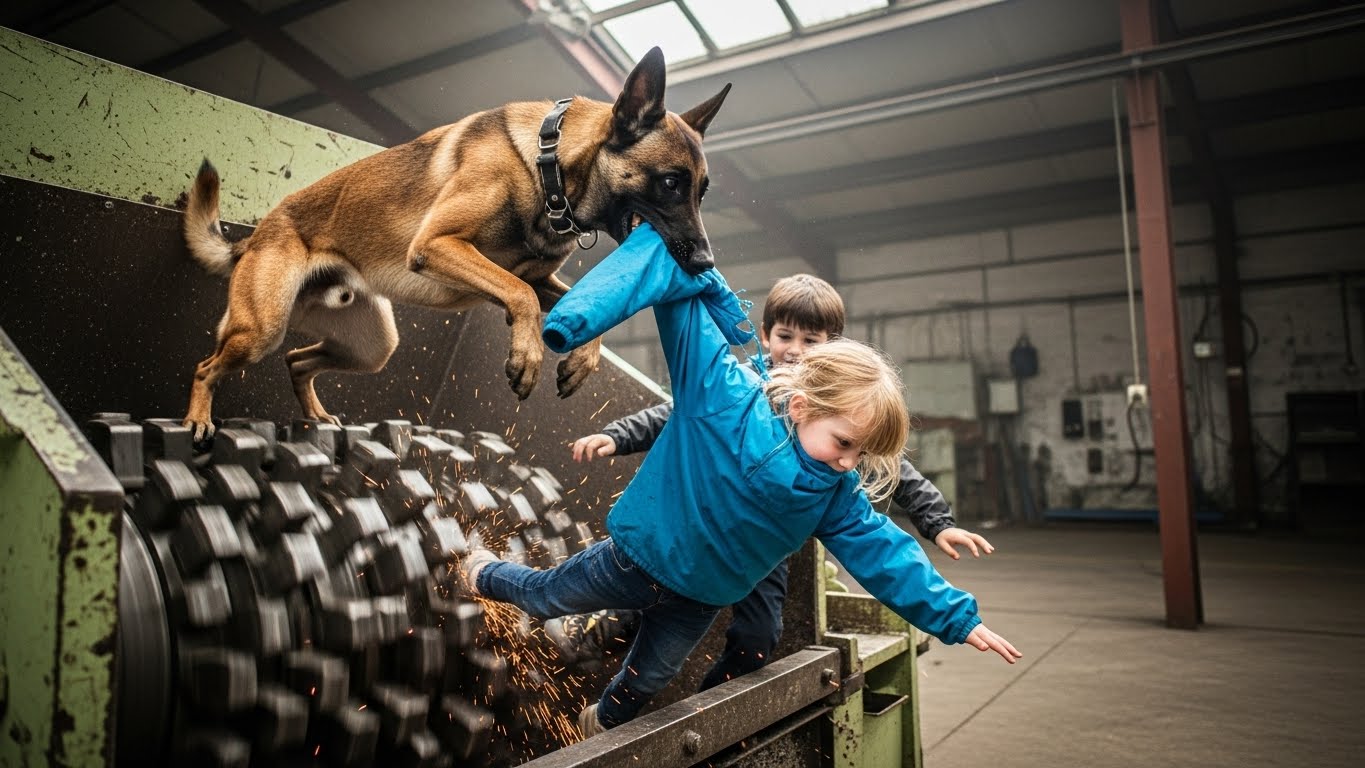
The manifest listed the crate as counterfeit ceramics to be destroyed, but my K9 partner just threw himself into the industrial crusher to stop it… And then I heard the whimpering.

The rain at the Port of Tacoma doesn’t wash things clean; it just makes the grime slicker. It was 2:00 AM on a Tuesday, the kind of graveyard shift that feels less like law enforcement and more like industrial waste management. My name is Officer Elias Thorne, and for the last six years, my partner has been a seventy-five-pound Belgian Malinois named Kaiser.

We were working the “Burn and Turn” detail. That’s slang for the destruction of seized counterfeit goods. It’s the unglamorous end of Customs and Border Protection. We catch the stuff, the legal team signs off on it, and then we watch it get fed into a massive industrial shredder or a hydraulic crusher depending on the material. Tonight, it was a mixed load: fake designer handbags, bootleg electronics, and a pallet marked “Fragile: Antique Vases – Replica/Counterfeit.”

The manifest claimed the vases were cheap plaster knockoffs of Ming dynasty pottery, seized due to lead paint regulations and copyright infringement. They were slated for the crusher.

“Come on, Thorne, let’s move it,” yelled Henderson, the yard foreman. He was sitting in the elevated cab of the claw crane, a cigar unlit in his mouth. “I got a union break coming up in twenty minutes and three pallets to clear.”

“Hold your horses, Henderson,” I muttered, tugging my collar up against the freezing drizzle. Kaiser was at my heel, but he was acting off. Usually, around the machinery, he’s distinctively calm—a statue of disciplined muscle. But tonight, he was pacing. His ears were swiveling like radar dishes, and a low, vibrating whine was emanating from his throat.

“What is it, boy?” I whispered, resting a hand on his wet fur. He didn’t look at me. His amber eyes were locked on the conveyor belt.

The belt was a loud, rattling beast of rubber and steel that fed objects into the ‘Maw’—a hydraulic crushing chamber designed to pulverize rock, let alone plaster vases. The noise was deafening: the groan of hydraulics, the screech of metal, and the relentless hum of the generator.

Henderson dropped the pallet of “vases” onto the loading ramp. The crate was wood, roughly four feet by four feet, stamped with red Chinese characters and the English words FRAGILE and CERAMICS.

Kaiser went rigid. The hair along his spine stood up in a jagged ridge.

“Scan complete,” I called out, half-heartedly waving the wand over the box. The density scanner had cleared it earlier that week, but protocol demanded a visual check. I walked toward it to cut the straps.

“Clear!” Henderson shouted, his hand hovering over the ‘engage’ button for the belt.

I reached for the crate. Suddenly, Kaiser broke his “Heel” command. He didn’t just break it; he exploded.

He lunged forward, snapping the leash taut so hard it burned my glove, nearly dislocating my shoulder. He wasn’t attacking me; he was trying to get to the box. He slammed his front paws against the wood, barking—not his alert bark, but his distress bark. High-pitched, frantic, piercing.

“Kaiser! Aus! Down!” I shouted, trying to regain control.

He ignored me. That never happens. He began tearing at the wood with his teeth, splinters flying.

“Get your dog under control, Thorne!” Henderson yelled over the comms. “I’m starting the belt!”

“Wait! Henderson, hold on!” I waved my arms.

But Henderson was already looking down at his clipboard, and the belt lurched forward. The crate, with Kaiser still scratching at it, began to move toward the crusher. The Maw was ten feet away, its steel teeth rotating slowly, hungry for the load.

Kaiser didn’t retreat. He jumped onto the moving belt.

Panic, cold and sharp, spiked in my chest. “NO! KAISER, OFF!”

The dog stood his ground between the crusher and the crate, bracing his legs against the rubber belt, pushing his chest against the heavy wooden box as if he could physically stop the tons of torque driving it forward. He looked back at me, his eyes wide with a terror I had never seen in an animal before.

I didn’t think. I sprinted.

I vaulted the safety rail, landing hard on the slick concrete, and scrambled toward the emergency shut-off panel on the side of the machine. The belt was moving fast. The crate was five feet from the teeth. Kaiser was slipping, his claws scrabbling on the wet rubber.

I slammed my fist into the red mushroom button.

CLUNK.

The hydraulics hissed. The belt groaned and shuddered to a halt. The silence that followed was heavy, broken only by the rain and my own ragged breathing. The crate was teetering on the lip of the crusher. Kaiser was panting, licking the side of the box.

“Are you crazy?” Henderson screamed, climbing down from his cab. “You can’t just kill the line like that! Do you know the paperwork involved in an emergency stop?”

I ignored him. I climbed up onto the belt, my boots slipping. “Kaiser, here. Now.”

The dog wouldn’t move. He nudged the box with his nose, then looked at me and whined again.

I pulled out my serrated knife. “If there are drugs in here, Henderson, you’re going to wish you kept your mouth shut,” I said, my voice trembling with adrenaline.

I jammed the knife under the lid of the crate. The wood groaned. I pried it up. One nail popped. Then another. I ripped the top plank off.

Inside, there were no vases. There were no drugs.

Packed tight in Styrofoam peanuts and dirty straw, there was a small cage. And inside the cage, huddled together, were three creatures.

At first, my brain couldn’t process what I was seeing. They looked like small, furless monkeys. But as the rain hit them, one of them turned its head. It wasn’t a monkey.

It was a child.

A human child.

I dropped the knife. It clattered onto the metal belt.

The sound that came out of the box wasn’t the sound of ceramics breaking. It was a terrifying, low moan of a child too weak to cry. There were three of them, curled into a ball for warmth, malnourished, their skin grey in the harsh floodlights. They couldn’t have been more than five years old.

“Oh my god,” Henderson whispered. He had climbed up behind me. The cigar fell from his mouth.

I ripped the rest of the wood away, my hands shaking so bad I could barely grip the planks. Kaiser was right there, licking the face of the child closest to the edge. The child didn’t recoil; he leaned into the dog’s warmth.

“Radio dispatch,” I choked out, tears mixing with the rain on my face. “Get EMS. Get the port commander. Get everyone.”

We got them out. They were severely dehydrated, drugged to stay quiet, and suffering from hypothermia, but they were alive. The manifest had been swapped. The ‘Vases’ were a cover for a high-end trafficking ring moving ‘product’ through the waste disposal channels to avoid the standard exit checks. They assumed no one checked the garbage.

They didn’t account for Kaiser.

Later that night, after the ambulances had left and the crime scene tape was fluttering in the wind, I sat in the back of the ambulance with a thermal blanket around my shoulders. Kaiser was sitting at my feet, chewing on a treat the EMTs had given him.

The Port Commander walked over, looking pale. “Thorne,” he said. “The density scanner… the logs show it was tampered with. It was looped. If you hadn’t stopped that belt…”

He didn’t finish the sentence. He didn’t have to.

I looked down at Kaiser. He wasn’t just a dog. He was the only thing standing between three innocent souls and the machinery of death. He rested his head on my knee and let out a long, contented sigh.

The manifest said ‘Antique Vases.’ I will never trust a piece of paper again. But I will trust this dog with my life, and the lives of anyone else, until the day I die.