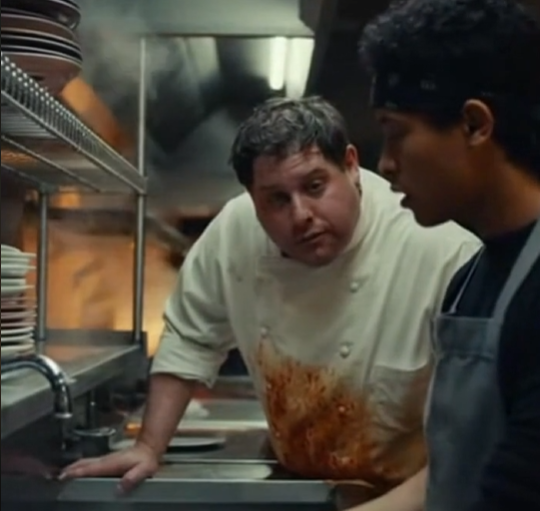
A dishwasher was quietly working when a chef humiliated him in front of the entire kitchen… But what the manager did next left everyone speechless.
Marcus had been washing dishes at Giovanni’s for three years. Every night, he arrived at 5 PM, tied his apron, and disappeared into the steam and clatter of the dish pit. He never complained. Never asked for recognition. He just showed up, did his work, and went home to his small apartment where his daughter waited for him.
Thursday nights were always the worst. The restaurant would be packed, tickets flying, chefs screaming orders across the line. Marcus would be elbow-deep in scalding water, scrubbing pans crusted with carbonara and burnt marinara, his hands raw and pruned.
That particular Thursday started like any other. The dining room was full, the kitchen was chaos, and Marcus was moving as fast as he could to keep clean plates flowing. But he was one person, and the kitchen had five chefs all demanding their tools back immediately.
“Where are my sauté pans?” Chef Derek bellowed, his face red and shining with sweat. He was the sous chef, second-in-command, and he’d been increasingly volatile lately. Word around the kitchen was that he was angling for the head chef position and trying to prove himself.
“Coming in two minutes,” Marcus called back, not looking up from the industrial sink.
“Two minutes? I needed them five minutes ago!” Derek slammed his hand on the counter. “What the hell are you even doing back there?”
Marcus bit his tongue. He’d learned long ago that arguing never helped. He just worked faster, his movements becoming more frantic as he tried to scrub the pan clean.
But Derek wasn’t done. He stormed over to the dish pit, his chef’s whites spotted with sauce, his eyes wild with kitchen stress. “You know what your problem is? You’re slow. You’re always slow. My grandmother could wash dishes faster than you, and she’s been dead for ten years.”
The kitchen went quiet. Even the line cooks, normally too busy to notice anything, glanced over. This had crossed a line, and everyone knew it.
Marcus’s jaw tightened. His hands, submerged in soapy water, gripped the edge of the sink. But he didn’t respond. He couldn’t afford to lose this job. His daughter needed new school supplies. The rent was due in a week.
“What, nothing to say?” Derek leaned against the dish pit entrance, a cruel smile on his face. “That’s what I thought. Just keep your head down and wash faster, yeah? That’s all you’re good for anyway.”
Something inside Marcus cracked. Not into anger, but into something worse—resignation. The belief that maybe Derek was right. That this was all he was worth.
He was about to go back to scrubbing when a voice cut through the kitchen like a knife.
“Derek. My office. Now.”
Everyone turned. Standing in the kitchen doorway was Sarah Chen, the general manager. She was small, barely five-foot-three, but she carried herself with an authority that made everyone stand a little straighter. She’d been in the back office doing inventory and had apparently heard everything.
Derek’s smug expression faltered. “Sarah, I was just—”
“Now.” Her voice was ice.
Derek glanced around the kitchen, looking for support, but every head was down, every chef suddenly very interested in their station. He untied his apron and followed Sarah out.
The kitchen stayed quiet for a moment, then slowly the sounds resumed. Orders being called. Pans hitting burners. But everyone was listening, straining to hear what was happening in the office down the hall.
Marcus went back to washing dishes, but his hands were shaking.
Fifteen minutes later, Derek emerged from the office. His face was pale, his swagger completely gone. He walked to his station, grabbed his knife roll, and left without a word. He didn’t even look at Marcus.
Sarah appeared in the kitchen doorway. “Can I get everyone’s attention for a moment?”
The kitchen stopped again. Every chef, every prep cook, every server passing through turned to face her.
“Derek is no longer with us,” she said simply. “And I want to make something very clear. This kitchen operates on respect. Every single person here—from the executive chef to the dishwasher—is essential to what we do. We don’t talk down to each other. We don’t demean each other. And we sure as hell don’t humiliate each other in front of our colleagues.”
She paused, letting her words sink in.
“Marcus has been with us for three years. He shows up every single night, does one of the hardest jobs in this building, and never complains. He deserves the same respect as anyone else wearing an apron. If you can’t treat your coworkers with basic human decency, you don’t belong in my kitchen. Are we clear?”
A chorus of “Yes, chef” rippled through the room.
Sarah’s expression softened slightly. “Good. Now let’s get back to service. We’ve got a full house and we’re down a sous chef, so everyone needs to step up.”
The kitchen exploded back into motion, but something had shifted. As the night went on, Marcus noticed small changes. A line cook brought him a bottle of water during a lull. Another chef thanked him when he brought out clean pans. The head chef, usually gruff and distant, stopped by the dish pit.
“You good?” he asked Marcus.
Marcus nodded, not trusting his voice.
“Derek was out of line,” the chef continued. “Way out of line. You do solid work. Don’t let anyone tell you different.”
After service ended and the kitchen was clean, Marcus was gathering his things when Sarah approached him.
“Marcus, do you have a minute?”
His stomach dropped. Was he in trouble somehow?
They walked to her office, and she gestured for him to sit. “First, I want to apologize. That should never have happened. Derek’s behavior was completely unacceptable, and I should have addressed his attitude issues before tonight.”
“It’s okay,” Marcus said quietly.
“No, it’s not.” Sarah leaned forward. “I’ve been reviewing our staffing, and we’re going to need someone to step up with Derek gone. I know you’ve been working dish for three years, but I also know you have line experience from your previous job.”
Marcus looked up in surprise. He’d mentioned it once, briefly, during his interview. He hadn’t thought anyone remembered.
“How would you feel about training on the line? We’d start you on prep, see how you do, and go from there. It would mean a raise, better hours, and honestly, we could use someone with your work ethic in a more visible position.”
Marcus felt his throat tighten. “I… I don’t know what to say.”
“Say yes,” Sarah smiled. “You’ve earned it. And Marcus? In this restaurant, everyone matters. Don’t ever let anyone make you feel like you don’t.”
Three months later, Marcus was working the garde manger station, plating salads and appetizers with precision. He’d proven himself quickly, his quiet competence and attention to detail making him a natural fit for the line. The raise had meant he could finally afford to move his daughter into a better school district.
But more than that, something else had changed. The kitchen culture had shifted. People said “please” and “thank you” more often. When someone was drowning in tickets, others jumped in to help without being asked. And when a new dishwasher started, nervous and overwhelmed on his first night, it was Marcus who brought him water and told him he was doing great.
Because he remembered what it felt like to be invisible. To be treated as less than. And he remembered what it meant when someone finally stood up and said, “Not in my kitchen.”
Respect, he’d learned, wasn’t just about avoiding cruelty. It was about recognizing the humanity in every person, no matter their role. It was about understanding that everyone who showed up and did their job with dignity deserved to be treated with dignity in return.
And it started with someone brave enough to draw the line and say, “This ends now.”
Giovanni’s never forgot the lesson that Thursday night taught them. Some restaurants run on fear and hierarchy. But the best ones—the ones where people actually want to come to work—run on something simpler and more powerful: basic human respect. And that starts at the top, with leaders willing to protect the people others might overlook.
Because in the end, kindness at work isn’t about grand gestures or motivational speeches. It’s about the small moments when you stand up for the person who can’t stand up for themselves. It’s about recognizing that every role matters, and every person deserves dignity.
That’s the kind of kitchen worth working in. That’s the kind of workplace worth building.
And it all started with a manager who heard someone being disrespected and said, simply, “Not here. Not ever.”