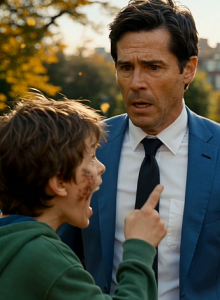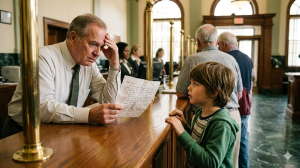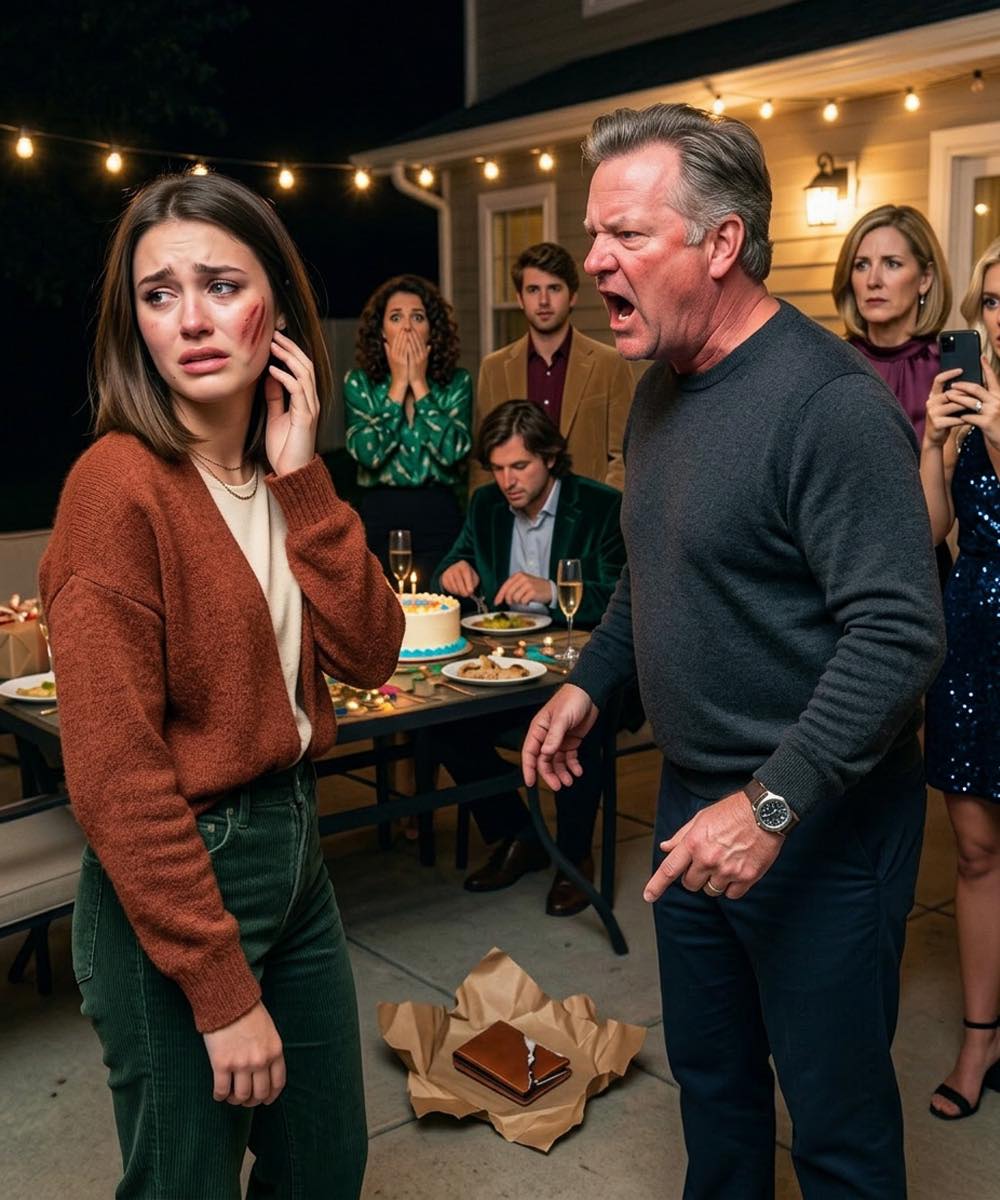

My father hit me on his fifty-fifth birthday because I gave him a wallet.
Not a bad wallet. A real one — tan leather, hand-stitched edges, a small gold monogram pressed into the corner. I had chosen it from a display case at a boutique on Mulberry Street, and the woman behind the counter had wrapped it in brown paper and tied it with a length of cord without me asking her to. I remember watching her hands. I remember thinking: someone is going to do something kind for me today, even if it’s a stranger.
I had saved for it over three months, skimming tip money from my jar on the windowsill of the storage closet I called a bedroom — a basement room with no window, a water-stained ceiling, a mattress Gerald Talbot had dragged in from someone’s curb when I was nine years old and never replaced. Every Thursday after my dishwashing shift at Rosie’s Roadhouse I’d sit on the edge of that mattress and count the bills. Eight dollars. Seventeen. Thirty-one. Sixty. Eighty-four.
I told myself the number like a prayer.
Eighty-four dollars. For the man who had raised me.
The party was held on the back patio, strung with amber lights, catered by the Italian place Gerald liked on the other side of town. Thirty people. Neighbors, colleagues, members of his poker group. His wife Donna wore a green dress and carried a clipboard. His daughter Megan, my adoptive sister, had arrived from college for the weekend and moved through the guests with the easy authority of someone who had never once wondered if she belonged somewhere.
I had been assigned the job of greeting people at the door, taking coats, and making sure the cooler stayed filled with ice.
No one had assigned me a seat at the tables.
I gave him the wallet just after the cake, when the small crowd had gathered around him in a loose semicircle and someone said, “Gerald, open your presents.” I had wrapped it myself in the same brown paper the boutique woman had used, and I handed it to him with both hands, the way you hand something fragile to someone you respect.
He tore the paper off without looking at me.
He looked at the wallet.
He looked at me.
And then the sound cracked across the patio — sharp and flat and final, like a board splitting — and my head was turned sideways, and the champagne flute near my elbow was falling, and a voice was saying: “What kind of worthless junk is this? Three months and this is all you could get me?”
I tasted blood where my teeth had caught the inside of my cheek.
Everyone froze.
Thirty people, amber lights, the sound of a song coming from a bluetooth speaker inside the house — and total silence. The kind of silence where you can hear someone shift their weight on a patio chair. The kind where no one breathes.
My adoptive mother Donna looked down at her plate.
Megan raised her phone.
Only our next-door neighbor, Ruth Kessler — sixty-two, a retired school librarian with steel-gray hair and no tolerance for cruelty — stood up from her chair.
“Gerald,” she said clearly. “That was uncalled for.”
“Stay out of my family business, Ruth.”
She sat back down. But she didn’t look away from me. Not once, for the rest of the night.
I bent and picked up the wallet from where he had dropped it. I put it in the pocket of my good pants — the dark ones I only wore for things that mattered — and I walked back into the house and down to the basement.
I sat on the mattress for a long time.
I’m not sure how long. Long enough for the party noise to swell back up above me, for the laughter to return, for the music to change. Long enough to stop shaking.
Then I thought: I have been waiting my whole life for this house to start feeling like home.
It never has. It never will.
I pulled my backpack off the wall hook and packed everything that was mine: two shirts still clean from the laundry, one pair of jeans without a tear in the knee, my toothbrush, my phone charger, and the three hundred forty dollars I’d been keeping in a cut-out space behind the back panel of my desk drawer. I packed the leather wallet too. I wasn’t going to leave it there.
And then I packed the envelope.
I had found it four months earlier while emptying a trash box Gerald had left by the recycling bins — one of those document purges he did twice a year, feeding old files through the shredder in his study. I’d spotted the Virginia state seal through a torn corner. I didn’t know exactly what the form inside meant, but it had my name on it — my original name, the one no one in this house ever used — and the phrase adoption assistance disbursement summary.
I had hidden it without knowing why. Instinct, maybe. The same instinct that told you to save certain things even when you didn’t understand their value.
I put it in my backpack.
I walked upstairs. Through the sliding glass door I could see Megan showing the video to two of Gerald’s friends, tilting the screen toward them, watching them flinch. Gerald was laughing at something across the patio. Donna was refilling wine.
No one saw me walk out the front door.
October had arrived cold that year. The air stung my left cheek, which still pulsed with heat under the surface. I walked down Patterson Avenue with the backpack straps pressing into my shoulders and no destination in my head — only the clean, simple idea of away.
I had made it perhaps two miles when the headlights appeared behind me.
A black Cadillac Escalade slowed at the curb, keeping pace with me for half a block before stopping. The rear door opened. A tall man in a dark coat stepped out. Behind him, a woman with red hair and a leather portfolio stepped out from the opposite side of the vehicle.
The man’s hands were shaking.
Under the streetlamp he looked to be in his mid-forties, with strong cheekbones and dark hair going silver at the sides. But it was his eyes that stopped me — hazel green, wide-set, bracketed by the same slight downward tilt at the outer corners that I had studied in bathroom mirrors my entire life. I had assumed, for as long as I could remember, that my eyes were unusual. Distinctive. Mine alone.
They were looking at me from another face.
He stopped a few feet away and stood very still, the way you stand near a wild animal you don’t want to startle. His hands were still shaking. He pressed them together in front of him, then released them, then pressed them together again.
“I’m sorry to frighten you,” he said quietly. “My name is Richard Whitford.”
A pause.
“And I believe I’m your biological father.”
—
I didn’t get into the Escalade because I believed him.
I got in because he knew my mother’s name.
He said it in that same quiet voice, without preamble: “Your mother was Catherine Whitford. She had auburn hair. Her smile went slightly to the left — you do the same thing, when you think no one is watching.”
The red-haired woman — his attorney, Margaret Hale — held a manila envelope under the streetlight and drew out a photograph.
The woman in the photograph had my face. Not just resemblance — my face, arranged on someone else’s features, someone older, someone looking at the camera with an expression of joy so complete that it had no distance in it. She was holding a toddler with hazel-green eyes. The toddler looked uncertain and delighted at the same time, the way small children look when the world is still entirely new.
“Catherine died in a car accident,” Richard said. “When you were two years old. I was in the passenger seat. I spent three months in the hospital. By the time I could stand upright, you had been placed in emergency foster care, and by the time I could drive myself to the courthouse, the paperwork had been signed.”
“Signed,” I said.
“There’s a form with my signature on it. A relinquishment of parental rights. Except —” He stopped. The muscle in his jaw moved. “I never signed it.”
Margaret opened the portfolio.
—
The hotel suite smelled like fresh linen and room service coffee. Margaret spread the documents across the low table in the sitting room while Richard sat across from me in an armchair with his hands loosely clasped, watching me the way someone watches a candle in a draft — careful, a little frightened, but unable to look away.
She walked me through it methodically.
Richard had been challenging the adoption for years. He had hired investigators, filed records requests, consulted forensic document experts. The court record showed a relinquishment form dated two weeks after the accident. The handwriting expert Margaret had already retained believed the signature was not Richard’s. There was a discrepancy in the notary seal. There was a social worker named Leonard Grubb who had processed my placement — and who, according to financial records Margaret had subpoenaed, had received a payment of five thousand dollars from a Gerald Talbot eighteen days before my adoption was finalized.
The room went very quiet when she said that.
“They paid someone,” I said.
“We believe so. We’re still building the case.”
Then I opened my backpack and took out the envelope.
Margaret read it once through.
Then she put it down on the table and looked at me.
“Do you know what this is?”
“Not exactly.”
“It’s a summary of the state adoption assistance payments issued to your guardians for your care.” She paused. “Over eighteen years, the state of Virginia paid Gerald and Donna Talbot approximately eight hundred ten dollars per month.”
The number didn’t compute at first. Then it did.
“That’s —”
“Approximately one hundred seventy-five thousand dollars,” she said. “Over the course of your placement.”
I thought of the mattress from the curb. The storage room. The lunch shifts I worked without eating. The winters I slept in a coat because the basement heat was on a separate thermostat Gerald controlled from upstairs. The night I asked for winter boots and he told me I was ungrateful, that he didn’t have money to waste.
I had never been a burden.
I had been a revenue stream.
The pieces rearranged themselves with a kind of cold, mechanical precision. I thought of the “voluntary guardianship agreement” Gerald had pushed across his desk two weeks before the party — the one that would have kept him drawing state and federal assistance tied to my care even after I turned twenty-one, the one that had four pages of boilerplate and a clause on page four that essentially signed away my financial independence in exchange for the illusion of continued support.
I had asked for time to read it.
He had said: “What do you need to read it for? You don’t understand legal documents.”
I had said: “I’d still like to.”
He had said nothing. But he had looked at me with something I had not seen before — not anger, not contempt, but calculation. The look of someone who has just realized a long-running arrangement may be about to end.
That was why he slapped me at the party.
Not the wallet. Not the eighty-four dollars. Not some petty humiliation about a gift being insufficient.
I had, for the first time in eighteen years, said no. And he had felt the structure shifting beneath him.
—
I asked for a DNA test before I agreed to anything. I said it looking at the floor, half-expecting Richard to flinch or argue or remind me that he had already shown me a photograph and a court record and a dead woman’s face.
He just said: “Of course.”
Two words. No performance. No wounded pride.
Of course.
I cried a little in the bathroom after he said that. Not because it was proof. Because it was the sound of someone treating me like a person whose doubts were reasonable.
We went to a certified lab in Richmond the following afternoon. Margaret had already identified the facility. Five to seven business days for results.
In those five days, she built a case I did not fully understand until I read the final summary document she handed me the night before court.
The forensic handwriting analyst submitted a fourteen-page report concluding that the signature on the relinquishment form was not consistent with any verified sample of Richard Whitford’s handwriting. The probability of a match was less than one percent.
Financial records obtained through a civil subpoena showed the five-thousand-dollar wire transfer from Gerald Talbot to Leonard Grubb’s personal account — not his business account, not a consultancy, not a nonprofit — eleven days before my adoption was finalized.
Leonard Grubb had retired from Virginia Social Services four years after my placement and now lived in a lake house in North Carolina. Margaret’s investigator had confirmed he was still alive and that subpoenas had been served.
Derek Simmons, a current DSS investigator, had reviewed the documentation of my living conditions at the Talbot house — the basement room, the absence of a proper bed, the lack of any personal identification documents, the evidence that I had been required to perform domestic labor without compensation from the age of ten. His preliminary assessment, filed as an affidavit, described a pattern consistent with guardianship fraud and institutional neglect.
Ruth Kessler had signed a sworn declaration. It was three pages long. She had been watching for years, she said. She had documented incidents. She had dates and notes. She had called the child welfare line twice before I turned eighteen and been told the matter was under review.
And on the fifth day — a cold, clear Wednesday morning, the kind that feels like the world has been rinsed clean — the DNA results came back.
I sat on the bed in my hotel room and read the number three times.
99.998% probability of paternity.
Richard was in the chair across from me, waiting, with his hands clasped and his coffee going cold beside him.
I looked up.
“It’s a match,” I said.
He closed his eyes.
He sat like that for perhaps twenty seconds — eyes shut, very still — and then he opened them, and his face was the face of someone who has been running toward something for a very long time and has just stopped because they’ve arrived.
“Okay,” he said.
Just that. Okay.
—
The night before court, Margaret turned the hotel conference room into a staging area.
Five stacks of documents. Each labeled with a Post-it in her precise handwriting: DNA. Handwriting analysis. Financial records. DSS report. Affidavits.
Richard sat at the far end of the table, reading through the handwriting report for what I suspected was not the first time. He was quiet for most of the evening. When he spoke, it was practical things — timings, procedures, what to expect from Gerald’s likely defense.
At one point, around eleven o’clock, when Margaret had stepped out to take a call, he looked at me across the stacked documents and said:
“Whatever happens tomorrow, you are already free.”
I didn’t say anything. I wasn’t sure what to say. But I wrote it down later, in the margin of the hotel notepad, because I wanted to make sure I didn’t forget the way it sounded when he said it — not like a reassurance, not like a performance of comfort, but like a simple fact he was reporting.
You are already free.
—
I wore the navy blazer Margaret had bought me the afternoon before, with a white button-down she’d pressed herself at the hotel iron, and my hair pulled back tightly from my face. I had no jewelry. I didn’t need any.
The family court building was ordinary — pale brick, fluorescent lights in the lobby, a security guard who waved us through with barely a glance. We took the elevator to the third floor. Margaret walked slightly ahead, her portfolio under one arm, moving with the unhurried certainty of someone who has prepared for this room for a long time.
We entered the courtroom.
Gerald Talbot was already there.
He sat at the respondent’s table in a charcoal suit, with the attorney I recognized from the one time I’d been brought to his office — a small, precise man named Greer who specialized in family matters and was very good at looking sympathetic. Gerald had his hands folded on the table. He looked composed. Controlled. The way he always looked in situations where he expected to win.
He saw me come in.
He looked at Richard beside me.
He looked at the banker’s box Margaret set on our table — document tabs color-coded, spines labeled, the systematic architecture of every lie he had ever told laid out in physical form on four square feet of laminate tabletop.
And for the first time in my life — the very first time — I watched something move across Gerald Talbot’s face that I had never seen there before.
Not anger. Not contempt.
Fear.
The kind that comes when a person who has operated entirely without consequences suddenly understands that consequences, it turns out, have been building the whole time, accumulating in other rooms, in other hands, moving toward him the way weather moves — without asking for his permission, without caring what he thinks.
I sat down.
I folded my hands on the table.
I looked straight ahead.
The judge entered.
The room rose.
And for the first time in twenty-one years, I was exactly where I was supposed to be — not in a storage room, not behind a catering station, not at the edge of a lit patio with no chair assigned to me — but at the center of something that was finally, irreversibly, about me.
Whatever happened next, he was right.
I was already free.