I was kayaking alone in Alaska when a 900-pound grizzly charged straight into the water after me… What happened next made me question everything I thought I knew about survival.
I’d been planning this trip for three years. Solo kayaking through the Kenai Peninsula backcountry—just me, my red kayak, and miles of untouched Alaskan wilderness. Everyone told me I was crazy. My wife begged me to take a guide. My best friend said I had a death wish. But I needed this. After losing my job and watching my marriage crumble, I needed to prove to myself that I could still do something that mattered.
The morning started perfect. Crystal-clear water, snow-capped peaks reflecting like glass, the kind of silence that makes you feel like the only person left on Earth. I’d been on the river for maybe two hours when I rounded a bend and saw it—the most breathtaking gorge I’d ever witnessed. The water picked up speed, white rapids churning between granite walls, and I felt that familiar rush of adrenaline that made me fall in love with kayaking twenty years ago.
I was so focused on reading the rapids that I didn’t see the bear until it was too late.
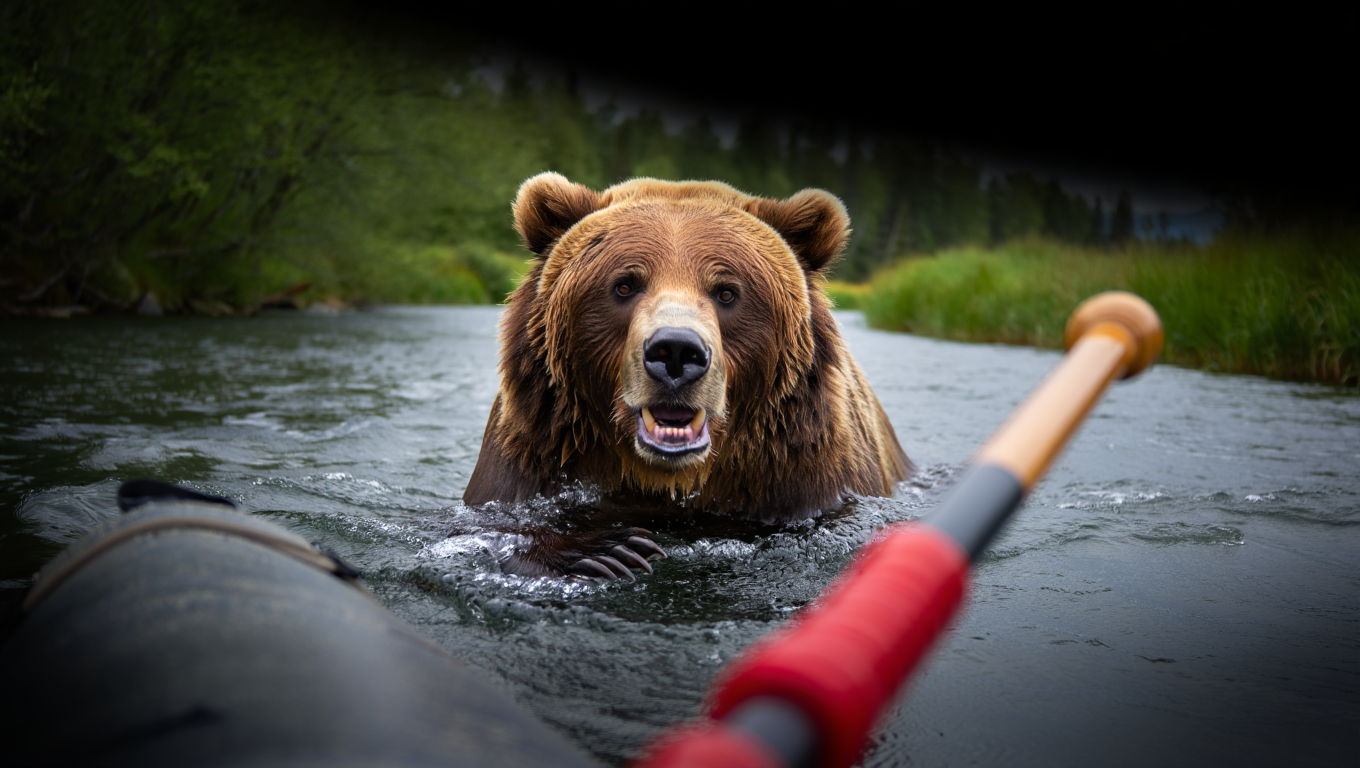
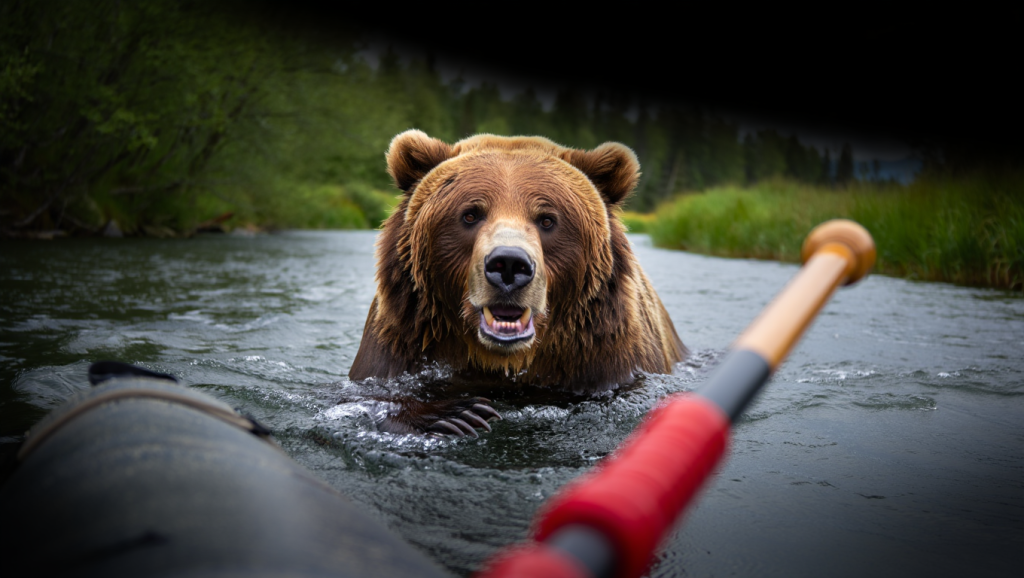
The sound hit me first—a deep, guttural roar that vibrated through my chest. I whipped my head toward the left bank, and there it was: a massive brown bear, easily 900 pounds, standing at the water’s edge. Its fur was thick and dark, still shedding its winter coat in patches. But it was the eyes that froze me—black, focused, locked directly on me.
For a split second, neither of us moved. The kayak drifted downstream, the current pulling me closer to the bear’s side of the river. Every survival guide I’d ever read flashed through my mind: make yourself big, back away slowly, never run. But I wasn’t on land. I was in a plastic kayak in the middle of rushing water with nowhere to go.
Then the bear charged.
I’ve never seen anything that big move so fast. It crashed through the shallows, sending up walls of spray, its massive paws slamming into the water with enough force to create waves. I dug my paddle in hard, trying to angle away, but the current was fighting me. The bear was closing the distance—fifty feet, forty, thirty.
“GO! GO! GO!” I was screaming at myself, at the river, at God, paddling so hard my shoulders burned. The kayak finally caught a faster current and lurched forward, but I could hear the bear behind me, the splashing getting louder, the breathing getting closer.
Twenty feet.
I could see its teeth.
Fifteen feet.
I made a split-second decision that went against every instinct—I stopped paddling and grabbed the bear spray from the holster on my chest. My hands were shaking so violently I almost dropped it. The bear was close enough that I could see the scars on its muzzle, smell the fish on its breath.
Ten feet.
I raised the canister and pressed the trigger.
Orange mist exploded between us. The bear’s roar turned into something else—a confused, angry bellow. It reared back, pawing at its face, and I didn’t wait to see what happened next. I jammed the spray back in its holster and paddled like my life depended on it, because it absolutely did.
The current grabbed me and pulled me through the rapids. Rocks scraped the bottom of the kayak. Water flooded over the sides. I didn’t care. I just kept paddling, kept moving, kept putting distance between me and that bear until my arms felt like they’d fall off.
When I finally glanced back, the bear was gone. The river had carried me around another bend, and all I could see was empty wilderness. I pulled into a calm eddy and just sat there, gasping, my entire body shaking with adrenaline.
That’s when I noticed the GoPro on my helmet was still recording.
I watched the footage that night in my tent, wrapped in my sleeping bag, still trembling. The video was insane—you could see everything. The bear’s charge, the spray deployment, my panicked breathing. But what struck me most was what I saw in those first few seconds before the bear moved.
It wasn’t hunting me. Its body language was all wrong for a predator. Ears back, head low—it was terrified. And then I saw it in the background of the frame, just barely visible on the bank: two small cubs.
I wasn’t being attacked. I was being protected.
That mama bear saw a strange red object drifting toward her babies and did the only thing a mother could do—she put herself between the threat and her children. She charged into freezing water, faced down a potential predator, and risked everything to keep them safe.
I cried watching that footage. Not from fear, but from understanding. I thought about my own daughter, how I’d barely seen her since the divorce. How I’d been so wrapped up in my own pain that I’d stopped being present in her life. This bear—this wild, powerful creature—had shown me something I’d forgotten: what it really means to protect what matters.
I cut the trip short and paddled out the next morning. When I got back to civilization, I called my ex-wife. Then I called my daughter. We talked for three hours. I told her about the bear. She told me about school, about her friends, about how much she missed our camping trips.
That kayak trip didn’t fix everything. My job was still gone. My marriage was still over. But something fundamental had shifted. I’d gone into the wilderness looking to prove I was still strong, still capable, still alive. Instead, a 900-pound grizzly bear taught me that real strength isn’t about conquering nature or proving you can survive alone.
It’s about knowing what’s worth protecting—and having the courage to charge into the river when it matters most.
Let me back up and tell you how I even got to that river in the first place. Because the truth is, my life had been falling apart in slow motion for years before that day.
Five years earlier, I was living what I thought was the dream. Corporate job in Seattle, nice house in the suburbs, beautiful wife, amazing daughter. I was a project manager at a tech company, pulling in six figures, driving a Tesla, taking the family to Hawaii every summer. On paper, everything looked perfect.
But perfection is exhausting.
I was working seventy-hour weeks, missing soccer games and piano recitals, barely seeing my wife except to argue about bills or my mother’s declining health or whose turn it was to take out the garbage. We’d stopped having real conversations years ago. We’d become roommates who shared a mortgage and a kid.
My daughter Emma was twelve when things really started to crack. I remember one Saturday—one of the rare weekends I wasn’t working—she asked me to take her hiking at Rattlesnake Ledge, this trail we used to do together when she was little. I said yes, then got a call from my boss about some crisis that needed immediate attention. I told Emma we’d go next weekend. She just nodded, but I saw something die in her eyes. That flicker of hope she’d had that maybe this time Dad would actually show up.
Next weekend came, and I had another excuse. And another. And another.
My wife Jennifer tried to talk to me about it. She’d say things like “You’re losing her” or “We need to prioritize family,” but all I heard was criticism. All I felt was pressure. I was carrying the financial weight of the household, dealing with constant stress at work, and now I was supposed to feel guilty about providing for my family? It didn’t make sense to me then.
Looking back, I see how blind I was. How selfish. How scared.
The job loss came out of nowhere. Well, not really—there had been warning signs for months. The company was struggling, there were layoffs, my performance reviews had been slipping. But I’d convinced myself I was indispensable. That they needed me. That my worth was tied to my productivity, my ability to solve problems, my willingness to sacrifice everything for the bottom line.
They let me go on a Tuesday. Not even in person—my boss called me while I was at a coffee shop, told me they were “restructuring,” that it wasn’t personal, that they’d provide a generous severance package. I sat in that coffee shop for three hours afterward, staring at my laptop, unable to process what had just happened.
I didn’t tell Jennifer right away. I pretended to go to work for a week, sitting in coffee shops and libraries, applying to jobs, spiraling deeper into shame and denial. When I finally told her, she didn’t yell. She didn’t cry. She just looked at me with this exhausted sadness and said, “I can’t do this anymore.”
The divorce was quick. Amicable, as these things go. We sold the house, split the assets, agreed on custody arrangements. Emma would spend weekdays with Jennifer, weekends with me. Everyone kept saying how mature we were being, how well we were handling it. But the truth is, we were both just numb. Too tired to fight. Too broken to care.
I moved into a small apartment in Fremont. One bedroom, barely enough space for Emma when she visited. I got a new job—lower pay, less prestige, but it paid the bills. I went through the motions. Work, gym, Netflix, sleep. Repeat.
Emma’s visits became increasingly awkward. She was fourteen by then, at that age where hanging out with your divorced dad isn’t exactly thrilling. We’d watch movies in silence, or I’d take her to restaurants where we’d both stare at our phones. I could feel the distance growing between us, could see her becoming a stranger, but I didn’t know how to bridge the gap.
That’s when I started thinking about the kayak trip.
I’d been an avid kayaker in my twenties, before the corporate grind consumed my life. Some of my best memories were from wilderness trips—the Rogue River in Oregon, the Boundary Waters in Minnesota, a crazy two-week expedition in British Columbia. Back then, I’d felt alive. Connected to something bigger than quarterly earnings and performance metrics.
I told myself the Alaska trip was about rediscovering that feeling. About proving I still had it in me. About reconnecting with nature and finding clarity. But really? I was running away. From the failed marriage, from the disappointment in my daughter’s eyes, from the crushing realization that I’d spent twenty years building a life that collapsed the moment I stopped performing.
The planning became an obsession. I researched routes, bought new gear, studied maps of the Kenai Peninsula. Jennifer thought it was a mid-life crisis. Emma seemed indifferent. My friends tried to talk me out of going solo, but I insisted. This was something I needed to do alone.
The irony wasn’t lost on me. I’d been alone for years, even when I was married. Even when I was sitting across the dinner table from my family. I’d been isolated inside my own head, my own ambitions, my own fear of not being enough. But I didn’t have the language for that then. All I knew was that I felt hollow, and I thought the wilderness might fill the void.
I flew into Anchorage on a Tuesday in late May. The weather was perfect—long days, minimal rainfall, rivers running high from snowmelt. I rented a car, drove down to the Kenai, and put in at the upper Russian River. The plan was to paddle downstream for five days, covering about seventy miles, ending at the confluence with the Kenai River where a shuttle would pick me up.
The first two days were everything I’d hoped for. Pristine wilderness, challenging water, the kind of solitude that makes you feel like you’ve stepped outside of time. I saw moose, bald eagles, salmon jumping in the shallows. I slept in my tent listening to the river, and for the first time in years, my mind felt quiet.
But there was also something unsettling about all that silence. Without the noise of work and responsibilities and daily routines, I was left alone with thoughts I’d been avoiding. Questions I didn’t want to answer. Like what was I actually doing with my life? What kind of father abandons his kid for a week to go paddle around in the wilderness? What was I trying to prove, and to whom?
I pushed those thoughts away and focused on the river. Read the currents, navigated the obstacles, stayed present with the physical challenge of the journey. This was what I’d come for. This was what would fix me.
And then I rounded that bend and saw the bear.
Everything I’m about to tell you happened in maybe two minutes, but it felt like hours. Time does that weird thing when you’re facing death—it stretches and compresses simultaneously. Every detail becomes hyperreal while also feeling like a dream.
The bear’s initial roar was unlike anything I’d ever heard. It wasn’t the sound an animal makes when it’s hunting. It was the sound of pure, primal terror mixed with rage. A mother’s sound. The sound of someone willing to die to protect what they love.
When it charged into the water, my first thought was that I was going to die. Not as a dramatic exaggeration, but as a calm, clear fact. Bears can swim. This bear was massive and fast and motivated. I was in a kayak with nowhere to run. The math didn’t add up in my favor.
But then survival instinct kicked in. I wasn’t thinking about my daughter or my ex-wife or my failed career. I wasn’t having some profound moment of clarity. I was just an animal trying not to get killed by a bigger animal. Pure biology. Pure fear.
The paddle became an extension of my body. I wasn’t steering the kayak—we were one organism fleeing a predator. Water splashed into my face. My arms burned. The bear’s splashing and roaring filled my ears, drowning out everything else. I could feel it getting closer, could sense its mass displacing water behind me.
When I grabbed the bear spray, my hands were shaking so badly I almost couldn’t get it out of the holster. I’d practiced with it before the trip, knew how to deploy it, but practice is different from performance. Practice doesn’t include a 900-pound grizzly bear six feet behind you.
I remember thinking: if this doesn’t work, I’m going to feel very stupid for about three seconds before I die.
The spray shot out in a cone of orange mist. I couldn’t see if it hit the bear directly—I was already turning back to paddle—but I heard the change in its roar. The anger turned to confusion, then discomfort. Then I was in the rapids and all I could do was hold on and try not to flip.
Rapids that would have been fun and exciting ten minutes earlier were now terrifying. Every rock felt like it could capsize me. Every drop felt like it could end me. But the water carried me forward, and eventually the sound of the bear faded behind me.
When I pulled into that eddy and sat there shaking, I thought about calling the trip off immediately. Getting to the nearest road, hitching a ride, flying home. But then I thought: home to what? To my empty apartment? To another awkward weekend with Emma where we’d both pretend everything was fine?
So I made camp early, about five miles downstream from the encounter. I set up my tent on high ground, far from the water, with clear sightlines in all directions. I barely slept that night. Every sound made me grab the bear spray. Every rustle in the bushes made my heart race.
The next morning, I almost did leave. I had my gear packed, was ready to paddle hard downstream and get the hell out of the wilderness. But first, I decided to review the GoPro footage. Just to see if I’d actually captured what happened, or if the whole thing would turn out to be a blur of water and panic.
What I saw changed everything.
The footage was crystal clear. You could see the bear on the bank, see the moment it spotted me, see it make the decision to charge. But more importantly, you could see what I’d missed in the moment: the context.
In the background, partially hidden by willows, two cubs. One was climbing a rock, the other was at the water’s edge. They were maybe four months old, still small enough that they looked more like large dogs than bears. And they were playing, completely oblivious to the danger I represented.
Then there was the mama bear. Before she charged, you could see her looking between me and her cubs, calculating. Her ears were back not in aggression, but in fear. Her head was low, her body tense. This wasn’t a predator stalking prey. This was a mother facing a threat.
And I was the threat.
This bright red kayak, moving fast down the river, heading straight toward where her babies were playing. Of course she charged. What else was she supposed to do? Hope I’d just paddle by and ignore her cubs? Trust that this strange object would mean them no harm?
She did what any mother would do. She put herself between danger and her children, consequences be damned.
I watched that footage maybe twenty times that morning. And each time, I saw something new. The way she positioned herself to give the cubs time to retreat. The way she never actually lunged at me—she was trying to intimidate, to turn me away, not to attack. The way she stopped chasing the moment I was past the cubs’ location.
This bear didn’t want to fight me. She just wanted to protect her babies.
And me? I’d spent the last two years running away from my baby. Making excuses. Choosing loneliness over the hard work of showing up. Convinced that my pain was more important than her need for a father.
I sat on that riverbank and I wept. Not quiet tears, but the kind of crying that comes from your gut, the kind that shakes your whole body. I cried for Emma, for all the times I’d chosen work over her. I cried for Jennifer, for the marriage I’d neglected until it died. I cried for myself, for the man I’d become—or failed to become.
But I also cried with gratitude. Because somehow, in the middle of nowhere, a wild animal had shown me the truth I’d been avoiding. I’d thought strength was about independence, about not needing anyone, about proving I could survive alone. But real strength is about connection. About caring for someone more than you care about your own comfort. About being willing to charge into freezing water if that’s what it takes to keep your loved ones safe.
That mama bear hadn’t chosen the safe option. She’d chosen the brave option. The loving option. The only option that mattered when something precious was at stake.
I needed to do the same.
I packed up my camp, loaded the kayak, and headed downstream. But I wasn’t running anymore. I was going home. Back to my daughter, back to the work of being a father, back to the life I’d been avoiding.
The rest of that day’s paddle was different. I noticed things I’d been too wrapped up in my own head to see before. The way the light hit the water. The patterns of wildlife along the banks. The sheer improbable beauty of this place I’d almost died in.
That night, I made camp at a wide, gentle section of the river. I built a fire—my first of the trip, since I’d been too anxious about bears before—and I cooked a real meal instead of just eating cold rations. And I thought about what I was going to say to Emma.
Not some grand speech or dramatic apology. Just the truth. That I’d been lost, and a bear had helped me find my way home. That I was sorry for all the ways I’d failed her. That I wanted to do better, to be better, and I needed her help to figure out how.
I also thought about the video. I knew it was powerful footage—the kind of thing that could go viral, that people would want to see. But I wasn’t sure if I wanted to share it. It felt too personal, too raw. Like sharing it would somehow cheapen the lesson I’d learned.
But then I thought about other parents out there who might be making the same mistakes I was. Other people who’d convinced themselves that providing was the same as parenting. Other fathers who were drifting away from their kids and didn’t know how to get back.
Maybe the video could help them. Maybe watching a mother bear risk everything for her cubs could wake them up the way it had woken me up. Maybe my near-death experience could prevent someone else from experiencing the living death of losing connection with their child.
I decided I’d share it. But I’d do it right. I’d tell the whole story, not just show the scary parts. I’d talk about what it taught me, what it cost me to learn it, what I was going to do differently.
The next two days of paddling were almost meditative. I was present in a way I hadn’t been in years. Not thinking about the past or worrying about the future, just experiencing each moment as it came. The river. The sky. The rhythm of the paddle. The knowledge that I was heading toward something that mattered instead of running away from it.
When I finally reached the take-out point, I felt different. Not fixed—I wasn’t naïve enough to think one encounter with a bear could undo years of damage—but changed. Like I’d shed some layer of bullshit I’d been carrying around and could finally see things clearly.
The shuttle driver was a guy named Mike, probably in his sixties, weathered face, kind eyes. He helped me load the kayak onto his truck and asked how the trip went.
“Life-changing,” I said.
He laughed. “They usually are, one way or another. This river’s got a way of showing you what you need to see.”
I almost told him about the bear, but decided against it. Some things need time to settle before you can talk about them. Instead, I asked him about his life, his family, what brought him to Alaska. We talked the whole drive back to Anchorage, and it felt good to just listen to someone else’s story instead of being trapped in my own head.
That night, in a hotel room in Anchorage, I called Jennifer. It was late in Seattle, but she picked up after two rings.
“Is everything okay?” she asked immediately, because why else would I be calling at eleven p.m.?
“Yeah,” I said. “I mean, no. I mean… I need to talk to Emma. Is she awake?”
“It’s eleven o’clock on a school night, so no.”
“Right. Sorry. I lost track of time.”
There was a pause, then Jennifer said, “What happened out there, James?”
I told her. Not everything, but the important parts. The bear, the cubs, the realization that I’d been a coward pretending to be independent. She listened without interrupting, and when I finished, she was quiet for a long moment.
“I’m glad you’re okay,” she finally said.
“I’m going to do better,” I told her. “With Emma. I know I’ve said that before, but this time I mean it. This time I understand what I was doing wrong.”
“You can’t just show up and expect her to trust you again,” Jennifer said, and there was no anger in her voice, just honesty. “You broke something with her. It’s going to take time to fix it.”
“I know. I’m not expecting instant forgiveness. I’m just asking for the chance to try.”
Another pause. Then: “Call her tomorrow after school. Three-thirty. She’ll be home.”
“Thank you.”
“Don’t thank me. Just show up.”
I hung up and sat on the edge of the hotel bed, staring at my hands. They were scratched and calloused from five days on the river, and I thought about how those same hands had pushed my daughter away, had chosen work over hugs, had waved off opportunities to connect. But hands can build too. Hands can hold. Hands can reach out instead of pulling away.
The next day, I flew home. On the plane, I edited the bear video on my laptop, cutting it down to the most intense two minutes. I wrote a simple description: “Mother grizzly protects her cubs from kayaker on Alaskan river.” No commentary, no explanation. Just the raw footage and a note that I’d tell the full story later.
I uploaded it from the airport and didn’t think much about it. I had more important things to focus on.
At three-thirty, I called Emma.
“Hey, Dad,” she said, and I could hear the caution in her voice.
“Hey, sweetheart. I wanted to talk to you about something.”
“Mom said you had some kind of bear encounter?”
“Yeah. It was… it was intense. But it also made me realize some things. About me, about us, about what’s important.”
“Okay…”
“I’ve been a terrible father,” I said, and I could hear her sharp intake of breath. “Not because I didn’t love you, but because I was too scared and too selfish to show up the way you needed me to. I kept choosing other things—work, my own comfort, my own pain—over you. And I’m sorry. I’m so, so sorry.”
She didn’t say anything, and I pushed forward.
“I know saying sorry isn’t enough. I know I have to actually change, actually do better. And I want to. I want to be the dad you deserve. I want to take you hiking again. I want to hear about your life. I want to be present, really present, not just physically there but emotionally available. And I know that’s going to take time, and I know you might not trust me right away, but I’m asking for the chance to try.”
There was a long silence, and then I heard it: she was crying.
“Emma? Are you okay?”
“I just—” Her voice was thick with tears. “I just really missed you, Dad. The real you. Not the stressed-out work robot or the guilty divorce dad. Just… you.”
Now I was crying too. “I’m here, baby. I’m right here. And I’m not going anywhere.”
We talked for over an hour. She told me about school, about the drama with her friends, about a boy she liked, about how hard it had been when Jennifer and I split up. I just listened, really listened, without trying to fix everything or offer advice or change the subject when it got uncomfortable.
And it felt like coming home.
The video started blowing up that evening. By the time I went to bed, it had 100,000 views. By morning, it was over a million. My phone was flooded with messages from old friends, former colleagues, reporters wanting interviews. The video was being shared on news sites, on Reddit, on Facebook. People were calling it “the most intense wildlife encounter caught on camera” and “a reminder of the power of nature.”
But they didn’t know the real story yet. They didn’t know what it had taught me.
I spent the next few days ignoring most of the interview requests and focusing on what mattered: rebuilding my relationship with Emma. I picked her up from school, took her to her favorite Thai restaurant, listened to her talk about her classes and her friends and her life. It felt awkward at first—we were both rusty at this—but it also felt right.
The following weekend was my normal custody time, and instead of our usual routine of movies and silence, I asked Emma what she wanted to do.
“Can we go hiking?” she asked. “Like we used to?”
So we did. We drove out to Rattlesnake Ledge, that trail I’d been promising to take her on for two years. It was crowded—it always is on weekends—but we didn’t care. We hiked at her pace, stopped to take photos, talked about everything and nothing.
At the summit, looking out over Rattlesnake Lake and the mountains beyond, Emma turned to me and said, “I watched your bear video.”
“Yeah? What did you think?”
“It was scary. But also…” She paused, choosing her words carefully. “It made me understand something. Like, that bear could have run away. She could have just grabbed her cubs and disappeared into the woods. But she didn’t. She ran toward the scary thing because that’s what you do when someone you love is in danger.”
I nodded, not trusting myself to speak.
“I think you were running away,” Emma continued. “After the divorce, after everything fell apart. You were scared and hurt, and you were running. But now you’re running toward something instead.”
“Toward you,” I said.
“Yeah.”
We stood there in silence, and I put my arm around her shoulders. She leaned into me the way she used to when she was little, and I thought about that mama bear standing in the river, refusing to back down.
That week, I wrote a long post to go with the video. I told the whole story—the divorce, the job loss, the wilderness escape, the encounter, the revelation. I talked about what the bear had taught me about strength and love and showing up. I talked about calling my daughter and starting the hard work of rebuilding our relationship.
The response was overwhelming. Thousands of comments from other parents who’d made similar mistakes, who’d put work before family, who’d drifted away from their kids. People thanking me for my honesty, sharing their own stories of loss and redemption and the daily struggle to be better.
But the comments that hit hardest were from adult children talking about their own absent fathers. Some were angry, some were sad, some were hopeful that their dads might one day have a similar awakening. Reading them felt like looking into a possible future where Emma was writing those same words about me, and it reinforced my commitment to never let that happen.
The video ended up with over ten million views. I got interview requests from major news outlets, podcast invitations, even a call from a production company wanting to turn it into a documentary. I turned most of them down. This wasn’t about fame or attention. This was about using a moment of grace—a moment where I could have died but didn’t—to make different choices.
I did do a few interviews, carefully chosen ones where I could tell the full story, not just show the scary footage. I talked about fatherhood, about mental health, about the ways men are taught to equate providing with parenting. I talked about how wilderness experiences can be transformative, but only if you bring the lessons back with you.
And I talked about that mama bear. About how she’d saved my life twice—once by not killing me, and once by showing me what kind of man I wanted to be.
Emma started joining me for more weekend activities. We tried rock climbing at a local gym. We took a cooking class together. We even planned a camping trip for the summer—nothing as intense as my Alaska adventure, just a few nights in the North Cascades where we could disconnect from the world and reconnect with each other.
The relationship with Jennifer improved too. We’d never get back together—that ship had sailed, and honestly, we were better as co-parents than we’d been as spouses—but the hostility faded. We could have conversations about Emma without it turning into a fight. We could even laugh occasionally about the absurdity of our past conflicts.
She told me once, about a month after I got back from Alaska, “Whatever happened out there, I’m glad it did. You’re different now. More present. More honest.”
“A bear tried to kill me,” I said.
“Well, it worked. You should send her a thank-you card.”
Six months after the encounter, I took Emma back to Alaska. Not to the same river—that felt too intense for a sixteen-year-old—but to a gentler section of the Kenai where we could kayak together in calm water. We saw eagles and otters and salmon, but no bears, which was probably for the best.
One evening, sitting by our campfire, Emma asked me if I ever thought about that mama bear and her cubs.
“All the time,” I said.
“Do you think they’re okay? Like, do you think they made it through the summer?”
“I hope so. Bear cubs have something like a fifty percent survival rate in their first year, so the odds aren’t great. But they had a good mom. A brave mom. I like to think that counted for something.”
Emma poked at the fire with a stick, sending sparks spiraling up into the darkening sky. “I’m glad she didn’t kill you.”
“Me too, kiddo. Me too.”
“But I’m also glad you went on that trip. Even though it was dangerous and kind of stupid.”
I laughed. “Your mother would agree with that assessment.”
“It’s just… you needed it, I think. To go out there and get lost so you could find your way back.”
She was right, of course. Sometimes you have to go into the wilderness to figure out where home really is. Sometimes you have to face death to remember why life matters. Sometimes you need a 900-pound grizzly bear to teach you how to love.
The video still circulates occasionally, usually during slow news cycles or when someone rediscovers it and shares it with the caption “TERRIFYING” or “NATURE IS SCARY” or some variation thereof. I don’t mind. Every time it makes the rounds, I get new messages from people telling me how it affected them, how it made them call their kids or their parents or their estranged siblings.
One message in particular stuck with me. It was from a guy named Marcus who said he’d been planning to skip his daughter’s dance recital because of a work conflict. He watched my video, read my story, and decided the work could wait. He went to the recital, watched his daughter perform, and told me it was one of the best decisions he’d ever made.
“Thank you for sharing your wake-up call,” he wrote. “It became mine too.”
That’s the thing about stories. The good ones don’t just entertain—they transform. They travel from person to person, changing shape slightly with each retelling, but maintaining their essential truth. And the truth at the heart of this story isn’t about a scary bear encounter. It’s about a man who’d forgotten how to be a father and a wild animal who reminded him.
It’s about the power of protection, the strength of vulnerability, the courage it takes to run toward danger instead of away from it.
It’s about coming home.
These days, Emma and I are close in a way we never were before. We text daily, have regular dinners, share hiking trails and inside jokes. She’s seventeen now, thinking about colleges, growing into an incredible young woman. And I get to be part of that journey not as an absent figure who occasionally shows up, but as a real presence in her life.
She’s applying to schools in Alaska, actually. Says she wants to study wildlife biology, maybe work for the National Park Service someday. I like to think my video played a small part in that interest, but really, she’s always loved animals. I was just too wrapped up in my own stuff to notice.
Last week, she showed me her college essay. It’s about the bear encounter, but from her perspective—what it was like to get that call from her dad, to hear him actually apologize, to watch him follow through on his promises for the first time in years. She wrote about how the bear didn’t just protect her cubs that day; she inadvertently protected a father-daughter relationship that was on the verge of dying.
Reading it made me cry. Again. I do that a lot now. I used to think crying was weakness, that men were supposed to tough things out, stay stoic, never show emotion. But I’ve learned that’s garbage. Crying is human. Feeling is strength. Vulnerability is the only real path to connection.
The essay ends with a line that pretty much destroyed me: “My dad went to Alaska to find himself. Instead, he found his way back to me.”
That’s what the bear gave me. Not just my life, but a life worth living. Not just survival, but purpose. Not just existence, but connection.
I still kayak. I still seek out wilderness experiences. But I never go alone anymore, and I always bring Emma when I can. We’re planning a big trip for after her high school graduation—two weeks in the Boundary Waters, just the two of us, paddling and camping and talking under the stars.
I’ve thought about going back to that specific bend in the Russian River, the place where it all happened. Part of me wants to see it again, to stand in the spot where my life changed, maybe to thank the universe or the river or the bear or whatever force put me in that exact place at that exact moment.
But I probably won’t. That moment is done. The lesson is learned. The bear is living her life, hopefully with those cubs grown strong and healthy. And I’m living mine—not perfectly, not without struggles, but with intention and presence and love.
Sometimes people ask me what I’d do differently if I could go back and live that day over again. Would I take a different route? Would I make more noise to avoid surprising the bear? Would I skip the trip altogether?
And my answer is always the same: I wouldn’t change a thing.
Because yes, it was terrifying. Yes, I could have died. Yes, it was dangerous and reckless and all the things my friends and family said it was.
But it also saved me.
That mama bear, protecting her cubs with every ounce of strength she had, showed me what I’d been missing. What I’d been running from. What actually mattered.
She showed me that love isn’t passive. It’s not about good intentions or convenient timing or doing it when it’s easy. Love is active. Love is brave. Love is running into freezing water toward danger because someone you care about needs you to.
And once you understand that—once you really get it in your bones—you can’t go back to sleepwalking through life. You can’t pretend that work or pride or fear are good enough reasons to avoid showing up.
You have to charge into the water.
Every day.
For the people who matter.
No matter what.
That’s what the bear taught me. That’s what I’m trying to teach Emma, not through words but through actions. That’s what I hope people take from the video and the story and all the attention it’s gotten.
Life is short. Relationships are fragile. The people we love need us to be brave, to be present, to choose them over our comfort and our excuses and our carefully constructed walls.
They need us to be like that mama bear: fierce, protective, unwavering in our commitment.
Because in the end, that’s all that matters. Not the job or the house or the accomplishments or the image we present to the world. Just the love we give and the love we receive. Just the connections we nurture and protect.
Just the willingness to charge into the river when it counts.
I think about that bear sometimes when I’m having dinner with Emma, or when I’m picking her up from school, or when we’re hiking some trail and she’s telling me about her day. I think about how close I came to losing all of this, how narrowly I avoided becoming the dad who was too busy, too absent, too late.
And I’m grateful. To the bear, to the river, to whatever cosmic coincidence put me in that kayak on that day at that exact moment when I needed to learn that exact lesson.
I’m grateful for the wake-up call.
And I’m determined never to hit the snooze button again.