A stranger was kneeling at my son’s grave in the pouring rain… But when she looked up, she had my dead wife’s eyes.
Grief doesn’t fade. It just learns how to sit quietly beside you, like an uninvited guest who never leaves but eventually stops demanding all your attention.
For five years, I had visited Oakwood Cemetery the same way. Same path winding through the ancient oak trees. Same silence broken only by the distant hum of traffic and the occasional bird. Same unbearable weight in my chest pressing down like a stone that never quite settled, never quite lifted. I never stayed long—just enough to remind myself that this pain was real, that love doesn’t end just because life does, that my son had existed and mattered and left a hole in the world that nothing could fill.
That morning in Seattle was cold and wet, the kind of rain that doesn’t fall hard but never seems to stop. The droplets clung to everything—the windshield, my coat, the bare branches overhead, the moss-covered headstones that stretched out in neat rows like a garden of grief. The sky was the color of pewter, heavy and low, pressing down on the earth.
I parked farther away than usual, letting myself walk longer than necessary. My therapist had suggested it months ago—giving myself time to transition, to prepare, to let the armor I wore through daily life slowly fall away. Walking gave my thoughts time to slow down, to settle into something I could carry without collapsing under the weight.
The gravel path crunched beneath my shoes. Water beaded on my jacket. My breath came out in small clouds. I knew every turn, every landmark—the angel statue with the broken wing, the mausoleum where the Henderson family rested, the bench under the willow tree where I sometimes sat when the weight became too much to stand.
That was when I saw her.
Someone was kneeling by my son’s grave.
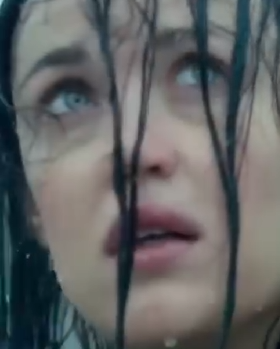
At first, anger surged through me like electricity through water. Oakwood was private. Quiet. Protected. No strangers came here by accident. The cemetery required permission for visitors outside of family members. And yet there she was—a young woman, wrapped in an oversized dark coat that swallowed her thin frame, her hair damp and dark from the rain, hanging in wet strands around her face. Her arms were wrapped around the headstone as if she were clinging to someone still alive, as if the cold marble could somehow hug her back.
This was my place. My loss. My child. My sacred, private grief.
I approached quickly, my frustration spilling out before reason could stop it, before compassion could whisper that maybe she had her own reasons, her own pain. “Excuse me,” I said sharply, my voice cutting through the soft patter of rain. “You can’t be here.”
She didn’t jump. She didn’t run. She didn’t even seem surprised. Slowly, deliberately, she lifted her head and looked at me.
And my breath caught in my throat.
Her eyes. They were unmistakable. A rare shade of green, fractured with gold like shattered glass catching sunlight, like leaves in autumn when the light hits them just right. Eyes I had memorized once, a lifetime ago. Eyes I had stared into on a wedding day, in a delivery room, across a thousand breakfast tables. Eyes that belonged to my late wife, Eleanor.
It wasn’t possible. Eleanor had been gone for over twenty years. But there they were, looking back at me from a stranger’s face.
“I’m sorry,” she whispered, her voice trembling, barely audible over the rain. “I didn’t mean any harm. I just… I needed to be here.”
I told myself it was coincidence. People share features. The world is full of similar faces, familiar echoes. Grief makes you see ghosts where there are none, makes you search for the dead in the faces of the living. But my hands were shaking as I asked her who she was, what she was doing here, how she knew my son.
She hesitated, rain dripping from her chin, her thin shoulders hunched against the cold. Then she said two words so softly I almost missed them beneath the rain.
“He’s my brother.”
The world tilted. The ground felt unstable beneath my feet.
My son had been an only child. That was what I had been told. What I had believed for over two decades. What I had built my grief around—the terrible finality of losing your only child, of watching your entire lineage end in one moment, one accident, one phone call that split your life into before and after.
“That’s not possible,” I said, but my voice cracked, betraying the certainty I was trying to project. “Michael didn’t have a sister. He was… he was our only child.”
Instead of answering, instead of arguing or explaining, she reached into her coat with trembling fingers and pulled out an old photograph, creased and water-worn, the edges soft from years of handling, the colors faded to something dreamlike and distant. She held it out to me with both hands, as if it were something precious, something fragile.
A hospital room. Harsh fluorescent lighting. A nurse in pale scrubs holding two newborns, side by side, wrapped in standard-issue hospital blankets.
One wrapped in blue. One in pink.
My vision blurred. I recognized that room. I had been there. I remembered the smell of antiseptic, the sound of machines beeping, the overwhelming terror and joy of becoming a father. But I only remembered one baby. One blue bundle. One son.
On the back of the photograph, in handwriting I would recognize anywhere—neat, careful, achingly familiar—were words written by my wife in black ink that had faded to brown:
My twins. Please keep them safe.
The rain felt heavier suddenly. Colder. It ran down my face, mixing with something else.
“Her name was Emma,” the young woman said quietly, her voice steadier now. “I’m Emma.”
I couldn’t speak. My throat had closed. Questions crowded my mind, tripping over each other—how, why, when, where. But all I could do was stare at this stranger who somehow carried my wife’s eyes, my son’s birthday, my entire life’s biggest missing piece.
Emma pulled her coat tighter around herself and began to speak, her words coming slowly, carefully, as if she’d rehearsed them a thousand times but never quite believed she’d have to say them out loud.
She told me she had grown up moving between foster homes, shelters, and streets. Fourteen different placements before she aged out of the system at eighteen. She had never known where she came from, only that she never quite belonged anywhere, never quite fit. The photograph had been the only thing she carried through all of it—passed from one social worker to another, tucked into a plastic bag with her few belongings, hidden under mattresses and in locker cubbies, the one constant in a childhood of constant change.
She had spent years trying to find answers. The photograph had led her to Oakwood, to this grave, to the brother she never met. The records were sealed. The hospital had changed ownership twice. The social workers who handled her case were retired or dead. She had hit wall after wall, dead end after dead end.
She hadn’t come looking for money. She hadn’t come looking for a father. She didn’t even know I existed, didn’t know if I was alive or dead or would want anything to do with her.
She had come to say happy birthday to the brother she never met.
Today. It was Michael’s birthday. November fourteenth. He would have been twenty-six.
Standing there in the rain, looking at this young woman who carried my wife’s eyes and my son’s birthday and a lifetime of questions I didn’t know existed, I felt something break open inside me. Grief layered over grief. Shock layered over regret. Rage at a system that had hidden her, that had made decisions about my family without my knowledge. Sorrow for the childhood she survived alone, for the father who never knew to look for her, for the mother who died carrying a secret I couldn’t begin to understand.
I didn’t argue. I didn’t accuse. I didn’t demand proof, though part of my mind was already spinning through the logistics—DNA tests, legal documents, hospital records.
I brought her home.
The drive was silent. Emma sat in the passenger seat, her hands folded in her lap, her eyes fixed on the rain-streaked window. I kept glancing at her, searching for other familiar features—the shape of her nose, the curve of her jaw, the way she bit her lower lip when she was thinking. All Eleanor. All impossibly, undeniably Eleanor.
My house felt different with someone else in it. It had been empty for so long, filled only with memories and silence and the carefully maintained spaces of a life that had ended decades ago. Eleanor’s favorite chair still sat by the window. Michael’s graduation photo still hung in the hallway. I had lived like a curator in a museum of my own grief.
I made coffee. Emma accepted it with both hands, wrapping her thin fingers around the warm mug as if trying to absorb the heat. She looked around the living room with wide eyes, taking in the bookshelves, the photos, the life she had never been part of.
“I don’t want to intrude,” she said quietly. “I can leave. I just… I wanted you to know I existed.”
“You’re not leaving,” I said, surprised by the firmness in my own voice. “Not until we figure this out.”
Over the next few days, pieces began to fall into place like puzzle fragments I didn’t know were missing.
I spent hours on the phone with hospitals, archives, lawyers. I dug through boxes I hadn’t opened in years, searching for medical records, birth certificates, anything that might explain how my daughter had vanished into the system without my knowledge.
What I found shattered me.
Eleanor had gone into premature labor at thirty-two weeks. I remembered the panic, the rush to the hospital, the terrifying hours of waiting. But what I didn’t know—what I had been deliberately kept from knowing—was that she delivered twins. A boy and a girl. Michael had been healthy, crying, perfect. Emma had been smaller, struggling, whisked away to the NICU before I could even see her.
The doctors gave her a ten percent chance of survival. Maybe less.
Eleanor, drugged and exhausted and terrified, had signed papers in those first chaotic hours. Papers I never saw. Papers that placed Emma into state care “temporarily” while she fought for her life, while we focused on Michael, while Eleanor recovered from a traumatic delivery.
But Eleanor never recovered. A pulmonary embolism two days later. Gone before I could ask questions, before I could understand what she’d done, before I could bring our daughter home.
And the system, overwhelmed and understaffed and operating on incomplete information, had simply… continued. Emma survived against all odds, spent six months in the NICU, and was eventually placed in foster care. The social workers couldn’t locate me—the address on the temporary placement papers was outdated, the phone number disconnected in the chaos of Eleanor’s death. And I, drowning in grief, focused on keeping Michael alive and myself functional, never knew there was another child to look for.
Letters had been sent to the wrong address. Calls had gone unreturned. Somewhere in the bureaucratic shuffle, Emma became just another orphan in an overloaded system. Just another file. Just another lost child.
The DNA test confirmed what my heart already knew. Emma was my daughter. Twenty-five years old. Born November fourteenth. Twin sister to the son I buried five years ago.
There was no dramatic confrontation. No chase. No violence. No villain to blame. Just the slow, devastating realization that silence and convenience and a series of small failures had stolen twenty years from both of us.
Healing didn’t happen overnight.
Emma was cautious in ways that broke my heart. She flinched when I moved too quickly. She apologized for taking up space, for eating food, for existing. She kept her belongings packed in her bag for the first two weeks, as if expecting to be sent away at any moment. She waited for doors to close again, for the inevitable moment when she’d have to leave, when this fragile new reality would collapse.
I learned how to be patient in ways I never had to be with Michael. Michael had grown up secure, loved, certain of his place in the world. Emma had grown up surviving, adapting, learning to make herself small and quiet and unobtrusive.
I learned how to listen instead of fix. How to sit with discomfort without trying to erase it. How to let her set the pace, choose the boundaries, decide what she needed.
We talked for hours. About Michael—his laugh, his terrible jokes, his love of soccer and terrible taste in music. About her childhood—the good homes where she’d felt almost safe, the terrible ones where she’d learned to hide and endure, the teachers who noticed and the ones who didn’t, the social workers who tried and the system that failed.
About Eleanor. The woman Emma never knew but somehow resembled in a hundred small ways.
They shared the same love of art, the same quiet way of observing the world before speaking. The same habit of tilting their head when they were thinking. The same preference for tea over coffee, for rainy days over sunny ones, for reading in corners rather than open spaces.
I showed Emma photos. Videos. Eleanor painting in the backyard. Eleanor laughing at something Michael said. Eleanor pregnant, her hand resting on her swollen belly, not knowing she was carrying twins, not knowing she had months to live.
Emma cried. I cried. We grieved together for all the years we’d lost, for the mother she never knew, for the brother she’d found too late.
But slowly, carefully, something began to grow. Not a replacement for what we’d lost—nothing could replace that. But something new. Something fragile and precious and worth protecting.
Emma started to unpack her bag. She accepted the guest room, let me buy her new clothes, began to believe that maybe this wasn’t temporary. She enrolled in community college, discovered she had a talent for graphic design, started to build a life that was hers.
I learned to be a father again. Not to a child, but to a grown woman who’d had to raise herself. I learned when to offer help and when to step back. When to share stories about Eleanor and Michael and when to be quiet and just be present.
The house felt less empty. The silence felt less suffocating. There was laughter again, tentative at first, then more genuine. There were dinners together, conversations that stretched late into the night, a sense of family that I thought I’d lost forever.
Months later, we returned to Oakwood together.
The rain had stopped. November had given way to early spring. Sunlight filtered through the trees, casting long shadows across the wet grass. The cemetery looked different in the light—less oppressive, more peaceful. Crocuses were pushing up through the ground, small purple and white blooms that signaled renewal.
Emma knelt where she had knelt before, but this time, she wasn’t alone.
She placed flowers beside the headstone—white roses, Eleanor’s favorite, and sunflowers for Michael, who had always loved their brightness. Her hands were steady now, no longer trembling with cold and fear and uncertainty.
“Hi,” she whispered to her brother, her twin, the other half of herself she’d never known. “I found Dad. And I think… I think I found home.”
I stood back, letting the moment belong to her. My throat tight. My chest aching in a different way now—not the sharp, stabbing pain of fresh grief, but something deeper, more complex. Sorrow and joy tangled together. Loss and gratitude existing side by side.
Grief was still there. It would always be there. But it no longer stood alone.
I thought about Eleanor, about the impossible choice she’d made in those chaotic hours after birth. Signing those papers, believing Emma might not survive, trying to protect everyone the only way she knew how. I understood now why she’d written those words on the photograph: My twins. Please keep them safe.
She hadn’t abandoned Emma. She’d tried to save her.
And somehow, against all odds, across twenty-five years and fourteen foster homes and a lifetime of not belonging, Emma had survived. She had found her way back. She had found her brother’s grave, and through it, found me.
People often think closure means forgetting. It doesn’t. It means understanding. Accepting what was, what is, what can never be, and what still might become.
I didn’t lose one child—I lost two lives worth of time. Two decades with my daughter. Five years where Michael and Emma could have known each other, could have been the twins they were meant to be. All those birthdays and holidays and ordinary moments that could have been shared but never were.
But I gained something too.
A daughter who survived. Who fought through impossible odds and refused to disappear. Who carried her mother’s eyes and her brother’s birthday and a strength that humbled me.
A truth that finally surfaced, painful and devastating but also liberating. No more mysteries. No more missing pieces. Just the complicated, messy reality of how families can be torn apart and, sometimes, stitched back together.
And a reminder that even after the longest silence, even after the deepest loss, love can still find its way home.
Emma stood, brushing dirt from her knees, and turned to me with a small smile. “Ready to go?”
I nodded, stepping forward to stand beside her at Michael’s grave. For the first time in five years, I didn’t feel the crushing loneliness that usually accompanied these visits. I wasn’t alone in my grief anymore.
“We’ll come back next month,” I said. “Together.”
“Together,” Emma echoed, and the word felt like a promise.
We walked back through Oakwood side by side, father and daughter, two people who had lost everything finding something new in the ruins. The sun was warm on my face. The flowers were blooming. And for the first time in longer than I could remember, the future didn’t seem quite so empty.