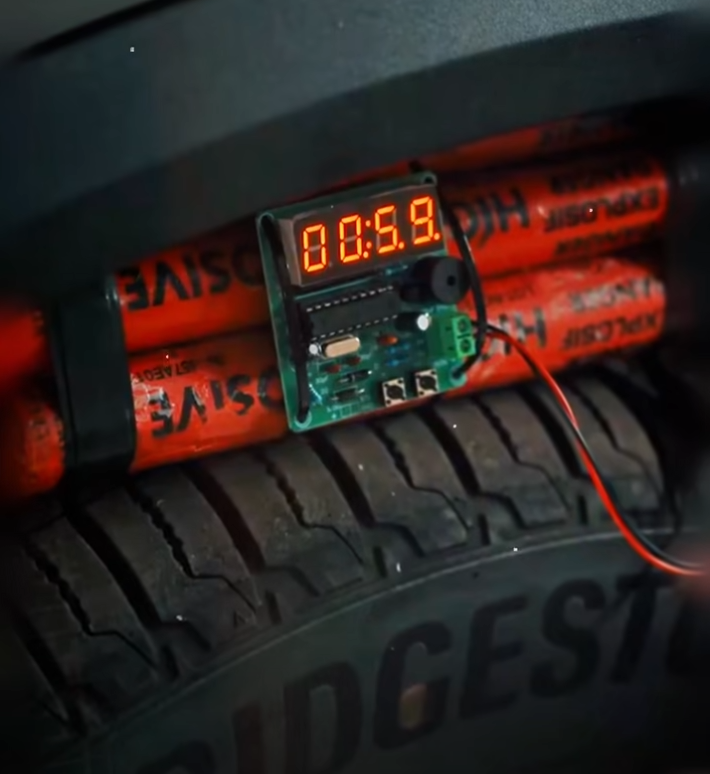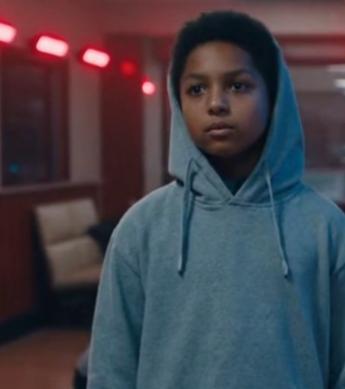
A 12-year-old boy stood up during a bank robbery and told armed thieves they had 10 seconds to leave… What happened next left everyone speechless.
Nobody could say exactly how long they’d been lying there on that cold marble floor. Time had stopped making sense the moment the shouting started.
The downtown bank smelled like metal and fear. A woman near the teller counter sobbed quietly into her sleeve, trying to muffle the sound. A businessman in an expensive suit lay face-down, eyes open but seeing nothing. Thirty-seven people pressed against the floor, hearts pounding, praying this would end.
Then steel flashed in the fluorescent light.
“Stay down! Everyone stays down!”
The voice cracked with nervous energy. One of the masked thieves paced between the bodies, heavy boots echoing like a death march. His ski mask clung to his face, damp with panicked breath. The hunting knife in his hand trembled—he told himself it was adrenaline, not fear.
Near the vault, his partner stood rigid, gun raised, eyes scanning frantically behind his mask. This was supposed to be quick. Clean. In and out before anyone could react.
But plans never survived reality.
The security guard lay unconscious near the entrance. Cell phones scattered across the tile like fallen leaves. The alarm system had been disabled—they’d made sure of that. Every hostage had learned the same brutal lesson: movement equals death.
Except one person hadn’t gotten the message.
The boy had been sitting with his mother near the waiting area when chaos erupted. Twelve years old, wearing scuffed sneakers and an oversized hoodie. When the screaming started, his mother yanked him to the ground, whispering urgently, “Don’t look at them. Don’t move. Don’t even breathe loud.”
But the boy was looking.
Not at the weapons. Not at the masks.
He was studying their hands. The way the knife-wielder kept adjusting his grip. The slight tremor in the gunman’s stance. The crack in their voices when they shouted commands.
The boy took a slow, measured breath.
And stood up.
The sound of movement cut through the silence like a gunshot.
Someone gasped. Another voice whispered, “Oh God, no.”
The pacing thief spun around mid-step, knife rising.
“What did I just say?” he snarled. “Get on the ground!”
The boy didn’t move. Didn’t flinch.
He looked impossibly small standing there, surrounded by grown adults flattened against the floor. But his eyes held something that didn’t belong to a child—a calm certainty that made the air feel heavier.
“You need to leave,” the boy said quietly. “Right now.”
His voice didn’t shake. Didn’t plead.
“This is your last warning.”
For three heartbeats, the entire bank held its breath.
Then both thieves laughed—a harsh, disbelieving sound.
“You think this is a game?” The knife-wielder stepped forward aggressively. “This ain’t a superhero movie, kid. Sit down before I make you.”
The boy tilted his head slightly, as if listening to something only he could hear.
“No,” he said simply. “It’s not a game.”
His mother’s hand shot out, grabbing desperately at his ankle. “Please,” she begged, tears streaming. “Baby, please just sit down.”
The boy didn’t acknowledge her.
The second thief raised his gun, finger hovering near the trigger—then hesitated.
Something was wrong. Deeply wrong.
There was no fear in the kid’s expression. No false bravado. No trembling. Just absolute, unshakeable certainty.
“You have about ten seconds,” the boy continued evenly. “After that, the choice won’t be yours anymore.”
The knife pressed forward, point aimed at the boy’s chest.
“On the ground. Now. Last chance.”
The boy smiled—small, almost sad.
Then the lights flickered.
Just once. Brief. Impossible to miss.
A deep hum resonated through the building’s foundation, like distant thunder rolling beneath their feet.
Both thieves went rigid.
“What was that?” one hissed.
The boy’s eyes flicked briefly to the ceiling, then returned to them. “That’s time running out.”
Behind the second thief, the vault door suddenly clicked.
Then clicked again.
And locked solid with a heavy mechanical thunk.
The thief spun around. “Did you—did someone—”
“I didn’t touch anything!” his partner shouted.
A calm, feminine automated voice filled the bank from hidden speakers.
“Emergency protocol activated. Lockdown initiated.”
Both men went white beneath their masks.
“No,” the knife-wielder breathed. “No, no, NO—”
The boy’s voice cut through their panic, suddenly commanding.
“Everyone stay down,” he ordered. “Cover your heads. This ends in sixty seconds.”
Red emergency lights flooded the room, bathing everything in crimson.
Steel security shutters crashed down over every exit with deafening finality. The thieves sprinted toward the main entrance—but three inches of reinforced metal had already sealed them inside.
“WHAT DID YOU DO?” the man screamed, whirling back toward the boy, knife raised high.
The kid reached into his hoodie pocket.
“Don’t you—”
The boy pulled out a small black device and calmly pressed a button.
Sirens erupted outside. Not approaching. Not distant.
Already there.
The windows darkened as armored tactical vehicles rolled into position, surrounding the building. Blinding spotlights pierced through the glass. A voice boomed from external speakers—calm, authoritative, absolute.
“This is federal law enforcement. Drop all weapons immediately and place your hands on your head.”
The thieves’ control shattered.
The knife-wielder lunged at the boy with a desperate scream.
He made it exactly three steps.
The floor beneath him sparked brilliant blue-white. His body seized mid-stride, every muscle locking as electricity surged through concealed security plates built into the bank’s foundation. He collapsed like a puppet with cut strings.
The second thief froze, gun clattering from his shaking hands.
“Please,” he whispered, voice breaking. “Please, we didn’t know—I swear we didn’t know—”
The boy sat down cross-legged.
Just like that, it was over.
Heavy silence filled the space, broken only by sobbing hostages and the crackle of tactical radios outside.
Within two minutes, heavily armed federal agents swept through the secured entrance, weapons raised, movements precise and practiced. They secured both thieves, checked every hostage, helped shaking people to their feet. Medics rushed in with blankets and calm voices.
A female agent approached the boy and knelt to his eye level.
“You followed protocol perfectly,” she said quietly, something like pride in her voice.
The boy nodded, and suddenly he looked twelve again—small, tired, scared.
His mother pulled him into a crushing embrace, sobbing openly against his shoulder. “You terrified me,” she whispered. “Don’t you ever—”
“I know, Mom,” he said softly. “I’m sorry. I had to.”
As agents escorted the handcuffed thieves past, one turned his head, eyes wild and uncomprehending behind his mask.
“That kid,” he muttered to no one. “That wasn’t normal. That wasn’t human—”
The agent guiding him said nothing.
Outside, news vans were already assembling, cameras rolling. Within the hour, headlines would scream across every screen: “Brave 12-Year-Old Stops Armed Robbery.” “Child Hero Saves Dozens.” “Young Boy Outsmarts Thieves.”
But inside the bank, as the boy walked toward the exit holding his mother’s hand, one agent spoke quietly into her encrypted radio.
“Asset secure. Situation contained. Protocol Shepherd successful.”
The boy glanced up at her. “Am I going to be in trouble?”
She smiled slightly, something warm beneath the professional exterior. “No. But you’re getting extra homework for the next month.”
He groaned dramatically. Just a normal kid again.
Behind them, the bank doors reopened. Police tape went up. Statements were taken. Life slowly, cautiously resumed.
But for every single person who’d been pressed against that cold marble floor, one truth had been permanently burned into their memory:
Sometimes the most dangerous person in the room isn’t the man holding the knife.
It’s the quiet twelve-year-old who tells you to leave—
And has the power to make you wish you’d listened.