I paid $3,000 for a “healing session” where horses were supposed to cure my chronic pain… What happened next left me questioning everything I believed about medicine.
Three years ago, I would have laughed at anyone who suggested I’d be lying on a massage table in the middle of a forest, letting a thousand-pound animal breathe on my face. But chronic pain has a way of making you desperate, of opening doors you never knew existed.
It started after the car accident. The doctors said I was lucky—no broken bones, no internal bleeding, just some “soft tissue damage” that should heal in six to eight weeks. That was eighteen months before I found myself driving three hours into the wilderness of Northern California, following hand-drawn directions to a place that didn’t show up on Google Maps.
The pain never left. Physical therapy didn’t work. Medications made me feel like I was living underwater. Injections provided relief that lasted exactly nine days each time. I tried acupuncture, chiropractors, yoga, meditation apps, elimination diets, supplements that cost more than my car payment. Nothing worked. The pain was always there, a constant companion that colored every moment of my existence.
My sister found the retreat. She’d been following this woman on Instagram—Celeste, a former veterinarian who claimed she’d discovered something revolutionary about animal-assisted healing. The photos looked like something out of a fairy tale: horses standing calmly beside people, their massive heads lowered in what looked like prayer, all bathed in golden forest light that seemed too perfect to be real.
“It’s called Equine Energetic Therapy,” my sister explained over coffee, showing me video after video on her phone. “These horses can sense pain in the human body and help release it. There are testimonials from people with fibromyalgia, chronic migraines, PTSD. People who tried everything else first.”
I was skeptical. I’m a chemical engineer. I believe in peer-reviewed studies and double-blind trials. But I was also exhausted. Exhausted from hurting, from disappointing my family when I canceled plans, from the way my seven-year-old daughter had started asking “Does Mommy’s back hurt today?” before inviting me to play.
The retreat cost $3,000 for a three-day intensive. I used money from my late grandmother’s inheritance, money I’d been saving for something important. I guess I decided that reclaiming my life qualified.
The drive took me deeper into the mountains than I’d been in years. Cell service disappeared. The paved road became gravel, then dirt. Just when I was certain I’d made a terrible mistake, the forest opened into a clearing where a hand-painted sign read “Serenity Pine Sanctuary.”
Celeste met me at what I can only describe as a mystical parking area—just a flat space among the trees where three other cars sat. She was exactly like her photos: blonde, probably in her early fifties, wearing the kind of flowing linen dress that suggested she’d never experienced a practical concern in her life. But her handshake was firm, her eyes sharp and assessing.
“You’re holding your left shoulder three inches higher than your right,” she said immediately. “The pain radiates from your lower back, up through your shoulder blade, and into your neck. Worse in the mornings, worse when it rains, worse when you’re stressed. You’ve been taking ibuprofen like candy, and it stopped working six months ago.”
I stared at her. She smiled gently.
“The horses told me you were coming. They’re very excited to meet you.”
That first day, I met Apollo and Artemis—the white mare and brown gelding who would become my unexpected healers. Apollo was the white one, seventeen hands of pure power wrapped in a coat that gleamed like fresh snow. Artemis was smaller, darker, with intelligent eyes that seemed to look straight through me.
Celeste explained that horses are prey animals with nervous systems designed to detect danger at incredible distances. They can sense a predator’s heartbeat from meters away, feel changes in electromagnetic fields, detect cortisol levels in human sweat. “When humans are in pain,” she said, “we create specific patterns of tension, breathing, and energy. Horses can read those patterns better than any MRI machine.”
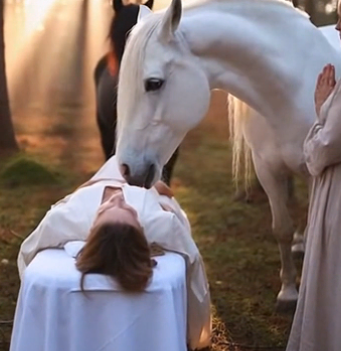
The first session was… strange. I lay on a portable massage table set up in a clearing where the pine trees created a natural cathedral. The air smelled like sap and earth. Celeste guided me through breathing exercises while Apollo approached slowly, methodically, his massive head lowering until I could feel his breath on my face.
It was warm and sweet, smelling faintly of grass and something else I couldn’t identify. His breath came in slow, deliberate patterns that seemed to invite my own breathing to match. Celeste stood at my head, one hand resting lightly on my shoulder, murmuring instructions I only half-heard.
“Let him read you,” she whispered. “Don’t try to control anything. Just be.”
Apollo’s muzzle moved across my chest, my stomach, down to my hip where the worst of the pain lived. Every few seconds, he would pause, and I would feel his breath concentrate in one spot—hot and focused like a laser. Artemis stood at my feet, occasionally stomping, creating a rhythm that vibrated through the table.
I waited for something to happen. Some dramatic release, some moment of transformation. But there was nothing except the strange, uncomfortable intimacy of being so vulnerable in front of these massive animals. After forty-five minutes, Celeste helped me sit up.
“How do you feel?” she asked.
“The same,” I admitted, trying not to sound disappointed. “Maybe a little more relaxed.”
She smiled like she’d expected this. “The first session is always about establishing trust. The horses need to understand your pain signature. Tomorrow will be different.”
That night, in the small cabin where I was staying, I cried. Not from pain—though my back ached from lying on the table—but from the crushing weight of false hope. I’d been so desperate to believe in something, anything, that I’d driven three hours and spent my grandmother’s money to have horses breathe on me in the woods.
But something strange happened while I was sleeping. I woke around 3 AM, and for exactly seven seconds before I remembered to brace for it, there was no pain. It rushed back immediately, of course, but those seven seconds haunted me. I hadn’t experienced seven consecutive pain-free seconds in eighteen months.
The second day, Celeste had me do more preparatory work. I spent an hour just standing with Apollo in his paddock, learning to match my breathing to his, to feel the rise and fall of his massive ribcage. She taught me to place my hand on his chest and feel his heartbeat—slow and steady at around forty beats per minute, compared to my anxious eighty-five.
“Your nervous system is stuck in fight-or-flight,” she explained. “The accident traumatized your body, and it never received the signal that the danger passed. Your muscles have been braced for impact for eighteen months. That’s why nothing’s worked—you’re not treating an injury anymore. You’re treating a nervous system that forgot how to feel safe.”
The afternoon session was different. This time, when Apollo approached, something shifted. Maybe I was more relaxed, or maybe he’d figured something out, but when his breath touched the exact spot where my worst pain lived, I felt it.
It’s hard to describe. It wasn’t heat, exactly, though there was warmth. It was more like pressure releasing, like something that had been clenched for so long it had become part of my baseline experience suddenly… letting go. My entire left side began to twitch and shake, small muscle spasms that traveled from my hip up through my shoulder.
“Don’t fight it,” Celeste murmured. “Let it move through you.”
Tears started streaming down my face without warning. Not sad tears—I wasn’t even feeling sad. It was like my body was crying without consulting my mind. Apollo didn’t move away. He stayed there, breathing steadily on my hip, while I shook and wept and made embarrassing sounds.
Artemis moved closer, positioning himself so his flank was pressed against the table near my head. I reached up without thinking and buried my fingers in his mane. He stood perfectly still, solid and real and somehow exactly what I needed.
When it was over—and I have no idea how long it lasted, could have been ten minutes or an hour—I felt hollowed out. Exhausted in a way that had nothing to do with physical exertion. Celeste helped me sit up slowly, and I realized something impossible.
The pain was different. Not gone, but… quieter. Like someone had turned down the volume from a scream to a murmur.
“What the hell just happened?” I asked.
Celeste smiled. “Your nervous system just remembered that the accident is over. Your body finally got permission to stop protecting you from something that’s not happening anymore.”
The third day was about integration. Shorter sessions, more time just being present with the horses without any agenda. Celeste taught me techniques I could use at home—breathing patterns, visualization exercises, ways to check in with my body without judgment.
But the most important lesson wasn’t technical. It was about the nature of healing itself.
“Western medicine treats the body like a machine,” Celeste explained as we walked through the forest, Apollo and Artemis following behind us like enormous dogs. “Something breaks, you fix it. But mammals aren’t machines. We’re relational creatures with nervous systems designed to co-regulate with other mammals. When we’re traumatized or in chronic pain, we often need another nervous system to show ours how to regulate again.”
“But why horses?” I asked. “Why not dogs, or other people?”
“Horses are prey animals with incredibly sensitive nervous systems. They have to be—their survival depends on detecting danger instantly. But they’re also large enough and calm enough not to be overwhelmed by human pain the way dogs sometimes are. They can hold space for our big emotions without getting dysregulated themselves. They’re like… nervous system translators.”
I drove home on the fourth morning with a list of practitioners Celeste recommended—a somatic therapist, a trauma-informed physical therapist, an acupuncturist who understood polyvagal theory. The pain wasn’t gone, but it was different. Manageable. For the first time in eighteen months, I felt hope that wasn’t desperate and grasping.
That was three years ago.
I’m not going to lie and say horses magically cured me. The pain didn’t disappear overnight. But that weekend in the forest changed the trajectory of my healing in ways I’m still understanding. It gave me a new framework for understanding what was happening in my body, and it connected me with practitioners who treated chronic pain as a nervous system issue rather than just a mechanical problem.
I found a local equine therapy program and started volunteering. I worked with my new somatic therapist twice a week for six months, then once a week, then monthly. I learned that my body had been stuck in a trauma response, and I needed to teach my nervous system that it was safe to relax again.
The pain decreased slowly, inconsistently, with plenty of setbacks. But the trajectory was clear. Six months after that forest weekend, I was at about 60% better. A year later, 80%. Now, three years out, I have occasional flare-ups, usually when I’m stressed, but they’re manageable. They don’t run my life anymore.
My daughter is ten now. Last week, she asked me to go horseback riding with her for her birthday. We spent three hours at a local stable, and I didn’t have to cancel, didn’t have to disappoint her, didn’t have to watch her try to hide her sadness while telling me it was okay.
I still don’t fully understand what happened in that forest. The scientist in me wants peer-reviewed studies and reproducible results. But the person who lived through it knows this: sometimes healing requires us to step outside our paradigms and be willing to look foolish. Sometimes we need to lie on a table in the woods and let a horse breathe on us.
My former colleagues think I’ve gone a bit woo-woo. My sister takes credit for saving my life. Celeste still posts those fairy-tale photos on Instagram, and now I understand they’re not fake—they’re just capturing something real that looks impossible.
I keep a photo from that weekend on my desk at work. It’s me on that massage table with Apollo’s massive head lowered over my chest, morning light filtering through the pines. I look vulnerable and small and brave. On the worst days, when old patterns try to reassert themselves, I look at that photo and remember: healing isn’t always linear, it doesn’t always make sense, and sometimes the most important thing is just finding the courage to be open to the impossible.
The horses knew I was coming, Celeste said. I don’t know if I believe that. But I believe they knew what I needed when I arrived. And I believe they helped me find my way back to a life where pain was a temporary visitor rather than a permanent resident.
Sometimes I drive back to Serenity Pine Sanctuary, now just two hours away since I’ve mapped the route properly. Celeste always greets me the same way, and Apollo always remembers me, lowering his massive head so I can press my forehead against his soft nose. We breathe together, his heartbeat slow and steady against my palm, and my nervous system remembers: the danger has passed, it’s safe to let go, healing is possible.
That lesson, more than anything else, was worth every penny of my grandmother’s inheritance. I think she would have understood.