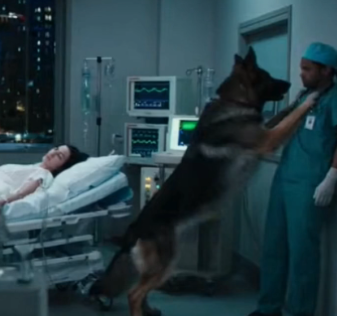
The heart monitor flatlined and the doctor moved to pull the plug… But our rescue dog pinned him against the wall, teeth bared.
The sterile hospital room had become our second home over the past three weeks. My wife Sarah lay motionless in the bed, her once-vibrant face now pale and still, surrounded by machines that beeped and hummed with mechanical precision. The doctors had prepared us for this moment, but nothing—absolutely nothing—could have prepared us for what our dog Bear would do when it finally came.
It was 3:47 AM on a Tuesday when everything changed.
Bear wasn’t supposed to be there. Hospital policy strictly forbade animals in the ICU, but after seventeen days of watching Sarah slip further away, I’d stopped caring about rules. I’d smuggled him in through the service entrance, hidden in a large duffel bag, his therapy dog certification badge clipped to his collar as my insurance policy. The night shift nurses had looked the other way. They’d seen how Sarah’s vitals improved during his previous “unauthorized” visits, how her breathing steadied when he rested his massive head on her bed.
Bear was an eighty-pound mixed breed we’d rescued from a kill shelter three years earlier. The shelter workers said he’d been found chained to a tree, starving, covered in scars from what they suspected was dog fighting. He was scheduled to be euthanized the day we walked in. Sarah had taken one look at his sad, amber eyes and said, “That one. We’re taking that one home.”
In the years since, Bear had transformed from a traumatized, cowering creature into the gentlest giant I’d ever known. He followed Sarah everywhere, slept at the foot of our bed, and seemed to sense her moods before she did. When she was diagnosed with the brain aneurysm, Bear had known something was wrong before the seizure even hit. He’d refused to leave her side, whining and pawing at her until she finally agreed to go to the emergency room.
Now, three weeks post-surgery, the doctors said there was nothing more they could do. The aneurysm had caused catastrophic damage. She was brain-dead, they insisted, kept alive only by machines. Dr. Harrison, the chief surgeon, had recommended we consider withdrawing life support. He’d used careful, clinical language—”allowing her to pass peacefully,” “preventing unnecessary suffering,” “respecting her wishes.”
But Sarah had never told me her wishes about something like this. We were both only thirty-two. These were conversations we thought we had decades to have.
I’d been sitting in that uncomfortable vinyl chair for hours, Bear’s head resting on my lap, when Dr. Harrison entered with two nurses. His face carried that practiced expression of professional sympathy that somehow made everything worse.
“Mr. Chen, I think it’s time,” he said quietly. “She’s been unresponsive for twenty-one days. The scans show no brain activity. At this point, we’re only prolonging the inevitable.”
I couldn’t speak. My throat had closed up completely. I just nodded, tears streaming down my face.
Dr. Harrison moved toward the ventilator, his hand reaching for the controls. The machines maintained their steady rhythm—beep, whoosh, beep, whoosh—the sounds that had become the soundtrack of my nightmare.
That’s when the heart monitor’s steady beep transformed into a single, endless tone.
Flatline.
The sound pierced through me like a physical blow. This was it. This was the moment I’d been dreading, the moment where Sarah left me forever.
Dr. Harrison’s hand moved toward the power switch. “I’m sorry,” he murmured.
And then Bear moved.
I’d never seen him move that fast. One second he was lying calmly by my chair; the next, he was airborne. Eighty pounds of muscle and fury launched across the room with a guttural snarl that didn’t sound like it could come from him.
Before anyone could react, Bear had Dr. Harrison pinned against the wall, massive paws on his chest, teeth bared inches from the surgeon’s face. Not biting, not attacking—just holding him there with a force and aggression I didn’t know he possessed.
“Bear! No!” I shouted, lunging forward.
But Bear didn’t budge. His eyes were locked on Dr. Harrison, a low growl rumbling from his chest. The two nurses had frozen in place, one with her hand on the emergency call button.
“Get this animal OFF me!” Dr. Harrison’s voice cracked with fear.
I grabbed Bear’s collar, trying to pull him back, but it was like trying to move a statue. He was completely focused, utterly immovable.
“Bear, down! Come!” Nothing worked. He’d never disobeyed a command in three years.
And then I heard it.
Through the chaos, through the flatline alarm still screaming, through everyone’s shouting—I heard a small sound.
A gasp.
I spun around.
Sarah’s chest moved. Not the mechanical rise and fall from the ventilator, but an additional movement, a struggle.
“Wait,” I said. “WAIT!”
Her hand twitched.
“Oh my God,” one of the nurses whispered.
Dr. Harrison stopped struggling against Bear. Everyone’s eyes locked on Sarah.
Her fingers curled slightly. Then her eyelids fluttered.
The flatline alarm suddenly stopped. The monitor beeped once. Twice. A rhythm established itself—weak, irregular, but there.
“That’s impossible,” Dr. Harrison breathed.
Bear immediately released him and bounded to Sarah’s bedside, his aggression evaporating as quickly as it had appeared. He placed his massive head gently on the bed next to her hand, whining softly.
Sarah’s fingers moved again, this time with purpose. They slid across the blanket until they found Bear’s fur. She gripped it weakly.
Her eyes opened.
Confused, unfocused at first, but open. Seeing.
“Sarah?” My voice came out as a choked whisper.
Her gaze found me. Her mouth moved, fighting against the ventilator tube.
The room erupted into controlled chaos. Dr. Harrison, despite nearly being mauled seconds ago, immediately shifted into doctor mode. Nurses rushed to check vitals, examine responses, verify what we were all witnessing.
“This doesn’t make sense,” Dr. Harrison kept muttering as he shone a light in Sarah’s eyes, watching her pupils react. “The scans showed no activity. She was gone.”
But she wasn’t gone. She was squeezing Bear’s fur, her eyes tracking between the dog and me, clearly aware, clearly present.
Over the next hour, they ran every test imaginable. The ventilator came out. Sarah couldn’t speak much at first—her vocal cords were damaged from the tube—but she could nod, shake her head, squeeze hands. All signs of consciousness, cognition, awareness.
The neurologist they called in was baffled. He reviewed the previous scans, compared them to new ones, checked and rechecked the results.
“I don’t understand,” he admitted to me in the hallway at dawn. “The damage shown in the earlier imaging was extensive. Unsurvivable. But the new scans show… healing. Regeneration. The brain doesn’t do this. It doesn’t repair damage like this, especially not in three weeks, and certainly not in someone who was clinically brain-dead.”
“But she’s awake,” I said.
“She’s awake,” he confirmed, shaking his head in wonder. “Her cognitive function appears remarkably intact. Some memory gaps, some coordination issues, but nothing like what we should be seeing given the initial injury. Mr. Chen, I’ve been practicing neurology for twenty-three years. I have never seen anything like this.”
No one had an explanation. Dr. Harrison admitted, with visible discomfort, that if Bear hadn’t stopped him, he would have withdrawn life support within minutes of the flatline. Sarah would have died—or rather, they would have killed her, believing she was already gone.
The hospital’s ethics board launched a quiet investigation into what they called “the incident.” They reviewed the case files, the decision to recommend withdrawal of life support, the timing of Sarah’s miraculous recovery. Their final report used careful language, but the conclusion was clear: they had misdiagnosed her condition. The brain-dead patient they’d given up on had been in there somewhere, fighting to come back.
As for how Bear knew—that remained the biggest mystery of all.
Sarah’s recovery was slow but steady. She spent six more weeks in the hospital, then three months in rehabilitation. The doctors warned us she might never be the same, that brain injuries of that severity always left lasting damage.
But Sarah proved them wrong in almost every way.
She had to relearn some things—how to walk without assistance, how to write smoothly, some vocabulary she’d lost. But her personality was intact. Her memories, mostly intact. Her spirit, completely intact.
And Bear never left her side through any of it.
Physical therapists would work with Sarah, and Bear would position himself where she could see him, as if encouraging her. When she got frustrated with speech therapy, he’d nudge her hand with his nose. During the painful occupational therapy sessions, he’d rest his head in her lap.
The staff at the rehabilitation center made him an official therapy dog, giving him a badge and special permission to be there during all her sessions. He took his job seriously.
Nine months after that terrible Tuesday morning, Sarah walked out of the rehabilitation center on her own two feet, Bear trotting beside her. She still had some lingering effects—occasional headaches, a slight tremor in her left hand when she was tired, some difficulty with complex mathematical calculations she used to do easily.
But she was alive. She was herself. She was home.
We never got a scientific explanation for what happened. Dr. Harrison, to his credit, visited Sarah several times during her recovery. He apologized profusely for almost giving up on her, though we never blamed him. He’d made the decision based on the information he had, the scans that showed a brain that shouldn’t have been functioning.
“I’ve been thinking about your dog,” he told us during his last visit, a year after the incident. “About how he reacted, what he seemed to know. We have documentation of animals detecting seizures before they happen, sensing cancer, alerting diabetics to blood sugar changes. They perceive things we can’t measure with our instruments.”
He paused, looking at Bear, who was sprawled at Sarah’s feet as usual.
“Maybe,” Dr. Harrison continued, “he could sense something in her that our machines couldn’t detect. Some spark of consciousness, some brain activity too subtle or too deep for our scans to register. Maybe she wasn’t brain-dead at all. Maybe she was just… somewhere we couldn’t reach her. And maybe he could sense that she was fighting to come back.”
It was as good an explanation as any.
Sarah and I talked about that night often in the months that followed. She had fragmented memories of it—impressions more than concrete recollections. She remembered darkness, feeling trapped, hearing voices but being unable to respond. She remembered frustration, terror at being locked inside herself.
And she remembered Bear.
“I heard him,” she told me one evening as we sat on our porch, Bear between us. “When everything went dark, when I felt myself fading, I heard him barking. Not the sound of it, exactly, but the… presence of it. Like he was calling me back. I followed that sound. I followed him home.”
She buried her fingers in his fur, and he leaned against her leg with a contented sigh.
“He saved me twice,” she said softly. “Once when you found him at that shelter and brought him home to me. And once when he refused to let them give up on me.”
We reported the shelter’s scheduled euthanasia date for Bear—it had been September 14th, three years before. We’d adopted him September 13th, literally the day before he was scheduled to die.
Sarah had saved him first. He’d returned the favor.
The local news got wind of the story eventually. They wanted to do a feature—”Miracle Dog Saves Owner’s Life” or something equally sensational. We declined. This wasn’t about publicity or fame. This was about family, about the inexplicable bonds that tie us to the creatures we love, about the mysteries that exist in the spaces between what science can measure and what the heart knows to be true.
But I did start volunteering at the shelter where we’d found Bear. Every Saturday, Sarah and I would go together, Bear in tow, and we’d walk the dogs scheduled for euthanasia. We’d photograph them, post them on social media, advocate for them, give them a few hours outside their kennels to just be dogs.
We couldn’t save them all. But we saved some. Seventeen in the first year alone.
Each one we pulled from the euthanasia list, we’d bring home for a night or a week or however long it took to find them a permanent home. Bear would greet each one like a long-lost friend, as if he understood what it meant to be given a second chance.
Some people ask if we believe in miracles now. I don’t know how to answer that. I believe in what I witnessed. I believe that my wife was supposed to die that Tuesday morning, and somehow she didn’t. I believe that our rescue dog—the one who was supposed to die three years ago—stopped the doctors from ending her life moments before she woke up.
Coincidence? Timing? Miracle? Medical anomaly?
I’ve stopped trying to categorize it.
All I know is this: Sarah is here. Bear is here. We’re together.
Two years have passed since that night. Sarah went back to work part-time as a teacher, though she gets tired more easily now and has to take frequent breaks. Bear accompanies her to school sometimes, officially certified as her service dog, though really he’s just her best friend who happens to wear a vest.
Last month, we attended a fundraiser for brain aneurysm research. Sarah shared her story with a room full of survivors and their families. She talked about the importance of advocacy, of fighting for patients who can’t fight for themselves, of never giving up even when the medical evidence suggests there’s no hope.
And she talked about Bear.
“I don’t know how he knew,” she told the audience. “I don’t know what he sensed or heard or felt. But he knew I was still in there. He knew I was fighting. And he made sure I had the time I needed to find my way back.”
There wasn’t a dry eye in the room.
Dr. Harrison was there too. He approached us afterward, shook our hands, and told Sarah that her case had changed how he approached end-of-life decisions. He was more cautious now, he said. More willing to wait, to question the data, to consider the possibility that the instruments might not be telling the whole story.
“Your dog taught me something,” he said, looking down at Bear, who gazed back with those calm amber eyes. “He taught me that sometimes the most sophisticated technology in the world can’t measure what matters most. Sometimes you need to trust the instincts that tell you to fight for one more minute, one more hour, one more day.”
He crouched down and held out his hand to Bear—the same dog who’d had him pinned against a wall two years ago. Bear sniffed his hand politely, then licked it.
Dr. Harrison laughed, tears in his eyes. “We’re good, buddy. We’re good.”
As we drove home that night, Sarah reached over and took my hand.
“What are you thinking about?” she asked.
I glanced in the rearview mirror at Bear, who was sprawled across the back seat, tongue lolling in a doggy smile.
“I’m thinking about second chances,” I said. “And how they come from the most unexpected places.”
Sarah smiled and squeezed my hand. In the back seat, Bear’s tail thumped against the upholstery.
We’d both been given second chances—Sarah at life, Bear at finding a family who loved him. And in return, he’d given us the greatest gift imaginable: he’d given us each other, one more time, when all hope seemed lost.
People say dogs are man’s best friend. That they’re loyal, loving, devoted.
But that doesn’t begin to capture it.
Bear wasn’t just our pet. He was our guardian, our protector, our family. He was the voice that called Sarah back from the darkness. He was the force that gave her the time she needed to find her way home.
And on that Tuesday morning at 3:47 AM, when the monitors flatlined and the doctors reached for the switch, he was the miracle we didn’t know we needed.
Every night before bed, I kneel down next to Bear and scratch behind his ears, looking into those amber eyes that once held only fear and pain but now shine with contentment and peace.
“Good boy,” I tell him. “Good boy.”
It’s not enough. Those words will never be enough to thank him for what he did, for who he is, for the life he gave back to us.
But it’s all I have.
And somehow, I think he understands.