I was 8, starving, and forced to work like a slave by my cruel aunt. I ran to my mother’s grave and cried, “Mom, I’m so hungry.” I didn’t know a billionaire was hidden nearby, listening to every word… Ten years later, he returned to destroy the woman who tormented me.
The afternoon sun blazed over the small, dying town of Maplewood, Tennessee, staining the dry, cracked earth a golden hue. I was eight years old, but I felt ancient—like every year of childhood had been stolen from me. My bare feet were caked in mud, the soles hardened like old leather from endless work. I carried a bucket of water that sloshed and pulled at my thin arms, making my shoulders scream in protest. My little sister, Lily, only five years old, stumbled beside me with her own small bucket, which was almost too heavy for her fragile frame.
We had been working since dawn broke: feeding the chickens, mending the broken fence with wire that cut our fingers, scrubbing the porch floor with lye soap that left my hands red, raw, and bleeding. Ever since our parents died in that terrible car accident last winter—their car sliding off an icy bridge into the frozen river—we had been living with our Aunt Margaret. But “living” wasn’t the right word. We were surviving. Barely.
Her house smelled of dust, stale beer, cigarette smoke, and a rage that never faded, that hung in the air like poison. The walls were stained yellow from years of nicotine, and the floors creaked with neglect. It was a house that had forgotten what love felt like.
We went inside, and the screen door slammed shut behind us with a bang that made me flinch. Aunt Margaret was sitting at the kitchen table, smoking, her eyes cold and sharp as broken glass. Her face was hard, etched with bitterness and cruelty. She looked at us like we were insects—annoying, unwanted pests.
“Where have you been all this time?” she barked—not as a greeting, but as an accusation, as if we had committed some terrible crime by completing our endless list of chores.
“We finished the chores, Aunt Margaret,” I said quietly, my voice barely above a whisper. I had learned that speaking too loudly was dangerous. “We’re just… hungry.”
Her eyes flashed with anger, and she took a long drag from her cigarette before exhaling smoke in our direction. “You’re always hungry. Always complaining. There’s no free food in this house, you hear me? You think I’m made of money?”
She pushed a pile of dirty, foul-smelling laundry toward me. The stench made my stomach turn—sweat, beer, and something worse. “Wash this. Every piece. Maybe then, if you do a good job, you’ll earn a piece of bread. Maybe.”
I swallowed the lump in my throat, fighting back tears. I wanted to scream that I was just a child, that I was hungry, that none of this was fair. I wanted to tell her that my mama would never have treated us this way, that we deserved better, that we were human beings, not slaves. But I knew that silence was safer. Speaking up only brought the belt, or worse.
I took the clothes outside, my arms trembling under the weight. I knelt by the old metal tub in the yard and began to scrub, the harsh soap stinging my open cuts and blisters. My knuckles turned white, then red, then began to bleed, mixing with the dirty water. Lily sat nearby on the dusty ground, her small body curled into a tight ball, hugging her knees to her chest. Her eyes were distant, haunted.
“Grace,” she whispered, her voice trembling like a leaf in the wind, “I miss Mama.”
I stopped scrubbing, my chest tightening with a pain that had nothing to do with physical exhaustion. “Me too, Lil. Me too.”
“Can we go see her?” she asked, her eyes wide and pleading, filled with a desperate hope that broke my heart. “Just for a little bit. Please?”
I hesitated. Aunt Margaret would be furious if she found out. She’d surely leave us without dinner—not that we’d get much anyway. She’d probably use the belt, too, the thick leather one that left welts on our backs and legs for days. But the thought of Mama’s grave—the only place in this whole rotten, cruel world that still felt peaceful, that still held any trace of love—tugged at my heart with an irresistible pull.
“Okay,” I said at last, making a decision that felt both reckless and necessary. “Just for a bit. We have to be quick, though. Before she notices we’re gone.”
We left the laundry half-finished and ran. We ran past the broken-down houses, past the abandoned gas station, past the fields of dead crops. We ran until our lungs burned and our legs ached, but we didn’t stop. Not until we reached the old cemetery at the edge of the woods.
The cemetery was forgotten by most people in town. Wildflowers grew through the cracks of forgotten graves, and weeds choked the pathways. The iron gate hung crooked on rusted hinges. The sun was fading, painting the sky in beautiful shades of orange and purple—a stark contrast to the ugliness of our lives.
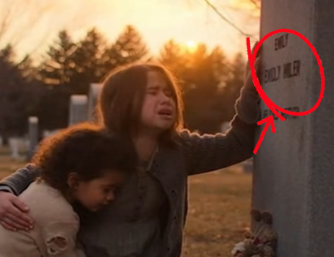
We found Mama’s grave easily. We had been there so many times since she died that we could walk to it with our eyes closed. The weathered marble headstone read EMILY MILLER, BELOVED MOTHER, the letters barely visible now, eroded by rain and time.
Lily knelt down first, resting her head against the cold stone as if she could somehow hear Mama’s heartbeat through it. I knelt beside her, and we sat there in silence for a moment, just breathing, just being.
“Mama,” Lily murmured, tracing her small, dirty fingers over the carved letters, “we’re hungry. Aunt Margaret doesn’t feed us. She hits us when we cry. She makes us work all day. Please… please come back. We need you.”
My eyes filled with hot, angry tears that I had been holding back for months. I bit my lip hard to keep from sobbing, tasting blood, but when Lily’s small body began to shake with silent, heartbreaking weeping, I couldn’t hold back anymore. The dam broke.
“Mama, I’m so hungry,” I cried out, the words torn from the very depths of my soul, raw and desperate. “I’m sorry, Mama. I’m trying to be strong. I’m trying to take care of Lily like you asked me to, but I can’t… I can’t do it anymore. I’m failing. I’m failing you. Please, please help us. Please send someone. Anyone.”
The sound of our voices—two little girls begging a ghost for food, for love, for salvation—shattered the peaceful silence of the cemetery. Birds flew away from nearby trees, startled by our grief. We cried until we were empty, until there were no more tears left, until our throats were raw and our bodies exhausted.
We didn’t know we weren’t alone.
We didn’t know that, only twenty yards away, hidden behind a large weeping willow tree with branches that draped to the ground like a curtain, a man was standing. A tall man in an expensive charcoal suit that cost more than most people in Maplewood earned in a year. His face was pale, stricken with a grief and horror we couldn’t comprehend. His hands were clenched into fists at his sides, trembling.
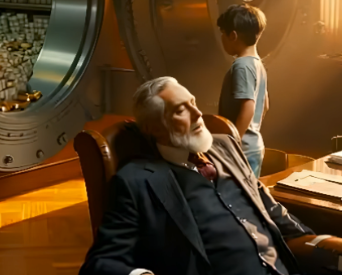
His name was Alexander Cross, though we didn’t know that then. He was a billionaire from New York City, a man whose name appeared in Forbes magazine, whose companies employed thousands. He had returned to Maplewood—the town he had fled thirty years ago—to visit his own family’s grave. His younger sister had died here when they were children, and he came back every year on the anniversary of her death, seeking some kind of peace that always eluded him.
And he had heard every single one of our heartbreaking words.
Ten years later, I was eighteen years old, working two jobs to put myself through community college and support Lily, who was now thirteen. We had survived Aunt Margaret’s house by the skin of our teeth. When I turned sixteen, I had finally worked up the courage to report her to Child Protective Services. They removed us, placed us in foster care—which wasn’t perfect, but it was paradise compared to Aunt Margaret’s hell.
I had learned to be strong, to be independent, to rely on no one but myself. I had learned that the world was cruel and that fairy tales didn’t come true. I had learned that no one was coming to save us.
I was wrong.
It was a Tuesday morning in early spring when everything changed. I was working at the diner on Main Street, serving coffee and pancakes to the handful of customers who still came to Maplewood. The town had only gotten smaller, more forgotten. Most young people left as soon as they could.
The bell above the door chimed, and I looked up automatically, ready to greet another customer with my practiced smile. But the words died in my throat.
A man walked in—tall, imposing, dressed in a suit that looked completely out of place in our run-down diner. He was probably in his late forties, with silver streaking through his dark hair and eyes that were intense, haunted. He looked around the diner as if he was searching for something specific.
His eyes landed on me, and he froze. For a long moment, we just stared at each other. There was something in his gaze—recognition? Sadness? I couldn’t quite place it.
“Grace Miller?” he asked quietly, his voice deep and controlled, but with an undercurrent of emotion.
My heart skipped a beat. “Yes? Do I… do I know you?”
He walked closer, and I noticed his hands were shaking slightly. “No. But I know you. I’ve been looking for you for a very long time.”
Fear crept up my spine. “I don’t understand. Who are you?”
“My name is Alexander Cross,” he said. “Ten years ago, I was at Maplewood Cemetery, visiting my sister’s grave. And I heard you and your sister crying at your mother’s grave. I heard everything.”
The world tilted. The sounds of the diner—the clinking of silverware, the murmur of conversation—faded into white noise. I gripped the edge of the counter to steady myself. “You… you heard us?”
“Every word,” he said, his voice thick with emotion. “And I’ve regretted not doing something that very day for ten years. I was a coward. I was dealing with my own grief, my own demons, and I walked away. But your voices—your cries—they haunted me. Every single day.”
Tears welled up in my eyes before I could stop them. “Why didn’t you help us then? Do you have any idea what we went through? What she did to us?”
“I know,” he said, his face etched with genuine pain and regret. “And I’m sorry. I’m so, so sorry. But I’m here now. And I want to make it right.”
“Make it right?” I laughed bitterly. “How can you possibly make it right? Those years are gone. That suffering can’t be undone.”
“You’re right,” he said simply. “I can’t undo the past. But I can help shape your future. I’ve spent the last ten years building a case against Margaret Patterson. I hired private investigators, lawyers, forensic accountants. I found dozens of other children she abused over the years. She’s going to prison, Grace. For a very long time.”
I blinked, processing his words. “What?”
“She was arrested this morning,” he continued. “She’ll face charges of child abuse, neglect, fraud—she was collecting welfare benefits meant for you and Lily while starving you. The trial will be swift. I’ve made sure of it.”
I felt like I couldn’t breathe. “Why? Why would you do all this for us? We’re nobody. We’re just—”
“You’re not nobody,” he interrupted firmly. “You were two innocent children who deserved better. And I failed you when you needed help most. I can’t change that. But I’ve spent ten years trying to make amends.”
He reached into his jacket and pulled out an envelope. “This is for you and Lily. College funds, housing, medical care—everything you need to build the life you deserve. No strings attached. I don’t want anything from you. I just want you to have a chance.”
I stared at the envelope like it was a foreign object. “I don’t… I can’t accept this.”
“Yes, you can,” he said gently. “Your mother would want you to. She loved you so much, Grace. I could hear it in your voice that day, even in your grief. She raised you to be strong and loving. Honor her memory by letting someone help you for once.”
The tears came then, unstoppable. For ten years, I had built walls around my heart, refusing to let anyone in, refusing to hope. And now this stranger—this man who had heard the worst moment of my life—was offering me a future I had never dared to dream of.
“Why?” I whispered. “Why do you care so much?”
His eyes grew distant, haunted. “Because my sister—the one buried in that cemetery—she died when I was seventeen. I was supposed to be watching her, but I wasn’t. I was selfish, distracted. And when I heard you and Lily crying that day, it was like hearing her voice again. I couldn’t save her. But maybe… maybe I could save you.”
I understood then. This wasn’t charity. This was his own path to redemption, his own way of healing wounds that had never closed. We were both broken in different ways, shaped by loss and regret.
“Thank you,” I said finally, my voice barely audible. “Thank you for not forgetting us.”
He smiled then—sad, but genuine. “I could never forget you. Your strength, your love for your sister, your resilience—those cries at your mother’s grave weren’t cries of weakness. They were cries of survival. And you survived, Grace. Against all odds, you survived.”
That was three years ago. Lily is now sixteen, thriving in a private school, planning for college. I graduated with honors, got my degree in social work, and now I help children who are going through what we went through. Alexander became like a father figure to us—not replacing our parents, but honoring their memory by ensuring their daughters had every opportunity to flourish.
And Aunt Margaret? She’s serving a twenty-five-year sentence in federal prison. I don’t hate her anymore. I pity her. She was a broken, bitter woman who inflicted her pain on innocent children. But she no longer has power over me.
I visit Mama’s grave often, but now when I kneel there, I don’t cry from desperation. I tell her about my life, about Lily’s achievements, about the children I’ve helped. I tell her that we made it. That we’re okay.
And sometimes, when the wind blows through the weeping willow, I swear I can feel her pride, her love, wrapping around me like a warm embrace.
We survived. And more than that, we learned that sometimes, when you cry out into the darkness, someone is listening. Sometimes, help comes from the most unexpected places. Sometimes, broken people find each other and help heal the wounds that seemed permanent.
My name is Grace Miller. I was eight years old when I thought the world had abandoned me. I was wrong. And I’ve spent every day since then making sure no child ever feels that alone again.