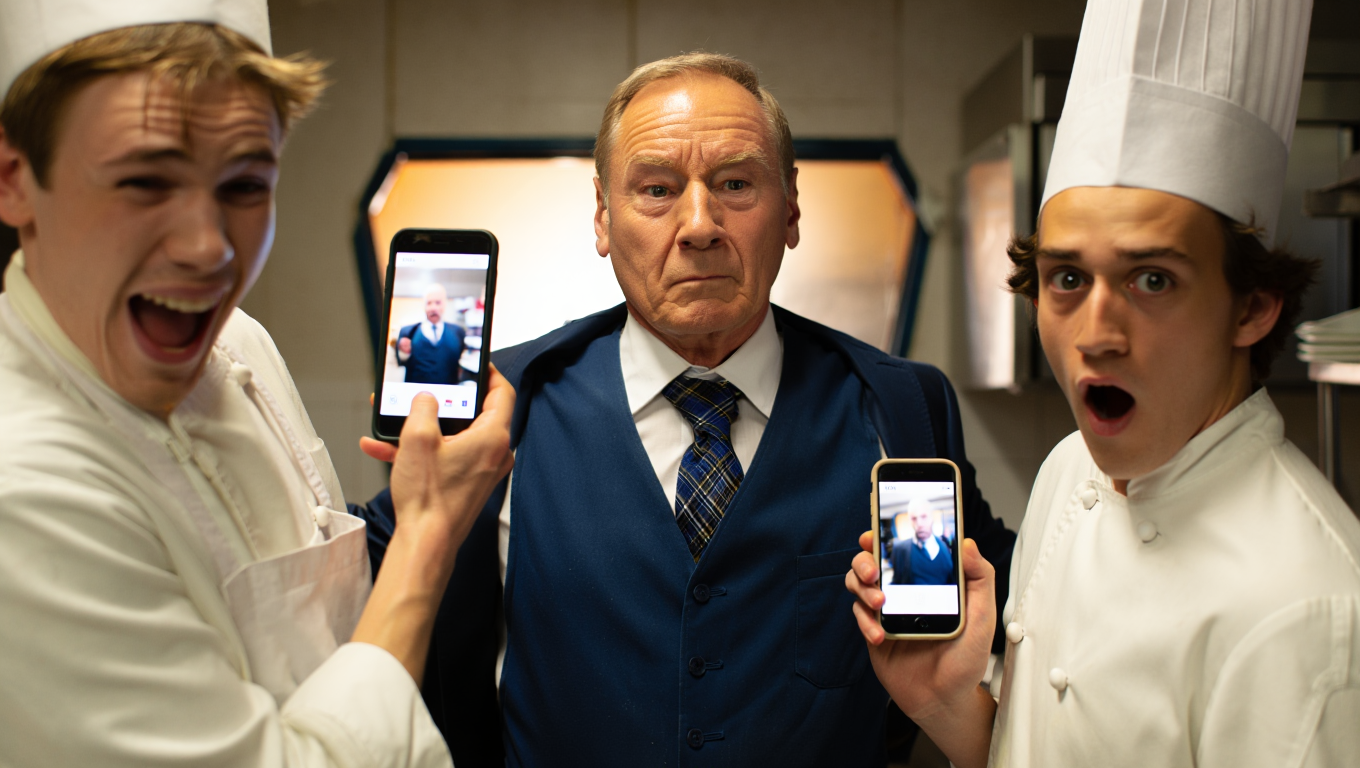
Two arrogant workers filmed themselves bullying the “old dishwasher” in the kitchen… But when he removed his apron, they realized they’d just mocked their actual CEO.
The fluorescent lights hummed overhead in the bustling kitchen of La Belle Maison, one of the most prestigious restaurant chains on the East Coast. Steam rose from industrial pots, knives clattered against cutting boards, and orders were shouted across the line in that familiar symphony of controlled chaos that defined every dinner rush.
In the far corner, near the three-compartment sink, stood Marcus Webb. At sixty-seven years old, his weathered hands moved methodically through mountains of dishes, his shoulders slightly hunched from decades of hard work. To everyone in that kitchen, he was just another face in the background—the quiet old man who’d been hired three weeks ago to help with the dishwashing during their busiest season.
But that’s exactly what Marcus wanted them to think.
Twenty-two-year-old Devon Matthews and his buddy Craig Peterson, both line cooks who’d been with the restaurant for less than a year, had made Marcus their favorite target. It started small—snide comments about his age, jokes about him being “too slow,” deliberate messes left near his station. Marcus never responded. He just smiled that gentle smile of his and continued working.
“Yo, check this out,” Devon whispered to Craig during a brief lull in orders, pulling out his phone. His eyes gleamed with that particular brand of cruelty that comes from insecurity masked as confidence. “This is gonna go viral.”
Craig grinned, already reaching for the spray nozzle attached to the industrial sink. “Do it, bro. Content is content.”
Marcus was bent over, carefully stacking clean plates, when the first blast of cold water hit him square in the back. He straightened slowly, water dripping from his work shirt, his grey hair plastered to his forehead.
“Oh man, my bad, old timer!” Devon called out, phone raised and recording. “Guess your reflexes are too slow to dodge, huh?”
Several other kitchen staff glanced over, but quickly looked away. Nobody wanted to get involved. Jobs were hard to come by, and Devon’s uncle was the regional manager—everyone knew he had protection.
Craig unleashed another spray, this time hitting Marcus’s face. “Maybe this’ll wake you up! Speed it up back there, grandpa!”
The two young men were laughing so hard they had tears in their eyes, Devon’s phone capturing every second of their “hilarious prank.” A few nervous chuckles echoed from other parts of the kitchen, the uncomfortable laughter of people who knew this was wrong but felt powerless to stop it.
Marcus stood perfectly still, water pooling at his feet. Then, slowly, deliberately, he reached up and began unbuttoning his soaked work shirt.
“Dude, what’s he doing?” Craig whispered, his smile faltering.
Beneath the cheap, water-stained work shirt was a crisp white dress shirt. Marcus shrugged off the outer layer and let it fall to the floor. Then he removed the worn apron, revealing tailored charcoal wool trousers held up by a Hermès belt. His weathered work shoes came off next, and from a locker that everyone assumed held his lunch, he retrieved a pair of polished Italian leather Oxfords.
The kitchen had gone silent. Even the sizzling from the grill seemed to quiet.
From the same locker, Marcus pulled out a navy blue suit jacket—Tom Ford, if anyone had known enough to recognize it. He slipped it on with practiced ease, the fabric settling perfectly across his shoulders. Finally, he produced a burgundy silk tie and fastened it with the smooth, automatic movements of someone who’d done it ten thousand times.
Devon’s phone was still recording, but his hand had begun to shake. The smile had vanished from his face.
Marcus ran his fingers through his wet hair, slicking it back, and suddenly the tired old dishwasher was gone. In his place stood a man who commanded board rooms, who’d built an empire from nothing, whose signature was on every paycheck in this building.
“Would you two gentlemen please follow me outside?” Marcus’s voice had changed too—no longer the soft, humble tone of the dishwasher. This was the voice of authority, of decades of leadership, of a man who’d earned every ounce of respect he commanded.
Craig’s face had gone pale. “Sir, I… we didn’t—”
“Outside. Now.”
The walk through the kitchen felt like a funeral procession. Every staff member had stopped working, their eyes wide with recognition and dawning horror. The head chef, Pierre Laurent, stood frozen with a pan in mid-air, his mouth hanging open. He’d worked for Marcus Webb for fifteen years and had no idea his boss had been washing dishes in his kitchen for the past three weeks.
Marcus pushed through the back door into the cool evening air. The alley behind La Belle Maison was where deliveries came in, where staff took their smoke breaks, where the dumpsters were kept. It was also well-lit and private—perfect for what came next.
Devon and Craig stumbled out behind him, Craig already crying, Devon’s bravado crumbling with each second.
Marcus turned to face them, his hands clasped behind his back in that CEO stance they’d seen in a thousand corporate photos but never connected to the old man they’d been tormenting.
“Do you know why I was working as a dishwasher?” Marcus asked, his voice calm, almost gentle.
Neither young man could speak. Devon was gripping his phone so hard his knuckles had gone white.
“Three months ago, my executive team came to me with concerning reports about workplace culture across our properties. Bullying. Harassment. Staff turnover rates that were completely unacceptable. When I asked for specifics, I was given sanitized reports, carefully worded memos that told me nothing useful.” Marcus paused, letting his words sink in. “So I decided to see for myself.”
“Mr. Webb, please—” Craig managed to choke out.
Marcus held up a hand. “I’ve spent the last three months working in different positions across fifteen of our locations. Dishwasher. Prep cook. Custodian. I wanted to see what really happens when people think no one important is watching. I wanted to understand what it feels like to be the person everyone thinks they can treat like garbage.”
Devon was shaking now, tears streaming down his face. “Sir, we were just joking around. We didn’t mean—”
“You didn’t mean what? To humiliate another human being? To abuse someone you perceived as powerless? To film it for entertainment?” Marcus’s voice remained level, but there was steel underneath. “Tell me, Devon, what exactly were you going to do with that video?”
“I… I was gonna post it on TikTok,” Devon whispered.
“So you could what? Get likes? Go viral by mocking an elderly man who was just trying to do his job?” Marcus shook his head. “Do you have any idea how many people I’ve watched cry in locker rooms over these past three months? How many dedicated, hardworking people have been driven to quit because of treatment exactly like what you just demonstrated?”
Craig fell to his knees. Actually fell to his knees on the dirty asphalt. “Please, Mr. Webb. Please don’t fire me. I’ve got student loans. My mom is sick. I need this job. I’m sorry. I’m so, so sorry.”
Marcus looked down at him, and for a moment, the hard CEO facade cracked, revealing genuine sadness underneath. “Stand up, Craig. Have some dignity.”
Craig stumbled to his feet, wiping his nose on his sleeve.
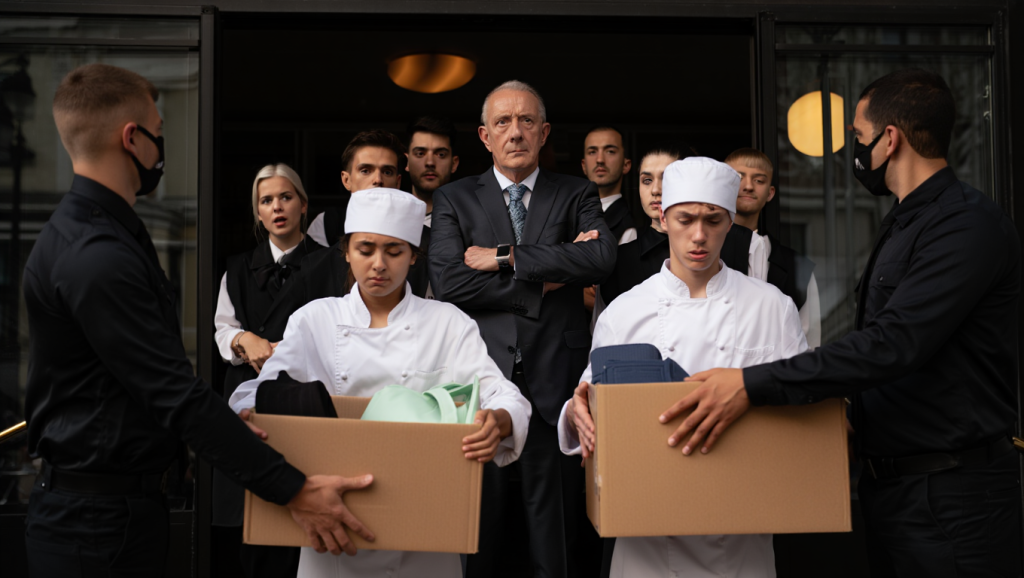
“Here’s what’s going to happen,” Marcus said, addressing them both. “You’re both terminated, effective immediately. You’ll be escorted by security to collect your personal belongings. You’ll receive two weeks’ severance pay—which is more generous than you deserve—and your final checks will be mailed to you.”
“No, please!” Devon dropped his phone, the screen cracking on the pavement. “My uncle—”
“Your uncle is also terminated,” Marcus said calmly. “He’s known about your behavior for months and chose to protect you rather than address it. That ends now.”
“But I need this job!” Devon’s voice rose to a shout. “You can’t do this! I’ll sue! I’ll—”
“You’ll what?” Marcus asked quietly. “Post that video? Please do. I’d love for the world to see you bullying someone you thought was a powerless old man. I’m sure that’ll help your future employment prospects tremendously.”
The fight went out of Devon all at once. He sagged like a puppet with cut strings.
“However,” Marcus continued, and both young men looked up with desperate hope, “I’m not a cruel man, despite what you might think right now. This is not about revenge. It’s about accountability and change.”
He pulled two business cards from his jacket pocket and handed one to each of them.
“This is the contact information for a counselor who specializes in workplace behavior and personal development. I’ve already arranged for each of you to have three months of sessions, fully paid. Whether you take advantage of this is entirely up to you.”
Craig stared at the card, confused. “I don’t understand.”
“I’m giving you a chance to learn from this,” Marcus said. “To understand why what you did was wrong, to develop empathy, to become better men. The counseling is free. What you do with it is your choice.”
“And then?” Devon asked, his voice hoarse. “After three months?”
“After three months, if you’ve completed the program and your counselor signs off that you’ve made genuine progress, I’ll provide you with a neutral reference. Not a glowing recommendation—you haven’t earned that—but I won’t stand in the way of you rebuilding your careers elsewhere.”
“But we can’t come back here?” Craig asked.
“No. Your time at La Belle Maison is over. But your lives don’t have to be defined by this moment. That’s up to you.”
Marcus turned toward the door, then paused. “Devon, delete that video. All copies. If I ever find out you shared it, the severance disappears, the counseling disappears, and the reference disappears. Are we clear?”
“Yes, sir,” Devon mumbled, already pulling out his phone to comply.
“One more thing,” Marcus said, his hand on the door handle. “In my office, I have a wall of photos. Hundreds of them. Every single person who’s worked for me over the past forty years. I know their names, their families, their dreams. Do you know why?”
Neither answered.
“Because every person who works in my restaurants is valuable. From the dishwasher to the executive chef, every single person deserves respect, dignity, and fairness. That’s not just good ethics—it’s good business. When you treat people well, they do excellent work. When you create a culture of fear and humiliation, you get exactly what we’ve had: good people quitting, bad behavior spreading, and a company culture I’m ashamed of.”
Marcus pulled open the door. “Security will be here in five minutes. Use that time to think about the kind of men you want to be.”
He stepped back into the kitchen, where every single staff member immediately snapped to attention. Marcus walked slowly through the space, making eye contact with each person.
“Listen up, everyone,” he said, his voice carrying authority but also warmth. “What you just witnessed is going to happen across every one of our locations. This company is changing, starting now. There will be anonymous hotlines. There will be third-party audits. There will be mandatory training. And there will be consequences for anyone—I don’t care what position they hold—who treats another human being the way those two treated me tonight.”
He paused by the dish station, looking at the mountain of plates still waiting to be washed.
“But there will also be rewards for those who exemplify the values we should have been living all along. Starting next month, every location will implement a profit-sharing program. There will be paths for advancement based on merit, not connections. There will be tuition assistance for anyone who wants to further their education. And there will be respect—non-negotiable, fundamental respect—for every person who works here.”
Pierre, the head chef, stepped forward. His eyes were red. “Monsieur Webb, I had no idea. I should have stopped them. I should have—”
“You were afraid,” Marcus said gently. “That’s my failure, not yours. I built a system where good people felt powerless to do the right thing. That changes now.”
He looked around the kitchen one more time. “Anyone here who’s been bullied, harassed, or mistreated—I want you to email me directly. My address is … You will be heard. You will be believed. And action will be taken. That’s my promise to you.”
The kitchen remained silent for a long moment. Then, slowly, someone started clapping. It was Maria, one of the prep cooks, a grandmother from El Salvador who’d been washing vegetables in this kitchen for eight years. Others joined in, and soon the entire kitchen was applauding.
Marcus felt his throat tighten. He held up a hand to quiet them.
“Thank you. But applause isn’t what I’m after. I want change. Real, lasting change. And that starts with each of us, every day, choosing to treat each other with the dignity we all deserve.”
He headed toward the kitchen’s back office, then turned back one final time.
“Oh, and one more thing—everyone here is getting a twenty percent raise, effective immediately. You’ve all been underpaid for too long.”
The kitchen erupted into genuine cheers this time. Marcus smiled—that same gentle smile he’d worn while being bullied—and disappeared into the office.
Outside, Devon and Craig stood in the alley, waiting for security, their lives irrevocably changed. The video was deleted. Their jobs were gone. Their futures were uncertain.
But they’d been given something most people never get: a second chance to become better.
Whether they’d take it was entirely up to them.
Back in the kitchen, Maria approached the dish station and began washing plates alongside her coworkers who’d volunteered to help. As her hands moved through the warm, soapy water, she thought about the quiet old man who’d worked beside her for three weeks, who’d shared his lunch with her, who’d listened to stories about her grandchildren with genuine interest.
She’d known there was something special about him.
She just hadn’t realized he’d been testing whether they could see it too.
The dinner rush resumed, but the kitchen felt different now. Lighter somehow. As if a weight everyone had been carrying—without even realizing they were carrying it—had finally been lifted.
And in his office, Marcus Webb removed his expensive suit jacket, rolled up his sleeves, and got to work. He had fourteen more locations to visit, hundreds more employees to meet, and an entire company culture to rebuild.
But for the first time in months, he felt something he hadn’t felt in a long time.
Hope.
The next morning, Marcus would call an emergency meeting of his entire executive team. There would be uncomfortable conversations. There would be resignations, both requested and voluntary. There would be a complete overhaul of human resources policies, whistleblower protections, and accountability measures.
It would take years to fully transform the culture he’d allowed to develop. But every journey starts with a single step.
And sometimes, that step requires a CEO to put on an apron, wash some dishes, and remember what it feels like to be treated as invisible.
Because the people doing the hardest work in our society are often the ones we see the least.
It was time to change that.