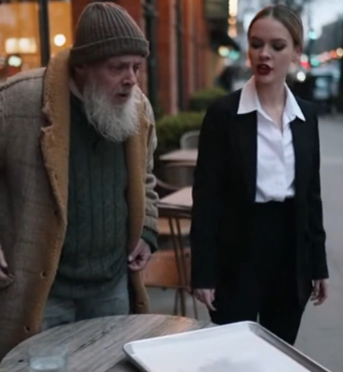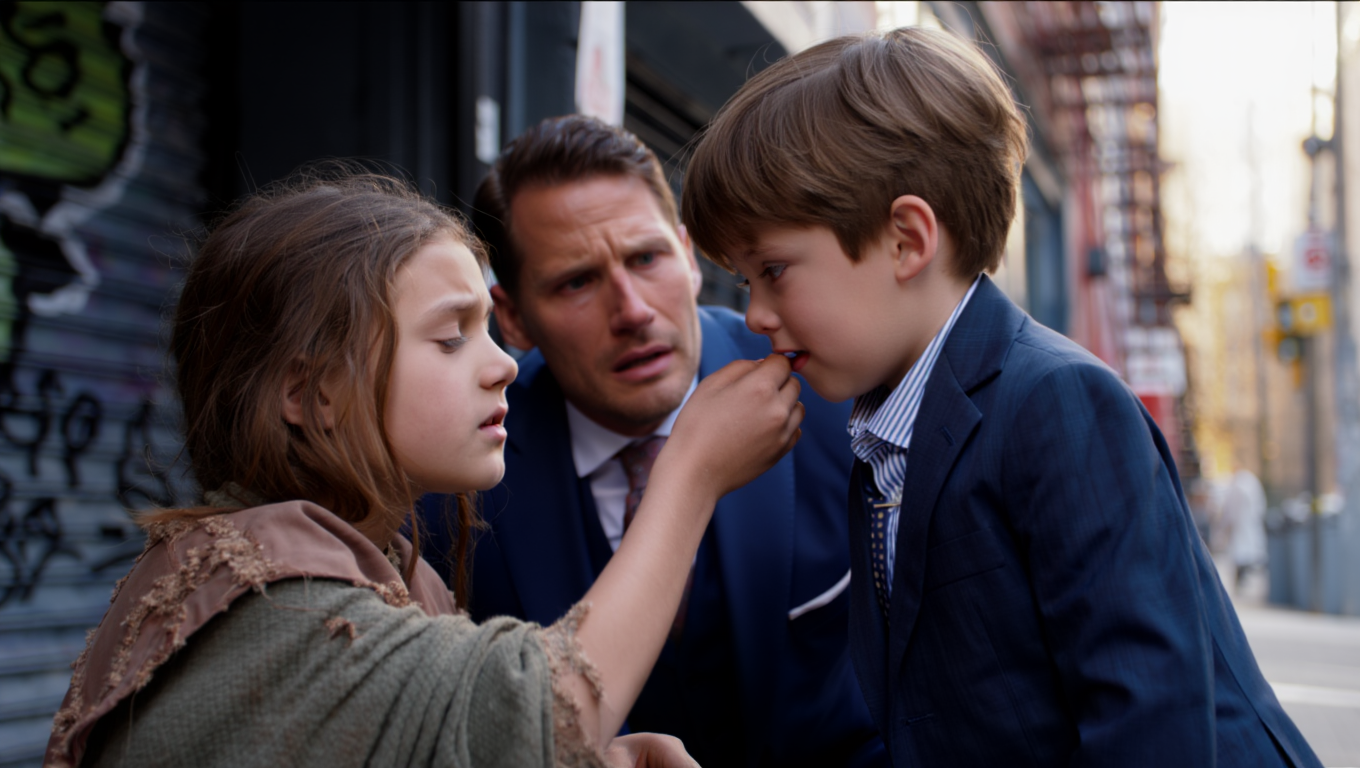
A homeless girl was helping a crying rich boy when his father stormed out screaming, “What did you do to my son?”… But what she was really doing left him speechless.
The morning sun blazed mercilessly over the pristine white mansion, its rays bouncing off marble columns and imported Italian tiles. Maya sat cross-legged on the edge of the grand patio, her fingers trembling as she worked carefully on the little boy’s eye. Dust and ash still clung to her torn brown jacket—remnants of last night’s sleep beneath the highway overpass.
“Hold still, okay?” she whispered to the boy, whose name she’d learned was Oliver. “I almost got it.”
Oliver whimpered, tears streaming down his flushed cheeks, mixing with the glitter that had somehow gotten lodged beneath his eyelid. Maya had been walking past the mansion’s iron gates when she heard his desperate crying. While the gardeners and household staff walked by without stopping, she’d climbed through a gap in the hedge to help.
She’d seen this before—her little brother used to get things stuck in his eyes all the time, back when they had a home. Back before the fire. Back before everything fell apart.
“There,” Maya said softly, extracting a tiny shard of metallic glitter with the thin edge of a clean twig she’d carefully prepared. “Got it. You’re okay now.”
Oliver blinked rapidly, relief flooding his small face. “Thank you,” he said, his voice shaky but grateful. “The glitter from my art project—it hurt so bad. Nobody would help me.”
“WHAT DID YOU DO TO MY SON?”
The roar came from the mansion’s entrance like thunder. Maya’s head snapped up to see a tall man in an expensive navy suit charging down the stone steps, his face purple with rage. His designer shoes clacked against the stone like gunshots.
Maya scrambled to her feet, instinctively putting herself between Oliver and the perceived threat, even though this was clearly the boy’s father. Her heart hammered in her chest. She knew how this looked—a dirty street kid hovering over a wealthy man’s crying child.
“Dad, wait—” Oliver started, but his father was already there, grabbing Maya’s wrist with crushing force.
“I’m calling the police,” the man snarled, pulling out his phone with his free hand. “Security! Where the hell is security?”
“Mr. Harrison, please—” Oliver was crying again now, tugging at his father’s suit jacket. “She was helping me! She got the glitter out of my eye!”
But the man wasn’t listening. His eyes were fixed on Maya with a mixture of disgust and fury. “How did you even get in here? What else did you take?”
Maya’s voice came out small, defeated. She’d been through this before—the assumptions, the accusations. Being homeless meant being guilty until proven innocent. “I didn’t take anything. Your son was crying. Nobody was helping him.”
“Don’t lie to me,” the man spat, tightening his grip. “Jennifer! Call 911!”
A woman in a pristine white blouse appeared at the doorway, phone already in hand, her face pale with concern. The household staff began emerging from various corners of the property—the same people who’d walked past Oliver’s cries without a second glance.
“STOP IT!” Oliver’s scream cut through the chaos. The eight-year-old planted himself in front of Maya, small fists clenched, facing down his own father. “She didn’t hurt me! She saved me!”
The man paused, finally looking—really looking—at his son. Oliver’s eye was red and irritated but clear, no longer filled with tears of pain. In his small hand, he clutched the tiny shard of glitter Maya had removed.
“There was glitter stuck in my eye from my art project,” Oliver said, his voice trembling but determined. “It hurt so bad I couldn’t see. I was crying and crying. The gardener walked past. Maria walked past. Even Mom walked past.” He shot a look at the woman in the doorway, who had the grace to look ashamed. “But SHE stopped. She climbed through the fence because she heard me crying. She helped me when nobody else would.”
The man’s grip on Maya’s wrist loosened. She could see the gears turning in his head, watching his assumptions crumble in real-time.
“I… I saw you hovering over him, and he was crying, and I thought…” His voice trailed off as the reality of what he’d done sank in.
“You thought the worst,” Maya finished quietly, rubbing her wrist where red marks were already forming. “Everyone always does.”
The patio fell silent except for the distant hum of a lawnmower and the splash of the infinity pool. The man—Jonathan Harrison, tech CEO and philanthropist, according to the business magazines—looked at the scared, dirty girl in front of him and seemed to truly see her for the first time.
“What’s your name?” he asked, his voice completely different now—softer, almost broken.
“Maya.”
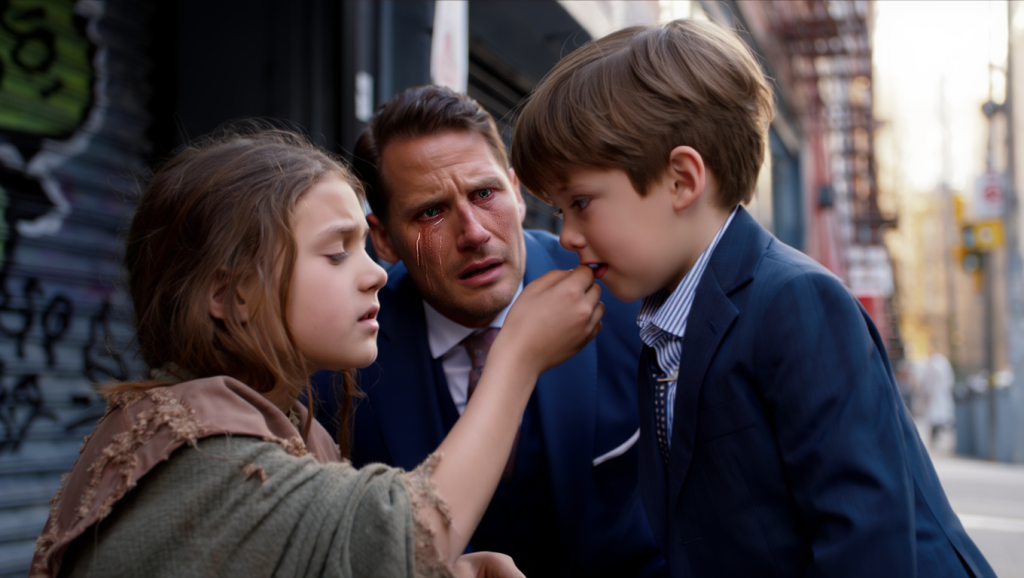
“Maya, I…” Jonathan ran a hand through his perfectly styled hair, destroying its careful arrangement. “I am so sorry. I saw someone I didn’t recognize with my son, and I just… I reacted. That’s no excuse for how I treated you.”
“People like me don’t get excuses,” Maya said, not unkindly. Just stating a fact. “We get assumptions.”
Oliver grabbed Maya’s hand. “Dad, she lives under the bridge. She told me. She doesn’t have a home.”
Jonathan’s eyes widened. The woman—Jennifer, his wife—slowly lowered the phone, guilt washing over her features. The staff suddenly found the ground very interesting to look at.
“You’re homeless,” Jonathan said slowly, processing this information. “And you still stopped to help my son. While my own staff…” He turned to look at the assembled employees, who collectively seemed to shrink under his gaze. “While people I pay walked right past a child in pain.”
“He needed help,” Maya shrugged. “That’s all that mattered.”
Jonathan looked at this girl—this child who had nothing but still gave everything—and something fundamental shifted in him. Here he was, living in a ten-million-dollar mansion, employing a small army of staff, and a homeless girl had shown more compassion in five minutes than his entire household had all morning.
“How old are you, Maya?”
“Fourteen. Almost fifteen.”
The same age as his niece. Jonathan felt sick. “Where are your parents?”
Maya’s face shuttered closed. “Gone. House fire two years ago. I’ve been on my own since the foster system didn’t work out.”
Jennifer gasped audibly. Oliver’s grip on Maya’s hand tightened.
“Jennifer,” Jonathan said, his voice taking on the decisive tone that had built his tech empire. “Cancel my morning meetings. All of them.” He turned to Maya. “Have you eaten today?”
Maya hesitated, then shook her head.
“Then you’re having breakfast with us. No arguments.” He held up a hand as Maya started to protest. “After that, we’re going to talk. Really talk. Because I think… I think maybe you walked through our gate for a reason.”
“Dad’s right,” Oliver piped up, smiling for the first time. “You should stay. You’re nice.”
Maya looked at the mansion, at the family standing before her, at the opportunity suddenly opening up like a door she’d thought was locked forever. Part of her wanted to run—she’d learned not to trust offers that seemed too good to be true.
But something in Jonathan Harrison’s eyes had changed. The rage was gone, replaced by something that looked like genuine remorse and, perhaps, hope.
“Just breakfast?” she asked warily.
“Just breakfast,” Jonathan agreed. Then, more softly, “And maybe a conversation about what comes next. If you’re willing.”
As they walked toward the mansion, Oliver chattering excitedly about his art project and how the glitter had caused all the trouble in the first place, Jonathan couldn’t stop thinking about how close he’d come to calling the police on the person who’d shown his family what real kindness looked like.
He’d spent years funding charities and attending galas for the homeless, writing checks and feeling philanthropic. But it took a fourteen-year-old girl with nothing to teach him what compassion actually meant.
By the time breakfast ended three hours later, Maya had heard an offer she never expected: a chance at a real home, a family who wanted to help her, and a father figure who understood he had as much to learn from her as she might from him.
“You don’t have to decide now,” Jennifer said gently, passing Maya another helping of fresh fruit. “But we have a guest house. It’s just sitting empty. You could stay there while we figure things out properly—social services, school enrollment, whatever you need.”
Maya looked down at her plate, at the abundance of food, then up at Oliver’s hopeful face. “Why?” she whispered. “Why would you do this?”
Jonathan leaned forward, his eyes serious. “Because you showed my son—showed all of us—that humanity isn’t about what you have. It’s about what you do when someone needs help. You could have walked past. You didn’t. That says everything about who you are.”
“And maybe,” he added quietly, “it says something about who we need to become.”
As the morning sun climbed higher over the mansion, Maya made a decision. She would stay—not because she needed saving, but because sometimes kindness creates a bridge between two different worlds. And sometimes, the person who seems to need help the most is actually the one teaching everyone else how to be human.
Three months later, the mansion’s guest house had transformed into Maya’s room, filled with books and art supplies and all the things a fifteen-year-old deserved. She was enrolled in the local high school, excelling in her classes, and had become Oliver’s fiercest protector and best friend.
But every Sunday, Maya insisted on volunteering at the homeless shelter downtown. And every Sunday, the entire Harrison family went with her.
Because some lessons, Jonathan realized, are too important to forget. And some teachers come from the most unexpected places.