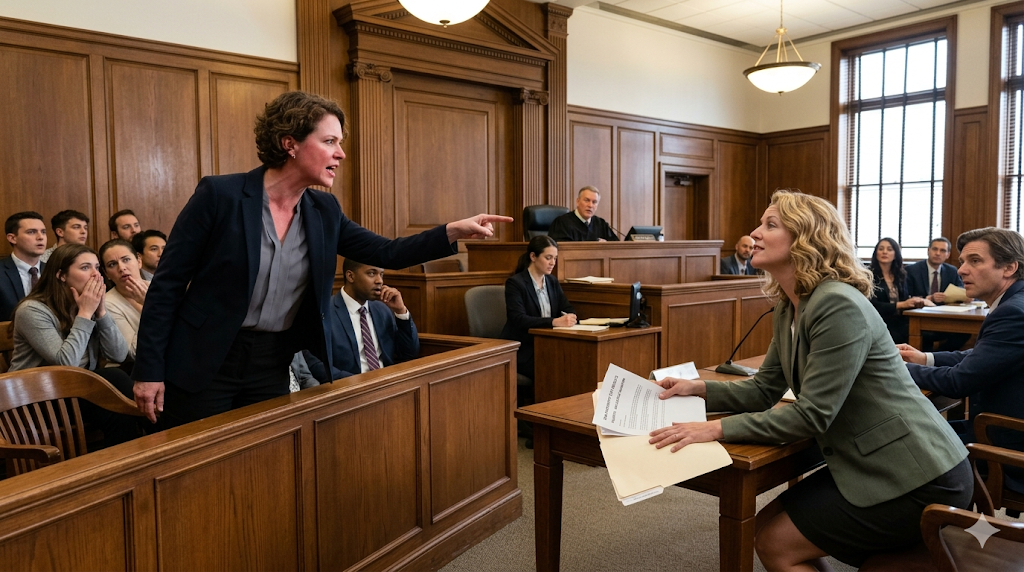

A woman stood up in court and accused the stranger across the room of being a gold-digger who showed up the day her father died… but the DNA test the stranger slammed on that table changed everything.
The courtroom on the seventh floor of the Hargrove County Courthouse had seen its share of battles — custody wars, fraud cases, fortunes split between feuding siblings. But nobody who filed into Room 14 that Tuesday morning could have predicted what they were about to witness.
The case of the Estate of Raymond Harlow Calloway was docketed as a standard probate dispute. Raymond Calloway, sixty-eight, founder of Calloway Industrial Solutions, had died of a heart attack eleven days earlier in his penthouse apartment. He had no will on file. His eldest daughter, Margaret Calloway-Ashford, had immediately moved to claim the entirety of his $14 million estate. Standard procedure, her attorneys argued. She was his only child. His only living family. The matter should have been settled in an afternoon.
Then a young woman named Nadia Reyes filed a claim of her own.
Margaret arrived first, as she always did everywhere — composed, deliberate, dressed in a black wool crepe dress that cost more than most people’s car payments. The pearl necklace at her throat had been her mother’s. She wore it like armor. She was fifty-one years old, had her father’s hard jaw and her mother’s cold eyes, and she had spent thirty years building a life in the orbit of Raymond Calloway’s money and approval. She was not about to let a stranger walk into this room and take any of it.
She recognized Nadia the moment the girl walked through the double doors. She’d seen her exactly once before — at the funeral, standing just outside the reception line, in a beige cardigan that looked like it had been bought for the occasion. Young. Mid-twenties. Dark hair. The kind of face that looked perpetually uncertain of whether she was allowed to be in the room.
Margaret had assumed she was a former employee. Someone Raymond had been mentoring, perhaps. He’d done that occasionally — taken young people under his wing, helped them into careers. It would be just like him to die and leave some intern feeling sentimental enough to attend his services.
She had not expected a legal claim.
The courtroom filled slowly. Margaret’s attorney, a silver-haired man named Phillip Dane who charged $900 an hour and had never lost an estate case, arranged his papers with quiet confidence. On the other side of the aisle, Nadia sat with a younger attorney in a suit that was slightly too large for him, holding a manila folder against her chest like it was a shield.
Judge Elaine Moreno entered and called the room to order. She was in her late fifties, no-nonsense, the kind of judge who had seen too many grief-soaked courtrooms to be moved by displays of emotion but who had not yet become immune to truth.
“We’re here today in the matter of the Estate of Raymond Harlow Calloway,” she said. “Ms. Reyes has filed a claim as an heir. Ms. Calloway-Ashford contests that claim. Counsel, let’s begin.”
Phillip Dane rose smoothly. His argument was elegant in its simplicity. Raymond Calloway had one daughter: Margaret. This was documented across forty years of tax filings, school records, holiday photographs, and the man’s own public biography. Nadia Reyes had appeared — Dane chose the word deliberately — appeared at Raymond Calloway’s funeral without an invitation, without a prior relationship, without a single piece of verifiable evidence connecting her to the deceased. She was, Dane suggested with practiced calm, exactly the kind of person who studied obituaries and spotted opportunities.
He did not use the word fraud. He didn’t have to.
Margaret watched Nadia’s face as Dane spoke. The girl’s jaw tightened. Her hands, folded on the table, pressed slightly white at the knuckles. But she didn’t look down. She kept her eyes on the judge, and there was something in that steadiness — not defiance exactly, but a kind of rooted dignity — that Margaret found, to her irritation, unsettling.
When Dane finished, Nadia’s attorney stood. His name was Joel Carver, thirty-two years old, two years out of law school, and he was clearly nervous. But he spoke clearly.
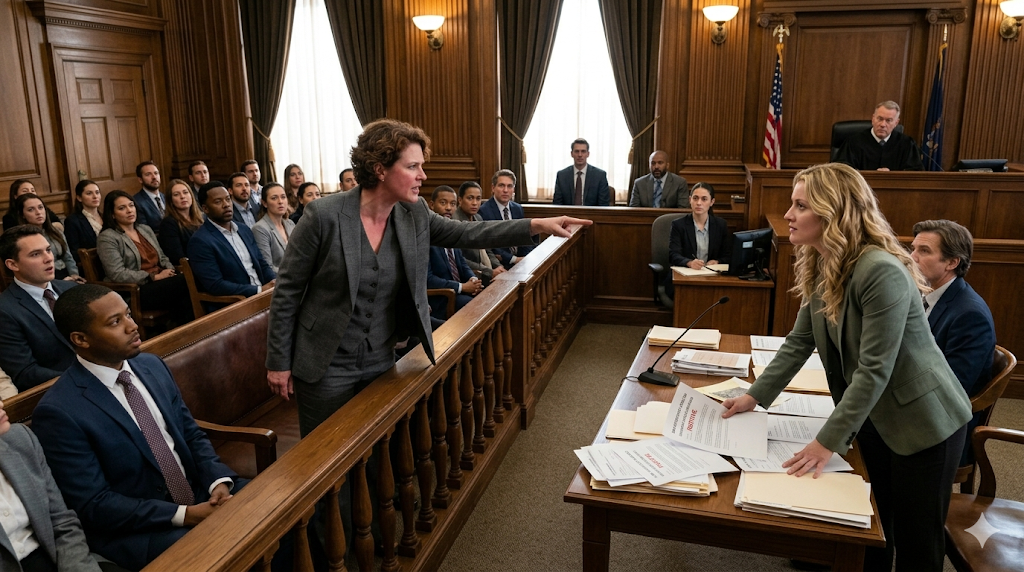
“Your Honor, my client is not contesting the nature of Raymond Calloway’s estate or the sincerity of Ms. Calloway-Ashford’s grief. She is simply asserting her legal right as a biological heir.”
“On what basis?” Judge Moreno asked.
“On the basis of parentage.”
Dane was already half-risen. “Your Honor, if Ms. Reyes is claiming to be Raymond Calloway’s daughter, she needs to provide —”
“We have documentation,” Carver said.
That was when Margaret stood up.
She hadn’t planned to. Dane would have told her not to. But something inside her — some tightly wound spring that had been coiling since the moment Nadia Reyes walked through those doors — snapped loose, and Margaret was on her feet before she could stop herself.
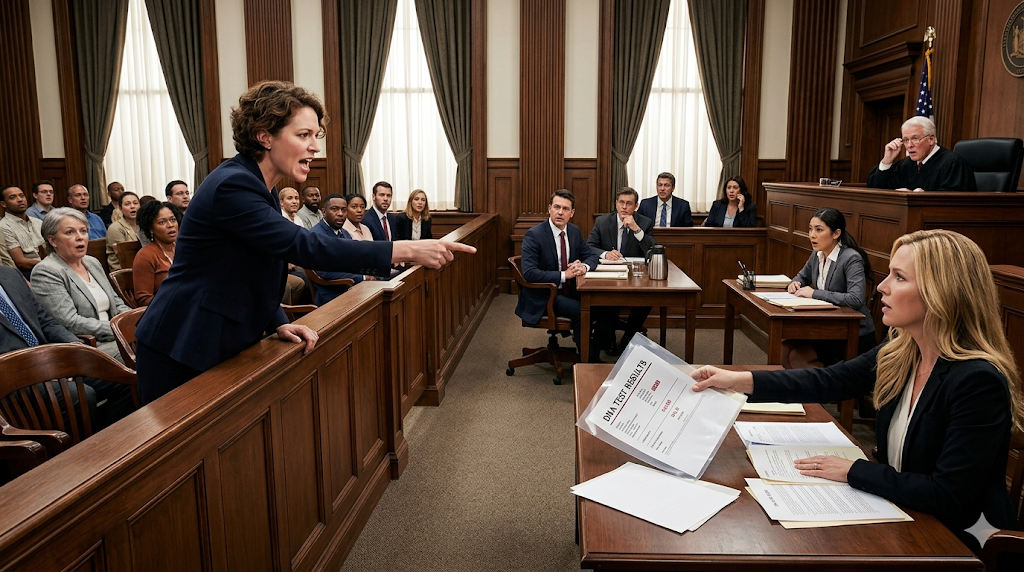
“She’s a fraud.” Her voice was louder than she intended, scraping against the high ceiling of the courtroom. “She showed up the day after his death for money. That’s all this is.”
“Ms. Calloway-Ashford —” the judge began.
“My father worked his entire life —”
“Ms. Calloway-Ashford, you will sit down or I will hold you in contempt.”
Margaret sat. Her hands were shaking. She pressed them flat against the table and breathed.
Nadia was already standing.
She didn’t shout. Her voice was low and very even, which made it somehow worse. “I showed up because he was my father.”
The words landed in the room like stones dropped into still water. Several of the spectators in the gallery shifted. Someone murmured something. Dane touched Margaret’s arm and she resisted the urge to shake him off.
“You expect anyone to believe that?” Margaret said. She was aware of the judge’s warning but couldn’t stop herself. “Where’s your proof?”
Nadia reached into the manila folder.
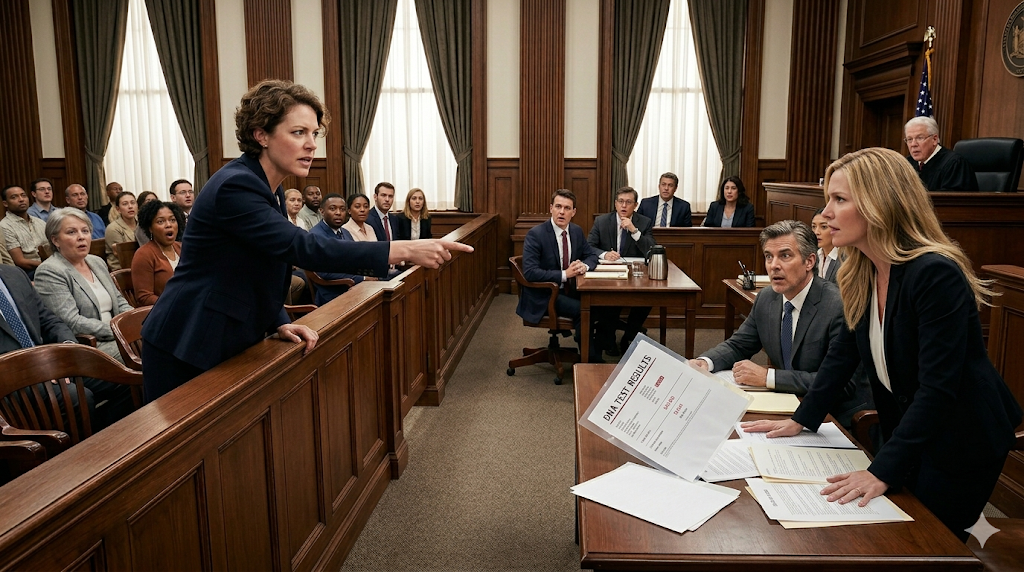
She removed a document — several pages, stapled together — and walked it to the clerk’s table herself. Her attorney didn’t stop her. She set it down and stepped back.
The bailiff carried the document to Phillip Dane. He looked at it. His expression — thirty years of professional composure — flickered once, briefly, and then went very still. He looked at Margaret.
She had never seen Phillip Dane look at anyone the way he looked at her in that moment.
“Well,” he said quietly. “It’s a match.”
Margaret’s breath went out of her.
“She’s not a second child,” Dane said, his voice low, intended only for her, but the room was so quiet that it carried. He looked at Nadia, then back at the document, then at Margaret. “She’s not a second child. She’s the first.”
Silence.
The kind of silence that has weight to it.
Judge Moreno leaned forward slightly. “Counsel, would you like to explain for the record what you’re looking at?”
Carver cleared his throat. “Your Honor, what Mr. Dane is holding is a certified DNA report from Harrow Genetics Laboratory, processed six days ago. It confirms, with 99.997% certainty, that Nadia Reyes is the biological daughter of Raymond Harlow Calloway.” He paused. “It also contains a notarized letter from Raymond Calloway himself. Signed fourteen months ago.”
The gallery stirred. Someone in the back row said something under their breath. The judge raised a hand for quiet.
“A letter,” Judge Moreno said.
“Yes, Your Honor. Mr. Calloway had been in contact with my client for approximately two years before his death. He knew about her. He wanted her to know about him.” Carver’s voice was careful, measured. “The letter states, in his own words, that Nadia was born before his marriage to Margaret’s mother — the result of a relationship he had at twenty-three years old with a woman named Catalina Reyes. He did not know about the pregnancy. He did not know Nadia existed until she contacted him, through his company’s public email address, two years ago.”
Margaret’s ears were ringing.
She heard the words. She processed them technically, the way you process the sound of glass breaking — you understand what has happened before the full meaning of it arrives.
A relationship before his marriage. Before her mother. Before Margaret herself.
A daughter who had reached out to a father she’d spent her life looking for.
A father who had — quietly, privately, away from the life everyone knew — reached back.
And had not told Margaret.
“The letter also states,” Carver continued, “that Mr. Calloway intended to update his estate documents to include Nadia. He had consulted with an attorney in January of this year. He had not yet executed the changes when he died.”
“Which is why we’re here,” Judge Moreno said. It wasn’t a question.
“Yes, Your Honor.”
The judge looked at the document for a long moment. Then she looked at Margaret. There was no cruelty in her gaze — just a kind of careful assessment, the look of someone watching a person absorb something enormous.
“Ms. Calloway-Ashford,” Judge Moreno said. “Do you wish to respond?”
Margaret opened her mouth. Closed it.
She looked at Nadia.
Nadia was looking back at her. Not triumphant. Not angry. Just — watching. With an expression that Margaret couldn’t immediately name, and then could: careful. The expression of someone who has been in a precarious situation long enough that they’ve learned not to trust good moments until they’re sure they’re real.
Margaret had grown up as Raymond Calloway’s daughter. She had grown up in the penthouse, in the private schools, in the company box at the stadium, in the shadow of a man whose approval she’d spent her whole life chasing and never quite catching. She had organized his seventieth birthday party — which had never happened because he died three months before it — and she had picked out his favorite bourbon for the toast, and she had not cried at his funeral because she had learned, growing up, that her father did not like displays of emotion.
She wondered, suddenly and unwillingly, what Nadia’s life had looked like. Growing up without a father whose name she knew. Spending years building up the courage to send an email to a stranger’s company address. Waiting to see if he would write back.
She wondered if he had written back quickly, or if he had made her wait.
She thought she knew the answer. Raymond Calloway had always made people wait. It was a strategy he’d employed his whole career. Let them wonder. Keep them off-balance. It wasn’t cruelty, exactly. It was just how he operated. It was how he had always operated with Margaret, too.
“Your Honor,” Dane said, his voice back to its usual polished calm, though with something underneath it that hadn’t been there before. “My client would like to request a brief recess.”
Judge Moreno granted it.
The room rose. People began to move, to murmur. Carver turned to Nadia and said something low and quick. She nodded once, her eyes still on the middle distance, her hands finally still at her sides.
Margaret stood at the table and did not move.
After a moment, Dane leaned close. “Margaret.” He almost never used her first name. “We need to talk about where this goes from here.”
“I know,” she said.
“The DNA is admissible. The letter is notarized and timestamped. Without a will to contest, and with biological evidence this clean —”
“I know,” she said again.
She was still looking at Nadia, who was now standing near the window at the far side of the room, her arms wrapped around herself as if she were cold, staring out at the gray November sky. Her attorney was on the phone a few feet away, but she wasn’t listening to him. She looked — Margaret searched for the right word — she looked exhausted. The way people look when they’ve been holding something heavy for a very long time and haven’t yet let themselves put it down.
Margaret remembered something her father had said to her once, when she was twelve years old and furious about some injustice she could no longer recall. He had looked at her with those flat gray eyes and said: The world is not interested in what you deserve. It is only interested in what you can prove.
She had spent her whole life trying to prove she was worth his attention.
She had never quite managed it.
She wondered — and she hated herself for wondering, hated the softness of it — whether Nadia had.
Whether two years of secret correspondence with Raymond Calloway had given this young woman more of him than forty years of being his recognized, legitimate daughter had given Margaret.
She picked up her bag. “Tell them I’ll consider a settlement.”
Dane blinked. “Margaret, we haven’t even —”
“Tell them I’ll consider a settlement,” she said again, quietly. “But not today. I need to think.”
She walked toward the door. And then, without fully deciding to, she changed course. She walked across the room instead — past the spectator benches, past the clerk’s table, across the pale winter light coming through the tall windows — until she was standing six feet from Nadia Reyes.
Nadia turned from the window. She looked at Margaret without flinching, and Margaret saw, for the first time, that Nadia had their father’s eyes. Not the color — Nadia’s were dark brown, her mother’s eyes presumably — but the shape. The slight downward cast at the outer corners. The particular stillness.
Margaret had spent forty years looking at those eyes in photographs and across dinner tables and in the mirror of her father’s face. She recognized them instantly and she didn’t know what to do with that recognition.
“I didn’t know,” Margaret said finally.
Nadia’s expression didn’t change. “I know you didn’t.”
“He didn’t tell me.”
“He didn’t tell me about you either,” Nadia said. “Not at first. I had to ask.”
A beat. The room’s noise moved around them without touching them.
“What was he like?” Margaret asked. “When you talked to him. What was he like?”
Something moved across Nadia’s face. Grief, maybe. Or something adjacent to it — the particular ache of having wanted something for a long time and only barely having gotten it before it was taken away.
“He was careful,” Nadia said. “He asked a lot of questions. He didn’t offer things easily.” She paused. “But he remembered everything I told him. Every single thing. And the next time we talked, he’d ask about it.”
Margaret looked at the floor. Then at the window. Then back at Nadia.
“He did that with me too,” she said. “When I was small.”
She didn’t say: and then he stopped. She didn’t need to. She had a feeling — sudden and strange and unwelcome — that Nadia would understand.
The bailiff was calling the room back to order. Dane was gesturing from across the aisle. They were out of time.
Margaret straightened. Adjusted the pearl necklace. Turned back toward her table.
Behind her, Nadia said quietly: “I didn’t come for the money.”
Margaret stopped walking. She didn’t turn around.
“I know,” she said. And then, after a moment: “Neither did I.”
She went back to her seat. The proceedings resumed. The judge spoke. Attorneys spoke. Documents were entered into evidence. All of it moved forward with the impersonal machinery of the law, which has no interest in sorrow and only moderate interest in truth, but which can be compelled, in the right circumstances, to serve both.
Margaret signed a settlement agreement six weeks later. She split the estate — not equally, but not unequally either. The lawyers negotiated the percentages. It was a fair enough outcome, in the end, by the only standard that mattered: both women accepted it.
She did not call Nadia afterward.
She thought about it. She picked up her phone twice. She put it down both times.
Three months later, she was going through boxes of her father’s things — the apartment had finally sold, the storage unit emptied — and she found a photograph she had never seen before. Her father, much younger, maybe thirty-five, sitting at a park bench somewhere. He was looking at something off-camera and almost smiling. Next to him was a little girl, maybe six or seven years old, with dark braids and an expression of total, absorbed concentration — she was looking at something in her hand, a leaf or a stone, utterly focused.
Margaret turned the photograph over. On the back, in her father’s handwriting, two words: San Diego, 2003.
She sat with that for a long time.
Then she found Nadia’s email address — it was still in the estate correspondence — and she sent a message. Three sentences. She asked if Nadia had ever been to San Diego as a child. She said she had found something. She asked if Nadia would like to see it.
Nadia wrote back in eleven minutes.
The reply was four words: Yes. When? Where?
Margaret looked at those four words for a long time.
She thought about her father. About the life she’d known about and the one she hadn’t. About the things he had been, and the things he hadn’t. About the particular loneliness of being the only child of a man who was always slightly unreachable — and the strange comfort, like cold water on a burn, of finding out you had never actually been alone in that loneliness.
She typed back: Sunday. I’ll come to you. Tell me where.
Then she set down the phone, picked up the photograph again, and finally — finally — allowed herself to cry.