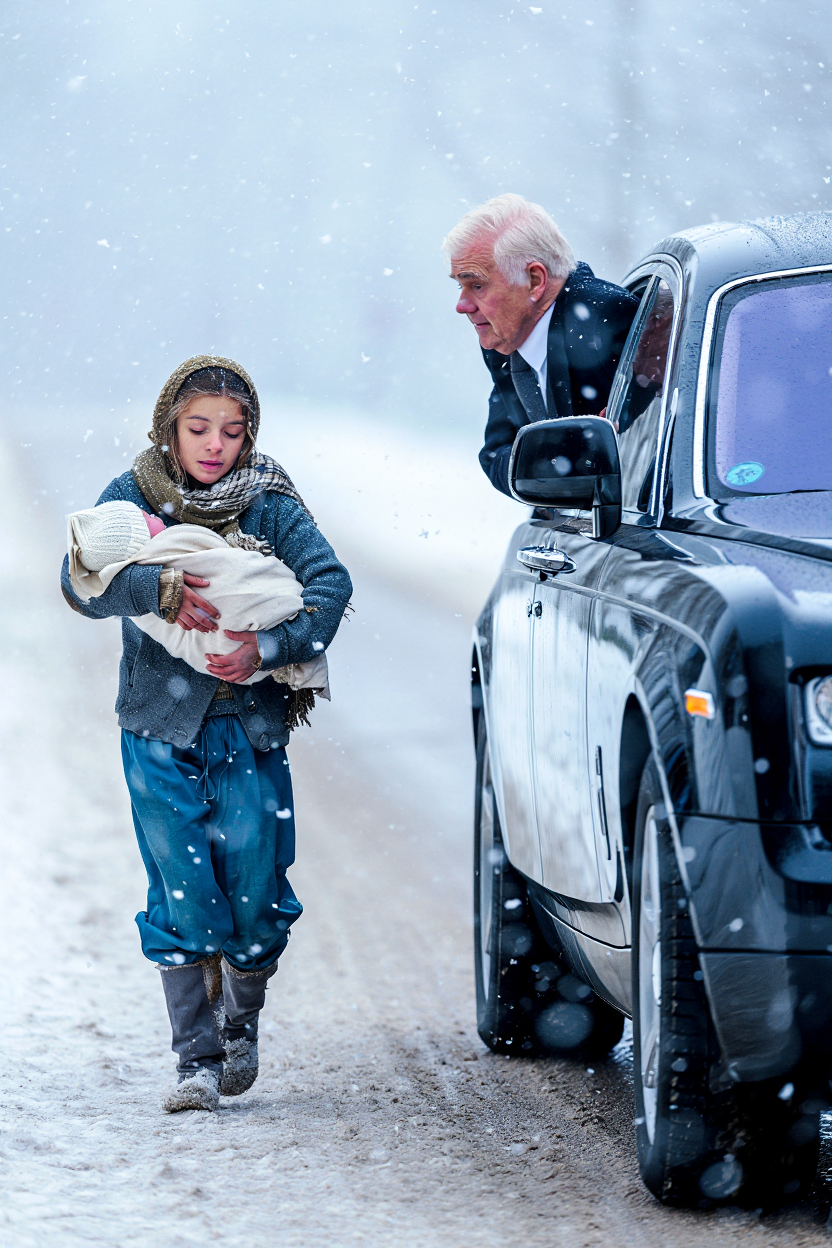
I was walking through freezing snow with my newborn because my parents said we were broke… Then my billionaire grandfather pulled up in a luxury car and asked why I wasn’t using the Mercedes he gave me.
The cold that morning wasn’t the pretty, postcard kind of winter cold. It was the kind that froze your eyelashes solid and made every breath feel like broken glass in your lungs. The kind that turned the sidewalk into a slick warning. The kind that stripped our quiet suburb outside Minneapolis down to one thing only: survival.
I was outside anyway, because Noah’s formula was almost gone.
That was the reason. The only reason.
Not fresh air. Not a walk. Not “clearing my head.” Just the brutal math of motherhood: baby eats, baby lives, and the world doesn’t care that your husband is deployed overseas or that your parents treat you like a temporary inconvenience in your own childhood home.
Noah was strapped to my chest in an old baby carrier I’d bought secondhand online, the fabric worn soft by other mothers’ panic. His small face rested against me, quiet. Too quiet—the kind of quiet that made me wonder what tension he’d already learned to recognize.
I pushed a battered bicycle with one hand because the tire had gone flat the moment I left the driveway. The rubber had collapsed with a defeated sigh, like it had finally given up too.
My fingers were numb. My cheeks burned. My body still felt foreign after childbirth. I’d been sleeping in fragments for weeks, and none of it repaired anything.
That’s when the black sedan pulled up beside me.
At first, I didn’t recognize it. Just the clean lines. The tinted windows. The way it moved like it owned the road.
Then the back window lowered.
My grandfather’s face appeared, and the fury in his eyes was so immediate, so total, that I actually stepped back.
“Melissa.” His voice cut through the wind. “What in God’s name are you doing?”
I couldn’t speak. My throat had closed. Noah shifted against my chest, and I felt the automatic tightening of my arms around him.
“Get in the car,” my grandfather said. “Now.”
“I can’t—I have to get formula—”
“Formula?” He said the word like it was evidence in a trial. “You’re walking in subzero temperatures with my great-grandson to buy formula?”
The driver had already stepped out. A man in his fifties with kind eyes and a professional blankness that suggested he’d seen enough family drama to fill libraries.
“Sir,” the driver said quietly, opening the back door.
My grandfather didn’t wait for me to comply. He stepped out himself, his wool coat immaculate, his leather gloves pristine. He looked at the broken bicycle. At my torn sneakers. At the carrier that was holding together with safety pins in two places.
“Where,” he said slowly, “is the Mercedes?”
I blinked. “What Mercedes?”
His jaw tightened. “The one I gave you four months ago. The SUV. White. Registered in your name. I had it delivered to your parents’ house with explicit instructions that it was for you and the baby.”
The world tilted.
“I—I didn’t—”
“You didn’t know.” It wasn’t a question. His voice had gone very quiet. Very dangerous.
He pulled out his phone. Tapped twice. Held it to his ear.
“This is Richard Holloway,” he said. “I need a welfare check and a records pull on a vehicle. Minnesota plates.” He rattled off a number I’d never heard before. Then he looked at me. “Your sister. What’s her name?”
“Vanessa,” I whispered.
“Vanessa Cormier,” he said into the phone. “Yes. I’ll hold.”
The driver gently guided me into the car. The warmth hit me like a wall. Noah stirred, made a small sound, and I realized I was crying.
My grandfather slid in beside me. His hand rested briefly on Noah’s head—just once, so careful—and then he turned his attention back to the phone.
“Uh-huh,” he said. “Uh-huh. And the registration shows—yes. That’s correct.” A pause. “No. The registered owner is here with me now. She’s never seen the vehicle.” Another pause, longer this time. “I see. Thank you.”
He hung up. Looked at me.
“Your sister has been driving that car for four months,” he said. “She re-registered it under a joint title with your mother. Forged your signature.”
I couldn’t breathe.
“That’s not all,” he continued. His voice was ice. “The trust fund I established for you when you turned eighteen—$400,000, managed through a family account your parents had access to as co-signatories until you turned twenty-five—do you know what the balance is?”
I shook my head.
“Twelve hundred dollars.”
The car was moving. I didn’t know where. I couldn’t think.
“Your mother has been making withdrawals for three years,” he said. “Small ones at first. Then larger. The documentation lists them as ‘educational expenses’ and ‘medical costs,’ but there’s no supporting paperwork. Nothing legitimate. Just steady theft.”
“They told me we were broke,” I heard myself say. “They said there wasn’t enough. That I needed to be grateful they were letting me stay. That I was a burden—”
“You were never a burden.” His voice cracked, just once. “You were never supposed to be in that house at all. I built you an apartment. Did you know that? Above the garage on my property. Fully furnished. I told your mother you’d be moving in before the baby came.”
“She said you didn’t want me there. That you were too old to deal with a crying baby. That I’d be imposing—”
“Melissa.” He turned to face me fully. His eyes were wet. “I have been trying to reach you for six months. Your mother blocked my number on your phone. She told me you needed space. That you were overwhelmed and didn’t want visitors. I respected that because I thought it was what you wanted.”
The driver pulled into a parking lot. I looked up.
Police station.
“No,” I said. “Please—I don’t want—”
“This isn’t optional,” my grandfather said, but his hand found mine. Squeezed. “You’re not in trouble. But they are. And you’re going to let me fix this.”
Inside, the station smelled like burnt coffee and old paperwork. An officer took us into a small room. My grandfather laid it out with the precision of a man who’d built empires: the forged registration, the drained trust fund, the intercepted communications.
The officer took notes. Asked questions. Pulled up records on a computer that seemed older than Noah.
Then she leaned back in her chair and looked at me.
“Ma’am,” she said quietly, “this is financial exploitation of a vulnerable adult. That’s a felony in Minnesota. And the vehicle fraud—that’s another charge entirely.”
“I don’t want to press charges,” I said immediately. “They’re my family—”
“They stole nearly $400,000 from you,” the officer said. “They forged your name. They isolated you. They lied to your grandfather to keep him away.” She glanced at Noah, still sleeping against my chest. “And they let you walk through a Minnesota winter with a newborn because they wanted you to believe you had no other options.”
My grandfather’s hand tightened on mine.
“I need you to be very clear about something,” he said. “This isn’t about revenge. This is about protecting you. And protecting him.” He nodded toward Noah. “Because if we don’t stop this now, it won’t stop. They’ll take everything. They’ll convince you that you’re nothing. And one day, Noah will be old enough to watch it happen.”
I closed my eyes.
I thought about my mother’s voice, always disappointed. My father’s silence, always complicit. Vanessa’s smirk when I asked to borrow the car—”the car,” not “my car,” because I’d never known it was mine.
I thought about the apartment I’d never seen. The money I’d never touched. The grandfather who’d been trying to reach me while I believed I’d been abandoned.
“Okay,” I whispered.
The officer nodded. Stood. “We’ll start with the vehicle. Bring it in for an examination, verify the forgery. Pull the financial records. It might take a few days, but we’ll build the case.”
My grandfather drove me to his house afterward. The apartment above the garage was exactly as he’d described: warm, clean, stocked with diapers and formula and a crib that looked like it cost more than my parents’ mortgage payment.
“This is yours,” he said. “For as long as you need it. Forever, if that’s what you want.”
I stood in the center of the room, Noah still strapped to my chest, and I felt something I hadn’t felt in months.
Safe.
Three weeks later, my mother and sister were formally charged. The Mercedes was returned. The trust fund—what was left of it—was placed under a new account with my name only. My grandfather’s lawyers were working on recovering the stolen funds, and the early signs were promising.
I didn’t go to the arraignment. I stayed in the apartment, feeding Noah, watching snow fall outside the window, learning what it felt like to be cared for.
My grandfather visited every day. He didn’t ask for anything. Didn’t demand gratitude or explanations. He just sat in the rocking chair, held Noah while I showered, and told me stories about my grandmother—his late wife—who he said would have loved us both.
“She always said family wasn’t about blood,” he told me one night. “It was about who showed up. Who stayed.”
I looked at him, this man I’d been taught to fear was too busy, too distant, too indifferent.
“You showed up,” I said.
“I should have shown up sooner,” he replied. “I won’t make that mistake again.”
And he didn’t.