A security dog went crazy at the airport, barking nonstop at a pregnant woman’s belly… What it detected made doctors rush her to emergency surgery.
Emily Carter had always been the calm type. The kind of woman who planned everything down to the last detail, who never missed a prenatal appointment, who read every parenting book cover to cover. So when her doctor cleared her for travel at seven months pregnant, she didn’t hesitate to book the flight to Chicago for her sister’s wedding.
Standing in the TSA security line at Denver International Airport that Thursday morning, Emily felt the familiar flutter of her baby kicking. She smiled, rubbing her belly through her maternity dress. Everything was going according to plan.
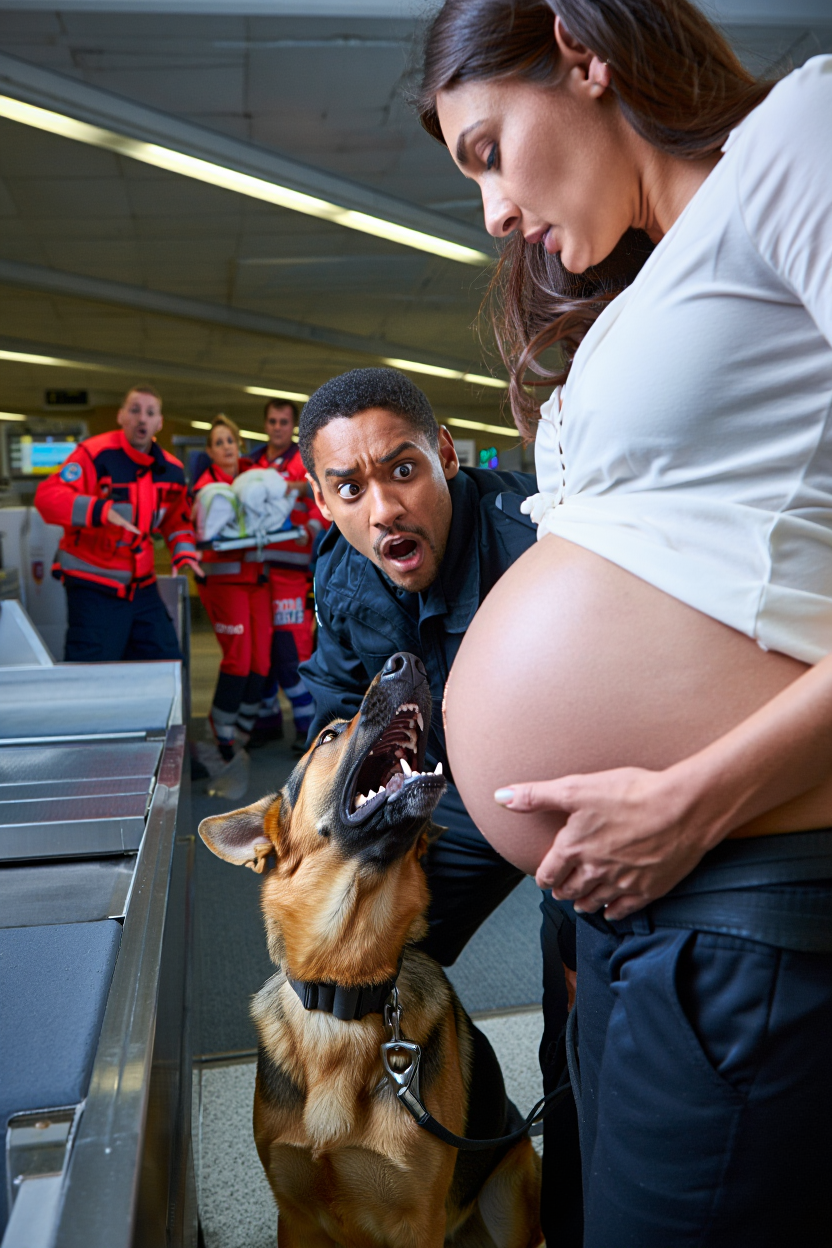
Then the German Shepherd started barking.
The sound cut through the ambient noise of the terminal like a siren. Emily looked down to see the K-9 unit dog straining against its leash, its intense brown eyes locked on her, its body rigid with alarm. The handler, a muscular man in his forties, struggled to control the animal.
“Rex, heel!” he commanded, but the dog ignored him completely.
The security line ground to a halt. Passengers stepped back, creating a bubble of space around Emily. She felt dozens of eyes on her, saw phones being raised to record. Her cheeks burned with embarrassment.
“Ma’am, I need you to step aside,” a TSA officer said, his hand hovering near his radio.
“I… I don’t understand,” Emily stammered. “I haven’t done anything wrong.”
The dog barked again, this time pawing at the air near her stomach. Its behavior was frantic, almost desperate. Emily’s heart began to race. The baby kicked hard against her ribs, as if sensing her distress.
“Rex is trained to detect explosives and hazardous chemical compounds,” the handler explained, his brow furrowed in confusion. “I’ve worked with him for six years. I’ve never seen him react like this.”
They escorted her to a private screening room. The clinical white walls and harsh fluorescent lighting made everything feel surreal. The dog followed, still agitated, still focused on her belly. Emily’s hands trembled as she tried to process what was happening.
A female TSA supervisor entered, followed by two more officers. They exchanged worried glances.
“We need to understand what’s triggering this response,” the supervisor said gently. “Have you been in contact with any chemicals? Cleaning products? Fertilizers?”
“No, nothing,” Emily insisted. “Just my prenatal vitamins and lotion. That’s it.”
The dog whined, a high-pitched sound of distress. It scratched at the floor, then sat abruptly, staring at Emily’s stomach with unwavering focus.
That’s when the handler’s face went pale.
“Dogs can detect changes in body chemistry,” he said slowly. “They can smell cancer, seizures, low blood sugar…” He paused, meeting Emily’s eyes. “Sometimes they detect things before we know they’re there.”
The words hit Emily like ice water. Her mind raced through the past few weeks. She’d been tired, yes, but she was pregnant—that was normal. There’d been some unusual cramping last week, but her doctor said it was probably Braxton Hicks contractions. A strange metallic taste in her mouth, but pregnancy did weird things to your senses.
“I need a phone,” Emily said urgently. “I need to call my OB-GYN.”
The supervisor nodded, handing her a landline. Emily’s fingers shook as she dialed. The receptionist put her through immediately when she explained where she was and what was happening.
Dr. Patricia Moore had been Emily’s doctor for two years. She knew Emily’s medical history, had monitored every milestone of this pregnancy. When Emily described the dog’s reaction, there was a long pause on the other end of the line.
“Emily,” Dr. Moore said carefully, “I want you to go to the nearest hospital emergency room. Right now.”
“What? But you said I was fine to fly—”
“I know what I said. But if a trained detection dog is reacting to something… we can’t ignore that. It might be nothing, but it might be something we missed in your last ultrasound.”
The airport called an ambulance. Emily sat in the screening room, feeling her world tilt off its axis, while the dog remained by the door, calmer now but still watchful. The baby kicked again, and Emily whispered to her unborn child, “Please be okay. Please.”
At the hospital, they rushed her into an examination room. The emergency OB-GYN on duty, Dr. James Chen, ordered an immediate ultrasound. Emily lay on the table, cold gel spread across her swollen belly, watching the grainy black-and-white images appear on the screen.
Dr. Chen’s expression shifted from professional calm to focused concern.
“There,” he said, pointing to a dark mass on the screen. “Do you see that?”
Emily squinted. “Is that the baby?”
“No, the baby is here.” He indicated a different area. “This is something else. It appears to be a placental abruption—the placenta is separating from the uterine wall. But there’s also… something unusual about your blood chemistry.” He studied the monitor readings. “We need to run immediate bloodwork.”
The next hour was a blur of needles, tests, and worried faces. Emily called her husband David, who was already on his way to Chicago. He immediately turned around and headed for the airport, his voice breaking over the phone.
When Dr. Chen returned to her room, he had another doctor with him—an oncologist.
Emily’s blood went cold.
“The detection dog was right,” Dr. Chen said quietly. “Your bloodwork shows extremely elevated levels of hCG—much higher than they should be at this stage of pregnancy. Combined with some other markers, we have reason to believe you may have a gestational trophoblastic disease.”
“What does that mean?” Emily whispered.
The oncologist stepped forward. “In rare cases, pregnancy can trigger abnormal tissue growth in the uterus. Sometimes it’s benign, like a molar pregnancy. Sometimes it’s cancerous. The elevated chemical compounds in your system—that’s likely what the dog detected.”
Emily felt the room spin. “The baby—”
“Your baby appears to be developing normally,” Dr. Chen assured her. “But the placental abruption is serious. Combined with this tissue growth, we need to monitor you very closely. There’s also a significant risk of severe hemorrhaging.”
They admitted her immediately. Over the next two days, a team of specialists ran every test imaginable. David arrived and didn’t leave her side. Emily’s sister postponed the wedding—”As if I’d get married without you there,” she said through tears on FaceTime.
The diagnosis came back on Saturday morning: choriocarcinoma, a rare and aggressive cancer that develops in the placenta. But it was caught extraordinarily early, before it had spread. The tissue growth was minimal. If they’d missed it for even a few more weeks, the outcome could have been catastrophic.
“The dog saved your life,” Dr. Chen told her. “And potentially your baby’s life too.”
Emily had to begin treatment immediately—a modified chemotherapy regimen that was safe for the baby but aggressive enough to target the cancer. It meant no travel, strict bed rest, and constant monitoring. The Chicago wedding would go on without her, but she’d be alive to see the photos.
Two weeks later, Emily was back at Denver International Airport—not to fly, but to meet someone. The K-9 unit handler, Officer Marcus Torres, had requested to see her. He brought Rex, the German Shepherd who’d caused such a scene.
Emily knelt down as much as her pregnant belly would allow. Rex approached cautiously, sniffed her once, then sat calmly and looked up at his handler as if to say, “All clear now.”
“He knows,” Torres said with a smile. “Dogs are remarkable that way.”
Emily scratched behind Rex’s ears, tears streaming down her face. “Thank you,” she whispered to the dog. “Thank you for not giving up.”
The oncologist had told her the prognosis was excellent. The cancer was responding to treatment. The baby was strong and healthy. She’d deliver via C-section at 37 weeks, and they’d complete her cancer treatment afterward. She’d beat this.
All because a dog barked at an airport.
Three months later, Emily gave birth to a healthy baby girl. She named her Hope. And in the birth announcement, alongside the standard photos and details, she included a picture of herself with Rex, the German Shepherd who’d detected what no human could see, who’d refused to stay quiet, who’d saved two lives with nothing but his nose and his instincts.
Officer Torres received a commendation from the airport. Rex got a steak dinner and a new toy. But more importantly, airports across the country began reviewing protocols for how detection dogs were utilized, recognizing that these remarkable animals could detect more than just explosives and drugs—they could detect medical emergencies in progress.
Emily made a full recovery. Hope grew into a curious, energetic toddler. And every year on Hope’s birthday, Emily sent a card and a care package of dog treats to Rex, the hero who’d barked when it mattered most.
Sometimes the universe sends you a warning in the most unexpected package. Sometimes that package has four legs and a wet nose. And sometimes, if you’re very lucky, that warning comes just in time to save everything you hold dear.
Emily never took another flight. But she never looked at a security dog the same way again, either. Those animals weren’t just doing a job—they were guardian angels in K-9 vests, watching over us in ways we’d never fully understand.
And somewhere in Denver, a German Shepherd named Rex continued his work, protecting travelers from dangers both obvious and invisible, carrying the knowledge that sometimes the most important detection isn’t about what someone’s carrying in their luggage—it’s about what they’re carrying inside themselves.