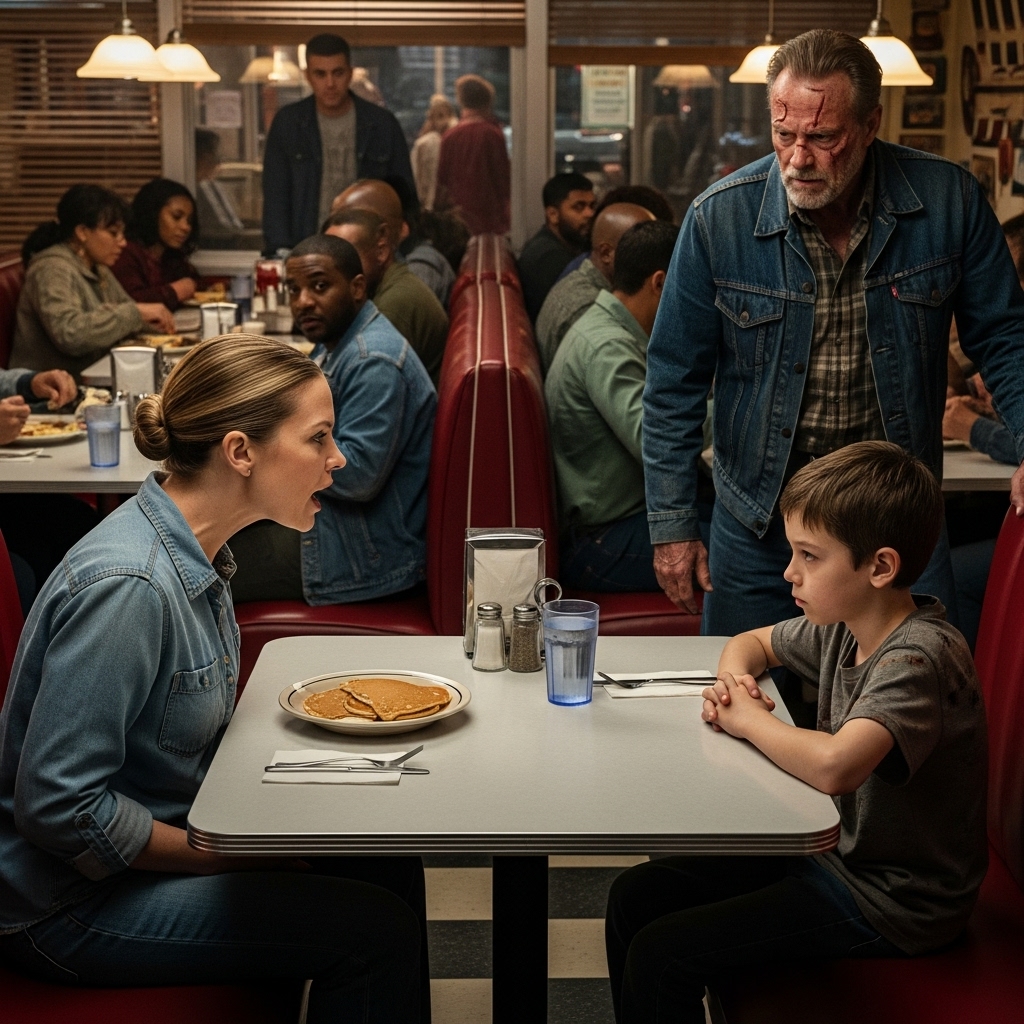
A foster mother refused to feed her starving son as a “lesson” in a crowded diner… But when a scarred Vietnam Vet stood up from the corner booth, her reign of terror came to a crashing halt.
The air in “Mabel’s Greasy Spoon” was thick with the scent of burnt coffee and sizzling bacon, but for seven-year-old Leo, it smelled like a dream he wasn’t allowed to touch. He sat on the edge of the cracked vinyl booth, his small hands tucked under his thighs to hide their trembling. Across from him sat Eleanor Vance, a woman whose outward appearance—perfectly coiffed blonde hair and a designer trench coat—belied the coldness of her heart.
Eleanor wasn’t Leo’s mother by blood; she was his foster parent, a role she took on for the monthly checks and the social standing it gave her in her local “charity” circles. To the world, she was a saint. To Leo, she was a jailer.
“Please, Mrs. Vance,” Leo whispered, his voice cracking. “My stomach hurts. Just a piece of toast?”
Eleanor didn’t look up from her phone. She was busy scrolling through a curated feed of her own “selfless” activities. “We discussed this, Leo. You broke the vase. Disobedient children don’t get treats. Hunger is a teacher, and today, you’re an eager student.”
She had ordered a full lumberjack breakfast for herself—piles of pancakes, glistening sausages, and eggs sunny-side up. She ate slowly, deliberately, letting the steam drift toward the boy. Whenever he looked at her plate, she would pull it slightly further away, a cruel smirk playing on her lips.
A few booths away, Silas Thorne sat alone. Silas was a man who looked like he had been carved out of old oak and mountain stone. His face was a map of experiences most people spent their lives trying to avoid, including a jagged scar that ran from his temple to his jaw—a souvenir from the jungles of ’67. He was a Vietnam Veteran who preferred the silence of his own thoughts to the noise of the modern world. But today, the silence was being broken by a sound that made his blood boil: the sound of a child’s spirit being crushed.
Silas had been watching for ten minutes. He saw the way the boy’s ribs seemed to poke through his thin t-shirt. He saw the way the woman looked at the child—not with love or even irritation, but with a clinical, detached cruelty.
“Eat your ice, Leo,” Eleanor said, pushing a glass of water with three melting cubes toward him. “It fills the stomach just as well.”
The clatter of a heavy fork hitting a ceramic plate echoed through the diner. Silas stood up. He was a large man, and when he moved, people tended to notice. He walked over to their booth, his gait steady despite a slight limp.
Eleanor looked up, her expression shifting from boredom to immediate haughtiness. “Can I help you, sir? This is a private conversation.”
Silas didn’t look at her. He looked at Leo. The boy’s eyes were wide, filled with a mixture of terror and curiosity. Silas reached into his pocket, pulled out a worn, silver challenge coin, and placed it on the table in front of the boy.
“In the jungle,” Silas said, his voice a low, gravelly rumble that seemed to vibrate the table, “we had a rule. No man goes hungry while another man has a plate. It’s a code of honor. You know about honor, ma’am?”
Eleanor scoffed, waving a manicured hand. “I am teaching this child discipline. He is a ward of the state under my care. I suggest you mind your own business before I call the police.”
“The police,” Silas repeated, a grim smile touching his lips. “That’s a fine idea. But before they get here, let’s talk about ‘care.’ I spent two years in a POW camp. I know what starvation looks like. I know the look in a human being’s eyes when they are being systematically broken. And I see it in this boy.”
The diner had gone silent. Even the cook had stepped out from behind the grill.
Silas turned to the waitress, a young woman named Sarah who was already hovering nearby with tears in her eyes. “Sarah, bring the boy the biggest steak you’ve got. Double mashed potatoes. Extra gravy. And a tall glass of whole milk. Put it on my tab.”
“He will not eat a bite!” Eleanor shrieked, standing up. “Leo, we are leaving!”
She reached out to grab Leo’s arm, her fingers curling like talons. But before she could touch him, Silas’s hand shot out, intercepting her wrist. He didn’t squeeze, but the strength in his grip was undeniable.
“Sit. Down,” Silas commanded. It wasn’t a request. It was the voice of a Sergeant Major who had seen the worst of humanity and survived it.
Eleanor sank back into the booth, her face turning a mottled purple. “You’re assaulting me! I’ll have you arrested!”
“Call them,” Silas said, pulling a chair from the neighboring table and sitting at the head of theirs. “I’d love to tell the officers—and the social worker I’m sure is assigned to this boy—exactly what I’ve witnessed. I’d love to tell them how you sat here gorging yourself while this boy begged for a piece of toast. I’d love to tell them about the ‘discipline’ you’re practicing.”
He looked at Leo, his expression softening instantly. “Eat, son. You’re safe now.”
When the food arrived, Leo hesitated, looking at Eleanor.
“Don’t look at her,” Silas said gently. “She has no power over you today. In this diner, on this ground, you are under my protection.”
Leo began to eat. It wasn’t the frantic, messy eating of a typical child; it was the slow, desperate consumption of someone who didn’t know when the next meal would come. It was heartbreaking to watch.
While Leo ate, Silas pulled a small notebook from his jacket. “I’ve got friends, Eleanor. Friends in the VA, friends in the local precinct, and friends who run the state’s foster oversight committee. They don’t like me very much because I’m loud and I don’t give up. And starting today, I’m going to be your shadow.”
Eleanor tried to regain her composure. “You think you’re a hero? You’re just a broken old man interfering in things you don’t understand.”
“I understand hunger,” Silas replied. “And I understand bullies. I spent a long time fighting them in a land far away. I didn’t think I’d have to find one in a diner in my own hometown.”
The police did eventually arrive, called by Sarah the waitress. But they didn’t arrest Silas. They listened to his statement. They listened to Sarah’s testimony. They looked at the way Leo flinched when Eleanor spoke. And they looked at the boy’s thin, bruised collarbone, visible now that he had taken off his oversized hoodie to eat.
The “discipline” Eleanor bragged about was quickly revealed to be a long-standing pattern of neglect. That afternoon, Leo was removed from Eleanor’s home. But the story didn’t end there.
Silas didn’t just walk away. He followed the case. He showed up at every hearing. He used his veteran’s pension and his savings to hire a lawyer to ensure Leo wouldn’t just be tossed into another “system” home.
Six months later, Silas sat in the same diner. This time, he wasn’t alone. Sitting across from him was Leo—no longer trembling, his cheeks full and healthy. He was living with Silas’s niece, a woman with a house full of books, laughter, and most importantly, an open pantry.
Leo reached across the table and pushed a silver challenge coin toward Silas. “I think you need this back, Mr. Silas.”
Silas smiled, his eyes crinkling. “Keep it, Leo. It’s a reminder. No matter how dark the jungle gets, there’s always someone watching out for you.”
Leo looked at his plate—a mountain of pancakes—and then at Silas. “I know,” Leo said. “Because I have a hero.”
Silas shook his head. “No, son. You’re the hero. You survived. I just provided the cover fire.”
As they finished their breakfast, the entire diner seemed brighter. The shadows of the past had been chased away by a simple act of intervention. Eleanor Vance lost her license and faced charges of child endangerment, but more importantly, a boy who had been forgotten by the world found a family that would never let him go hungry again.