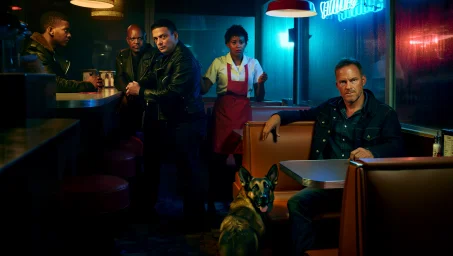
Three thugs thought they could terrorize a defenseless waitress in a lonely roadside diner… But they didn’t realize the quiet man in the corner was a Navy SEAL with a deadly companion.
The neon sign for “Café El Camino” hummed with a rhythmic, dying buzz, casting a sickly flickering light over the cracked asphalt of the parking lot. Inside, the air was a thick soup of old grease, burnt coffee, and the weary sighs of people who had nowhere else to be. It was 2:00 AM, the hour when the world feels thin, and the only things moving are those with secrets or those with no home.
Lucía Jiménez wiped the counter for the hundredth time that night. Her hands were raw from the cheap soap, and her lower back throbbed with a dull, insistent ache. At twenty-four, she felt sixty. This wasn’t the life she had imagined when she moved to the city, but here she was, serving caffeine to truckers and drifters in a place the GPS barely recognized. She wore an “automatic smile”—a mask she put on to keep the tips coming and the trouble away.
But tonight, the mask was slipping.
The door creaked open, letting in a gust of hot, dusty wind and three men who looked like they were hunting for something to break. They wore heavy leather jackets despite the heat, and their boots struck the linoleum floor with the heavy, deliberate thud of predators entering a new territory. They didn’t just walk in; they occupied the space, their loud, jagged laughter cutting through the quiet hum of the diner like a blade.
“Well, look at that—such pretty service,” said the leader, a man with a patchy, unkempt beard and eyes that moved too fast. He kicked a stool as he sat down, mocking the silence of the room.
Lucía felt a chill that had nothing to do with the air conditioning. She kept her head down, focusing on a stubborn coffee stain. In this line of work, you learn that eye contact is often an invitation you don’t want to send. But these men weren’t looking for service; they were looking for a reaction.
“Hey, blondie,” the bearded one barked, leaning over the counter. “Don’t you have something hotter than that coffee? Maybe something behind the counter worth our time?”
The other two laughed, a harsh, guttural sound. One had a jagged scar running through his eyebrow; the other was built like a brick wall, silent and menacing. Lucía’s heart began to hammer against her ribs like a trapped bird. She looked around the room, desperate for an ally. Don Toño was hunched over the grill in the back, his ears blocked by the sizzle of onions. Mrs. Marta was preoccupied with the register, her eyes fixed on the numbers, her shoulders hunched as if trying to shrink away. The few patrons—truckers and a pair of students—all had their noses buried in plates or phones. They were good people, but they were tired people. And tired people are often too afraid to be brave.
“What would you like to order?” Lucía asked, her voice hovering on the edge of a tremor.
“Whatever you recommend, sweetheart,” the man with the scar whispered, leaning so close she could smell the stale beer and tobacco on his breath. “But we want it up close. Real close.”
The harassment escalated with sickening speed. They moved from words to gestures, whistling and making crude remarks that felt like physical blows. Lucía tried to retreat toward the kitchen, but they were faster. In a coordinated move, they slid off their stools and cornered her in the narrow space between the counter and the pass-through window.
“Don’t go, beautiful,” the scarred man said, his hand snaking out to grip her upper arm. His fingers dug into her flesh, hard enough to leave a bruise. “We just want to talk.”
“Please… let me go,” Lucía whispered. The tray she was holding began to shake. A half-filled cup of coffee tipped, the dark liquid spilling across the white laminate like a spreading inkblot.
“Look what you did!” the bearded man mocked, his face inches from hers. “Now you’ve got to clean it up. Maybe we should help you.”
He grabbed her other arm, pinning her. Lucía’s breath hitched. This was the moment where the world usually turned away. But as her voice broke, a sudden, unnatural silence fell over the Café El Camino. It wasn’t just the absence of noise; it was a shift in the atmosphere, a drop in pressure that made the hair on the back of everyone’s neck stand up.
The three thugs didn’t notice it at first. They were too drunk on their own perceived power. They didn’t notice the man sitting in the far corner booth.
He had been there for forty minutes, a ghost in plain sight. He wore a faded olive jacket and jeans that had seen better years. He hadn’t said a word, just sipped his black coffee and watched the road through the window. He had the kind of face that was hard to remember—until you looked into his eyes. They were the eyes of a man who had seen the end of the world and decided to come back.
Beside him, lying perfectly still under the table, was a German Shepherd. The dog was a mirror of its master: motionless, disciplined, and terrifyingly alert. Its ears were pricked, and its dark eyes were locked onto the bearded man’s hand—the one currently bruising Lucía’s arm.
The man in the booth didn’t shout. He didn’t make a scene. He simply set his coffee cup down. The ceramic clicked against the table with the finality of a gavel.
He stood up.
His movements were fluid and economical, the gait of a man who knew exactly how much force was required for any given situation. He walked toward the counter, the German Shepherd gliding beside him like a shadow made of muscle and teeth.
“Let her go. Now.”
The voice was low, gravelly, and carried the weight of an undisputed command. It wasn’t a request. It was an ultimatum.
The three thugs turned. The bearded leader let out a nervous, jagged laugh. “And who the hell are you, buddy? Her boyfriend? Or just some hero looking for a hospital bed?”
The man didn’t respond with words. He took one more step, entering their personal space. The German Shepherd let out a sound—not a bark, but a low, subterranean growl that vibrated in the floorboards. It was the sound of a predator counting down.
“Don’t get involved,” the scarred man threatened, his hand moving toward the waistband of his jeans, reaching for a tucked-away blade. “This doesn’t concern you.”
“It does now,” the man replied.
What happened next lasted less than three seconds, but to Lucía, it moved in slow motion. The scarred man pulled his knife, the blade catching the flickering neon light. He never got to swing it.
The stranger moved with a precision that defied the laws of physics. In one motion, he parried the man’s arm, his hand slamming into the wrist with a sickening crack. Before the man could scream, the stranger’s elbow connected with his jaw, sending him spiraling into a stack of chairs.
The bearded leader lunged, but the German Shepherd was a blur of fur and fury. The dog didn’t bite to kill; it struck with tactical efficiency, taking the man’s leg out from under him and pinning him to the floor with a terrifying display of dominance, its jaws inches from the man’s throat.
The third thug, the heavy one, froze. He looked at his two companions—one unconscious, one pinned by a beast—and then looked at the stranger. The stranger’s expression hadn’t changed. His heart rate hadn’t even climbed. He simply stood there, a silent sentinel of justice.
“Pick them up,” the stranger said to the third man. “And leave. If I see your truck on this highway again, the dog won’t be so polite.”
The heavy man scrambled to grab his friends. They practically fell over each other as they scrambled out the door, the bell chiming a frantic goodbye.
The diner remained silent for a long beat. Then, the man turned to Lucía. The hardness in his eyes softened just a fraction. He reached into his pocket, pulled out a twenty-dollar bill, and laid it on the counter next to the spilled coffee.
“Sorry about the mess,” he said quietly.
He whistled softly, and the German Shepherd returned to his side, its tail giving a single, calm wag. Without another word, they walked out into the night, disappearing into the darkness of the desert.
Lucía stood there, her breath finally returning. She looked at the twenty-dollar bill, then at the door. For the first time in years, the automatic smile was gone—replaced by a real one, born of the knowledge that even in the darkest corners of the world, there are those who watch over the innocent.