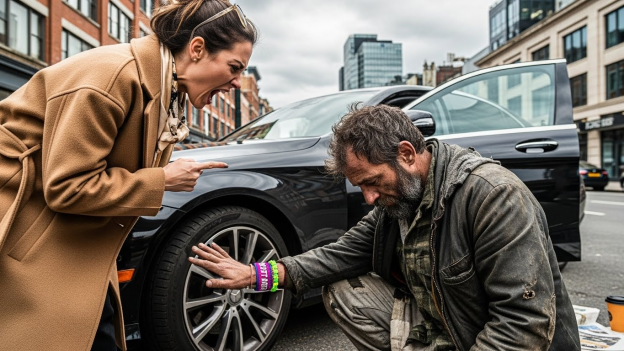
She screamed at a homeless man for touching her car… But the bracelet on his wrist was the one her son made for his dead father.
Meredith had always prided herself on control. Control over her schedule, her career, her emotions. That Tuesday morning started like any other—coffee in hand, heels clicking against pavement, mind already racing through the presentation waiting at the office. She was running late, which meant she was already irritated before she even reached her car.
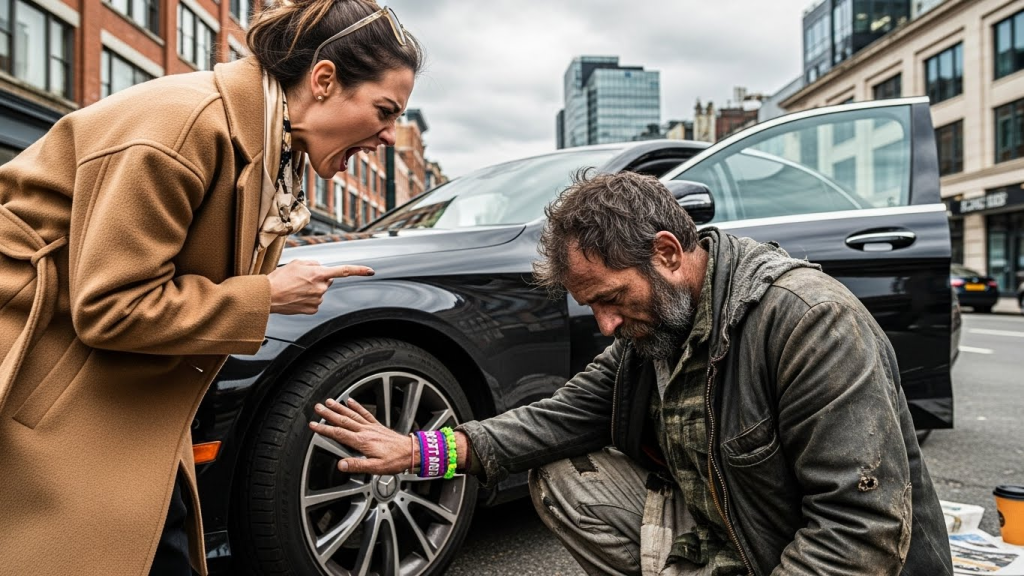
The man appeared out of nowhere, stumbling slightly, his weathered hand reaching out to steady himself against her gleaming black Mercedes. The sound of his palm against the paint made her stomach clench.
“Hey. Don’t touch that,” she snapped, the words escaping before she could soften them.
He jerked back as if burned, his eyes widening with genuine alarm. “I’m sorry,” he said quickly, his voice carrying the careful politeness of someone used to apologizing for existing. “I didn’t mean any harm. I just—I lost my balance.”
But Meredith was already wound too tight to hear him. Eight years of building walls, of pushing forward, of refusing to look back had left her with sharp edges she didn’t know how to retract.
“Do you have any idea how much that car costs?” The words came out harsh, louder than she intended. “You can’t just lean on someone else’s property like that.”
A few pedestrians slowed their pace, glancing over with that particular mix of curiosity and judgment that only strangers can offer. Someone muttered something she couldn’t quite hear. The man stood there, head lowering, hands dropping to his sides in a gesture of complete surrender.
“I understand,” he said softly. “I didn’t mean to upset you.”
Meredith felt a flicker of something—shame, maybe, or guilt—but she pushed it down. She had places to be. Problems to solve. A life that didn’t have room for this kind of distraction.
The man turned to leave, shoulders hunched against the morning cold, and Meredith reached for her car door handle.
That’s when the light caught it.
A flash of color on his wrist, just visible beneath a frayed jacket sleeve. Meredith’s hand froze on the door. Her breath caught.
No. It couldn’t be.
She stared at the bracelet—simple, handmade, the kind of craft project a child makes with cheap plastic beads and elastic string. Blue, green, yellow, red. The pattern was random, chaotic, exactly the way a seven-year-old would string them together without caring about symmetry or design.
Her seven-year-old.
Her son, Ethan, sitting at their kitchen table eight years ago, tongue poking out in concentration as he carefully threaded each bead. The memory hit her like a physical blow. She could see his small fingers working, hear his excited voice: “It’s for Daddy. So he always has something from me, even when he’s at work.”
David had worn it every single day after that. Even though it was ridiculous—a grown man, a serious attorney, wearing a child’s bracelet. He’d laughed when colleagues teased him about it, but he never took it off.
He was wearing it the night he disappeared.
“Wait,” Meredith heard herself say, though her voice sounded distant, unfamiliar. “Wait. Please.”
The man stopped, turned back slowly, confusion written across his lined face.
Meredith’s heart hammered against her ribs. She forced herself to look at him—really look at him—for the first time. Beneath the weathered skin, the unkempt beard, the hollow cheeks, there was something. Something in the shape of his jaw, the set of his eyes.
“Where did you get that bracelet?” Her voice came out strangled.
He glanced down at his wrist, touching the beads with surprising gentleness. “This? I… I don’t really know.” He looked back up at her, and she saw confusion in his eyes, mixed with something deeper. Something lost. “I’ve had it for a long time. I woke up in a hospital once, years ago. They said I’d been found unconscious near the river. No ID, no memory of how I got there. This was in my pocket.” He touched it again. “It’s the only thing I have from… from before.”
The world tilted.
Meredith gripped the car door to steady herself. Her mind was screaming impossible, impossible, impossible, but her heart was racing ahead, connecting pieces she’d never allowed herself to consider.
“What… what’s your name?” she whispered.
The man’s expression grew pained. “They called me John at the shelter. John Doe. I don’t… I don’t remember my real name. Sometimes I think I’m close to remembering, but then it slips away.”
Meredith’s vision blurred. Eight years. Eight years of believing David was dead. Eight years of grief, of rebuilding, of explaining to their son why Daddy was never coming home. The police had found his car by the river, his wallet inside, but no body. They’d called it a probable suicide, though they never said it outright. Depression, they suggested. Work stress. She’d accepted it because what else could she do?
But she’d buried an empty casket.
“David?” The name escaped her lips like a prayer, like a question, like an accusation all at once.
The man—John, or whoever he was—flinched at the sound. His hand went to his temple, pressing hard as if fighting against a sudden pain.
“I… that name…” He looked at her with sudden intensity, his eyes searching her face. “Do I know you?”
Meredith’s legs nearly gave out. She stumbled forward, closer to him than she’d been since that first angry moment. Up close, she could see it more clearly. The scar above his left eyebrow—from a childhood bike accident he’d told her about on their third date. The small gap between his front teeth. The way he stood with his weight slightly more on his left foot, an old sports injury that never quite healed.
“It’s me,” she breathed. “Meredith. Your wife.”
The words hung in the cold morning air between them.
His face went pale. He opened his mouth, closed it, opened it again. “I… I have a wife?” The question was so raw, so genuinely confused, that fresh tears spilled down Meredith’s cheeks.
“You had a son,” she said, her voice breaking. “Ethan. He made you that bracelet. He was seven. You wore it every day. You…” She had to stop, had to breathe. “You disappeared eight years ago. We thought you were dead.”
John—David—whoever he was in this moment—stared at her with growing horror. His fingers found the bracelet again, turning it around his wrist like a rosary.
“I have a son,” he repeated, and the words seemed to unlock something in him. His eyes squeezed shut. “I sometimes dream about a child. A little boy. He’s crying. He’s calling for someone. For… for me?”
“His name is Ethan,” Meredith said again, desperately, as if saying it enough times would break through whatever wall existed in his mind. “He’s fifteen now. He still asks about you. He still…” She couldn’t finish.
Around them, the street continued its normal rhythm. Cars passed. People walked by, wrapped up in their own lives, completely unaware that Meredith’s entire world was reconstructing itself on this sidewalk.
David—because she couldn’t think of him as anything else now—opened his eyes. They were wet.
“I don’t… I can’t remember,” he said, his voice cracking. “I’m sorry. I want to. God, I want to remember, but it’s like trying to hold water. Everything just… slips away.”
Meredith reached out without thinking, her hand finding his arm. He didn’t pull away. Through the worn fabric of his jacket, she could feel how thin he’d become, how fragile.
“What happened to you?” she whispered. “Where have you been?”
He shook his head slowly. “Streets, mostly. Shelters when it’s cold enough. I tried to find work, but without ID, without memory… nobody wants to hire someone who can’t even tell them their real name. I kept the bracelet because…” He looked down at it again. “Because it felt important. Like an anchor. Like proof that I was someone once, even if I couldn’t remember who.”
The coffee shop door across the street opened, releasing a burst of warm air and the smell of fresh pastries. Normal life, continuing on. But nothing would ever be normal again.
“Come with me,” Meredith said suddenly. The words were out before she’d fully thought them through, but once said, she knew they were right. “Please. Come home. Let me help you. We can figure this out. We can—”
“I can’t,” he interrupted, stepping back. Fear flashed across his face. “I can’t just… what if I’m wrong? What if I’m not who you think I am?”
“You are,” Meredith said fiercely. “I know you are. That bracelet, your face, everything—”
“But what about your life?” he pressed. “You’ve moved on. You said it’s been eight years. You probably… you might have someone else now. A family. I can’t just walk back into that and destroy it.”
“There’s no one else,” Meredith said quietly. “There’s never been anyone else. Just you. Just waiting. Just hoping for some kind of answer about what happened.”
David’s resolve wavered. She could see it in his eyes.
“I’m scared,” he admitted, his voice barely audible. “What if I never remember? What if I’m just… broken?”
“Then we’ll figure it out together,” Meredith said. She was crying openly now, not caring who saw. “Please. Our son needs you. I need you. Even if you never remember everything, we can build something new. We can try.”
He stood there, this man who was and wasn’t her husband, looking at her with equal parts hope and terror.
Finally, slowly, he nodded.
“Okay,” he whispered. “Okay.”
Meredith felt something break open in her chest—eight years of grief and loss and carefully maintained control, all shattering at once. She stepped forward and wrapped her arms around him, this stranger who wore her husband’s face and their son’s gift. He smelled like old clothes and the street, nothing like the cologne David used to wear, but when his arms came up tentatively to return the embrace, she felt, for the first time in eight years, like she might be home.
They stood like that for a long moment, two people finding each other in the ruins of a life that had collapsed.
When they finally pulled apart, Meredith wiped her eyes and tried to steady her breathing.
“We should go to the hospital first,” she said, her mind already racing through logistics. “Get you checked out. Maybe they can help with your memory. And then…” She paused. “Then we need to tell Ethan.”
The thought of her son’s face when he learned his father was alive made her stomach clench with a mixture of joy and dread.
David nodded, still looking overwhelmed, but there was something new in his expression. Hope, maybe. Purpose.
“The bracelet,” he said quietly, looking down at it. “All this time, it was trying to bring me home.”
Meredith took his hand—carefully, gently, as if he might disappear again if she held too tight.
“It did,” she said. “It finally did.”
They walked toward her car together, and for the first time in eight years, Meredith didn’t feel like she was walking alone. There would be questions to answer, tests to run, authorities to contact, and a teenage son to somehow prepare for the impossible. There would be therapy and legal complications and the slow, painful work of rebuilding what had been lost.
But right now, in this moment, all that mattered was the bracelet on his wrist and the hand in hers.
The rest, they would figure out together.