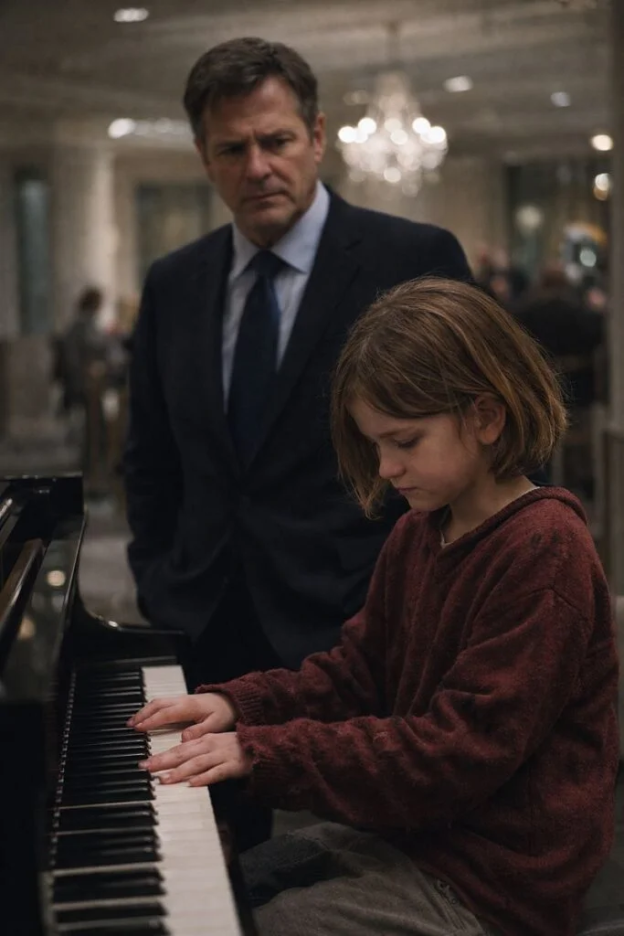
He mocked a homeless girl, promising to adopt her if she could play the hotel’s grand piano… But the melody she played revealed a secret that brought the millionaire to his knees.
The winter wind in Chicago didn’t just blow; it bit. It gnawed at exposed skin and slipped through the seams of coats, finding every weak point. For ten-year-old Elara, there were nothing but weak points. Her coat was three sizes too big, a discarded wool trench she’d found in a donation bin, smelling faintly of mothballs and damp earth.
She sat on the marble steps of the Sovereign Hotel, a towering monolith of gold light and old money. She wasn’t begging. She had learned long ago that looking people in the eye only made them walk faster. Instead, she made herself small, tucking her chin into her knees, closing her eyes, and listening.
Through the revolving glass doors, the sound drifted out. It was a Steinway—she knew the timbre, rich and dark like melted chocolate. Someone was playing a generic jazz standard, clumsy and soulless, but the instrument itself was perfect.
A sleek black Maybach pulled up to the curb, the tires crunching softly on the salted asphalt. The doorman sprang into action, opening the rear door for a man who stepped out like he owned the pavement beneath his Italian leather shoes.
Julian Thorne. Thirty-five, a venture capitalist with a net worth that rivaled the GDP of small countries, and a heart that had calcified years ago. He was on his phone, barking orders about a hostile takeover in Tokyo. He ended the call with a sharp tap and shoved the device into his pocket, adjusting his cashmere scarf.
That’s when he saw her. A smudge of dirt against the pristine entrance of his favorite hotel.
He paused, not out of charity, but out of irritation. She was an aesthetic error in his perfectly curated evening.
“Hey,” he said, his voice deep and impatient.
Elara didn’t flinch. She just opened her eyes. They were grey, startlingly clear against her grime-streaked face. “Hello.”
“You can’t sit here. It’s private property,” Julian said, checking his watch. He was early for his dinner meeting. He had time to be petty.
“I’m listening to the music,” she said softly.
Julian scoffed, a short, sharp sound of disbelief. “Music? That noise? That’s just background filler for tourists.” He looked down at her, seeing the frayed hems of her pants and the red, raw skin on her knuckles. “Do you even know what a piano is? Lessons cost more than you’ll see in a lifetime.”
Elara looked toward the revolving doors. “I know what it is.”
Her calm demeanor irked him. She should be groveling. She should be asking for a dollar. Instead, she possessed a quiet dignity that made him feel small, and Julian Thorne hated feeling small.
The devil on his shoulder whispered a cruel idea. A way to humiliate her and prove a point about the order of the world—that some people belonged inside, and some belonged out.
“Tell you what,” Julian said, a smirk playing on his lips. He pitched his voice loud enough for the doorman and a passing couple to hear. “Since you appreciate the arts so much… go inside. If you can play that piano—and I mean really play it, not just bang on the keys—I’ll adopt you. I’ll take you out of this filth tonight.”
It was a grotesque joke. A safe bet. He expected her to look down in shame.
Instead, Elara stood up. She dusted off her oversized coat.
“Really?” she asked. Her voice didn’t tremble.
The doorman stepped forward nervously. “Mr. Thorne, I can remove her—”
“No,” Julian waved a hand, his ego fully engaged. “Let her in. I made a generous offer. Let’s see if she can back it up.”
He led the way, the staff parting like the Red Sea. Elara followed, her oversized boots clomping awkwardly on the polished marble floors. The warmth of the lobby hit her like a physical blow, smelling of lilies and expensive perfume. Patrons in evening gowns and tuxedos stopped their conversations, staring at the dirty child trailing the billionaire.
The jazz pianist, a bored teenager in a vest, looked up in confusion as Julian approached.
“Get up,” Julian commanded. “Give the maestro a seat.”
The boy scrambled away.
Julian gestured to the bench. “Your stage, kid. Impress me.”
The silence in the lobby was heavy, suffocating. People were whispering, phones were raised to record the spectacle. Julian crossed his arms, waiting for the humiliation, waiting for her to run away crying so he could go to dinner with a story about the audacity of the homeless.
Elara climbed onto the bench. It was adjustable, but she didn’t change the height. She sat on the edge. She didn’t look at the crowd. She didn’t look at Julian. She looked at the keys.
Fifty-two white, thirty-six black. The geography of her lost world.
She raised her hands. Her fingernails were dirty, her skin chapped from the cold, but her wrists were loose, her posture suddenly regal.
She closed her eyes and took a breath.
Then, she dropped her weight into the keys.
It wasn’t a nursery rhyme. It wasn’t a simple pop song.
It was Rachmaninoff. Prelude in C Sharp Minor.
The first three chords crashed through the lobby like thunder—A, G#, C#. Heavy, ominous, demanding absolute submission.
Julian’s smirk vanished instantly.
The girl’s hands flew. They were a blur of motion, spanning octaves with a reach that defied her size. The music shifted from the ominous opening to the frantic, cascading middle section. It was technically ferocious, a piece that frustrated conservatory students, yet this child in dirty rags was playing it with a terrifying intensity.
She wasn’t just playing notes; she was exorcising demons. Every chord was a scream she hadn’t let out; every run was the wind that froze her at night. The dynamics dropped to a whisper, a ghostly melody that made the chest ache, before building back up to the catastrophic, thundering finale.
The lobby was paralyzed. A waiter dropped a tray of champagne flutes; the crash was ignored, swallowed by the music.
Julian felt a chill crawl up his spine that had nothing to do with the winter air. He stared at her profile. He saw the way she swayed, the way her lips moved silently, counting time or perhaps speaking to someone who wasn’t there.
As she hit the final, resonant chords, letting them ring out into the vaulted ceiling, Elara kept her hands hovering over the keys. She sat there for a long moment, shaking slightly, before lowering her arms.
Silence. Absolute, stunned silence.
Then, a single clap.
It was the doorman. Then the manager. Then the entire lobby erupted. It wasn’t polite applause; it was a roar. People were wiping tears.
Elara didn’t bow. She slid off the bench, her boots hitting the floor with a thud. She turned to Julian.
He stood frozen, his face pale. The arrogance was stripped away, leaving a man who looked suddenly terrified.
“You said…” Elara’s voice was hoarse. “You promised.”
Julian looked around. Dozens of phones were pointed at him. He was trapped. But more than that, he was shaken to his core.
He knelt down, ruining the crease in his trousers, so he was eye-level with her. Up close, he saw the intelligence in her eyes, and something else—familiarity.
“Where did you learn to play like that?” he whispered.
“My mother taught me,” Elara said. “Before the fire.”
The fire.
Julian’s breath hitched. Three years ago, a historic apartment complex in the arts district had burned down. A famous concert pianist, Elena Vostokova, had died. Her daughter was never found, presumed lost to the system or the ashes.
“Elena?” Julian breathed. He had been a patron of the arts. He had seen Vostokova play. He realized now why the girl’s swaying looked so familiar.
“I’m Elara,” she corrected him.
Julian swallowed hard. The weight of his careless joke crashed down on him, morphing into a burden of responsibility he hadn’t asked for, but now couldn’t escape.
He stood up, turning to the hotel manager who was approaching with security.
“Mr. Thorne, I apologize for the disruption, we can have her escorted—”
“Don’t touch her,” Julian snapped, his voice ringing with a new authority. He took off his $5,000 cashmere coat and draped it over Elara’s small shoulders. It engulfed her, dragging on the floor.
He looked at the crowd, then down at the girl.
“I made a deal,” Julian said, his voice carrying through the lobby. “Come on, Elara. We’re going home.”
He reached out a hand.
Elara looked at the manicured hand of the man who had mocked her five minutes ago. She hesitated. But the warmth of the coat was already seeping into her bones. She reached out and took it.
Julian Thorne didn’t make it to his dinner meeting. He walked out of the Sovereign Hotel holding the hand of a homeless prodigy, the flash of cameras following them into the night.
The adoption papers were filed the next morning. It wasn’t easy—Julian knew nothing about children, and Elara had forgot how to trust. There were tantrums, silent treatments, and nights where she slept on the floor because the bed felt too soft.
But every evening, the house filled with music. And slowly, the man who thought he could buy anything learned that the most valuable things—talent, trust, and family—had to be earned.