My foster son trembled before a glass of water… But when I said he didn’t have to ask, he collapsed and whispered a question that shattered my world.
The silence in the house was the first thing I noticed when Leo arrived. It wasn’t the peaceful quiet of a lazy Sunday morning, or the comfortable hush of a home settling into its rhythm; it was a heavy, suffocating silence, the kind that spoke of survival, not solace. It felt like the air itself was holding its breath around him, a palpable tension.
Leo, my new seven-year-old foster son, had been with me for exactly six hours. Six hours during which he hadn’t touched a single one of the brightly colored toys I’d carefully arranged in a basket – the LEGOs, the action figures, the worn but loved teddy bear. He hadn’t sat on the plush sofa with its inviting throw blankets or the cozy armchair by the window. He hadn’t spoken a word above a whisper, his voice a fragile thread barely audible against the gentle hum of the refrigerator or the distant chirping of crickets outside. He stood, rigidly, in the precise center of the living room rug, his battered sneakers perfectly aligned with the geometric pattern. It was as if stepping even an inch onto the polished hardwood floor, or indeed, making any unapproved movement, was a transgression punishable by an unseen, yet deeply feared, law.
I stood in the kitchen doorway, wiping my hands on a dish towel, a dull, familiar ache throbbing in my chest. It had been there, constant and unwelcome, ever since my divorce had left an echoing emptiness in my meticulously planned life. I longed to be a mother, a need so profound it felt like a physical hunger, a gnawing emptiness in my soul that no amount of personal achievement or quiet evenings could fill. I had diligently taken all the classes, endured the rigorous background checks, and meticulously prepared the “cool kid” bedroom with its superhero sheets and glow-in-the-dark stars, imagining laughter and bedtime stories. But none of the training manuals, none of the well-meaning social workers, none of my own hopeful daydreams, had told me what to do when a child looked at you as if you were a ticking bomb, liable to detonate at any unexpected movement, any misplaced word. They hadn’t prepared me for this profound, unsettling stillness.
“Leo?” I called out softly, my voice carefully modulated, trying to project warmth without sounding imposing, trying to bridge the vast, invisible chasm between us.
He flinched. It was a subtle movement, a tightening of his small shoulders, a tremor barely perceptible, yet profoundly there. His body seemed to coil, ready for impact. He turned slowly, his gaze fixed on my waist, never rising to meet my eyes. It was a practiced deference, an avoidance I found deeply unsettling, a ghost of past interactions I could only imagine.
“Yes, Ma’am?” His voice was barely a breath, a faint rustle of air, as if speaking any louder would draw unwanted attention.
“You don’t have to stand there, honey,” I said, trying to infuse my tone with genuine lightness, with an easy invitation. “You can sit on the couch. You can turn on the TV. This is your home now.” I swept my hand around the living room, a silent plea for him to relax, an offering of sanctuary.
He didn’t move. He simply nodded, a jerky, robotic motion that lacked any real comprehension. His eyes, though still averted, seemed distant, preoccupied. “I’m okay, Ma’am. I’m waiting.”
“Waiting for what?” My brow furrowed, a growing sense of unease starting to prickle at me, a cold premonition unfolding in my gut.
“For the rules list.”
I blinked, confused. The warmth in the kitchen, usually so comforting, seemed to dissipate, replaced by a sudden chill that raised goosebumps on my arms. “The rules? Well, we don’t really have a list, Leo. Just… be kind, brush your teeth, no running with scissors. Normal stuff. Common sense, you know?” I tried to offer a small, reassuring laugh, but the sound felt hollow, brittle in the heavy air.
Leo finally looked up, and the raw confusion in his eyes pierced through my carefully constructed composure, shattering it like thin ice. It wasn’t childish bewilderment, the kind you see when a child doesn’t understand a complex game. This was the genuine incomprehension of someone dropped into an alien world, a place where the fundamental laws of existence had suddenly been rewritten. He couldn’t fathom a reality without a rigid, explicit set of laws governing every action, every breath. “But how do I earn points?” he asked, his voice a whisper, laced with a fear he didn’t quite understand how to hide, a fear that was a fundamental part of his being.
“Points?” I repeated, the word tasting foreign and bitter on my tongue, a concept so utterly divorced from the world I wanted to create for him.
“For dinner,” he clarified, his voice trembling slightly, his small hands clenching at his sides, knuckles white. “And for the bathroom. I need to know the exchange rate.” He spoke of his most basic human needs as if they were commodities, privileges to be earned, to be bought with good behavior or suffering.
A cold, icy dread ran down my spine, seemingly dropping the temperature in the warm Ohio kitchen by twenty degrees. The gentle hum of the refrigerator suddenly seemed ominous, like a distant, menacing growl. I walked over to him, my movements slow and deliberate, my heart pounding a frantic rhythm against my ribs. I knelt down, trying to make myself less imposing, ignoring the subtle way he instinctively leaned away from me, a faint shadow of fear crossing his face, his small frame tightening further.
“Leo,” I said, keeping my voice steady, trying to project calm despite the growing alarm within me, the burgeoning anger at a system, at people, I didn’t yet understand. “You don’t need points here. You eat when you’re hungry. You use the bathroom when you need to. Everything here is free. It’s yours.” I gestured vaguely around the room, trying to convey abundance, unconditional access, a haven.
He looked at me then, not with childish innocence, but with the deep-seated skepticism of a cynical old man, a wisdom born of harsh experience, of betrayal. He didn’t believe me. Not for a second. His eyes held a flicker of something I couldn’t quite name – distrust, certainly, but also a profound, heartbreaking inability to process a world so fundamentally different from the one he knew, a world without conditions. My words, meant as comfort, were met with an impenetrable wall of ingrained fear.
The incident that would truly break my heart, that would redefine everything I thought I knew about trauma and resilience, happened two hours later.
It was a scorching July day. The air conditioner was humming, battling valiantly against the oppressive humidity that pressed against the windows, but the heat still clung stubbornly near the glass, a tangible, stifling presence. I had made spaghetti—a universally accepted comfort food, I’d hoped, a neutral offering to a child who seemed to view all food with suspicion. Leo ate with methodical precision, his fork scraping against the plate until it shone, a relentless, almost desperate act. He consumed every single crumb, every last strand of pasta, as if each morsel was precious, too valuable to waste, too critical to leave behind. There was no joy in his eating, only a grim, quiet determination to finish, to perform the required action. He sat perfectly still, his eyes fixed on his plate, never making eye contact.
After dinner, as I started loading the dishwasher, the clatter of plates and the gurgle of water filling the sink provided a momentary soundtrack to our otherwise quiet evening. The silence, though less oppressive now, still held an edge. I turned around to see Leo standing by the refrigerator. He was staring at the water dispenser, a silent, intense focus in his gaze, an almost hypnotic pull. His lips were visibly chapped, almost cracked, a testament to the heat and perhaps something more. He swallowed hard, his Adam’s apple bobbing frantically in his skinny throat, a tiny, urgent movement. He looked at the water, then at me, then back at the water, a silent, agonizing internal debate playing out on his small, vulnerable face. It was clear he was parched, desiccated by the summer heat and perhaps by something far deeper, a deeper thirst for safety or kindness he had never known.
“Go ahead, bud,” I said, smiling, trying to project an easy, welcoming demeanor, unaware of the treacherous ground beneath my feet. “Get some water. As much as you want. There’s plenty.”
He froze. His entire body stiffened, like a small animal caught in a predator’s gaze, every muscle tensing. “May I?” he asked, the question laced with an almost unbearable hesitation, with a deep-seated expectation of rejection, as if he expected a trick, a cruel joke.
“Of course,” I replied, my smile unwavering, though a knot of unease began to tighten in my stomach, a cold tendril of fear curling around my heart. What was he afraid of?
He took a plastic cup—one I’d specifically bought because it was unbreakable, a small, futile attempt at creating a safe, forgiving environment—and filled it. Exactly halfway. Not a drop more. It was a precise, measured amount, dictated by an invisible ledger. He drank it in one long, desperate gulp, his throat working visibly, gasping for air when he finished, his eyes still wide and wary. He placed the cup down with deliberate precision, then looked at me, waiting. Waiting for permission, for a directive, for… what judgment?
“You can have more,” I said, my voice softer now, a tremor of concern starting to creep in, a sense of growing alarm. “It’s hot out. And you’ve been so quiet.”
He shook his head, his brown hair falling across his eyes, his gaze once again dropping to the floor. “I don’t have any credits left.”
I stopped loading the dishwasher. The sound of the running water in the sink, which moments ago had been soothing background noise, suddenly became deafening, an overwhelming, accusatory rush. “Leo, what are you talking about?” My voice was sharper than I intended, laced with disbelief, with a nascent horror.
He pointed to his now-empty plate, a clear, logical connection in his traumatized mind. “I finished the meal. That’s one drink. If I want a second drink, I have to do a chore. Or… or take a timeout.” His voice trailed off, the last words barely audible, filled with a palpable fear that was sickening in its intensity. A timeout. What did that mean in his past?
My stomach churned, a cold, sickening sensation. I turned off the faucet with a sharp twist, the sudden silence almost as jarring as the water’s roar, and dried my hands, trying desperately to keep the rage—a sudden, fierce, protective rage at whoever had instilled such terror in this small boy—from showing on my face. My breath caught in my throat, a painful constriction. I walked over to the fridge, took the cup from the counter, filled it to the brim with ice-cold water, the condensation already beading on its surface, promising sweet relief, and gently, slowly, handed it to him. My hand was steady, but my heart hammered.
“Drink,” I commanded, my voice deliberately gentle, yet firm, an invitation, not a punishment, a simple offering of unconditional hydration.
He looked terrified. His eyes widened, darting frantically between the full cup and my face, searching for a hidden meaning, a trap, a cost he couldn’t fathom. “But I didn’t—” he started, his voice a choked gasp.
“Leo, listen to me. Look at me.” I waited, holding the cup steady, my gaze unwavering, until his terrified brown eyes finally met mine, filled with a raw, unadulterated fear that made my own heart ache with a physical pain. “In this house, water is free. You can drink the whole ocean if you want to. You never, ever have to ask, and you never have to pay for it. Understand? It’s yours. Always. There are no points. No credits. Just water.”
I thought I was being kind. I thought I was liberating him, offering him freedom from a terrible, unseen burden, a cruel, invisible leash.
I was wrong.
Utterly, catastrophically wrong.
The cup slipped from his small, trembling fingers.
Smack.
The sound was sharp, brittle, echoing in the sudden, horrifying silence of the kitchen, amplifying the shock of the moment. Water splashed everywhere—a cold, cruel spray soaking his oversized cargo shorts, pooling instantly on the shiny linoleum, a cold wave splattering onto my bare feet and socks.
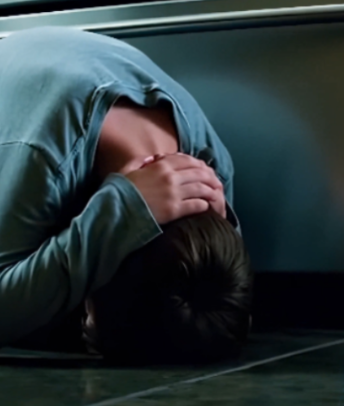
Leo didn’t jump. He didn’t run. He didn’t even cry out in surprise or childish frustration over the mess. His reaction was instantaneous, terrifying in its practiced speed, horrifying in its mechanical precision. He instantly dropped to his knees, slamming his forehead against the wet floor with a sickening thud that made me wince. His hands clasped tightly behind his neck, in a position of surrender that looked not only practiced but perfected, honed through countless, brutal repetitions, etched into his very being.
“I’m sorry! I’m sorry!” he screamed, a raw, guttural sound that didn’t belong in a quiet suburban kitchen, a sound ripped from the deepest parts of a child’s terror, a primal cry of absolute fear. “I didn’t mean to steal it! I’ll give it back! I promise! Please don’t make me go!”
“Leo, it’s okay! It’s just water! You didn’t steal anything! You’re safe!” I cried, my own voice cracking, my hands trembling as I reached down, instinctively, to pull him up, to comfort him, to tell him everything was alright. But my words were futile against the torrent of his fear.
He scrambled backward on his hands and knees, slipping in the spreading puddle of water, his desperation overriding any sense of caution, any thought of the cold or the wet. He backed himself into the tight, unforgiving corner between the refrigerator and the wall, like a cornered animal, his small body a tight ball of pure terror. He was shaking so hard his teeth clicked, an uncontrollable, rhythmic chattering that sent icy shivers down my spine, echoing the chill in my soul. His breath came in ragged, hyperventilating gasps, each inhale a desperate, futile attempt to escape the invisible horrors haunting him.
“Please,” he sobbed, tears and snot streaking his already smudged face, his voice a raw, broken plea. “Please, Miss Sarah. Just tell me. Don’t trick me.”
“Tell you what, baby? I’m not tricking you. You’re safe here. Truly safe.” My voice was barely a whisper now, my own composure shattering under the immense weight of his profound terror, the incomprehensible suffering it implied.
He looked up then, his face a mess of tears and snot, his beautiful brown eyes wide with a terror so pure, so unadulterated, that it stopped my heart in my chest. It was the face of a child who had seen unspeakable things, who expected the worst, always, whose only certainty was pain.
“If I drink without asking… does the closet come next? Or is it the box outside?”
I stood there, frozen in place, the cold water soaking into my socks, a chilling, sickening realization spreading through me like an invasive, toxic vine. The “points system,” the “credits,” the “chores,” the “timeouts”—they weren’t just abstract rules. They were inextricably linked to a profound, physical, isolating terror. For Leo, a glass of water wasn’t a simple drink to quench his thirst. It was a test. A trap. A currency for pain. And in my well-meaning ignorance, my desperate attempt to offer freedom, I had just sprung it.
The weight of his question hung in the air, heavy and suffocating, each word a hammer blow to my heart. “The closet… or the box outside?” The unspoken horrors these simple words represented painted a vivid, horrifying picture in my mind, a stark contrast to the bright, cheerful home I had tried to create. My “cool kid” bedroom, with its superhero sheets, felt like a cruel joke now, an insult to the reality of his past. This was not about superheroes; it was about basic survival, about teaching a broken child how to live again, how to trust the very air he breathed, the water he drank.
I didn’t try to touch him immediately. The sheer panic in his eyes told me that any sudden movement would only deepen his fear. Instead, I sank slowly to my knees, meeting his terrified gaze at his level. My own tears blurred my vision, but I blinked them back, forcing myself to be calm, to be his anchor. “No, Leo,” I whispered, my voice thick with unshed tears and a fierce, nascent protectiveness. “Never. No closet. No box. Not here. Ever.” I slowly reached out, not to grab him, but to gently wipe away a tear from his cheek with the back of my hand, a feather-light touch, watching his reaction closely. He flinched, but didn’t pull away completely.
That night, after I had carefully cleaned up the spilled water and, with painstaking slowness, coaxed him to drink several more small, supervised cups, reassuring him with every sip, Leo finally fell asleep in his superhero bed. But his sleep was fitful, punctuated by small whines and jerking movements. I sat beside his bed for hours, just watching him breathe, the image of his face, contorted in terror, etched permanently into my mind. I stared at the glow-in-the-dark stars on his ceiling, but all I could see were the shadows of a closet, the impenetrable darkness of a box. The anger simmered beneath my skin, a hot, bitter wave against the cold dread. I didn’t know what “the box” was, but I knew, with every fiber of my being, that I would spend every waking moment of my life making sure Leo never saw one again. This was our beginning, a fractured, terrifying, but ultimately hopeful beginning. I had to learn how to parent not just a child, but a survivor. And I was ready.