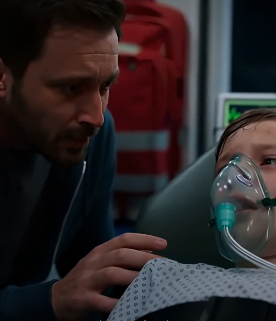
My 9-year-old son walked to school with a burst appendix because he was too terrified to tell me he hurt… But the note the doctor found in his pocket shattered my entire reality.
CHAPTER 1: THE STERLING WAY
The phone rang right in the middle of my pitch. It wasn’t just any pitch. It was the frantic, final play for the downtown redevelopment project—the kind of contract that secures a partnership and pays for the Ivy League trust fund.
I silenced it.
“As I was saying,” I continued, smoothing my silk tie, projecting the calm, confident authority of a man who never loses control. “Structure is nothing without discipline. The foundation must be unshakeable.”
The phone vibrated again. Then again. It was buzzing against the mahogany table like an angry hornet.
My boss, Marcus, raised an eyebrow. “David. You might want to get that. It’s the school line.”
I clenched my jaw, feeling the familiar tightening in my temples. “It’s fine. Leo probably forgot his lunch again. He needs to learn consequences. Hunger teaches focus.”
“David,” Marcus said, his voice dropping an octave, losing its friendly veneer. “They’ve called the office line, too. Pick it up.”
I stepped out of the glass-walled conference room, irritation prickling at the back of my neck like a sunburn. I loved my son. I did. But Leo was nine years old. Old enough to pack his bag. Old enough to tie his shoes. Old enough to navigate a Tuesday without needing a rescue mission. Since his mother, Sarah, died three years ago, that had been our mantra. Be a rock. Rocks don’t break. Rocks don’t cry.
“This is David,” I answered, clipping the words, checking the time. 10:15 AM.
“Mr. Sterling?” The voice on the other end wasn’t the secretary. It was heavy, wet, and breathless. “This is Principal Higgins. You need to come to Oak Creek Elementary. Now.”
“Is he in trouble?” I asked, looking through the glass at the investors. “If he got into a fight, suspend him. I’ll deal with it tonight. I’m in a meeting that determines my future.”
There was a silence on the other end. A thick silence that made the hair on my arms stand up.
“Mr. Sterling,” Higgins said, her voice cracking. “The paramedics are already here. Leo collapsed in the cafeteria. He’s not waking up.”
CHAPTER 2: THE DIAGNOSTIC
The drive from the city to the suburbs usually took forty minutes. I made it in twenty.
My mind wasn’t on the medical emergency. Not really. My brain, trained to analyze data and mitigate risk, was running a diagnostic on Leo’s behavior this morning.
He had been slow. Sluggish. He’d sat at the breakfast island, pushing his oatmeal around with a spoon, looking pale, his skin having a strange, greyish sheen.
“I’m not hungry, Dad,” he’d whispered.
“Eat,” I’d told him, not looking up from my iPad, checking the Nikkei index. “Fuel is distinct from pleasure, Leo. You have PE today. You don’t quit on the field, you don’t quit at the table.”
He had eaten it. All of it. He’d gagged once—a sharp, wet sound—took a sip of water, and finished.
I felt a surge of pride remembering that. That was the Sterling way. We didn’t whine. We didn’t complain about tummy aches. We powered through.
I pulled up to the school curb, bypassing the line of parents waiting for pickups. The ambulance was idling by the gym doors, lights flashing but no siren.
That was good, right? No siren meant no rush. No siren meant stable.
I slammed the car door and adjusted my jacket. I needed to project stability. If Leo was just dehydrated or had a flu, I didn’t want him seeing me panicked. Panic is weakness. Panic is contagious.
“Mr. Sterling!”
It was Mrs. Gable, the crossing guard. She was crying. Why was she crying?
I brushed past her, ducking under the yellow caution tape. Two EMTs were wheeling a gurney out of the double doors.
Leo looked so small.
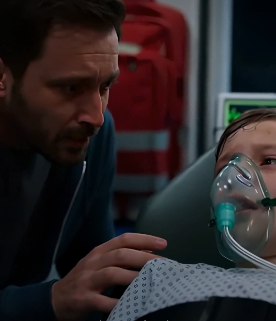
That was my first thought. He looked like a bundle of laundry under that white sheet. His skin was the color of old paper. An oxygen mask covered half his face.
“I’m the father,” I announced, my voice booming in the sudden hush of the parking lot. “Status?”
A female paramedic looked up. She didn’t look relieved to see me. She looked… angry.
“Are you David Sterling?”
“Yes. What happened? Did he fall?”
“He didn’t fall,” she said, her voice tight, clipping the IV bag onto the rail. “He collapsed. His BP is sixty over forty. His temperature is one hundred and four. He’s septic, sir.”
“He was fine this morning,” I insisted, falling into step beside the gurney as they rushed toward the ambulance. “He ate his breakfast. He walked to the car. He didn’t say a word.”
The paramedic stopped. She turned to me, her hand on the back door of the rig. The red strobe lights washed over her face, highlighting the judgment in her eyes.
“Sir, your son’s abdomen is rigid as a board. He’s been in excruciating pain for at least twenty-four hours. Maybe longer. His appendix didn’t just burst; it exploded.”
“That’s impossible,” I scoffed, though a cold knot was tightening in my stomach, heavier than lead. “Leo tells me everything. If he was hurting, he would have said so.”
She didn’t answer. She just loaded him in.
CHAPTER 3: THE APOLOGY
I climbed in the back, sitting on the narrow bench. The doors slammed shut, sealing us in the sterile, chemical-smelling box. The engine roared to life, and the siren finally wailed—a terrifying, lonely sound.
“Leo?” I said, leaning forward.
His eyes fluttered open. They were glassy, unfocused. He looked at the ceiling, then his gaze drifted to me.
I expected him to reach for me. I expected him to cry. I was ready to hold his hand, to tell him ‘Good job for staying strong, buddy.’
But when he saw me, he didn’t reach out.
He flinched.
He tried to curl into a ball, despite the straps holding him down. His breath fogged the plastic mask, coming in short, panicked rasps. The heart rate monitor beside his head started beeping faster. Beep-beep-beep-beep.
“It’s okay,” I said, confused, my own heart hammering against my ribs. I reached out to brush the damp hair off his sweaty forehead.
He squeezed his eyes shut. Tears leaked out the sides, running into his ears.
“I’m sorry,” he mumbled into the mask. His voice was so small I could barely hear it over the siren.
“Shh,” I said. “Don’t apologize. You’re sick. It happens.”
“I’m sorry,” he said again, more frantic this time. “I tried to eat it. I tried to walk straight. Please don’t be mad. I didn’t mean to fall.”
“Mad?” I looked at the paramedic. She was busy checking an IV line, but I saw her jaw clench so hard a muscle popped. “Leo, I’m not mad. Why would I be mad?”
“I ruined the schedule,” he whimpered, his body shaking with rigors. “I know you have the big meeting. I tried to hold it in. I promise. I tried to be a rock, Dad. Just like you said.”
The paramedic looked up then. Her eyes met mine. There was no professional courtesy left in her expression. Just pure, unadulterated disgust.
“Sir,” she said, her voice icy. “He’s not apologizing for being sick. He’s apologizing for being alive right now. You need to sit back.”
I sat back. I felt like I had been punched in the throat.
The ambulance hit a pothole, and Leo let out a sound I had never heard from a human being before—a guttural, strangled scream of agony that sounded like something tearing inside him.
And in that scream, for the first time in three years, I didn’t hear weakness.
I heard terror.
And as I looked at my son, fading in and out of consciousness, clutching the sheet with white-knuckled hands, I realized the terror wasn’t about the pain in his stomach.
He was looking right at me. He was afraid of me.
CHAPTER 4: THE WAITING ROOM
The surgery took three hours.
I spent those three hours pacing the waiting room of St. Jude’s, my expensive Italian loafers squeaking on the linoleum. I checked my phone. Fourteen missed calls from Marcus. Three texts from the client.
Contract signed?
David, where are you?
This is unprofessional.
I stared at the words. They looked like hieroglyphics. They looked like nonsense. I walked over to the trash can and threw the phone in. Just dropped it right on top of a half-eaten bagel.
“Mr. Sterling?”
A surgeon in green scrubs came out. He pulled his mask down. He looked exhausted.
“Is he…” I couldn’t finish the sentence. The word ‘dead’ got stuck in my throat, choked by the bile rising there.
“He made it,” the surgeon said. “Barely. The infection had spread to the peritoneum. Another hour, and we wouldn’t be having this conversation.”
I let out a breath that felt like it had been held for three years. “Thank you. God, thank you.”
“Don’t thank me yet,” the surgeon said, his tone sharp. He didn’t step aside to let me pass. He stood there, blocking my path. “We found something in his pocket, Mr. Sterling. The nurses thought you should see it.”
He handed me a piece of paper. It was wrinkled, stained with sweat, and folded into a tiny square.
My hands shook as I unfolded it.
It was a page torn from a small spiral notebook. Leo’s handwriting was messy, erratic, like he had written it while shaking.
At the bottom, in big, shaky letters, he had written:
I AM SORRY I FAILED NUMBER 5.
I stared at the note. I read line number 5 again. If I throw up, swallow it.
The memory of breakfast hit me. The gag. The sip of water.
He hadn’t been being a picky eater. He had been trying to keep his own vomit down because he thought that’s what I wanted. He thought his agony was an inconvenience to my schedule.
I fell.
I didn’t sit. I didn’t kneel. I collapsed. My legs just stopped working. I hit the hospital floor, clutching that dirty piece of paper to my chest, and a sound ripped out of me that matched the one Leo had made in the ambulance.
“Mr. Sterling?” The surgeon sounded alarmed now.
“I did this,” I sobbed, the tears coming hot and fast, washing away the calm, confident authority of David Sterling. “I made him do this. I told him rocks don’t break.”
“Well,” the surgeon said softly, looking down at me with a mixture of pity and warning. “He’s not a rock, Mr. Sterling. He’s a little boy. And right now, he’s a little boy who thinks his father loves his job more than his life.”
I looked up. “Can I see him?”
“He’s in recovery. He’s sedated.”
“Please.”
CHAPTER 5: A NEW FOUNDATION
I sat by his bed for two days. I didn’t shower. I didn’t shave. I didn’t go to work.
When Marcus showed up at the hospital room door, furious, demanding to know why I had ghosted the closing meeting, I walked out into the hall.
“David, do you have any idea what you’ve cost the firm?” Marcus hissed. “The deal is dead. They walked.”
I looked at Marcus. I looked at his perfect suit, his manicured nails, the stress vein throbbing in his forehead. I looked at him and I saw myself from three days ago.
“Good,” I said.
“Excuse me?”
“I quit, Marcus.”
“You… you can’t quit. You have a non-compete. You have the trust fund to think of!”
“I have a son to think of,” I said quietly. “And I nearly killed him trying to impress people like you.”
I turned around and walked back into the room, shutting the door in my boss’s face.
Leo woke up an hour later.
He blinked, his eyes adjusting to the dim light. When he saw me, he stiffened. His hand went to his stomach, protecting the incision.
“I’m sorry,” he whispered, his voice raspy. “Did you get the contract?”
I pulled the chair close. I took his hand—his small, fragile hand—and I pressed it against my cheek. I let him feel the stubble, the wetness of my tears.
“No, Leo,” I said. “I didn’t get the contract.”
Leo looked terrified. “I’m sorry. I’m so sorry, Dad.”
“No,” I said firmly. “Listen to me. I lost the contract because I quit.”
Leo’s eyes went wide. “You quit?”
“I quit,” I said. “Because I have a new job. A much harder one.”
“What is it?”
I pulled out the wrinkled note from my pocket. The Warrior List.
“My new job,” I said, tearing the paper in half, then in half again, “is teaching you that it is okay to hurt. It is okay to cry. And it is okay to need your dad.”
I dropped the confetti pieces of the note into the trash can.
“We aren’t rocks, Leo,” I whispered, kissing his forehead. “We’re just people. And people break. But we fix each other.”
Leo looked at me for a long time. Then, his lower lip trembled.
“It really hurt, Dad,” he whimpered. “It hurt so bad.”
“I know, buddy. I know.”
And for the first time in three years, my son didn’t apologize. He just cried. And I held him, and I cried with him, and we were weak together.
And it was the strongest I had ever felt.