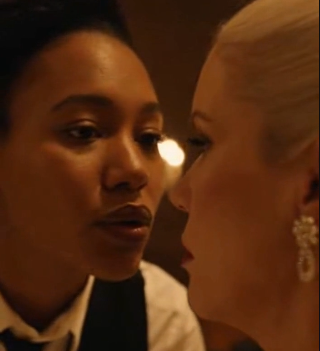
The billionaire’s wife enjoyed destroying the lives of anyone who dared to look her in the eye… But the new waitress knew a secret that would bring the queen of Manhattan to her knees.
The Golden Rose was not merely a restaurant; it was a cathedral of excess. Located in the glass-and-steel heart of Manhattan, its walls were lined with rare silk wallpaper, and its floors were polished to such a high sheen that the busboys joked they could see the souls of the miserable rich reflected in the marble. In this sanctuary of the elite, silence was the ultimate luxury. The staff moved like ghosts—unseen, unheard, and utterly terrified.
At the center of this fear lived the legend of Victoria Sterling. To the world of high finance and tech conglomerates, she was the elegant, philanthropic wife of Arthur Sterling, a man whose net worth could stabilize small nations. To the staff of The Golden Rose, she was “The Ice Queen.” She didn’t just demand perfection; she demanded a form of subservience that bordered on the Victorian. She didn’t need to raise her voice to fire someone. A slight curl of her lip, a lingering look at a smudge on a wine glass, or a soft, sighing “This is unacceptable,” was enough to end a career.
Thomas, a former waiter who had been top of his class at NYU, had been the most recent casualty. He had committed the cardinal sin of “human contact.” While placing a plate of $400 white truffles, his pinky finger had brushed the outer rim of Victoria’s bone-china plate. Victoria hadn’t screamed. She hadn’t even looked at him. She simply sat back, folded her hands, and said to the air, “It is contaminated. My evening is ruined.” Within ten minutes, Thomas was in the alleyway with his belongings in a paper bag, his dreams of law school evaporating into the New York humidity.
Then came Rachel Bennett.
Rachel was an anomaly in the world of fine dining. Only three months prior, she had been a rising star at a major news syndicate, an investigative journalist with a knack for smelling a lie from a mile away. But the industry was cruel, and budget cuts didn’t care about talent. She found herself wearing a crisp white apron and carrying heavy trays, her analytical mind constantly deconstructing the power dynamics of the dining room.
When she was warned about Table 4—Victoria’s table—the other servers spoke in hushed, jagged whispers. “Don’t look her in the eye,” they said. “Don’t speak unless she addresses you, which she won’t.”
Rachel watched from the shadows of the service station. She saw Victoria enter—a woman wrapped in a Chanel suit that cost more than Rachel’s college tuition, her face a mask of bored cruelty. She saw a young waiter tremble as he poured her sparkling water, a single drop landing on the tablecloth. Victoria’s eyes, cold as a winter morning in the Atlantic, fixed on the drop.
“I came here for excellence,” Victoria whispered, the sound cutting through the ambient hum of the room like a razor. “It seems I found incompetence instead.”
Rachel didn’t feel the fear the others felt. Instead, she felt a familiar spark—the one she used to feel when she was chasing a lead. She saw the way Victoria’s knuckles went white as she gripped her handbag. She saw the subtle, frantic twitch in her left eye. To the world, Victoria was a predator. To Rachel, she looked like a woman who was desperately trying to keep a crumbling house of cards from falling.
The following Friday, fate intervened. The regular captain, a man who had mastered the art of being a doormat, had been rushed to the hospital with a stress-induced ulcer. George, the manager, looked like he was about to faint.
“Rachel,” George hissed, grabbing her arm. “You’re on Table 4. Please, for the love of God, just… don’t exist. Be a shadow. If she asks for anything, get it instantly. If she insults your mother, thank her for the feedback.”
Rachel straightened her collar. “Don’t worry, George. I’ve dealt with tougher subjects than a billionaire’s wife.”
When Victoria arrived at eight o’clock sharp, the restaurant went into a localized deep freeze. She sat, her movements precise and rigid. Rachel stepped forward, her stride confident but respectful. She didn’t bow her head. She didn’t tremble.
“Good evening, Mrs. Sterling,” Rachel said, her voice steady and clear. “Tonight we have a special of wild-caught turbot, but I suspect you’re interested in the vintage Krug tonight.”
The table went silent. Several waiters nearby stopped mid-motion, waiting for the explosion. Victoria slowly looked up, her gaze traveling from Rachel’s shoes to her eyes. It was a challenge. A silent demand for Rachel to break.
“You speak,” Victoria said, her voice dropping to a dangerous register. “The previous boy didn’t speak. He barely breathed. I liked that better.”
“I find that communication prevents ‘contamination,’ Mrs. Sterling,” Rachel replied with a faint, knowing smile.
Victoria narrowed her eyes. She ordered the most complicated items on the menu, demanding substitutions that were technically impossible. Rachel didn’t flinch. She noted every detail, her journalistic memory capturing the specifics effortlessly. Throughout the meal, Victoria tried every trick in her arsenal. She sent back a wine because it was “too aggressive.” She complained that the air conditioning was directed specifically at her neck. She dropped her silk napkin twice, watching to see how fast Rachel would replace it.
Each time, Rachel responded with a calm, unbreakable dignity. She wasn’t playing the role of a servant; she was playing the role of an equal who happened to be providing a service.
The breaking point came at dessert. Victoria ordered the chocolate soufflé. When it arrived, perfect and billowing, Victoria took a small silver spoon, touched the top, and then let it drop onto the table with a clatter.
“It’s cold,” Victoria lied. It was clearly steaming. “Send it back. And bring me your manager. I think your employment here has reached its expiration date.”
The dining room held its breath. George the manager began to step forward, his face pale. But Rachel didn’t move. She leaned in just a fraction—closer than any server was ever allowed.
“Mrs. Sterling,” Rachel whispered, low enough that only Victoria could hear. “The soufflé is perfect. Just like your husband’s offshore accounts in the Cayman Islands were perfect… until the audit began this morning.”
Victoria’s face transitioned from ivory to a ghostly grey. Her hand, which had been reaching for her wine glass, stopped mid-air.
“What did you say?” Victoria hissed, her mask of composure finally cracking.
“I used to be a journalist, Victoria,” Rachel said, dropping the formal title. “I spent six months tracking the ‘Sterling Foundation’s’ diverted funds. I know why you’re so angry. I know that your husband is leaving you, and I know that the ‘fear’ you project in this restaurant is the only power you have left in your life. But taking it out on a nineteen-year-old busboy won’t save your bank account.”
For the first time in the history of The Golden Rose, Victoria Sterling had nothing to say. She looked at Rachel, and for a fleeting second, the Ice Queen disappeared. In her place was a terrified woman who realized she was no longer invisible.
“The soufflé?” Rachel asked, her voice returning to its professional, pleasant tone.
Victoria looked down at the dessert. Her voice was a mere shadow of itself. “It’s… it’s fine. Thank you.”
Rachel nodded. “Enjoy your evening.”
As Rachel walked back to the kitchen, the staff stared at her as if she had just tamed a dragon. Victoria finished her meal in total silence, paid the bill—including a 50% tip—and left without looking back. She never bullied another waiter again. And Rachel? She didn’t stay a waitress for long. Within a month, she published the story that would change the Sterling empire forever, proving that sometimes, the person serving your dinner is the one holding all the cards.