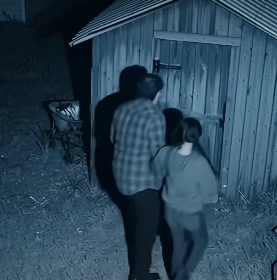
My father smashed my only meal and locked me in the rotting shed to teach me a lesson… But he forgot the security camera was recording every second of his cruelty.
The sound of ceramic shattering against the linoleum was louder than any scream I could have produced. It wasn’t just a plate; it was the last tether of my dignity, splintering into a thousand jagged daggers that now carpeted the kitchen floor. I stood there, trembling, my bare feet inches away from the sharp edges of what was supposed to be my dinner—a single piece of dry toast and a scoop of lukewarm beans.
My father stood over me, his chest heaving. His face, once a map of gentle lines and laughter when Mom was alive, was now a distorted mask of crimson fury. The smell of cheap bourbon clung to him like a second skin.
“You don’t deserve to eat!” he roared, his voice echoing off the sterile kitchen walls. “A burden like you… you’re the reason she’s gone. You’re the reason this house is a tomb!”
The words hurt more than the hunger. They were a poison I had been forced to drink every day for three years. Since the accident, I had become his punching bag—not always physically, but emotionally, a constant reminder of the life he lost. I looked down at the floor, my eyes stinging. I refused to let him see me cry. Crying was a weakness he exploited.
His hand clamped around my upper arm, his fingers digging into my bruised skin with terrifying strength. “I’m sick of looking at you,” he hissed.
He didn’t drag me to my room. He didn’t send me to the corner. He dragged me toward the back door. My heart plummeted. Not the shed. Please, not the shed.
The backyard was a suburban paradise to the neighbors—manicured lawns and the distant sound of children playing—but as the screen door slammed with a metallic clang, it felt like the gate to a prison. The shed sat at the very edge of the property, a dilapidated structure swallowed by the shadows of overgrown oaks. It smelled of wet earth, gasoline, and the slow rot of neglected wood.
He threw me inside. I stumbled over a stack of old tires, the rubber cold and clammy against my skin. The single, flickering lightbulb overhead cast long, skeletal shadows across the walls.
“Stay here and think about what you cost this family,” he said, his voice cold and final.
The heavy wooden door slammed shut. I heard the slide of the exterior bolt—a sound that signaled my complete isolation. I was trapped. The air was thick with mildew, making it hard to breathe. I sank to the floor, pulling my knees to my chest, listening to his retreating footsteps and the distant sound of his truck engine roaring to life. He was leaving. He always left after these episodes, leaving me to rot until he felt “merciful” enough to let me back into my own nightmare.
But as I sat there in the dark, a tiny red ember caught my eye.
High in the corner, nestled among the cobwebs, was the security camera. He had installed it months ago after a series of neighborhood break-ins. He was obsessed with “protecting his property,” never realizing that the greatest threat was already inside the house. The camera was motion-activated. It had recorded him dragging me. It had recorded the fury. It had recorded the imprisonment.
A surge of adrenaline replaced my despair. If I could get out, if I could get to the police, I would finally have proof. No one believed me before; he was the grieving widower, the hardworking father. I was just the “troubled” daughter. But the camera didn’t lie.
I scanned the walls, my mind racing. Then, a memory surfaced, flickering like a candle in the wind.
“In case of emergencies, Elara. Our little secret.”
My mother’s voice. I was eight years old, helping her sand a birdhouse in this very shed. She had shown me a loose board in the back, hidden behind a heavy workbench. She had been a survivalist at heart, always worried about “what ifs.”
I scrambled to the back of the shed, my hands frantically moving rusted tools and old paint cans. My fingernails tore as I clawed at the workbench, pushing it aside with a strength born of pure desperation. There it was. The wood was grey and weathered, but when I pressed against the bottom, it gave way with a groan.
I pushed with everything I had. My muscles screamed, and the rough wood scraped my shoulders, but finally, the board swung outward. I squeezed through the narrow gap, the cool night air hitting my face like a blessing.
I didn’t stop to look back. I ran. I ran through the thicket of bushes, over the neighbor’s fence, and straight toward the main road.
Three hours later, I sat in the back of a police cruiser, wrapped in a shock blanket. The officers had gone to the house. They had seen the broken plate. But more importantly, they had accessed the cloud storage for the security system.
They saw it all.
They saw the moment he broke. They saw the way he looked at me—not like a daughter, but like an enemy. As they led him away in handcuffs, he didn’t look like a monster anymore. He just looked small.
I am safe now. I am staying with my aunt, and for the first time in years, the air doesn’t smell like gasoline and fear. I found the footage on the shared drive before the police locked it as evidence. I need the world to see what happens behind closed doors.
I’ve uploaded the clip of the “burden” breaking her chains.