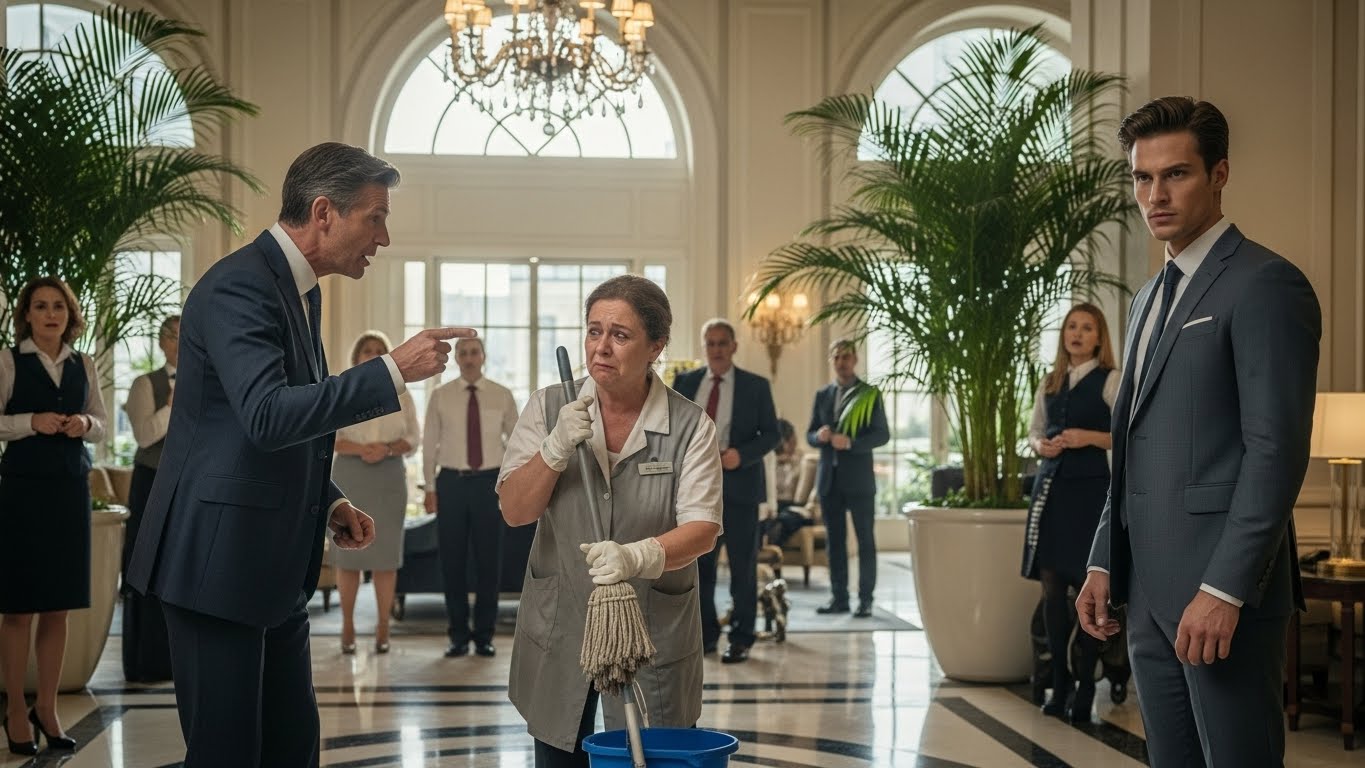
He humiliated the “cleaning lady” in front of the entire lobby and called her trash… But he had no idea she was my mother, and I owned every inch of the building he stood in.
The marble floors of the Sterling Heights Plaza didn’t just shine; they reflected the legacy of three decades of my blood, sweat, and absolute refusal to fail. At thirty-five, I stood at the helm of a real estate empire that controlled half the skyline, but to me, the heart of the building wasn’t the penthouse—it was the small, sun-drenched bistro in the corner of the lobby.
My mother, Elena, ran that bistro. She didn’t have to. I had bought her a villa in Tuscany and a mansion in the hills, but she refused to sit idle. “Elias,” she would tell me, her hands smelling of rosemary and yeast, “my soul is in my hands. If I stop working, I stop living.” So, we made a deal. She would run the café, but she had to wear the uniform like everyone else to “blend in.” She loved it. She loved the gossip, the morning rush, and the way people treated her like a human being—until today.
I was standing near the elevators, dressed in a casual hoodie and jeans—my “undercover” attire for when I wanted to observe the building’s flow without being swarmed by sycophants—when I heard the sound of shattering glass.
Then came the voice. It was sharp, nasal, and dripping with a sense of entitlement that made my skin crawl.
“You clumsy, pathetic old woman! Do you have any idea how much this suit costs? It’s bespoke! It’s worth more than your entire miserable life!”
I froze. I knew that voice. It was Julian Vane, a high-frequency trader who had just signed a lease for the most expensive office suite on the 40th floor. I turned slowly.
Julian was standing over a puddle of orange juice and shattered glass. My mother was on her knees, her face pale, reaching out to pick up the shards. A silver tray lay flipped over nearby.
“I am so sorry, sir,” my mother whispered, her voice trembling. “The floor was recently waxed, I slipped—”
“I don’t care why you’re incompetent!” Julian roared. He looked around the lobby, seeking an audience for his performance. He saw me—a guy in a hoodie—and sneered before looking back down at my mother. “You’re trash. Just like the filth you’re supposed to be cleaning up. People like you shouldn’t even be allowed to breathe the same air as the tenants in this building.”
The lobby went dead silent. The security guards started to move forward, but I raised a single hand, stopping them. I wanted to see how far this man would go.
Julian took it a step further. He lifted his expensive Italian leather shoe and intentionally ground a piece of shattered glass into the palm of my mother’s hand as she reached for a fragment. She let out a soft, sharp cry of pain.
The world went cold. That was the moment the tray hit the floor for the second time—this time, kicked away by Julian’s foot.
I walked forward. My footsteps were heavy on the marble. Julian noticed me and barked, “You! Kid! Get a mop and help this garbage heap clean up her mess. And then tell management I want her fired by noon.”
I reached my mother and knelt beside her. I didn’t look at Julian. I took her hand, carefully removing the small shard of glass from her palm. “Are you okay, Ma?” I asked softly.
She looked at me, her eyes brimming with tears, not of pain, but of embarrassment. “Elias, don’t. He’s a client. It’s fine.”
“It’s not fine,” I said. I stood up.
Julian chuckled, a dry, grating sound. “Wait… ‘Ma’? This trash is your mother? Well, that explains the wardrobe. The apple doesn’t fall far from the dumpster, does it?”
I looked Julian Vane directly in the eyes. I didn’t yell. I didn’t lose my temper. I used the voice that had closed billion-dollar deals and ended careers.
“Mr. Vane,” I said quietly. “You moved into Suite 4001 two days ago, correct? On a five-year commercial lease?”
Julian blinked, surprised. “How do you know that? And watch your tone, boy.”
“I know that because I signed the approval for your residency,” I said, stepping into his personal space. “My name is Elias Sterling. I own this building. I own the firm that manages your hedge fund’s assets. And most importantly, the woman you just called ‘trash’ is the reason this building exists. She worked three cleaning jobs to put me through school while you were likely snorting your inheritance.”
Julian’s face went from a flush of anger to a ghostly, sickly white. The transition was so fast it was almost comical. “I… Mr. Sterling? I had no idea. I thought… she was just…”
“Just a person?” I interrupted. “Just a human being deserving of basic dignity?”
I turned to my Head of Security, who was now standing inches behind Julian. “Mark, Mr. Vane’s lease has a ‘Moral Turpitude’ clause regarding the treatment of staff and conduct within common areas. Evict him. Now.”
“You can’t do that!” Julian gasped. “My entire infrastructure is moved in! The servers, the staff—”
“I can, and I am,” I said. “And as of this moment, Sterling Capital is withdrawing all liquidity from your fund. You have one hour to clear your desk before the locks are changed. If I see you near my mother again, you won’t just be broke; you’ll be in a courtroom.”
Julian looked around the lobby. The other tenants, people who had been watching in horror, began to whisper and point. His world didn’t just crumble; it vanished. He had spent years building an image of power, and in thirty seconds, he was a pariah.
He tried to speak, to apologize, to beg, but his voice failed him. He turned and practically ran toward the exit, nearly tripping on the same puddle of juice he had blamed my mother for.
I knelt back down and helped my mother up. The lobby burst into spontaneous applause, but I didn’t care about that. I took the apron off her shoulders.
“That’s it,” I said, smiling through my lingering anger. “No more bistro. You’re coming to the board meeting with me.”
She wiped her eyes and laughed, the strength returning to her face. “Only if we can have lunch afterwards, Elias. But not here. I think the floors are a bit too slippery today.”
I hugged her tight, knowing that while I owned the building, she was the one who truly held it up. As for Julian Vane? By the time the sun set, his firm was in freefall, proving that no matter how high you climb, the people you step on on the way up are the only ones who can catch you when you fall.
He knocked the tray from the cleaning lady’s hands and called her “worthless trash,” unaware that the woman he just humiliated was my mother—and I owned the very ground he stood on.
The rain battered against the tinted windows of the Maybach, blurring the neon lights of Chicago into streaks of electric blue and red. Inside, I adjusted my cufflinks, checking the time on my Patek Philippe. 7:45 PM. I was fifteen minutes early for the inspection, but that was the point. You don’t learn the truth about your empire by announcing your arrival; you learn it by walking in when no one expects you.
I had acquired The Sterling Grand three weeks ago. It was the jewel of the city—a forty-story monolith of glass and steel. I hadn’t stepped foot inside since the purchase papers were signed. My face wasn’t on the website yet. To the staff, Julian Vane was just a signature on a paycheck, a ghost in the boardroom.
” drop me at the side entrance,” I told the driver. “I want to walk through the lobby unnoticed.”
“Yes, Mr. Vane.”
I stepped out into the chill of the evening, pulling my coat collar up. I wasn’t dressed in my usual three-piece armor. I wore a simple black sweater and dark jeans. I looked like a tech start-up guy or a tourist, not the owner of the building.
The lobby was breathtaking. Vaulted ceilings, chandeliers that looked like frozen waterfalls, and a floor of polished Italian marble that cost more than my childhood home. But I wasn’t looking at the architecture. I was looking for her.
My mother, Elena.
She didn’t need to work. I had transferred five million dollars into her account two years ago. I had bought her a villa in Tuscany and a penthouse in Manhattan. But Elena was a woman who couldn’t sit still. She said idleness made her bones ache. When she found out I bought the Sterling, she begged to work a few shifts during the transition “just to keep busy,” she said. She wanted to be a part of my world, even if it meant wiping tables. I hated it, but I couldn’t say no to her. She was the woman who scrubbed floors for twenty years so I could go to Wharton.
I spotted her near the VIP lounge. She was wearing the crisp grey uniform of the hospitality staff, her hair tucked neatly under a cap. She looked tired but focused, balancing a heavy silver tray loaded with crystal champagne flutes and an expensive bottle of vintage Dom Pérignon.
I smiled, about to approach her and tell her to clock out and have dinner with me, when I saw him.
Marcus Thorne. The General Manager I had inherited with the building.
Thorne was a man who wore his arrogance like a cheap cologne. He was standing near the center fountain, berating a young valet, gesturing wildly. He turned sharply, his expensive leather shoes clicking on the marble, and marched toward the VIP section, right where my mother was navigating through a crowd of guests.
I started walking faster, sensing the collision before it happened.
Thorne was looking at his phone, typing furiously, not watching where he was going. My mother tried to pivot to let him pass, murmuring a polite, “Excuse me, sir.”
He didn’t stop. He didn’t even slow down. He plowed into her shoulder with the force of a linebacker.
CRASH.
The sound was deafening in the cavernous lobby. The silver tray hit the marble. Crystal shattered into a thousand glittering diamonds. The champagne exploded, foaming over the pristine floor and splashing onto Thorne’s polished shoes.
The lobby went silent. The piano player stopped mid-chord.
My mother gasped, her hands flying to her mouth. She immediately dropped to her knees, disregarding the broken glass, trying to stem the flow of champagne with her apron. “Oh my god, I am so sorry, sir! I didn’t see you—”
“You stupid, clumsy cow!” Thorne roared. His face turned a shade of violent crimson.
I froze. The blood in my veins turned to ice.
Thorne kicked a shard of glass toward her. “Look at this! Do you have any idea how much this suit costs? Do you know who I am?”
“I’m sorry, I’m so sorry,” my mother stammered, tears welling in her eyes. She reached for a napkin to dab at his shoe.
“Don’t touch me!” he recoiled, looking down at her with pure, unadulterated disgust. “God, why can’t we hire competent people? Why do we fill this place with garbage?”
He looked around at the guests, seeking validation. “Look at this mess. Unbelievable.” He looked back down at my mother, who was trembling. “You are trash. You are worthless, incompetent trash. Get out of my sight before I have security throw you out.”
“Sir, please,” she whispered, humiliated.
“You’re fired,” he spat. “Get your things and get the hell out of my lobby. And don’t expect a paycheck for this week. That champagne costs more than your life.”
I was behind him.
“She isn’t going anywhere,” I said. My voice was low, calm, and dangerous.
Thorne spun around, annoyed at the interruption. He looked me up and down, taking in the jeans and the sweater. He sneered. “Excuse me? This is a private conversation between management and staff. Walk away, pal.”
I stepped past him and offered a hand to my mother. She looked up, her eyes wide. “Julian?” she whispered.
“It’s okay, Mama,” I said softly, pulling her to her feet. I brushed a piece of glass from her uniform. “Are you hurt?”
“No, mijo, I’m just… I made a mess,” she cried.
“You didn’t make the mess,” I said, turning my gaze to Thorne.
Thorne let out a sharp, incredulous laugh. “Mama? Oh, this is perfect. The trash has a litter. Look, take your mother and get out before I call the police for trespassing.”
“You called her trash,” I said, stepping into Thorne’s personal space. I was three inches taller than him, and significantly broader.
“Because that’s what she is,” Thorne sneered, though he took a half-step back. “She’s a liability. And who are you? Her son? Great. Two nobodies for the price of one.”
I reached into my pocket and pulled out my phone. I dialed a number on speaker.
“Security,” the voice crackled on the other end.
“This is Julian Vane,” I said, my eyes never leaving Thorne’s.
Thorne’s face twitched. The name registered. He knew the name of the new owner. He just didn’t know the face.
“Mr. Vane!” the security chief’s voice shifted to panic. “We didn’t know you were on-site. Is everything alright?”
“No,” I said. “I’m in the lobby. I have a trespasser here who is harassing my mother.”
Thorne went pale. The blood drained from his face so fast it looked like he might faint. He looked from me to my mother, and then back to me. The realization hit him like a freight train.
“Mr… Mr. Vane?” Thorne stammered, his voice trembling. “I… I didn’t know… I mean, she was…”
“She was what?” I asked, stepping closer. “She was cleaning up your mess? I saw you walk into her, Marcus. I saw you looking at your phone.”
“It was an accident, sir! I was just… stressed. The gala tonight…”
“You called her trash,” I repeated, my voice rising just enough to echo off the vaulted ceiling. “You called the woman who raised me, the woman who is twice the human being you will ever be, trash in the lobby of the building that I own.”
The guests were watching now. Phones were out. Thorne was sweating profusely.
“Mr. Vane, please, I can explain. I can apologize to her. Ma’am, I am so sorry,” he turned to my mother, desperate.
“Don’t speak to her,” I snapped.
“Julian,” my mother said softly, touching my arm. “It’s okay. Let’s just go.”
“It’s not okay,” I said gently to her, before turning back to him. “Marcus, take off your jacket.”
“Excuse me?”
“The suit jacket. It has the hotel insignia on it. Take it off.”
Thorne’s hands shook as he unbuttoned his blazer and slid it off. He held it out.
“Drop it,” I commanded.
He dropped it on the wet, champagne-soaked floor.
“Now your badge.”
He unclipped his ID and dropped it.
“Pick up the tray,” I said.
Thorne blinked. “Sir?”
“You heard me. You made the mess. You humiliated my mother for it. Now, you will get on your knees and pick up every single shard of glass.”
“Mr. Vane, there are people watching,” he whispered, his pride shattering.
“I know,” I said cold as steel. “I want them to see what happens when you disrespect my family. Pick. It. Up.”
Slowly, agonizingly, Marcus Thorne sank to his knees in the puddle of champagne. The arrogant tyrant was gone, replaced by a broken man. He began picking up the glass, his hands shaking.
I turned to the head of security who had just arrived with a team.
“When he is finished cleaning this floor,” I said, loud enough for the lobby to hear, “escort him out. He is banned from this property and every other property under the Vane Corporation umbrella. If he sets foot within fifty feet of this building again, arrest him.”
“Yes, Mr. Vane,” the guard nodded.
I put my arm around my mother. “Come on, Mama. Let’s get you out of this uniform. We’re going to dinner. And you are officially retired.”
As we walked toward the elevators, leaving the former General Manager on his knees scrubbing the floor, my mother squeezed my hand.
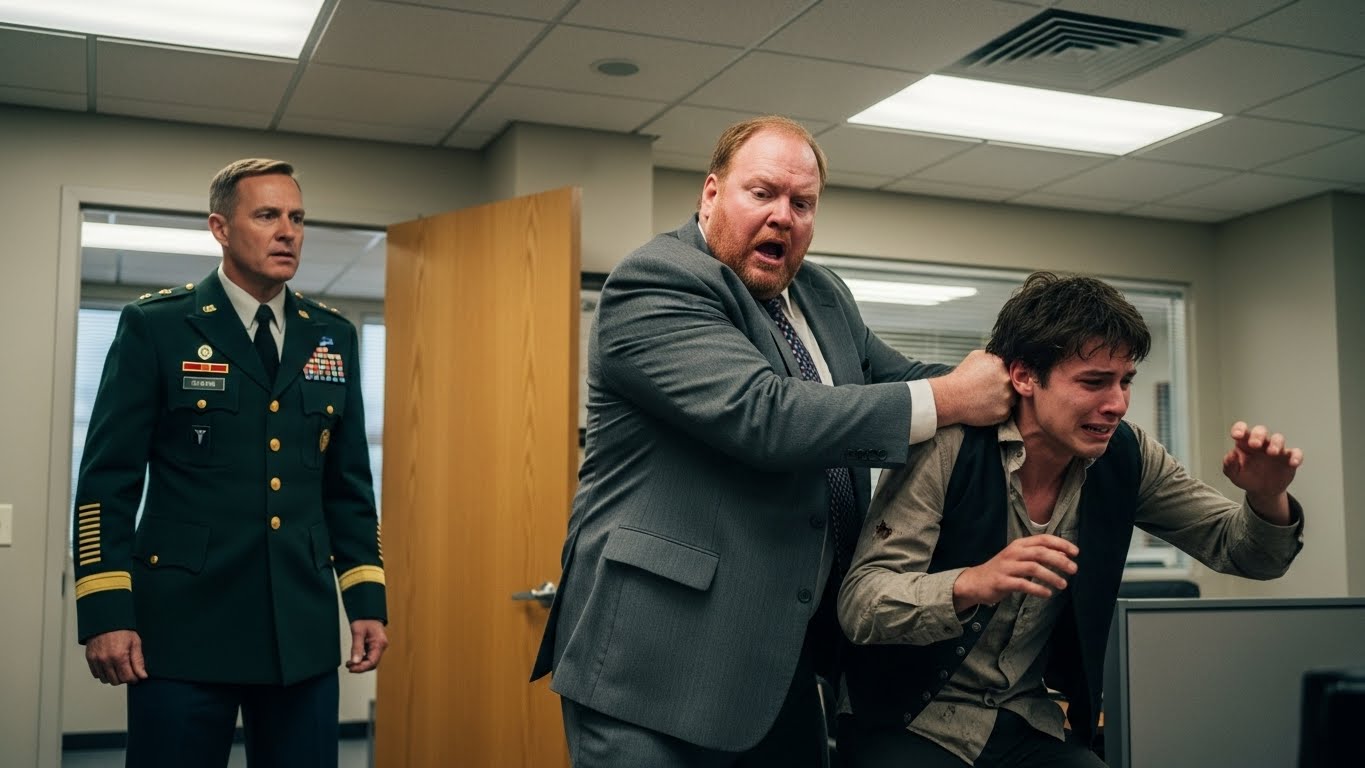
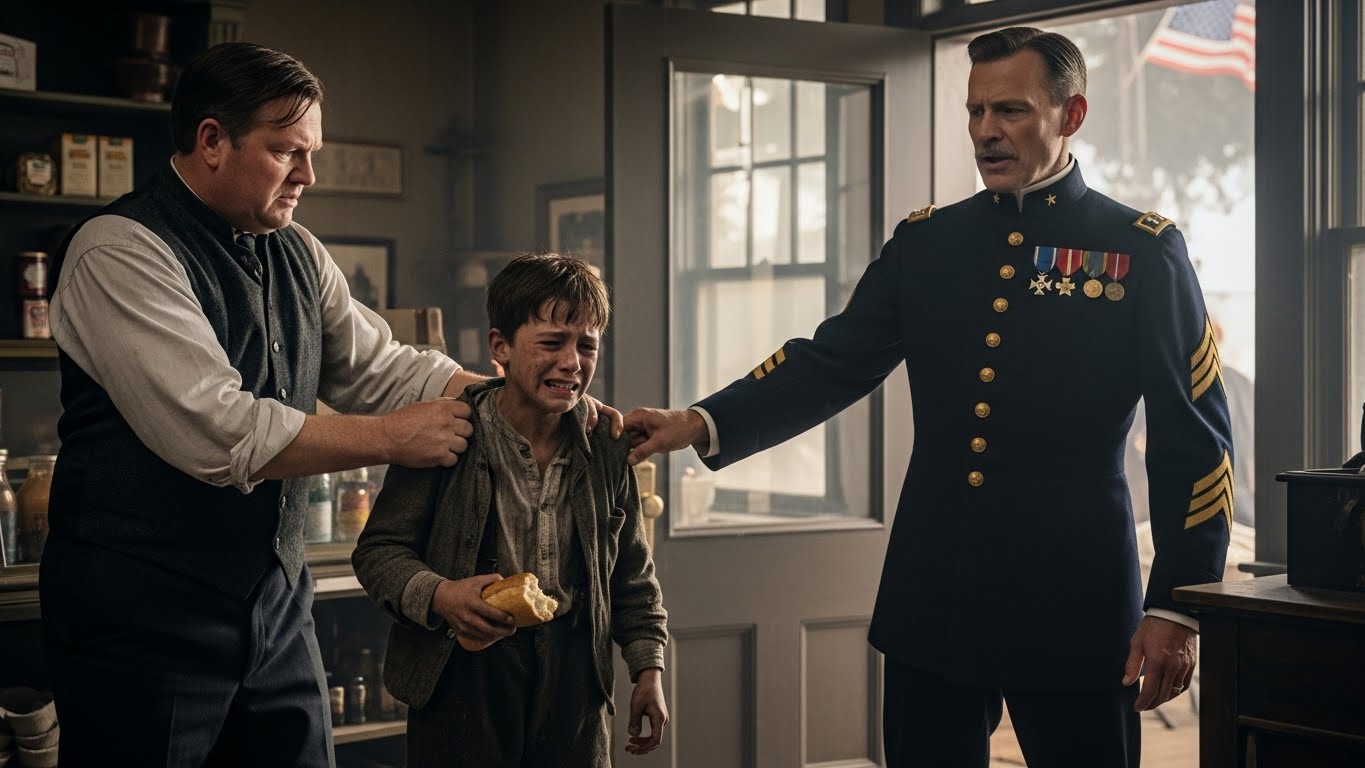
A store manager was dragging a starving orphan by his hair for stealing a loaf of bread… But his world collapsed when a 4-star General walked in and claimed the boy as his own.
The town of Oak Creek was the kind of place that forgot you existed if you didn’t have a zip code or a last name that meant something at the local country club. For ten-year-old Leo, Oak Creek wasn’t a town; it was a series of obstacles designed to keep him cold and hungry. November had arrived with a vengeful bite, turning the damp air into a serrated blade that cut through his oversized, moth-eaten wool coat.
Leo lived in the “crawlspace,” a hollowed-out concrete nook beneath the Miller Bridge. It was a place of shadows and damp stone, where he kept his only treasures: a plastic soldier with a missing arm and a tattered photograph of a woman he barely remembered, whose smile was the only warmth he knew. Hunger, however, was his most constant companion. It wasn’t a sharp pain anymore; it was a dull, rhythmic ache, a drumbeat in his marrow that started every afternoon and peaked when the sun dipped below the horizon.
He had rules. He wasn’t a “thief”—not in his heart. He was a collector of things the world had deemed unnecessary. But “Miller’s Quality Foods” was different. It was a cathedral of abundance, a brightly lit sanctuary where the air smelled of roasting rotisserie chickens and cinnamon-dusted pastries. To Leo, the store was a cruel joke played by the universe, a place where people bought more than they could ever eat while he contemplated the nutritional value of a discarded apple core.
On this Tuesday, the hunger won.
Leo slipped through the automatic doors, timed perfectly to the entrance of a boisterous family of five. He was a shadow, a glitch in the peripheral vision of the shoppers. He moved past the produce, past the artisan cheeses, straight to the back—the day-old bread bin. There it was: a loaf of sourdough, slightly hardened but smelling of yeast and hope. It was marked ninety-nine cents. To Leo, it might as well have been priced in gold bars.
He tucked the loaf inside his coat, the plastic crinkling like a gunshot in his ears. His heart hammered against his ribs—a trapped bird desperate for flight. He turned toward the exit, his eyes fixed on the gray sky visible through the glass doors. Ten feet. Five feet.
Then, the world tilted.
A hand, thick and calloused like a meat hook, clamped onto the back of Leo’s neck. A second later, that hand migrated to his hair, winding the matted strands around thick fingers.
“Gotcha, you little rat,” a voice hissed, dripping with a strange, fermented satisfaction.
It was Mr. Henderson, the store manager. Henderson was a man who felt small in his own life, and he compensated by making others feel microscopic. He didn’t just want to stop a theft; he wanted to perform an execution of dignity. He yanked Leo backward, and the boy let out a sharp, strangled cry as his feet flew out from under him. The sourdough loaf tumbled to the floor, rolling pathetically across the linoleum.
“Please!” Leo gasped, his hands clawing at Henderson’s wrist to ease the tension on his scalp. “I’m sorry! I’ll put it back! I’ll work for it!”
“You’ll work for it in a cell,” Henderson sneered. He didn’t lead Leo to the office. He began to drag him through the center of the store, toward the crowded checkout lines. He wanted an audience. He wanted the “decent” people of Oak Creek to see him as a guardian of their suburban peace.
“Look at this!” Henderson shouted, his voice echoing off the high ceilings. The hum of commerce died instantly. “This is the rot that’s creeping into our town! This little gutter-snipe thinks he can just walk in and take what your hard-earned money pays for!”
Leo’s face was hot with a shame so deep it felt like it was staining his bones. He saw the shoppers. Mrs. Gable, a regular who always wore pearls, looked away with a disgusted curl of her lip. Others watched with a morbid, silent curiosity, their phones beginning to rise like small glass tombstones to record his humiliation.
“Mr. Henderson, stop it!” Sarah, a young cashier, cried out. Her voice was trembling. “He’s just a child. You’re hurting him!”
“Stay out of it, Sarah, or you can join him in the unemployment line!” Henderson barked. He yanked Leo’s hair again, forcing the boy to his knees in the middle of the lobby. “I’m calling the police. We’re going to make sure this bridge-trash learns a lesson he won’t forget.”
Leo looked down at the floor, his tears dripping onto the white tiles. He felt smaller than a speck of dust. He felt like he was finally disappearing, just as the world had always wanted him to.
The automatic doors hissed open.
A sudden, heavy silence fell over the store. It wasn’t the silence of awkwardness, but the silence of gravity—the kind that occurs when something massive enters a room. The air didn’t just get colder; it got stiller.
Clack. Clack. Clack.
The sound of polished leather hit the floor with the rhythmic, terrifying precision of a ticking clock. The crowd parted like the Red Sea.
A man stepped into the light of the lobby. He was a titan, his posture so straight it seemed to defy the very concept of age. He wore the midnight-blue Army Service Uniform, the fabric so crisp the creases could have drawn blood. On his shoulders, four silver stars glinted under the fluorescent lights. His chest was a mountain of colored ribbons—medals for bravery, for sacrifice, for things most people in the store only saw in movies.
But it was his eyes that froze the room. They were a piercing, icy blue, set into a face of weathered granite. They weren’t looking at the store; they were locked onto Henderson’s hand, which was still tangled in Leo’s hair.
General Marcus Thorne didn’t speak immediately. He stopped three feet from Henderson. The manager, usually so full of bluster, felt the air leave his lungs. He looked at the stars. He looked at the “Thorne” nameplate. He looked at the man’s face and saw a level of controlled fury that made his own anger look like a temper tantrum.
“Release him,” Thorne said.
His voice wasn’t a shout. It was a low, vibrating growl that seemed to resonate in the very floorboards.
“Sir… General… you don’t understand,” Henderson stammered, his grip tightening instinctively on Leo’s hair as he tried to find his footing. “This boy is a thief. A vagrant. I was just… protecting the property until the police arrive.”
Thorne’s eyes narrowed. In a movement so fast it was a blur of blue and gold, the General stepped forward. He didn’t strike the man, but he grabbed Henderson’s wrist with a grip that could have crushed rebar.
Henderson let out a pathetic yelp, his fingers flying open as if shocked by electricity. Leo collapsed to the floor, sobbing, his hands immediately flying to his bruised scalp.
The General didn’t look at Henderson again. To him, the manager had ceased to exist. He did something that shocked every person holding a phone: he knelt. A Four-Star General, a man who moved armies, knelt on the dirty, salt-stained linoleum of a grocery store.
He placed a massive, gloved hand on Leo’s shoulder. The touch was so light, so impossibly gentle, that Leo stopped crying just from the shock of it.
“Are you alright, son?” Thorne asked.
Leo looked up through a veil of tears. He saw the stars. He saw the kindness in the man’s eyes—a look he hadn’t seen since the woman in the photograph had left. “I… I was just hungry,” Leo whispered, his voice cracking. “I’m sorry. I’m a bad person.”
“No,” the General said, his voice firming. “You are not a bad person. You are a hungry one. There is a difference.”
Thorne stood up slowly, bringing Leo up with him. He kept his arm around the boy’s shoulder, pulling him into his side, shielding him from the judgmental gaze of the crowd. He turned back to Henderson, who was nursing his wrist, his face a sickly shade of ash.
“You were asking if anyone knew this boy,” Thorne said, his voice now booming, filling every corner of the warehouse-like store.
“I… I didn’t know he had… anyone,” Henderson whispered.
“That is the problem with men like you, Henderson,” Thorne said, his eyes flashing like lightning. “You assume that because someone is alone, they are worth nothing. You look at a child in need and you see a target for your own insecurities.”
The General reached into his pocket and pulled out a crisp hundred-dollar bill. He didn’t hand it to Henderson; he let it flutter onto the counter like a dead leaf.
“The bread is paid for. And so is every other loaf this boy might ever need from this pathetic establishment,” Thorne stated.
He pulled Leo an inch closer.
“Let me make this very clear for the record,” the General said, looking directly into the camera of a teenager filming nearby. “Is there a problem with my son?”
The word ‘son’ hit the room like a physical shockwave. Leo’s heart stopped. He looked up at the General, his mouth hanging open. Henderson’s jaw worked soundlessly.
“Your… your son?” Henderson managed. “But he’s been living under the bridge… he’s a vagrant…”
“He is a Thorne,” the General declared, his voice ringing with a finality that brooked no debate. “And as of this moment, he is under the protection of the United States Army. If you, or anyone in this town, ever lays a hand on him again, you won’t be dealing with the local police. You will be dealing with me. Do I make myself clear?”
Henderson nodded frantically, his knees knocking.
Without another word, General Thorne turned, his hand still firmly and protectively on Leo’s shoulder. He guided the boy toward the exit. The automatic doors hissed open, and the cold November air rushed in, but as Leo stepped out onto the sidewalk, he didn’t feel the chill.
Waiting at the curb was a black armored SUV with government plates. A driver in uniform stepped out and opened the door with a sharp salute.
As they climbed inside, Leo looked at the General. “Why did you do that? You don’t even know me.”
The General looked at the boy, and for the first time, a small, sad smile touched his lips. He pulled a tattered, identical photograph from his own pocket—the same woman Leo had in his crawlspace.
“I’ve been looking for you for a long time, Leo,” the General whispered. “Your mother was my sister. I’m not letting you go again.”
Inside the store, the sourdough loaf lay on the floor, forgotten. But outside, as the SUV pulled away into the rain, the hunger in Leo’s heart was finally, after ten long years, replaced by the warmth of a home.
The store manager dragged the starving orphan by his hair… But then a 4-Star General walked in and asked one terrifying question.
The hunger wasn’t just a feeling for ten-year-old Leo; it was a living thing inside him, a clawed beast that woke up every time the sun went down.
Oak Creek in November was unforgiving. The wind cut through Leo’s oversized, moth-eaten wool coat like a razor, finding the shivering skin beneath. He had been living under the concrete arch of the Miller Bridge for three months, surviving on discarded apples and half-eaten sandwiches found in park bins. But today, the bins were empty. And the beast in his stomach was roaring.
It drove him to Miller’s Quality Foods.
The supermarket was a fortress of warmth and light. Through the sliding glass doors, Leo could see the rotisserie chickens spinning gold and brown, dripping fat. He could smell the yeasty, sour perfume of fresh bread.
He didn’t want to be a thief. His mother, before the sickness took her and the landlord took the apartment, had taught him better. “We don’t take what isn’t ours, Leo. We have dignity.”
But dignity didn’t stop the shaking in his hands.
Leo waited for a large family to enter—a mom distracted by a toddler and a dad on his phone—and slipped in their wake. He made himself small, a ghost in dirty sneakers. He headed straight for the clearance rack at the back.
There it was. A loaf of sourdough. Hard as a rock on one side, but edible. Ninety-nine cents. He had zero cents.
Leo grabbed it, tucking the cold plastic against his chest inside his coat. He turned, head down, walking fast. Just keep walking. Don’t run. Running looks guilty.
He was five steps from the exit when the world tilted sideways.
A hand clamped onto the back of his neck, the fingers digging in so hard they pinched a nerve.
“Thought you were slick, didn’t you, you little gutter rat?”
The voice belonged to Henderson, the store manager. A man who wore his polyester tie like a noose and his authority like a weapon. He had watched Leo on the cameras. He had been waiting.
“I’m sorry!” Leo squeaked, the bread tumbling from his coat to the floor. “I’ll put it back! I swear!”
“Put it back?” Henderson laughed, a cruel, wet sound. “Oh no. We’re making an example today.”
Instead of grabbing Leo’s arm, Henderson grabbed a fistful of Leo’s matted, dirty hair. He yanked hard. Leo screamed, his scalp burning, tears instantly blinding him.
“Please! It hurts!”
“Shut up!” Henderson bellowed. He dragged the boy backward, Leo’s heels skidding helplessly on the polished linoleum.
Shoppers froze. A woman in the produce section gasped. A cashier named Sarah took a step forward, “Mr. Henderson, stop! He’s just a child!”
“He’s vermin, Sarah! Get back to work!”
Henderson dragged Leo to the center of the store, right in front of the customer service desk. He forced the boy to his knees, keeping that painful grip on his hair, forcing Leo’s face up to the fluorescent lights.
“Look at this!” Henderson shouted to the stunned crowd. “This is what ruins neighborhoods! Filthy, thieving trash! I’m calling the police, and I hope they lock him up until he’s eighteen.”
Leo sobbed, his hands clutching at Henderson’s wrist, trying to relieve the pressure on his scalp. He felt the eyes of the town on him. The shame was worse than the hunger. He wished the floor would open up and swallow him whole. He was nothing. Just a waste of space.
Henderson reached for the landline phone on the counter with his free hand. “Hello? Police. I have a situation at Miller’s…”
The automatic doors hissed open.
It wasn’t just the wind that entered. The temperature in the room seemed to drop ten degrees, but the air suddenly felt heavy. Charged.
Clack. Clack. Clack.
Heavy boots struck the floor with a rhythm that sounded like a war drum.
The silence that fell over the store was suffocating.
A man walked in. He was a mountain of a human, dressed in a midnight-blue Army Service Uniform. The fabric was immaculate. On his shoulders, four silver stars caught the light. His chest was heavy with ribbons—Valor, Purple Heart, Distinguished Service.
But it was his eyes that terrified everyone. They were steel-gray, cold, and locked onto Henderson like a predator spotting wounded prey.
General Marcus Thorne didn’t rush. He didn’t shout. He simply walked. The crowd parted like the Red Sea.
He stopped two feet from the manager.
Henderson, sensing the shift, looked up. He saw the uniform. He saw the stars. The phone slipped from his fingers and dangled by its cord.
“Sir,” Henderson stammered, his grip on Leo’s hair loosening just a fraction. “I… I’m handling a shoplifter. Just waiting for the police.”
General Thorne didn’t blink. His voice was a low rumble, quiet but vibrating with enough power to shake the foundation.
“Let him go.”
“But… but he stole bread,” Henderson tried to regain his bluster, though his voice cracked. “He’s a nobody. An orphan. He has no one to answer for him.”
The General moved. It was a blur. One moment he was standing still, the next his gloved hand was wrapped around Henderson’s wrist—the one holding Leo’s hair.
Thorne squeezed.
Henderson shrieked, a high-pitched sound of pure agony. His fingers sprang open.
Leo collapsed to the floor, curling into a ball, covering his head with his arms, waiting for the next blow.
But the blow never came.
The General released Henderson, who stumbled back, clutching his crushed wrist, hyperventilating. Thorne ignored him. He dropped to one knee—slowly, deliberately—ignoring the dirt on the floor.
He reached out. Leo flinched.
“Easy,” the General whispered. The voice wasn’t scary anymore. It was deep and safe. “I’m not going to hurt you.”
He placed a large hand on Leo’s shoulder. It was warm. Solid.
“Stand up, soldier,” Thorne said softly.
Leo looked up, wiping snot and tears from his face. He saw the man’s face—scarred, tough, but looking at Leo with an expression that looked painfully like… grief? Or maybe recognition.
Thorne stood, bringing Leo up with him. He took off his dress jacket—a garment worth more than Leo’s life, probably—and draped it over the boy’s trembling shoulders. It was heavy and smelled like starch and old leather.
Thorne turned back to Henderson. The manager was pale, sweating profusely.
“You said this boy had no one,” Thorne said. He scanned the crowd, challenging anyone to speak. “You announced to this room that he was trash.”
“I… I didn’t know…” Henderson whimpered.
Thorne pulled Leo tight against his side.
“Is there a problem,” Thorne asked, his voice echoing off the high ceiling, “with my son?”
The gasp from the crowd was audible. Leo’s eyes went wide. He looked up at the General, but the man didn’t look down. He stared straight at Henderson with the intensity of a firing squad.
“Y-your son?” Henderson choked out. “But… he lives under the bridge. He…”
“He is a Thorne,” the General lied—or perhaps, decided—with a conviction that made it truth. “And you just assaulted him. If I see you near him, or any child, ever again… I won’t call the police. I will bring the full might of the United States Military down on this establishment until there is nothing left but dust. Do you understand me?”
“Yes! Yes, Sir! I’m sorry!”
Thorne reached into his pocket, pulled out a crisp hundred-dollar bill, and balled it up. He tossed it at Henderson’s feet.
“For the bread. Keep the change.”
Thorne guided Leo toward the door. The crowd stared in awe.
As they stepped into the cold rain, the warmth of the jacket kept Leo safe. He looked up at the stranger.
“Why?” Leo whispered. “I’m not your son.”
The General stopped. He looked down at the boy—at the hunger in his cheeks, the fear in his eyes. He saw a reflection of himself, years ago, before the army, before the stars.
“You needed a father,” Thorne said, his voice thick with emotion. “And it looks like I just found a son. Are you hungry, Leo?”
Leo nodded, tears spilling over again.
“Let’s go get a steak,” the General said, opening the door to his black car. “We have a lot to talk about.”
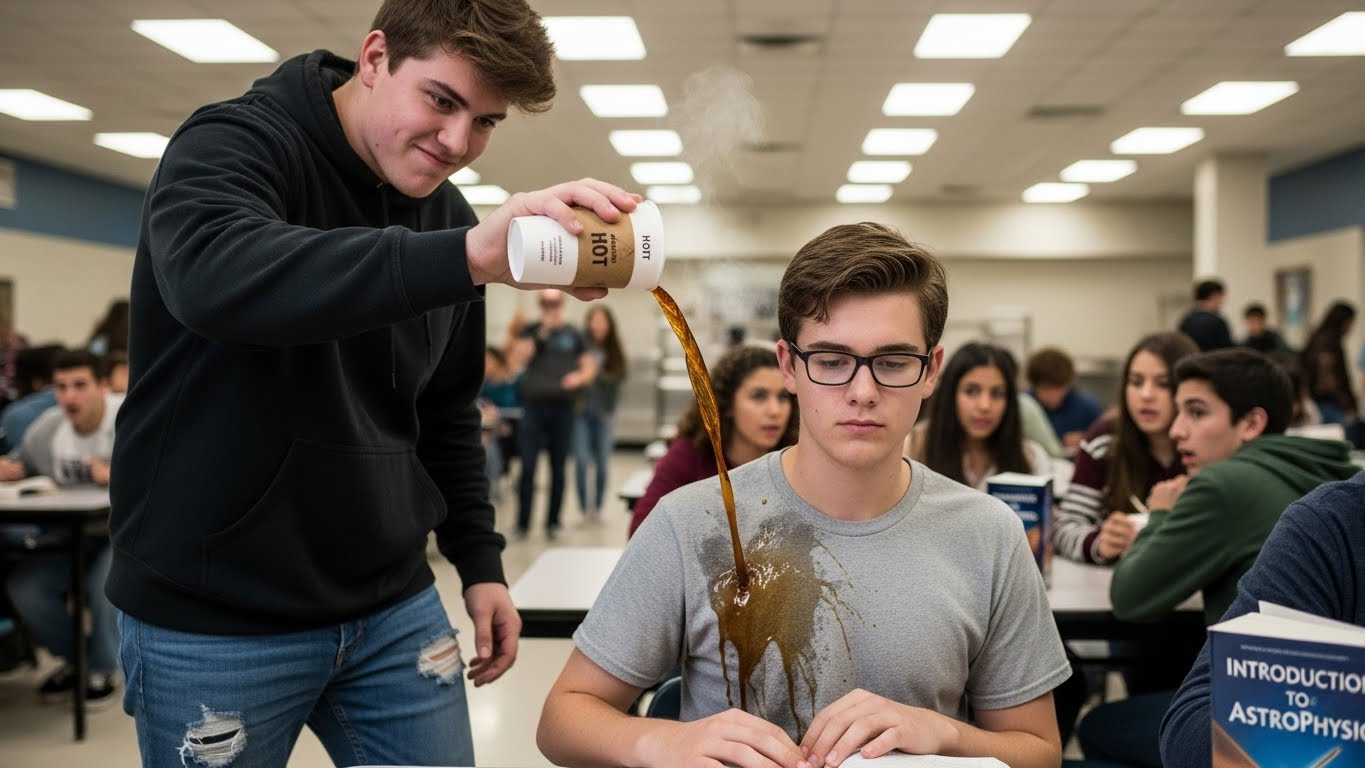
The school bully poured scalding coffee on the quiet new kid just to hear him scream… But he didn’t realize he just declared war on a world-class martial arts master.
Chapter 1: The Code of Silence
The hallways of Oak Ridge High were a ecosystem of predators and prey, a hierarchy written in shout-outs, shoved shoulders, and averted gazes. For Kenji Sato, a transfer student who had arrived only three weeks prior, the strategy was simple: become invisible.
Kenji was slight of build, with messy dark hair that hung over his eyes and a posture that suggested he was perpetually apologizing for taking up space. He wore oversized hoodies and kept his head down, clutching his beat-up biology textbook like a shield. To the untrained eye, he was the perfect victim.
To the trained eye, however, Kenji’s movements were different. He didn’t walk; he glided. His steps were silent, his weight perfectly distributed. When someone bumped him in the crowded corridor, he didn’t stumble; he flowed around the impact like water meeting a stone. But no one at Oak Ridge had a trained eye. Especially not Marcus Thorne.
Marcus was the varsity linebacker, a mountain of teenage muscle and insecurity masked by aggression. He ruled the cafeteria from a center table, holding court with a cruelty that he mistook for charisma. He had been watching the “new kid” for days. Kenji was too quiet. Too composed. It irritated Marcus in a way he couldn’t articulate. He needed to see Kenji break.
Kenji sat in the far corner of the cafeteria, nursing a bottle of water and a bento box. He closed his eyes for a moment, reciting the words of his grandfather, the Grandmaster of the Kyokushin Shadow Dojo in Kyoto.
“Violence is the last refuge of the incompetent. True strength is the discipline to keep the sword in the sheath, even when the enemy taunts you. You are a weapon, Kenji. And weapons must be secured.”
Kenji had promised. After the “incident” at his last school—where three seniors ended up in the hospital with dislocated shoulders after trying to jump him—Kenji had vowed to never raise his hand again unless it was life or death. He was here to study, to graduate, and to be normal.
Chapter 2: The Boiling Point
“Hey, fresh meat.”
The shadow fell over Kenji’s table first. Then came the smell—cheap body spray and the distinct, acidic scent of cafeteria coffee. Kenji opened his eyes. Marcus stood there, flanked by two of his grinning lackeys. Marcus was holding a large Styrofoam cup, steam curling from the lid.
“I’m talking to you,” Marcus sneered, kicking the leg of Kenji’s chair.
Kenji slowly packed his chopsticks away. “Can I help you?” His voice was calm, level.
“You’re sitting at my reserve table,” Marcus lied. Everyone knew the corner tables were for the outcasts.
“I wasn’t aware,” Kenji said, beginning to stand. “I’ll move.”
“Sit down,” Marcus barked, placing a heavy hand on Kenji’s shoulder. He squeezed, trying to elicit a wince. Kenji’s shoulder felt like iron wrapped in cotton. He didn’t flinch. He didn’t drop his gaze.
This lack of fear was the spark that lit the fuse. Marcus needed fear. He thrived on it. If Kenji wouldn’t give it willingly, Marcus would take it.
“You think you’re better than us? Too good to talk?” Marcus’s voice rose, drawing the attention of the surrounding tables. The cafeteria chatter died down. The air grew heavy with anticipation. Phones came out, recording.
“I just want to eat my lunch,” Kenji said softly. “Please, leave me alone.”
“Please?” Marcus mocked, looking at his friends. “He said please! Aww, look at the polite little puppy.”
Marcus leaned in close. “Let’s see if we can wake you up.”
Without a second of hesitation, Marcus popped the lid off the coffee. It was fresh from the urn—near boiling. With a cruel grin, he tipped the cup.
Chapter 3: The Awakening
The dark liquid cascaded down. It hit Kenji’s neck, soaking into the collar of his hoodie and running down his spine.
The pain was immediate and searing. The cafeteria gasped. A few girls screamed.
Marcus stepped back, laughing, waiting for the shriek, the tears, the flailing panic.
But there was silence.
Kenji stood freezing still. He didn’t scream. He didn’t jump around. He simply closed his eyes and exhaled, a long, hissing breath through his teeth. Ibuki. The breathing technique of the iron body.
He compartmentalized the pain, acknowledging the signal from his nerves but refusing to let it dictate his reaction. The coffee dripped from his chin onto the linoleum floor.
“What’s the matter?” Marcus laughed nervously, the silence unnerving him. “Cat got your tongue? Or did I burn it off?”
Kenji opened his eyes.
The change was subtle, but terrifying. The timid boy was gone. In his place stood something predatory. His posture shifted, his center of gravity dropping an inch. His hands, previously hanging loose, didn’t clench into fists—they opened into blades.
“You shouldn’t have done that,” Kenji whispered. It wasn’t a threat; it was a statement of fact.
Marcus, sensing his dominance slipping, lunged forward with a haymaker punch meant to knock Kenji out cold. “Shut up, freak!”
Chapter 4: The Art of Eight Limbs
Time seemed to slow for Kenji. He saw the rotation of Marcus’s hips, the tension in the shoulder, the telegraphing of the swing. It was clumsy. Slow. Amature.
Kenji didn’t block the punch. He simply wasn’t there when it arrived.
With a pivot of his left foot, Kenji slipped inside Marcus’s guard. The bully’s fist hit empty air. Before Marcus could recover his balance, Kenji’s hand shot out, palm open, striking Marcus in the solar plexus.
It wasn’t a hard strike—maybe 10% of Kenji’s power—but it was surgically precise.
Marcus gagged, the air instantly vacating his lungs. He doubled over.
“Get him!” Marcus wheezed to his friends.
The two lackeys charged. The first, a tall basketball player, tried to tackle Kenji. Kenji sidestepped, grabbed the boy’s wrist and used the attacker’s own momentum to send him spiraling into a rack of lunch trays with a chaotic crash. Aikido.
The second attacker threw a wild kick. Kenji caught the leg, swept the standing leg, and watched the boy hit the floor with a thud. Muay Thai sweep.
Marcus, now recovering his breath, saw red. Rage replaced logic. He roared and charged like a bull, head down, arms wide.
Kenji stood his ground. He waited until Marcus was two feet away.
In a blur of motion, Kenji dropped to one knee, spinning. His leg hooked behind Marcus’s ankles. The Dragon Tail Sweep.
Marcus hit the ground hard, face-first. But Kenji wasn’t done. Before Marcus could scramble up, Kenji was on him—not striking, but controlling. He utilized a Brazilian Jiu-Jitsu omoplata, locking Marcus’s shoulder in a position where a single inch of pressure would snap the joint.
The cafeteria was dead silent. The only sound was the hum of the vending machines and Marcus’s panicked breathing.
Kenji leaned down, his voice calm, right next to Marcus’s ear.
“This arm,” Kenji whispered, applying a millimeter of pressure. Marcus whimpered. “It allows you to throw a ball. To write. To eat. If I push my hips forward, you will never use it again. Do you understand the anatomy of the rotator cuff, Marcus?”
“Yes! Yes! I’m sorry!” Marcus sobbed, the tough guy facade shattered into dust.
“I didn’t hear you,” Kenji said, staring at the crowd of students standing on chairs to get a better look.
“I SAID I’M SORRY!” Marcus screamed, tears streaming down his face.
Kenji held the position for three more seconds—an eternity. Then, he released the pressure. He stood up, adjusted his coffee-stained hoodie, and looked at the crowd. He didn’t look triumphant. He looked sad.
He picked up his bento box, walked past the groaning lackeys, and headed for the exit. The sea of students parted for him like he was Moses.
Chapter 5: The Aftermath
Kenji sat in the Principal’s office, the stained hoodie folded in his lap. Principal Henderson looked from Kenji to the video playing on his tablet—footage of the fight that had already garnered 50,000 views on TikTok.
“Mr. Sato,” Henderson said, taking off his glasses. “I have three parents on the phone threatening to sue the school. Marcus has a bruised ego, Tyler has a sprained wrist, and the cafeteria needs a new tray rack.”
Kenji looked down. “I broke my promise, sir. I am prepared for expulsion.”
Henderson sighed. “I also have the security footage, Kenji. I saw the coffee. I saw the provocation. And…” He paused, looking at Kenji with a strange mix of scrutiny and respect. “I looked at your file from Japan. Your grandfather is Kaito Sato?”
Kenji nodded. “Yes, sir.”
“A living legend,” Henderson mused. “Kenji, what you did was violent. But looking at this video… you could have put those boys in the hospital. You didn’t. You dismantled them, but you showed restraint.”
“Restraint is the first lesson,” Kenji recited automatically.
“Marcus has been a problem for this school for a long time,” Henderson admitted, lowering his voice. “Bullying is a zero-tolerance issue. Usually, fighting back is too. But given the thermal burns on your neck—which the nurse has documented—I am classifying this as self-defense.”
Kenji looked up, surprised.
“However,” Henderson pointed a finger. “You are not to use those skills on school grounds again unless your life is in danger. And you will help the janitor clean the cafeteria for a week. Understood?”
“Yes, sir.”
Epilogue
The next day, Kenji walked into the cafeteria. The silence was deafening. He walked to his usual corner table.
As he sat down, he noticed something. His table was empty, but the tables around him were full. People were looking, but not with pity anymore.
Marcus walked in a moment later, his arm in a sling (mostly for dramatic effect). He saw Kenji. For a moment, their eyes locked. Marcus looked away first, changing his path to sit at a different table on the other side of the room.
A freshman, small and terrified-looking, hesitated near Kenji’s table. He was holding a tray, looking for a place to sit where he wouldn’t be bothered.
Kenji kicked out the chair opposite him.
“Sit,” Kenji said quietly.
The freshman sat.
“I’m… I’m David,” the boy stammered. “Is it true you’re a ninja?”
Kenji cracked a rare, small smile as he opened his water. “No, David. Just a student. Eat your lunch.”
But as he ate, Kenji knew things had changed. He wasn’t the invisible victim anymore. He was the guardian of the corner tables. And for the first time in a long time, the coffee at Oak Ridge High didn’t taste quite so bitter.
The school bully poured scalding coffee on the quiet new kid just to hear him scream… But he didn’t realize he just declared war on a world-class martial arts master.
Chapter 1: The Code of Silence
The hallways of Oak Ridge High were a ecosystem of predators and prey, a hierarchy written in shout-outs, shoved shoulders, and averted gazes. For Kenji Sato, a transfer student who had arrived only three weeks prior, the strategy was simple: become invisible.
Kenji was slight of build, with messy dark hair that hung over his eyes and a posture that suggested he was perpetually apologizing for taking up space. He wore oversized hoodies and kept his head down, clutching his beat-up biology textbook like a shield. To the untrained eye, he was the perfect victim.
To the trained eye, however, Kenji’s movements were different. He didn’t walk; he glided. His steps were silent, his weight perfectly distributed. When someone bumped him in the crowded corridor, he didn’t stumble; he flowed around the impact like water meeting a stone. But no one at Oak Ridge had a trained eye. Especially not Marcus Thorne.
Marcus was the varsity linebacker, a mountain of teenage muscle and insecurity masked by aggression. He ruled the cafeteria from a center table, holding court with a cruelty that he mistook for charisma. He had been watching the “new kid” for days. Kenji was too quiet. Too composed. It irritated Marcus in a way he couldn’t articulate. He needed to see Kenji break.
Kenji sat in the far corner of the cafeteria, nursing a bottle of water and a bento box. He closed his eyes for a moment, reciting the words of his grandfather, the Grandmaster of the Kyokushin Shadow Dojo in Kyoto.
“Violence is the last refuge of the incompetent. True strength is the discipline to keep the sword in the sheath, even when the enemy taunts you. You are a weapon, Kenji. And weapons must be secured.”
Kenji had promised. After the “incident” at his last school—where three seniors ended up in the hospital with dislocated shoulders after trying to jump him—Kenji had vowed to never raise his hand again unless it was life or death. He was here to study, to graduate, and to be normal.
Chapter 2: The Boiling Point
“Hey, fresh meat.”
The shadow fell over Kenji’s table first. Then came the smell—cheap body spray and the distinct, acidic scent of cafeteria coffee. Kenji opened his eyes. Marcus stood there, flanked by two of his grinning lackeys. Marcus was holding a large Styrofoam cup, steam curling from the lid.
“I’m talking to you,” Marcus sneered, kicking the leg of Kenji’s chair.
Kenji slowly packed his chopsticks away. “Can I help you?” His voice was calm, level.
“You’re sitting at my reserve table,” Marcus lied. Everyone knew the corner tables were for the outcasts.
“I wasn’t aware,” Kenji said, beginning to stand. “I’ll move.”
“Sit down,” Marcus barked, placing a heavy hand on Kenji’s shoulder. He squeezed, trying to elicit a wince. Kenji’s shoulder felt like iron wrapped in cotton. He didn’t flinch. He didn’t drop his gaze.
This lack of fear was the spark that lit the fuse. Marcus needed fear. He thrived on it. If Kenji wouldn’t give it willingly, Marcus would take it.
“You think you’re better than us? Too good to talk?” Marcus’s voice rose, drawing the attention of the surrounding tables. The cafeteria chatter died down. The air grew heavy with anticipation. Phones came out, recording.
“I just want to eat my lunch,” Kenji said softly. “Please, leave me alone.”
“Please?” Marcus mocked, looking at his friends. “He said please! Aww, look at the polite little puppy.”
Marcus leaned in close. “Let’s see if we can wake you up.”
Without a second of hesitation, Marcus popped the lid off the coffee. It was fresh from the urn—near boiling. With a cruel grin, he tipped the cup.
Chapter 3: The Awakening
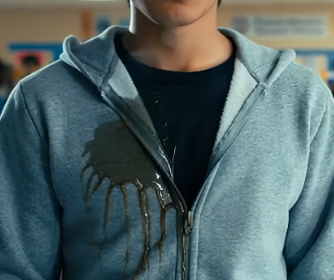
The dark liquid cascaded down. It hit Kenji’s neck, soaking into the collar of his hoodie and running down his spine.
The pain was immediate and searing. The cafeteria gasped. A few girls screamed.
Marcus stepped back, laughing, waiting for the shriek, the tears, the flailing panic.
But there was silence.
Kenji stood freezing still. He didn’t scream. He didn’t jump around. He simply closed his eyes and exhaled, a long, hissing breath through his teeth. Ibuki. The breathing technique of the iron body.
He compartmentalized the pain, acknowledging the signal from his nerves but refusing to let it dictate his reaction. The coffee dripped from his chin onto the linoleum floor.
“What’s the matter?” Marcus laughed nervously, the silence unnerving him. “Cat got your tongue? Or did I burn it off?”
Kenji opened his eyes.
The change was subtle, but terrifying. The timid boy was gone. In his place stood something predatory. His posture shifted, his center of gravity dropping an inch. His hands, previously hanging loose, didn’t clench into fists—they opened into blades.
“You shouldn’t have done that,” Kenji whispered. It wasn’t a threat; it was a statement of fact.
Marcus, sensing his dominance slipping, lunged forward with a haymaker punch meant to knock Kenji out cold. “Shut up, freak!”
Chapter 4: The Art of Eight Limbs
Time seemed to slow for Kenji. He saw the rotation of Marcus’s hips, the tension in the shoulder, the telegraphing of the swing. It was clumsy. Slow. Amature.
Kenji didn’t block the punch. He simply wasn’t there when it arrived.
With a pivot of his left foot, Kenji slipped inside Marcus’s guard. The bully’s fist hit empty air. Before Marcus could recover his balance, Kenji’s hand shot out, palm open, striking Marcus in the solar plexus.
It wasn’t a hard strike—maybe 10% of Kenji’s power—but it was surgically precise.
Marcus gagged, the air instantly vacating his lungs. He doubled over.
“Get him!” Marcus wheezed to his friends.
The two lackeys charged. The first, a tall basketball player, tried to tackle Kenji. Kenji sidestepped, grabbed the boy’s wrist and used the attacker’s own momentum to send him spiraling into a rack of lunch trays with a chaotic crash. Aikido.
The second attacker threw a wild kick. Kenji caught the leg, swept the standing leg, and watched the boy hit the floor with a thud. Muay Thai sweep.
Marcus, now recovering his breath, saw red. Rage replaced logic. He roared and charged like a bull, head down, arms wide.
Kenji stood his ground. He waited until Marcus was two feet away.
In a blur of motion, Kenji dropped to one knee, spinning. His leg hooked behind Marcus’s ankles. The Dragon Tail Sweep.
Marcus hit the ground hard, face-first. But Kenji wasn’t done. Before Marcus could scramble up, Kenji was on him—not striking, but controlling. He utilized a Brazilian Jiu-Jitsu omoplata, locking Marcus’s shoulder in a position where a single inch of pressure would snap the joint.
The cafeteria was dead silent. The only sound was the hum of the vending machines and Marcus’s panicked breathing.
Kenji leaned down, his voice calm, right next to Marcus’s ear.
“This arm,” Kenji whispered, applying a millimeter of pressure. Marcus whimpered. “It allows you to throw a ball. To write. To eat. If I push my hips forward, you will never use it again. Do you understand the anatomy of the rotator cuff, Marcus?”
“Yes! Yes! I’m sorry!” Marcus sobbed, the tough guy facade shattered into dust.
“I didn’t hear you,” Kenji said, staring at the crowd of students standing on chairs to get a better look.
“I SAID I’M SORRY!” Marcus screamed, tears streaming down his face.
Kenji held the position for three more seconds—an eternity. Then, he released the pressure. He stood up, adjusted his coffee-stained hoodie, and looked at the crowd. He didn’t look triumphant. He looked sad.
He picked up his bento box, walked past the groaning lackeys, and headed for the exit. The sea of students parted for him like he was Moses.
Chapter 5: The Aftermath
Kenji sat in the Principal’s office, the stained hoodie folded in his lap. Principal Henderson looked from Kenji to the video playing on his tablet—footage of the fight that had already garnered 50,000 views on TikTok.
“Mr. Sato,” Henderson said, taking off his glasses. “I have three parents on the phone threatening to sue the school. Marcus has a bruised ego, Tyler has a sprained wrist, and the cafeteria needs a new tray rack.”
Kenji looked down. “I broke my promise, sir. I am prepared for expulsion.”
Henderson sighed. “I also have the security footage, Kenji. I saw the coffee. I saw the provocation. And…” He paused, looking at Kenji with a strange mix of scrutiny and respect. “I looked at your file from Japan. Your grandfather is Kaito Sato?”
Kenji nodded. “Yes, sir.”
“A living legend,” Henderson mused. “Kenji, what you did was violent. But looking at this video… you could have put those boys in the hospital. You didn’t. You dismantled them, but you showed restraint.”
“Restraint is the first lesson,” Kenji recited automatically.
“Marcus has been a problem for this school for a long time,” Henderson admitted, lowering his voice. “Bullying is a zero-tolerance issue. Usually, fighting back is too. But given the thermal burns on your neck—which the nurse has documented—I am classifying this as self-defense.”
Kenji looked up, surprised.
“However,” Henderson pointed a finger. “You are not to use those skills on school grounds again unless your life is in danger. And you will help the janitor clean the cafeteria for a week. Understood?”
“Yes, sir.”
Epilogue
The next day, Kenji walked into the cafeteria. The silence was deafening. He walked to his usual corner table.
As he sat down, he noticed something. His table was empty, but the tables around him were full. People were looking, but not with pity anymore.
Marcus walked in a moment later, his arm in a sling (mostly for dramatic effect). He saw Kenji. For a moment, their eyes locked. Marcus looked away first, changing his path to sit at a different table on the other side of the room.
A freshman, small and terrified-looking, hesitated near Kenji’s table. He was holding a tray, looking for a place to sit where he wouldn’t be bothered.
Kenji kicked out the chair opposite him.
“Sit,” Kenji said quietly.
The freshman sat.
“I’m… I’m David,” the boy stammered. “Is it true you’re a ninja?”
Kenji cracked a rare, small smile as he opened his water. “No, David. Just a student. Eat your lunch.”
But as he ate, Kenji knew things had changed. He wasn’t the invisible victim anymore. He was the guardian of the corner tables. And for the first time in a long time, the coffee at Oak Ridge High didn’t taste quite so bitter.
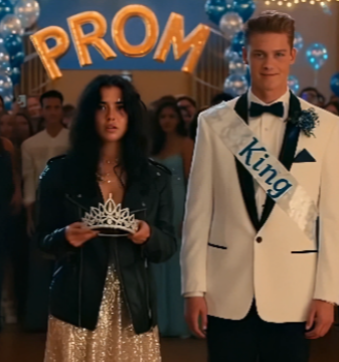
Everyone expected the Prom Queen to choose the Quarterback, but when the lights went down… She ran into the arms of the outcast everyone mocked.
Chapter 1: The Crown of Thorns
Vanessa Sterling adjusted the spaghetti strap of her silk dress, staring into the vanity mirror. The girl staring back was perfect. Not a hair out of place, not a pore visible under the airbrushed foundation, not a hint of the panic attack that was currently clawing at her throat. She was the undisputed ruler of Crestview High. She had the looks, the grades, the popularity, and the boyfriend—Chase, the linebacker with a jawline carved from granite and a personality as deep as a parking lot puddle.
To the 1,500 students at Crestview, Vanessa was royalty. To Vanessa, she was an inmate in a golden cage.
“V! You coming?” Chase’s voice boomed from downstairs, shaking the photos on her wall.
“Coming, babe!” she chirped back, the cheerfulness automatic, practiced. She grabbed her clutch, took a deep breath, and walked out of her room, leaving the real Vanessa behind in the mirror.
It was three months before Prom. The pressure was already suffocating. The campaign for Queen wasn’t just a tradition; it was a dynasty requirement. Her mother had been Queen. Her grandmother had been Queen. And now, Vanessa was expected to ascend the throne. But lately, the noise of the cafeteria, the incessant gossip, and Chase’s endless monologues about protein powder were becoming unbearable.
She needed an escape.
She found it on a Tuesday, during a free period. She had ducked into the old West Wing of the school, a section slated for renovation that nobody used. She was looking for a quiet place to hyperventilate in peace. Instead, she found the old auditorium stage.
And she wasn’t alone.
Sitting on the edge of the dusty stage, legs dangling into the orchestra pit, was Julian Blackwood.
Julian was the antithesis of Vanessa’s world. He wore oversized band hoodies, his hair was a jagged curtain of dyed black fringe that covered his eyes, and he rarely spoke. The rumors about him ranged from him being a vampire to him running a satanic cult in his basement. In reality, he was just… quiet.
He was strumming an acoustic guitar, battered and covered in stickers. He wasn’t playing the angry, discordant noise everyone assumed “emo kids” listened to. He was playing something intricate, melancholic, and hauntingly beautiful.
Vanessa froze in the shadows of the wings, listening. The melody seemed to wrap around her anxiety and soothe it.
Then, he stopped. “You breathe really loud for a ninja,” he said, not looking up.
Vanessa stepped into the light, cheeks flushing. “I… I was just…”
Julian looked up. His eyes were startlingly green under the black bangs, framed by a smudge of eyeliner. He blinked, recognizing her. “Oh. The Princess. Did you get lost on the way to the throne room?”
“It’s Vanessa,” she snapped, her defensive walls slamming into place.
“Okay, Vanessa,” he said, turning back to his guitar. “If you’re here to tell me I can’t be here, save it. Janitor let me in.”
“I’m not here to tell you anything,” she said, surprising herself by sitting down on a dusty crate a few feet away. “I just wanted… quiet.”
Julian paused, his fingers hovering over the fretboard. He looked at her, really looked at her, stripping away the reputation and the makeup. “Heavy is the head that wears the crown, huh?”
Vanessa let out a breath she felt like she’d been holding for three years. “You have no idea.”
Chapter 2: Shadows and Spotlights
That afternoon became a ritual. Every Tuesday and Thursday, while her friends thought she was at Student Council meetings, Vanessa was in the dusty West Wing.
It started with silence. Then, tentative questions. Julian was prickly at first, expecting her to mock him. But when he realized she was genuinely listening, he softened.
He introduced her to music that wasn’t on the Top 40 charts—The Cure, My Chemical Romance, old dashboard confessional tracks. He showed her his sketchbook, filled with charcoal drawings of the school that made the mundane hallways look like gothic cathedrals.
In return, Vanessa showed him the girl beneath the gloss. She admitted she hated football games. She confessed that she wanted to study literature, not business like her father wanted. She told him about the panic attacks.
“You’re an actor,” Julian observed one day, handing her one of his earbuds. “You’re playing the role of Vanessa the Prom Queen because you’re terrified the audience will boo the real you.”
“And what about you?” Vanessa countered, taking the earbud. “The black clothes, the hair, the ‘I hate the world’ vibe. Isn’t that a costume too? Armor to keep people away?”
Julian smirked, a rare expression that made Vanessa’s stomach do a strange flip. “Touché, Your Highness.”
They were opposites in every way. She smelled like expensive vanilla perfume; he smelled like clove cigarettes and old paper. She wore pinks and pastels; he wore fifty shades of black. But in the dark of the auditorium, they fit.
The shift happened in late April. It was raining. Vanessa had come in crying—Chase had forgotten their anniversary, and when she brought it up, he’d called her “high maintenance” in front of the entire cafeteria.
Julian didn’t say a word. He just set his guitar down, walked over to where she was curled up on the stage, and sat next to her. He awkwardly put an arm around her shoulders. Vanessa leaned into him, burying her face in his hoodie. It was rough and smelled like rain, and it was the safest she had ever felt.
“He’s an idiot,” Julian muttered into her hair. “He sees the trophy, not the girl.”
“I don’t know how to leave him,” she whispered. “Everyone expects us to win King and Queen. If I break up with him now, it’ll be a scandal. My mom will kill me.”
Julian pulled back, brushing a strand of perfect blonde hair out of her face. His fingers were calloused from guitar strings. “Who cares about the scandal, V? Who cares about the plastic crown? It’s high school. In five years, none of this matters. But you matter.”
He looked at her then, with an intensity that made her breath hitch. The distance between them vanished. Vanessa didn’t think; she just leaned in.
The kiss wasn’t like kissing Chase. Chase kissed like he was trying to win a point. Julian kissed her like she was something fragile and precious that he was terrified of breaking. It was electric, terrifying, and perfect.
Chapter 3: The Leak
They kept it secret. They had to. The social hierarchy of Crestview High was rigid. A Prom Queen didn’t date the Emo Kid. It would be social suicide for her, and physical suicide for him—Chase and his friends weren’t known for their tolerance.
But secrets in high school have a shelf life.
Two weeks before Prom, Vanessa left her phone unlocked on the cafeteria table while she went to the bathroom. Chase, suspicious of her recent distant behavior, went through her texts.
He found the thread with a contact saved as “J.”
See you at the sanctuary? I miss you. I love the song you wrote for me.
Chase didn’t make a scene immediately. He waited. He followed her.
The confrontation happened the next day in the main hallway, right during the passing period. Julian was at his locker, putting away a textbook. Chase slammed the locker door shut, hard enough to dent the metal.
“So,” Chase snarled, his voice echoing, drawing a crowd instantly. “This is the guy? The freak?”
Vanessa froze. She was at the other end of the hall, flanked by her posse. She saw Julian cornered by Chase and three other varsity players.
“Chase, stop!” Vanessa cried out, pushing through the crowd.
“Shut up, Vanessa!” Chase yelled, spinning around, his face red. “You’ve been cheating on me with this? This vampire wannabe?”
He shoved Julian. Julian stumbled back, dropping his books. He didn’t fight back; he knew the odds. He just looked at Vanessa.
The hallway went silent. Hundreds of eyes turned to Vanessa. The Queen. The icon.
“Tell me it’s not true,” Chase demanded, stepping closer to her. “Tell me you’re not hooking up with this loser.”
This was the moment. The script required her to laugh. To say it was a joke. To save her reputation. To keep the crown.
Vanessa looked at Chase, trembling with rage. Then she looked at Julian. He was clutching his arm, looking at the floor, expecting the betrayal. He was already resigning himself to being the punchline.
“He’s not a loser,” Vanessa said, her voice shaking but audible.
The crowd gasped.
“He listens to me,” Vanessa continued, tears pricking her eyes. “He knows who I am. You don’t even know my favorite color, Chase.”
“It’s pink,” Chase scoffed.
“It’s yellow!” she screamed. “It’s always been yellow! I just wear pink because you like it!”
She turned to Julian, extending a hand. But before she could reach him, Chase laughed—a cruel, barking sound. “Fine. You want the freak? You can have him. Have fun being social leprosy, Vanessa. You’re done.”
He stormed off. The crowd murmured, phones recording everything.
Julian looked at her, eyes wide. “You didn’t have to do that.”
“Yes,” she said, reaching for his hand. “I did.”
Chapter 4: The Fallout
The next two weeks were hell.
Vanessa was exiled. Her friends stopped texting. She was uninvited from parties. Whispers followed her everywhere. “She went crazy.” “Slumming it.” “Mental breakdown.”
But for the first time, she was free. She ate lunch with Julian behind the bleachers. She wore jeans and a t-shirt to school. She stopped wearing the heavy makeup.
However, Julian was pulling away. He felt the weight of her sacrifice.
“You gave up everything,” he said one night in his car, parked overlooking the town. “You were the Queen, V. Now you’re… with me.”
“I have everything I want,” she insisted.
“Do you?” Julian asked sadly. “Prom is Saturday. You have a dress that cost more than my car. You were supposed to be on that stage. Now, you’re not even going.”
“I don’t care about Prom.”
“You do,” he said. “I see it in your face. You worked for that crown for three years. I took that from you.”
“You didn’t take anything. You gave me back to myself.”
But Julian wouldn’t let it go. On Friday, the day before Prom, he broke up with her.
“I can’t be the reason you destroyed your life,” he told her, eyes red-rimmed. “Go back to them, V. Apologize to Chase. Get your crown. You belong there. I belong in the shadows.”
He walked away, leaving her heartbroken in the parking lot.
Chapter 5: Prom Night
Prom night at Crestview High was a glitter-bombed spectacle. The gym was transformed into ‘A Night in Paris.’ Chase was there, smug, campaigning for King solo, with a new girl on his arm.
Vanessa wasn’t there. She was in her bedroom, staring at the $600 dress hanging on her door.
She thought about Julian. She thought about his self-loathing, his belief that he wasn’t good enough for her, that their worlds were too different.
Screw the script, she thought.
She put on the dress. But she didn’t do the perfect updo. She left her hair down, messy and wild. She didn’t put on the heels; she pulled on her black Converse. And she grabbed her leather jacket—the one Julian had said looked cool on her.
She drove to the school.
She walked into the gym just as Principal Skinner was tapping the microphone. “And now, the moment you’ve all been waiting for. The announcement of your Prom King and Queen.”
The room went silent. Vanessa stood at the back entrance. People started to notice her. The whispers began, spreading like a wave. She’s here.Look at what she’s wearing.
“For Prom King,” the Principal announced. “Chase Miller!”
Cheers erupted from the jocks. Chase strutted to the stage, beaming.
“And for Prom Queen…” The Principal hesitated, looking at the card. The voting had been done days ago, before the breakup was finalized, before the fallout settled. “Vanessa Sterling.”
The applause was confused, scattered. Chase looked furious.
Vanessa walked through the crowd. The sea of students parted. She walked up the stairs to the stage. She took the microphone from the stunned Principal. She accepted the plastic tiara.
She looked out at the crowd. At the faces that had judged her, worshipped her, then cast her aside.
“I spent three years wanting this,” Vanessa said into the mic. The feedback whined. “I thought this crown meant I was special. I thought if I was perfect, I’d be happy.”
She looked at Chase, who was glaring at her.
“But perfection is a prison,” she said. “And I’m done serving time.”
She took the tiara off her head.
“Chase, you can keep the kingdom,” she said. “It’s all fake anyway.”
She dropped the tiara. It clattered loudly on the wooden stage.
Then, she ran.
She ran off the stage, past the stunned teachers, out the double doors, and into the cool night air. She didn’t stop at her car. She kept running across the parking lot toward the one place she knew he would be.
The football field bleachers were empty, except for a figure sitting on the top row, smoking a clove cigarette, looking at the stars.
Julian stood up as he saw the girl in the ballgown and leather jacket sprinting across the grass.
“V?” he called out.
She reached the bottom of the bleachers, breathless, mascara running. “I won,” she yelled up at him.
“What?”
“I won Prom Queen!” she shouted. “And I left the crown on the stage!”
Julian ran down the steps, his coat flapping behind him. He stopped on the last step, eye-level with her. “Why would you do that?”
“Because,” she said, grabbing the lapels of his jacket. “My King doesn’t wear a varsity jacket. He wears eyeliner and listens to The Cure.”
Julian stared at her, a slow smile spreading across his face, breaking the brooding mask he wore for the world. “You are insane.”
“I’m in love,” she corrected.
He jumped the last step and crashed into her. He kissed her, right there on the fifty-yard line, under the floodlights of the parking lot.
“So,” Julian whispered against her lips. “What now, Your Highness?”
Vanessa smiled, pulling his hood over his head and intertwining her fingers with his. “Now? Now we go get burgers. I’m starving, and this dress is really tight.”
They walked away from the school, hand in hand, leaving the music, the drama, and the expectations behind them. The Prom Queen and the Emo Nerd. It wasn’t the ending everyone expected, but it was the only one that was real.
He thought he was just meeting her strict father for dinner… Until the dad locked the door and placed a thick police dossier on the table.
The gravel crunched beneath the tires of Liam’s 2010 Honda Civic, a sound that seemed deafeningly loud in the pristine silence of the neighborhood. This wasn’t just a neighborhood; it was an estate. The kind of place where the lawns were manicured with scissors and the security cameras outnumbered the residents.
“Babe, stop sweating,” Maya said, placing a comforting hand on his knee. “He’s just a dad. He’s not going to eat you.”
“Maya, your dad isn’t just a dad,” Liam replied, his voice tight. “He’s a retired General who currently runs a private security firm. There is a distinct difference.”
Maya laughed, a light, airy sound that usually calmed him down. Today, it did nothing. “He’s a teddy bear once you get to know him. Just be yourself. Don’t lie. He hates liars.”
Don’t lie. That was the one instruction Liam wasn’t sure he could follow. Not because he was a bad person, but because his past was a jagged collection of mistakes he had spent the last five years burying under a pile of hard work, night classes, and a new identity.
He parked the car. The house loomed over them—a Georgian colonial beast of brick and pillars. As they walked to the door, Liam wiped his palms on his trousers. He checked his reflection in the brass knocker. He looked respectable. Blue button-down, chinos, hair combed. He looked like an accountant. He looked like someone who had never hotwired a car in his life.
The door swung open before they even knocked.
Standing there was a man who looked like he had been carved out of granite. General Marcus Thorne was six-foot-four, with silver hair cropped close and eyes that looked like they could spot a sniper in a blizzard. He wore a casual polo shirt, but on him, it looked like a uniform.
“Daddy!” Maya squealed, hugging him.
The General didn’t smile. He patted her back gently, his eyes never leaving Liam’s face. “Maya.” Then, he extended a hand to Liam. It was the size of a catcher’s mitt.
“Liam,” the General said. It wasn’t a question.
“Sir. It’s an honor to meet you,” Liam said, shaking the hand. He kept his grip firm, remembering the advice he’d read online. Don’t show weakness.
“We’ll see,” Thorne said cryptically. “Come in. Dinner is in ten minutes.”
The interior of the house was intimidatingly spotless. They moved to the dining room, a cavernous space with a mahogany table long enough to land a plane on. Maya sat on one side, Liam on the other. The General sat at the head.
Dinner was a roast, served by a silent housekeeper. For the first twenty minutes, the only sounds were the scraping of silverware and Maya’s valiant attempts to make conversation.
“So, Liam,” Thorne finally spoke. His voice was a deep rumble that vibrated through the table. “Maya tells me you work in logistics.”
“Yes, sir. I manage the supply chain for a mid-sized tech firm downtown.”
“Logistics,” Thorne repeated, cutting a piece of meat with surgical precision. “Requires attention to detail. Organization. A clean record.”
Liam swallowed a lump of potatoes that suddenly felt like concrete. “Yes, sir.”
“And where are you from originally, Liam?”
“Ohio, sir. A small town outside of Dayton.”
“Dayton,” Thorne mused. “Good people in Ohio. hardworking.” He paused, setting his knife down. “I have a friend in the Dayton PD. Chief Miller. Ever hear of him?”
Liam’s heart hammered against his ribs like a trapped bird. “No, sir. I didn’t have many run-ins with the police.”
The General stared at him. The silence stretched, thin and brittle, until it snapped.
“Maya, sweetheart,” Thorne said, his voice surprisingly gentle. “Would you go to the kitchen and ask Mrs. Gable for the dessert wine? The vintage one in the cellar.”
“Now? We haven’t finished the roast,” Maya said, confused.
“Please,” Thorne said. It wasn’t a request.
Maya looked between them, sensing the sudden drop in atmospheric pressure. “Okay. I’ll be right back.”
She left the room. The moment the kitchen door swung shut, the temperature in the dining room seemed to drop ten degrees.
Thorne reached under the table. Liam braced himself, half-expecting a weapon. Instead, Thorne pulled out a thick, manila folder. He tossed it onto the mahogany table. It slid across the polished surface and stopped inches from Liam’s plate.
“Open it,” Thorne commanded.
Liam’s hands trembled slightly as he opened the cover. The first thing he saw was a mugshot. It was him. Younger, angrier, with a split lip and a bruised eye. The name under the photo didn’t say Liam Davis. It said Leo Marcetti.
Liam closed his eyes. “Sir, I can explain.”
“Grand theft auto,” Thorne read from memory, not even looking at the file. “Possession with intent to distribute. Assault on a police officer. You were eighteen.”
“I was a kid,” Liam whispered. “I was stupid.”
“You were a criminal,” Thorne corrected. “And now you’re in my house, eating my food, dating my daughter under a false name.”
“I legally changed my name,” Liam said, his voice gaining a desperate edge. “I served my time. Two years in juvenile detention, three years on probation. I finished school inside. I got my degree the hard way. I changed my name because I wanted a fresh start, not to hide from the law. I haven’t even received a parking ticket in seven years.”
Thorne leaned forward, his elbows on the table. “You think a piece of paper changes who you are? You think because you put on a nice shirt and learned to use a salad fork, the rot is gone?”
“It’s not rot,” Liam said, meeting the General’s eyes for the first time. “It’s a scar. And yes, I think people can change. I work hard. I love your daughter. I would never hurt her.”
“Men like you always hurt the people around them,” Thorne said coldly. “It’s in your nature. Chaos follows you.”
“That’s not true.”
“Isn’t it?” Thorne flipped the file open to a specific page. “Two weeks ago. You were seen arguing with a man outside your apartment complex. A man identified as Marcus ‘Recall’ Jones. A known associate of the Marcetti crime family.”
Liam went cold. “He… he found me. He wanted money. I told him to get lost. I told him I was out.”
“So you say,” Thorne sneered. “Or maybe you’re looking for a new score. Maybe you found a rich girl with a naive heart and a father with deep pockets.”
Liam stood up, his chair scraping loudly against the floor. “I don’t want your money. I don’t care who you are. I love Maya. But I won’t sit here and be interrogated for mistakes I paid for a decade ago.”
“Sit down,” Thorne barked.
“No,” Liam said. “I’m leaving. I’ll tell Maya myself. I won’t let you twist this.”
“I said, sit down!” Thorne slammed his hand on the table, rattling the crystal glasses.
Suddenly, the lights in the dining room flickered and died. The entire house plunged into darkness.
“What the—” Thorne started.
A heavy thud came from the hallway, followed by the sound of glass shattering in the kitchen.
Maya screamed.
In the dark, the General shifted instantly from angry father to combat veteran. “Stay here,” he hissed at Liam.
“No,” Liam moved toward the door. “Maya is in the kitchen.”
“I have a weapon in my study, I need to—”
“There’s no time!” Liam yelled. He didn’t think. He didn’t calculate. He just ran.
He sprinted through the dark hallway toward the kitchen. He could hear struggling. Grunts. The crash of pots and pans.
Liam burst through the kitchen doorway. The emergency backup lights flickered on, casting a dim, eerie green glow over the room.
Two men in ski masks were there. One had Maya in a headlock, a knife pressed to her throat. The other was shoving silverware into a duffel bag.
“Let her go!” Liam shouted.
The man holding Maya laughed. “Back off, hero. Or she bleeds.”
Thorne appeared behind Liam, but he was unarmed. The study was too far. The intruders had the leverage.
“Take whatever you want,” Thorne said, his voice calm but dangerous. “Just let my daughter go.”
“We’re taking the silver and the girl,” the man with the knife sneered. “Insurance.”
Liam looked at the man. He looked at the stance, the way he held the knife. He recognized the tattoo on the man’s wrist just peeking out from the sleeve. A spiderweb.
Recall Jones.
The past had come knocking, just like Thorne said. But Thorne was wrong about one thing. It wasn’t rot inside Liam. It was experience.
“Recall,” Liam said, his voice dropping an octave. “You’re holding the knife wrong.”
The man froze. “What?”
“You’re holding it like a street punk,” Liam stepped forward, hands raised. “You cut her, you get blood on the floor, you slip, you go down. The General behind me? He’s ex-special forces. He kills you with his bare hands before you hit the ground. Me? I’m just the guy who knows you’re a coward.”
“Shut up, Leo!” the man shouted, ripping his mask off. It was Jones. “I told you you owed us!”
“I don’t owe you anything,” Liam said, inching closer. “But you owe me. Remember the stash house? 2018? Who pulled you out before the cops breached?”
Jones hesitated. The grip on Maya loosened by a fraction of an inch.
That was all Liam needed.
He didn’t swing a punch. He didn’t try a karate chop. He tackled. He launched himself like a linebacker, driving his shoulder into Jones’s midsection.
They crashed into the center island. The knife skittered across the floor.
Maya scrambled away, gasping.
Jones was scrapping, punching Liam in the ribs, aiming for the face. Liam took the hits. He tasted blood. He grabbed a heavy cast-iron skillet from the drying rack and swung it with a primal roar.
CLANG.
Jones went limp.
The second intruder realized the odds had shifted. He bolted for the back door.
“Freeze!”
The boom of a shotgun echoed through the kitchen. General Thorne stood in the doorway, a mossberg pump-action leveled at the fleeing man. The intruder stopped dead, raising his hands.
Silence returned to the house, broken only by Maya’s sobbing and Liam’s heavy breathing. Liam leaned against the counter, clutching his ribs. He looked at Jones, unconscious on the floor.
He looked up to see Thorne lowering the shotgun. The General looked at the intruder on the floor, then at Liam, then at the file that was still sitting on the dining room table in the other room.
Police sirens wailed in the distance.
Two hours later.
The police had come and gone. Statements were given. Jones and his accomplice were in custody. Maya was sitting on the living room sofa, wrapped in a blanket, drinking tea.
Liam stood on the porch, staring at the night sky. His lip was swollen again, just like in his mugshot. He heard the door open behind him.
“You should put ice on that,” Thorne’s voice said.
Liam didn’t turn around. “I’m going to head out, sir. I figure… I figure Maya needs some space. And you were right. Chaos follows me.”
“I was wrong,” Thorne said.
Liam turned. The General was holding two glasses of amber liquid. He held one out.
“It wasn’t chaos that followed you here, Liam. It was a test. And you didn’t run.”
Liam took the glass. “I lied to you. About who I was.”
“You omitted,” Thorne corrected. “And tonight, I saw who you are. You’re not Leo Marcetti. Leo Marcetti would have run out the front door when the lights went out. Or joined them.”
Thorne took a sip of his drink. “I saw the way you moved in there. You took the hit to get the weapon away from my daughter. You put yourself between the threat and the innocent.”
Thorne stepped closer, his face illuminated by the porch light. The harsh lines of his face seemed to soften.
“I have that dossier,” Thorne said.
“I know,” Liam said.
“I’m going to burn it,” Thorne said. “As far as I’m concerned, Leo Marcetti died a long time ago. Liam Davis, however… he’s welcome for dinner anytime.”
Liam felt the tension in his chest finally release. “Thank you, sir.”
“Don’t call me Sir,” Thorne grunted, turning back to the door. “Call me Marcus. But if you ever hurt her, I won’t need a file to end you.”
“Understood,” Liam managed a small, painful smile.
“Good. Now get inside. Maya is asking for you. And Liam?”
“Yeah?”
“Next time, work on your right hook. You left yourself wide open.”
My ex-Marine father disowned me for dating a “weak” gamer… But he had no idea that the “loser” he kicked out was the only person capable of saving his life.
The sound of silverware clinking against china was the only thing filling the silence in the dining room, but inside my head, it sounded like a jackhammer.
I looked across the table at Arthur. He was trying so hard. He was sitting up straight, wearing the tie I’d bought him, carefully cutting his steak the way my mother had taught me. But I could see the sweat beading on his hairline. His hand trembled slightly as he lifted the fork.
Then, I looked at my dad. Frank “The Tank” Miller. Retired Marine. Retired construction foreman. A man who measured worth in calluses and horsepower. He wasn’t eating. He was staring at Arthur like a wolf studying a wounded rabbit.
“So,” Dad grunted, his voice like gravel in a mixer. “Chloe tells me you work with… computers.”
Arthur swallowed hard. “Yes, sir. I’m a cybersecurity analyst. I mostly work on preventing data breaches for—”
“Video games,” Dad interrupted, a smirk curling his lip. “She said you play video games.”
“I… well, yes, in my spare time. But my job is—”
“Spare time,” Dad scoffed, dropping his fork. It clattered loudly. “When I was your age, I didn’t have spare time. I was building bridges. I was carrying eighty-pound packs twelve miles before breakfast. Let me see your hands, son.”
“Dad, stop,” I whispered, my stomach turning.
“I said, let me see your hands,” Dad commanded.
Arthur hesitated, then slowly extended his hands over the centerpiece. They were pale, slender, and smooth. The hands of a pianist, or a coder.
Dad laughed. It was a cruel, barking sound. “Soft. Marshmallow soft. You’ve never done a day of real work in your life, have you? Can you change a tire? Can you throw a punch? Can you protect my daughter if someone kicks down the door?”
“I love Chloe, sir,” Arthur said, his voice quiet but steady. “I take care of her.”
“You couldn’t take care of a goldfish,” Dad spat, standing up. He loomed over the table. “Chloe, I told you I wanted you to bring home a man. Not a boy who needs a nightlight. This is an insult.”
“Frank, please,” my mom pleaded from the other end of the table, looking terrified.
“No!” Dad slammed his fist on the table. The wine glasses jumped. “I’m done watching you throw your life away on losers. He leaves. Now. And if you go with him, don’t bother coming back. No daughter of mine is going to marry a coward.”
I stood up, my legs shaking. I looked at Arthur, who looked humiliated, his face burning red. Then I looked at my father—a man I had worshiped my whole life, a man who taught me how to fish and how to drive, now twisted by a toxic pride I couldn’t understand.
“Grab your coat, Arthur,” I said, my voice cracking.
“If you walk out that door, Chloe,” Dad warned, his face purple, “you’re out of the will. You’re out of this family. You’re dead to me.”
I grabbed Arthur’s hand. It was warm and firm. “Then I guess I’m an orphan.”
We walked out. I didn’t look back.
Three years went by.
Three years of silence. I sent Christmas cards; they came back “Return to Sender.” I called on birthdays; it went straight to voicemail. Mom would sneak call me sometimes from the grocery store, whispering updates, but she was too afraid of Dad’s wrath to visit.
Life with Arthur was wonderful, though different from how I was raised. He didn’t fix the sink with a wrench; he hired a plumber. He didn’t hunt for dinner; he ordered Thai food. But he was kind. He listened. And he was brilliant. He launched a startup that focused on forensic accounting and digital asset protection. We weren’t just comfortable; we were thriving.
But there was always a hole in my heart where my father used to be.
Then, the call came.
It was Mom. She wasn’t whispering this time. She was sobbing.
“Chloe, you have to come. It’s your father.”
“Is he… is he sick?”
“No. It’s worse. He’s going to lose everything. The house, the truck, the pension. Everything.”
I drove over immediately. Arthur insisted on driving me, though I told him to stay in the car. I didn’t want him subjected to more abuse.
When I walked into my childhood home, it felt like a funeral. The house was dark. Boxes were half-packed in the hallway. Dad was sitting at the kitchen table, his head in his hands. He looked twenty years older. The “Tank” had crumbled.
“What happened?” I asked.
Dad didn’t look up. Mom answered, wiping her eyes with a tissue. “A scam. An investment scam. Someone called him, pretended to be his old unit commander. Said there was a private contractor opportunity. Dad transferred… everything. His savings, the equity from the house… almost $400,000.”
“I went to the police,” Dad whispered, his voice broken. “They said the money is in an offshore account. Untraceable. Gone.”
He looked up at me, his eyes red-rimmed and watery. “I’m a fool, Chloe. I thought I was being smart. I thought I was providing. Now I can’t even put a roof over your mother’s head.”
For the first time in my life, I saw fear in my father’s eyes. Not the adrenaline of combat, but the cold, crushing fear of helplessness. The strong man, the protector, had been defeated by an invisible enemy he couldn’t punch or shoot.
“Let me make a call,” I said.
I went out to the driveway. Arthur was waiting, typing on his laptop.
“They lost everything, Arthur. It was a wire fraud scam.”
Arthur closed his laptop. He didn’t look smug. He didn’t say ‘I told you so.’ He just asked, “Do they have the transaction logs?”
“I think so.”
“Bring me inside.”
“Arthur, he—”
“Chloe. Bring me inside.”
We walked in. Dad stiffened when he saw Arthur. Even at his lowest, the prejudice was there. “What is he doing here? Here to laugh at the old man?”
Arthur ignored him. He sat down at the table, opened his laptop, and cracked his knuckles. “Mr. Miller, I need the routing numbers and the emails you exchanged with them. Now.”
Dad blinked, confused by the authority in Arthur’s voice. “It’s gone, kid. The police said—”
“The police deal with jurisdiction. I deal with code. Give me the laptop.”
For the next four hours, the kitchen was silent except for the furious clacking of Arthur’s keyboard. Dad sat there, watching the “weakling” work. Arthur was in a trance—screens of cascading code, maps appearing and disappearing, command prompts flashing green and black.
“Got you,” Arthur muttered.
“What?” Dad asked, leaning in.
“They used a double-blind VPN, but they got lazy with the packet encryption on the third hop,” Arthur said, speaking a language Dad didn’t understand. “They aren’t in Nigeria. They’re in Florida. And they haven’t washed the money yet. It’s sitting in a holding account pending a crypto conversion.”
Arthur picked up his phone. “I’m calling a contact at the FBI Cyber Division. I did some consulting for them last year. If we freeze the asset now, we can claw it back.”
Dad watched, mouth agape, as Arthur—the man with the “marshmallow hands”—commanded the attention of federal agents on the phone. He gave them coordinates, IP addresses, and hash keys. He was ruthless. He was precise. He was a weapon.
Two days later, the money was back in Dad’s account.
We were standing on the porch. The moving boxes were being unpacked.
Dad walked out. He looked at Arthur, really looked at him, for the first time. He looked at the soft hands that had just pulled his entire life out of a fire.
“I can’t pay you,” Dad said gruffly.
“I didn’t do it for money,” Arthur replied, closing his laptop bag. “I did it because you’re family. Whether you like it or not.”
Dad looked down at his own calloused hands, then at Arthur’s. He took a deep breath, his pride fighting a losing battle with his gratitude.
“I said you couldn’t protect her,” Dad said, his voice thick. “I said you were weak because you couldn’t fight like me.”
“I can’t fight like you, Frank,” Arthur said. “But the world has changed. The wolves don’t come to the door anymore. They come through the wires. And in that world? I’m the tank.”
Dad let out a breath that sounded like a laugh, or maybe a sob. He extended his hand.
“Thank you,” Dad said.
Arthur shook it. Dad didn’t squeeze too hard this time.
“Come inside,” Dad said, stepping back to hold the door open. “I bought steaks. And… Arthur? You can teach me how to set up that firewall thing.”
“Sure, Frank,” Arthur smiled. “But first, show me how to sharpen a knife properly.”
She mocked his broken English in front of her rich friends… But when her father arrived, she realized the “waiter” held her family’s future in his hands.
The chandelier light fractured against the polished wine glasses of La Esperanza, one of the most exclusive restaurants in the city. For Mateo, tonight was supposed to be a favor. His father, the owner, was short-staffed due to a flu sweeping through the kitchen crew, and Mateo—despite having just flown in from a grueling architectural conference in Zurich—had rolled up his sleeves, put on the white vest, and stepped onto the floor.
He wasn’t just a waiter, though he wore the uniform with pride. Mateo was a partner in the business and a renowned architect in his own right, but he believed no job was beneath him, especially when it came to the family legacy.
At table four, the energy was toxic.
Vanessa sat there like a queen holding court, surrounded by two friends who laughed too loudly and a boyfriend who looked like he wanted to be anywhere else. Vanessa was twenty-two, dressed in a gown that cost more than most people’s cars, and she was currently staring at the menu with disdain.
“Water,” she snapped as Mateo approached, not bothering to look up. “And make it sparkling. I don’t want tap water.”
“Certainly, Miss,” Mateo said. His accent was thick, a blend of his childhood in Michoacán and his teenage years in Mexico City, before he moved to the States for his Master’s degree. “We have San Pellegrino or—”
“I don’t care about the brand, just get it,” she interrupted, waving a manicured hand dismissively.
Mateo nodded, his face a mask of professional calm. “Right away.”
When he returned with the water and began to take their dinner orders, the situation deteriorated. Vanessa pointed at the ‘Mole Negro’ on the menu.
“Is this… spicy?” she asked, wrinkling her nose.
“It has a complexity of chiles, Miss,” Mateo explained, his voice soft and polite. “It is rich, with chocolate and spices. Not… how do you say… burning hot, but warm in flavor.”
Vanessa giggled, looking at her friends. “God, do you hear that? ‘Com-plex-i-ty.’ Did you learn that word today?”
Her friend, Jessica, snickered. “Vanessa, stop.”
“What?” Vanessa shrugged. “I just want to know what I’m eating, and I can barely understand him. It’s like, if you’re going to work in a high-end place, learn the language, right?”
Mateo tightened his grip on the notepad behind his back. He spoke four languages fluently—Spanish, English, French, and Italian—but when he was tired, or nervous, his native accent naturally deepened. “I apologize if I was unclear. The dish is savory and mild.”
“Savory,” she mimicked his accent, exaggerating the vowels until it sounded cartoonish. “Sa-vo-ry. Can you say ‘burrito’? Do you have those? Or is that too ‘complex’?”
The table went silent. Even the other diners nearby shifted uncomfortably.
“We do not serve burritos, Miss. This is Oaxacan fine dining,” Mateo said, his voice dropping an octave, losing its warmth.
“Whatever,” she rolled her eyes. “Just bring me the chicken. And send someone else over to pour the wine. Someone who can actually speak English.”
Mateo looked at her for a long second. In that moment, he could have kicked her out. He could have told her he owned the building. He could have told her that the ‘chicken’ she ordered was a recipe his grandmother perfected over fifty years. But he didn’t. He simply nodded.
“As you wish.”
He walked to the back, his jaw set. His father, don Hector, saw him. “Mijo? Everything okay?”
“Fine, Papi. Just a difficult table. I’m handling it.”
Twenty minutes later, the atmosphere in the restaurant shifted. The front doors opened, and a man in a sharp grey suit walked in, looking anxious. It was Mr. Sterling—Vanessa’s father. He was a real estate mogul known for his aggression, but tonight, he looked like a man walking to the gallows.
He spotted Vanessa and walked over.
“Daddy!” Vanessa beamed, oblivious to his mood. “You’re late! We already ordered. The service here is tragic, by the way. The waiter can barely—”
“Quiet, Vanessa,” Mr. Sterling hissed, wiping sweat from his forehead. “Not now.”
“What’s wrong?” she asked, offended.
“I’m here to meet the owner of the structural firm. The one holding the contract for the new Downtown project. If I don’t sign this deal tonight, the company goes under. We’re leveraged to the hilt, Nessie. I need this.”
Vanessa blinked. “Okay? So buy him a drink.”
“It’s not that simple. He’s brilliant, but he’s notoriously particular about who he works with. He values ‘integrity’ and ‘respect’ above money. I was told to meet him here.” Mr. Sterling scanned the room frantically. “I don’t see anyone sitting alone.”
At that moment, Mateo approached the table with the tray of food. He placed the Mole Negro in front of Vanessa.
“Here is your chicken, Miss,” Mateo said calmly.
Vanessa groaned, rolling her eyes at her father. “This is the guy, Dad. The one I was telling you about. He’s practically illiterate.” She turned to Mateo, speaking slowly and loudly. “Can… we… get… some… napkins?”
Mr. Sterling looked up, annoyed at the interruption, ready to wave the waiter away. But when his eyes locked onto Mateo’s face, the color drained from his skin.
Mr. Sterling stood up so fast his chair scraped loudly against the floor.
“Mr… Mr. Ramirez?” Sterling stammered.
Mateo looked at the older man, his expression unreadable. He didn’t look like a waiter anymore. He looked like a king in disguise. “Good evening, Mr. Sterling. You are ten minutes late.”
Vanessa froze, her fork halfway to her mouth. She looked from her father to the waiter. “Daddy? You know the help?”
“Shut up, Vanessa!” Sterling barked, his voice cracking. He turned back to Mateo, his hands shaking. “I am so sorry. Traffic was… I didn’t realize you worked here.”
“I don’t just work here,” Mateo said, smoothing the front of his vest. “I own La Esperanza with my father. And when I am not designing skyscrapers that save men like you from bankruptcy, I enjoy serving the food my family creates.”
The silence at the table was deafening. Vanessa’s face turned a bright, humiliating shade of crimson. Her friends looked down at their plates, terrified to make eye contact.
Mateo turned his gaze to Vanessa. It wasn’t angry; it was pitying.
“Your daughter had some concerns about the complexity of the menu,” Mateo said smoothly, his English perfect, his tone cutting like a diamond blade. “And she seemed to have trouble understanding my accent. I worry that if we were to work together on the Downtown project, Mr. Sterling, the communication barrier might be too great. After all, I am just a Mexican who cannot speak English.”
Mr. Sterling looked like he was about to have a heart attack. “Mr. Ramirez, please. She’s young, she’s foolish. She didn’t know.”
“She didn’t know I was powerful,” Mateo corrected him gently. “That is the problem. She treated me with disrespect not because of who I am, but because of who she thought I was. That tells me everything I need to know about the values of the Sterling family.”
Mateo placed the bill on the table. It was zeroed out.
“Dinner is on the house,” Mateo said. “We do not accept money from people who do not respect our culture. Please, finish your meal. But once you leave, do not return. And as for the contract…”
Mateo paused, looking Mr. Sterling in the eye.
“I think I will find a partner who understands that class has nothing to do with language.”
Mateo turned on his heel and walked back toward the kitchen.
“Wait! Mr. Ramirez!” Sterling shouted, but Mateo didn’t look back.
Vanessa sat in the ruins of her social status, the ‘savory’ chicken growing cold in front of her, as her father put his head in his hands and began to weep.