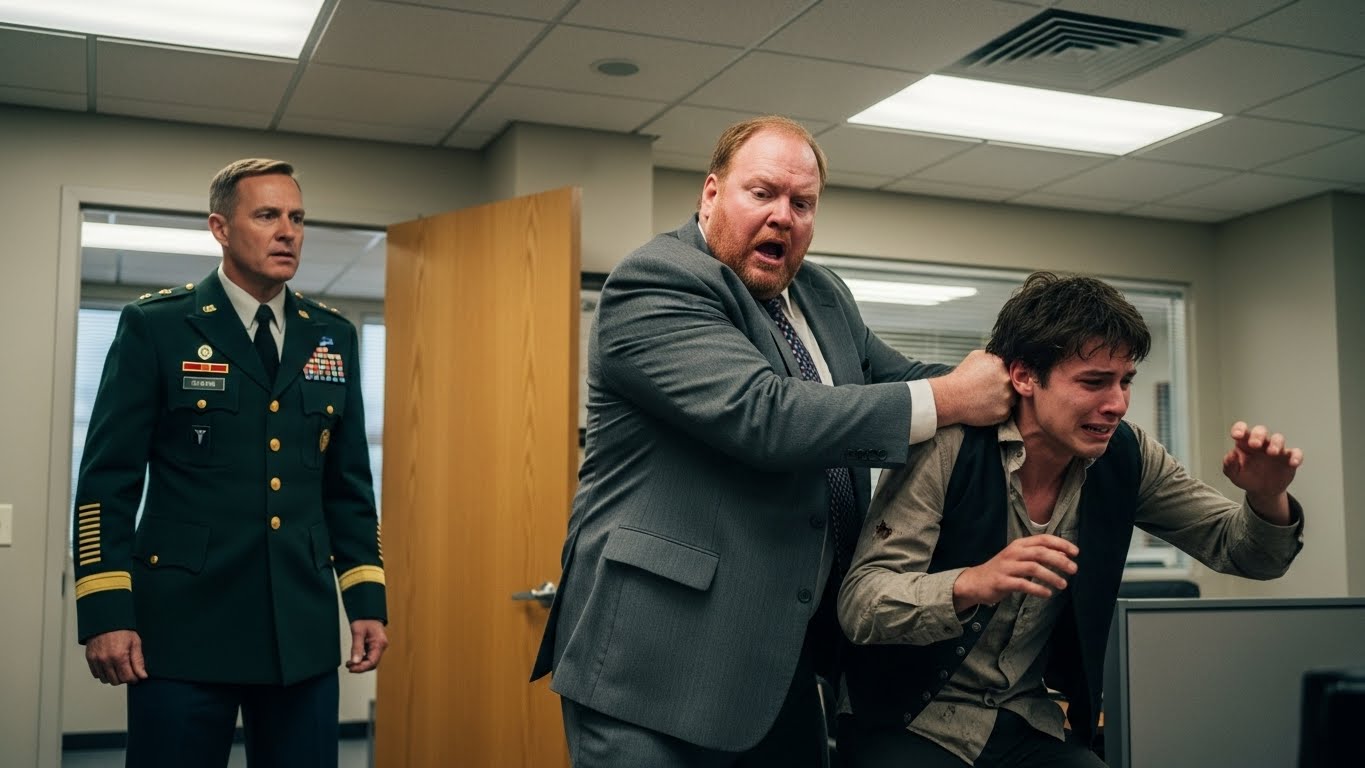
A store manager was dragging a starving orphan by his hair for stealing a loaf of bread… But his world collapsed when a 4-star General walked in and claimed the boy as his own.
The town of Oak Creek was the kind of place that forgot you existed if you didn’t have a zip code or a last name that meant something at the local country club. For ten-year-old Leo, Oak Creek wasn’t a town; it was a series of obstacles designed to keep him cold and hungry. November had arrived with a vengeful bite, turning the damp air into a serrated blade that cut through his oversized, moth-eaten wool coat.
Leo lived in the “crawlspace,” a hollowed-out concrete nook beneath the Miller Bridge. It was a place of shadows and damp stone, where he kept his only treasures: a plastic soldier with a missing arm and a tattered photograph of a woman he barely remembered, whose smile was the only warmth he knew. Hunger, however, was his most constant companion. It wasn’t a sharp pain anymore; it was a dull, rhythmic ache, a drumbeat in his marrow that started every afternoon and peaked when the sun dipped below the horizon.
He had rules. He wasn’t a “thief”—not in his heart. He was a collector of things the world had deemed unnecessary. But “Miller’s Quality Foods” was different. It was a cathedral of abundance, a brightly lit sanctuary where the air smelled of roasting rotisserie chickens and cinnamon-dusted pastries. To Leo, the store was a cruel joke played by the universe, a place where people bought more than they could ever eat while he contemplated the nutritional value of a discarded apple core.
On this Tuesday, the hunger won.
Leo slipped through the automatic doors, timed perfectly to the entrance of a boisterous family of five. He was a shadow, a glitch in the peripheral vision of the shoppers. He moved past the produce, past the artisan cheeses, straight to the back—the day-old bread bin. There it was: a loaf of sourdough, slightly hardened but smelling of yeast and hope. It was marked ninety-nine cents. To Leo, it might as well have been priced in gold bars.
He tucked the loaf inside his coat, the plastic crinkling like a gunshot in his ears. His heart hammered against his ribs—a trapped bird desperate for flight. He turned toward the exit, his eyes fixed on the gray sky visible through the glass doors. Ten feet. Five feet.
Then, the world tilted.
A hand, thick and calloused like a meat hook, clamped onto the back of Leo’s neck. A second later, that hand migrated to his hair, winding the matted strands around thick fingers.
“Gotcha, you little rat,” a voice hissed, dripping with a strange, fermented satisfaction.
It was Mr. Henderson, the store manager. Henderson was a man who felt small in his own life, and he compensated by making others feel microscopic. He didn’t just want to stop a theft; he wanted to perform an execution of dignity. He yanked Leo backward, and the boy let out a sharp, strangled cry as his feet flew out from under him. The sourdough loaf tumbled to the floor, rolling pathetically across the linoleum.
“Please!” Leo gasped, his hands clawing at Henderson’s wrist to ease the tension on his scalp. “I’m sorry! I’ll put it back! I’ll work for it!”
“You’ll work for it in a cell,” Henderson sneered. He didn’t lead Leo to the office. He began to drag him through the center of the store, toward the crowded checkout lines. He wanted an audience. He wanted the “decent” people of Oak Creek to see him as a guardian of their suburban peace.
“Look at this!” Henderson shouted, his voice echoing off the high ceilings. The hum of commerce died instantly. “This is the rot that’s creeping into our town! This little gutter-snipe thinks he can just walk in and take what your hard-earned money pays for!”
Leo’s face was hot with a shame so deep it felt like it was staining his bones. He saw the shoppers. Mrs. Gable, a regular who always wore pearls, looked away with a disgusted curl of her lip. Others watched with a morbid, silent curiosity, their phones beginning to rise like small glass tombstones to record his humiliation.
“Mr. Henderson, stop it!” Sarah, a young cashier, cried out. Her voice was trembling. “He’s just a child. You’re hurting him!”
“Stay out of it, Sarah, or you can join him in the unemployment line!” Henderson barked. He yanked Leo’s hair again, forcing the boy to his knees in the middle of the lobby. “I’m calling the police. We’re going to make sure this bridge-trash learns a lesson he won’t forget.”
Leo looked down at the floor, his tears dripping onto the white tiles. He felt smaller than a speck of dust. He felt like he was finally disappearing, just as the world had always wanted him to.
The automatic doors hissed open.
A sudden, heavy silence fell over the store. It wasn’t the silence of awkwardness, but the silence of gravity—the kind that occurs when something massive enters a room. The air didn’t just get colder; it got stiller.
Clack. Clack. Clack.
The sound of polished leather hit the floor with the rhythmic, terrifying precision of a ticking clock. The crowd parted like the Red Sea.
A man stepped into the light of the lobby. He was a titan, his posture so straight it seemed to defy the very concept of age. He wore the midnight-blue Army Service Uniform, the fabric so crisp the creases could have drawn blood. On his shoulders, four silver stars glinted under the fluorescent lights. His chest was a mountain of colored ribbons—medals for bravery, for sacrifice, for things most people in the store only saw in movies.
But it was his eyes that froze the room. They were a piercing, icy blue, set into a face of weathered granite. They weren’t looking at the store; they were locked onto Henderson’s hand, which was still tangled in Leo’s hair.
General Marcus Thorne didn’t speak immediately. He stopped three feet from Henderson. The manager, usually so full of bluster, felt the air leave his lungs. He looked at the stars. He looked at the “Thorne” nameplate. He looked at the man’s face and saw a level of controlled fury that made his own anger look like a temper tantrum.
“Release him,” Thorne said.
His voice wasn’t a shout. It was a low, vibrating growl that seemed to resonate in the very floorboards.
“Sir… General… you don’t understand,” Henderson stammered, his grip tightening instinctively on Leo’s hair as he tried to find his footing. “This boy is a thief. A vagrant. I was just… protecting the property until the police arrive.”
Thorne’s eyes narrowed. In a movement so fast it was a blur of blue and gold, the General stepped forward. He didn’t strike the man, but he grabbed Henderson’s wrist with a grip that could have crushed rebar.
Henderson let out a pathetic yelp, his fingers flying open as if shocked by electricity. Leo collapsed to the floor, sobbing, his hands immediately flying to his bruised scalp.
The General didn’t look at Henderson again. To him, the manager had ceased to exist. He did something that shocked every person holding a phone: he knelt. A Four-Star General, a man who moved armies, knelt on the dirty, salt-stained linoleum of a grocery store.
He placed a massive, gloved hand on Leo’s shoulder. The touch was so light, so impossibly gentle, that Leo stopped crying just from the shock of it.
“Are you alright, son?” Thorne asked.
Leo looked up through a veil of tears. He saw the stars. He saw the kindness in the man’s eyes—a look he hadn’t seen since the woman in the photograph had left. “I… I was just hungry,” Leo whispered, his voice cracking. “I’m sorry. I’m a bad person.”
“No,” the General said, his voice firming. “You are not a bad person. You are a hungry one. There is a difference.”
Thorne stood up slowly, bringing Leo up with him. He kept his arm around the boy’s shoulder, pulling him into his side, shielding him from the judgmental gaze of the crowd. He turned back to Henderson, who was nursing his wrist, his face a sickly shade of ash.
“You were asking if anyone knew this boy,” Thorne said, his voice now booming, filling every corner of the warehouse-like store.
“I… I didn’t know he had… anyone,” Henderson whispered.
“That is the problem with men like you, Henderson,” Thorne said, his eyes flashing like lightning. “You assume that because someone is alone, they are worth nothing. You look at a child in need and you see a target for your own insecurities.”
The General reached into his pocket and pulled out a crisp hundred-dollar bill. He didn’t hand it to Henderson; he let it flutter onto the counter like a dead leaf.
“The bread is paid for. And so is every other loaf this boy might ever need from this pathetic establishment,” Thorne stated.
He pulled Leo an inch closer.
“Let me make this very clear for the record,” the General said, looking directly into the camera of a teenager filming nearby. “Is there a problem with my son?”
The word ‘son’ hit the room like a physical shockwave. Leo’s heart stopped. He looked up at the General, his mouth hanging open. Henderson’s jaw worked soundlessly.
“Your… your son?” Henderson managed. “But he’s been living under the bridge… he’s a vagrant…”
“He is a Thorne,” the General declared, his voice ringing with a finality that brooked no debate. “And as of this moment, he is under the protection of the United States Army. If you, or anyone in this town, ever lays a hand on him again, you won’t be dealing with the local police. You will be dealing with me. Do I make myself clear?”
Henderson nodded frantically, his knees knocking.
Without another word, General Thorne turned, his hand still firmly and protectively on Leo’s shoulder. He guided the boy toward the exit. The automatic doors hissed open, and the cold November air rushed in, but as Leo stepped out onto the sidewalk, he didn’t feel the chill.
Waiting at the curb was a black armored SUV with government plates. A driver in uniform stepped out and opened the door with a sharp salute.
As they climbed inside, Leo looked at the General. “Why did you do that? You don’t even know me.”
The General looked at the boy, and for the first time, a small, sad smile touched his lips. He pulled a tattered, identical photograph from his own pocket—the same woman Leo had in his crawlspace.
“I’ve been looking for you for a long time, Leo,” the General whispered. “Your mother was my sister. I’m not letting you go again.”
Inside the store, the sourdough loaf lay on the floor, forgotten. But outside, as the SUV pulled away into the rain, the hunger in Leo’s heart was finally, after ten long years, replaced by the warmth of a home.