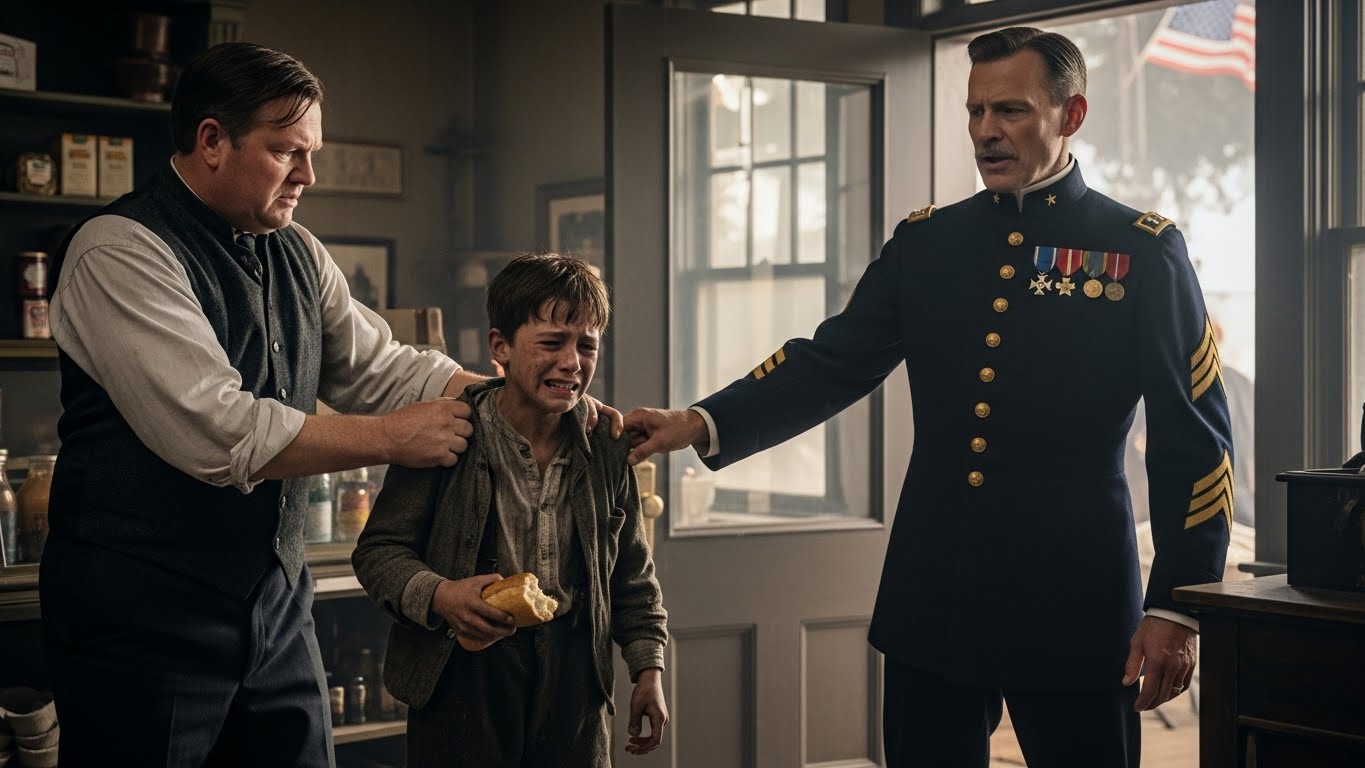
The store manager dragged the starving orphan by his hair… But then a 4-Star General walked in and asked one terrifying question.
The hunger wasn’t just a feeling for ten-year-old Leo; it was a living thing inside him, a clawed beast that woke up every time the sun went down.
Oak Creek in November was unforgiving. The wind cut through Leo’s oversized, moth-eaten wool coat like a razor, finding the shivering skin beneath. He had been living under the concrete arch of the Miller Bridge for three months, surviving on discarded apples and half-eaten sandwiches found in park bins. But today, the bins were empty. And the beast in his stomach was roaring.
It drove him to Miller’s Quality Foods.
The supermarket was a fortress of warmth and light. Through the sliding glass doors, Leo could see the rotisserie chickens spinning gold and brown, dripping fat. He could smell the yeasty, sour perfume of fresh bread.
He didn’t want to be a thief. His mother, before the sickness took her and the landlord took the apartment, had taught him better. “We don’t take what isn’t ours, Leo. We have dignity.”
But dignity didn’t stop the shaking in his hands.
Leo waited for a large family to enter—a mom distracted by a toddler and a dad on his phone—and slipped in their wake. He made himself small, a ghost in dirty sneakers. He headed straight for the clearance rack at the back.
There it was. A loaf of sourdough. Hard as a rock on one side, but edible. Ninety-nine cents. He had zero cents.
Leo grabbed it, tucking the cold plastic against his chest inside his coat. He turned, head down, walking fast. Just keep walking. Don’t run. Running looks guilty.
He was five steps from the exit when the world tilted sideways.
A hand clamped onto the back of his neck, the fingers digging in so hard they pinched a nerve.
“Thought you were slick, didn’t you, you little gutter rat?”
The voice belonged to Henderson, the store manager. A man who wore his polyester tie like a noose and his authority like a weapon. He had watched Leo on the cameras. He had been waiting.
“I’m sorry!” Leo squeaked, the bread tumbling from his coat to the floor. “I’ll put it back! I swear!”
“Put it back?” Henderson laughed, a cruel, wet sound. “Oh no. We’re making an example today.”
Instead of grabbing Leo’s arm, Henderson grabbed a fistful of Leo’s matted, dirty hair. He yanked hard. Leo screamed, his scalp burning, tears instantly blinding him.
“Please! It hurts!”
“Shut up!” Henderson bellowed. He dragged the boy backward, Leo’s heels skidding helplessly on the polished linoleum.
Shoppers froze. A woman in the produce section gasped. A cashier named Sarah took a step forward, “Mr. Henderson, stop! He’s just a child!”
“He’s vermin, Sarah! Get back to work!”
Henderson dragged Leo to the center of the store, right in front of the customer service desk. He forced the boy to his knees, keeping that painful grip on his hair, forcing Leo’s face up to the fluorescent lights.
“Look at this!” Henderson shouted to the stunned crowd. “This is what ruins neighborhoods! Filthy, thieving trash! I’m calling the police, and I hope they lock him up until he’s eighteen.”
Leo sobbed, his hands clutching at Henderson’s wrist, trying to relieve the pressure on his scalp. He felt the eyes of the town on him. The shame was worse than the hunger. He wished the floor would open up and swallow him whole. He was nothing. Just a waste of space.
Henderson reached for the landline phone on the counter with his free hand. “Hello? Police. I have a situation at Miller’s…”
The automatic doors hissed open.
It wasn’t just the wind that entered. The temperature in the room seemed to drop ten degrees, but the air suddenly felt heavy. Charged.
Clack. Clack. Clack.
Heavy boots struck the floor with a rhythm that sounded like a war drum.
The silence that fell over the store was suffocating.
A man walked in. He was a mountain of a human, dressed in a midnight-blue Army Service Uniform. The fabric was immaculate. On his shoulders, four silver stars caught the light. His chest was heavy with ribbons—Valor, Purple Heart, Distinguished Service.
But it was his eyes that terrified everyone. They were steel-gray, cold, and locked onto Henderson like a predator spotting wounded prey.
General Marcus Thorne didn’t rush. He didn’t shout. He simply walked. The crowd parted like the Red Sea.
He stopped two feet from the manager.
Henderson, sensing the shift, looked up. He saw the uniform. He saw the stars. The phone slipped from his fingers and dangled by its cord.
“Sir,” Henderson stammered, his grip on Leo’s hair loosening just a fraction. “I… I’m handling a shoplifter. Just waiting for the police.”
General Thorne didn’t blink. His voice was a low rumble, quiet but vibrating with enough power to shake the foundation.
“Let him go.”
“But… but he stole bread,” Henderson tried to regain his bluster, though his voice cracked. “He’s a nobody. An orphan. He has no one to answer for him.”
The General moved. It was a blur. One moment he was standing still, the next his gloved hand was wrapped around Henderson’s wrist—the one holding Leo’s hair.
Thorne squeezed.
Henderson shrieked, a high-pitched sound of pure agony. His fingers sprang open.
Leo collapsed to the floor, curling into a ball, covering his head with his arms, waiting for the next blow.
But the blow never came.
The General released Henderson, who stumbled back, clutching his crushed wrist, hyperventilating. Thorne ignored him. He dropped to one knee—slowly, deliberately—ignoring the dirt on the floor.
He reached out. Leo flinched.
“Easy,” the General whispered. The voice wasn’t scary anymore. It was deep and safe. “I’m not going to hurt you.”
He placed a large hand on Leo’s shoulder. It was warm. Solid.
“Stand up, soldier,” Thorne said softly.
Leo looked up, wiping snot and tears from his face. He saw the man’s face—scarred, tough, but looking at Leo with an expression that looked painfully like… grief? Or maybe recognition.
Thorne stood, bringing Leo up with him. He took off his dress jacket—a garment worth more than Leo’s life, probably—and draped it over the boy’s trembling shoulders. It was heavy and smelled like starch and old leather.
Thorne turned back to Henderson. The manager was pale, sweating profusely.
“You said this boy had no one,” Thorne said. He scanned the crowd, challenging anyone to speak. “You announced to this room that he was trash.”
“I… I didn’t know…” Henderson whimpered.
Thorne pulled Leo tight against his side.
“Is there a problem,” Thorne asked, his voice echoing off the high ceiling, “with my son?”
The gasp from the crowd was audible. Leo’s eyes went wide. He looked up at the General, but the man didn’t look down. He stared straight at Henderson with the intensity of a firing squad.
“Y-your son?” Henderson choked out. “But… he lives under the bridge. He…”
“He is a Thorne,” the General lied—or perhaps, decided—with a conviction that made it truth. “And you just assaulted him. If I see you near him, or any child, ever again… I won’t call the police. I will bring the full might of the United States Military down on this establishment until there is nothing left but dust. Do you understand me?”
“Yes! Yes, Sir! I’m sorry!”
Thorne reached into his pocket, pulled out a crisp hundred-dollar bill, and balled it up. He tossed it at Henderson’s feet.
“For the bread. Keep the change.”
Thorne guided Leo toward the door. The crowd stared in awe.
As they stepped into the cold rain, the warmth of the jacket kept Leo safe. He looked up at the stranger.
“Why?” Leo whispered. “I’m not your son.”
The General stopped. He looked down at the boy—at the hunger in his cheeks, the fear in his eyes. He saw a reflection of himself, years ago, before the army, before the stars.
“You needed a father,” Thorne said, his voice thick with emotion. “And it looks like I just found a son. Are you hungry, Leo?”
Leo nodded, tears spilling over again.
“Let’s go get a steak,” the General said, opening the door to his black car. “We have a lot to talk about.”