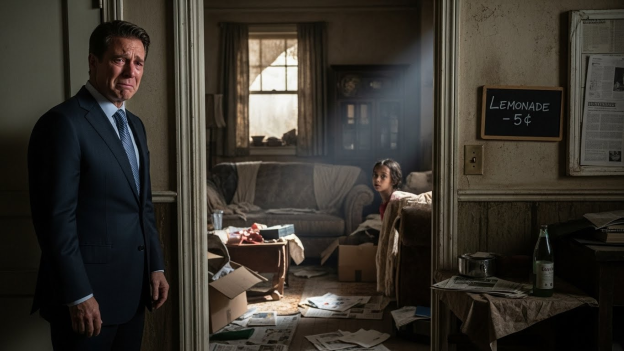
He went to evict a penniless tenant for three months of unpaid rent… But when he saw the seven-year-old’s blood-stained hands, the billionaire realized he was the one who owed a debt.
FULL STORY:
Julián Castañeda was a man built of cold numbers and iron-clad contracts. To him, the world was a ledger; you were either an asset or a liability. As he slammed the door of his matte-black SUV, the humidity of the city’s slums clung to his bespoke Italian suit like a layer of filth. He was here at the decaying apartment complex on Calle Norte for one reason: efficiency.
Three months of silence. Three months of skipped payments. Apartment 4B was a smudge on his quarterly report, and Julián didn’t like smudges.
The hallway smelled of damp concrete and desperation. Flickering fluorescent lights hummed a nervous rhythm, casting long, twitching shadows over the water-stained floors. He reached the door and delivered a knock that wasn’t a request—it was a demand.
When the door creaked open, Julián had a speech prepared about legal obligations and immediate vacation. But the words died in his throat.
Standing there was Valeria. She was no taller than his waist, with eyes that seemed to have seen decades more than her seven years of life. Her hair was a tangled nest, and her blouse was a mosaic of colorful thread and dust. In her small, trembling hand, she clutched a needle.
“I’m looking for your mother,” Julián said, his voice dropping an octave, the predatory edge suddenly dulled.
The girl didn’t speak. She simply stepped back, inviting him into a reality he didn’t know existed within the zip codes he owned. The apartment was a tomb of industry. On the central table sat an ancient, hand-cranked sewing machine. Scraps of cheap polyester and silk were piled high, and a half-finished dress lay beneath the presser foot.
Then, Julián saw her hands.
The tips of her fingers were a map of tiny red punctures. Some were old and scabbed; others were fresh, weeping small beads of crimson onto the white fabric she was working on. She wasn’t just playing; she was producing. She was a one-child factory.
“Where is Teresa?” he asked, his heart performing a slow, heavy thud against his ribs.
“Hospital,” Valeria whispered. The word was so fragile it seemed like it might shatter. “The medicine was expensive. She said… she said the rent had to wait. But I’m finishing the orders. I can pay you. Please.”
She scurried to the table and picked up a crumpled envelope. With shaking fingers, she pulled out a stack of small, dirty bills—singles and fives, likely gathered from neighbors or local markets where she’d sold her labor. It was nowhere near the amount owed, but it represented a lifetime of toil for a child.
Julián looked at the money, then at the mattress on the floor, and finally at the stack of empty medicine boxes by the wall. He was a man who owned skyscrapers, yet he felt smaller than the child standing before him. He realized that while he was calculating interest rates, this girl was calculating how many stitches it took to keep a roof over her head.
He didn’t take the money. Instead, he reached into his pocket and placed several hundred-dollar bills on the table—more than the rent, more than the value of the sewing machine.
Valeria didn’t cry. She didn’t thank him. She simply looked at the money with a haunting, professional detachment, then sat back down at the machine. She had a deadline. She had a mother to save.
Julián walked out, but the coldness he’d arrived with stayed behind in that room. That night, in his penthouse overlooking the shimmering lights of the city, he couldn’t sleep. The silence of his luxury felt deafening. Every time he closed his eyes, he saw the needle rising and falling, and the red stains on the white fabric.
At 5:00 AM, he was at a wholesale market. He filled his SUV with crates of fresh fruit, protein, milk, and soft blankets. He bought a modern, electric sewing machine—the best money could buy—and a mountain of high-quality fabrics.
When he returned to 4B, the door was already ajar. Valeria was asleep at the table, her head resting on a pile of scraps, her finger still hooked near the needle.
“Valeria,” he said softly, shaking her shoulder.
She woke with a start, her eyes darting to the door as if expecting the police. When she saw him, her gaze moved to the bags of food.
“I brought some things,” Julián said, feeling an unfamiliar lump in his throat. “And I called the hospital. Your mother’s bills are covered. She’s coming home tomorrow.”
For the first time, the mask of the “little worker” broke. Valeria’s lip trembled. She looked at the food, then at Julián, and finally at her own battered hands.
“Why?” she asked.
Julián knelt on the dirty floor, unheeding of his expensive trousers. He took her small, scarred hands in his. “Because I forgot that people live inside my numbers,” he whispered. “And because no one should have to bleed just to belong somewhere.”
He didn’t just pay the rent. He turned the building into a co-op, renovated the units, and established a foundation for the children of Calle Norte. But the greatest change was within himself. Every month, Julián returns to Apartment 4B—not to collect a check, but to sit at the table, share a meal with Teresa and Valeria, and remind himself that the most valuable things in life are the ones you can’t put a price on.