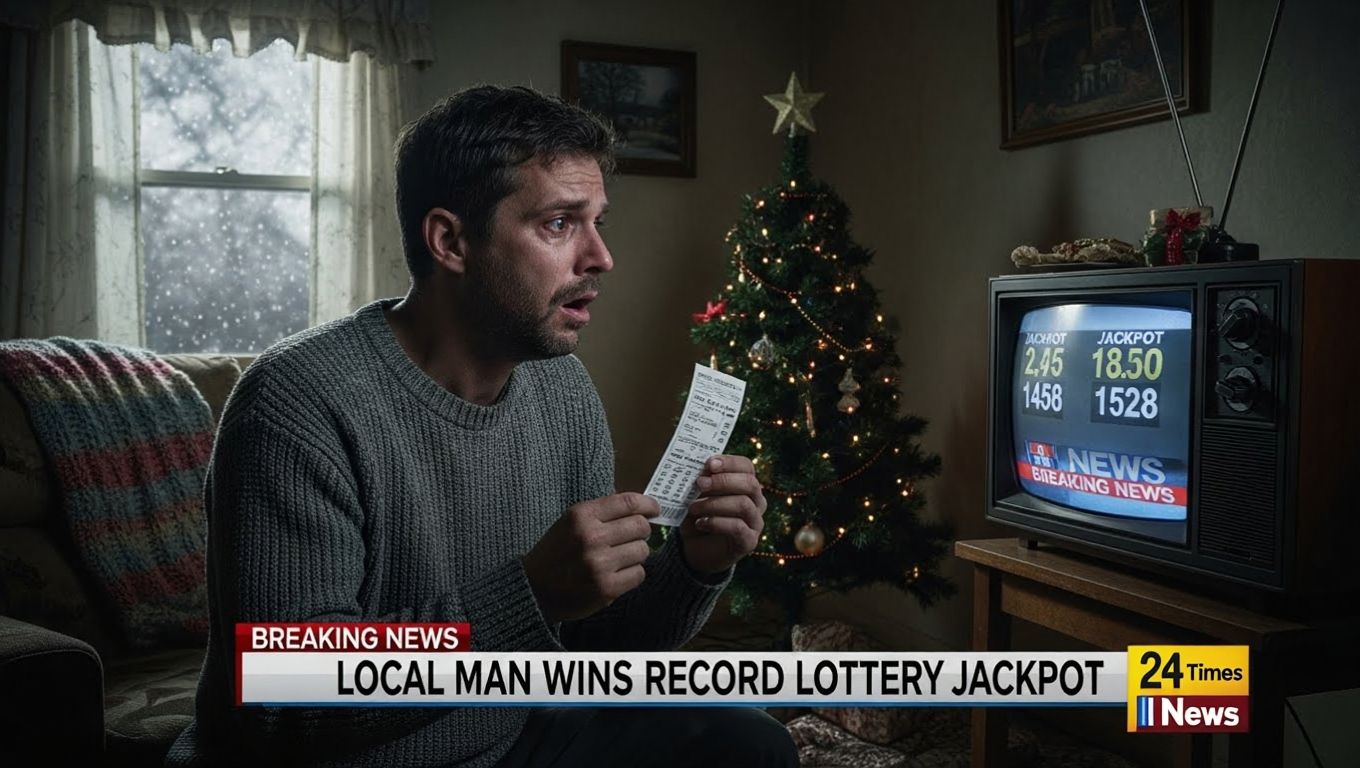
He spent his last $20 on a lottery ticket while his family struggled to keep the heat on for Christmas… But when the numbers rolled in, he realized his life had just become a national headline.
The wind in Arkansas cuts different in December. It doesn’t just blow; it bites, finding its way through the cracks in the window frames and the seams of worn-out coats. For Elias Thorne, a 54-year-old diesel mechanic in a town you’d miss if you blinked, the cold was the least of his worries. The stack of envelopes on the kitchen counter—specifically the red-stamped ones—was the real storm.
It was Christmas Eve. The house smelled faintly of cinnamon and pine, a valiant effort by his wife, Martha, to mask the scent of old drywall and anxiety. Elias sat in his truck in the driveway, staring at the steering wheel, his grease-stained hands trembling slightly. He had just finished a double shift, and his bank account balance was sitting at $42.18.
He had promised his grandson a bike. Not a fancy one, just something with two wheels and a chain that stayed on. He didn’t have the money. He didn’t have the money for the bike, or the heating oil refill, or the property tax hike that the county had so graciously mailed out three days prior.
He pulled the crumpled receipt from his pocket. Earlier that evening, in a moment of desperate, reckless superstition, he had stopped at the Sunoco on Route 65. He’d bought a gallon of milk, a loaf of bread, and with his last twenty-dollar bill, a Powerball ticket.
“Jackpot’s $1.8 billion, Elias,” the clerk, Old Man Miller, had wheezed. “Somebody’s gotta win it. Might as well be a sinner like you.”
Elias had laughed, a dry, humorless sound. He wasn’t a gambler. He was a worker. But desperation makes men do strange things.
He walked inside. The warmth of the house hit him, along with the sound of the TV. Martha was sitting on the sagging beige sofa, knitting a scarf that would likely be a gift for someone tomorrow.
“You look beat, Eli,” she said softly, not looking up. She knew. She always knew when the money was tight, which was always.
“Long day,” he grunted, hanging his coat. “Got the milk.”
They ate a quiet dinner of stew. The silence between them wasn’t angry; it was the heavy, comfortable silence of two people who had weathered thirty years of storms together and were just too tired to talk about the rain.
Christmas morning broke gray and slushy. The grandkids arrived at 9:00 AM, a whirlwind of energy that temporarily displaced the gloom. Elias watched them tear into the small, practical gifts they’d managed to scrape together. Socks, art supplies, a few plastic trucks. No bike. The twinge in his chest felt like a heart attack, but it was just shame.
Around noon, while the family was distracted by a movie, Elias retreated to the garage. He needed a cigarette, though he’d quit ten years ago. He settled for the solitude. He pulled out his phone. The drawing had happened last night, but he hadn’t had the heart to look.
He uncrumpled the ticket.
05 – 12 – 24 – 31 – 48. Powerball: 13.
He opened the lottery app. His connection was slow, the little wheel spinning like a mockery of his patience. Finally, the numbers popped up.
Winning Numbers:
05 – 12 – 24 – 31 – 48.
Powerball: 13.
Elias stared. He blinked. He wiped the screen with his thumb, smearing a bit of oil on the glass. He looked again.
The air in the garage suddenly felt very thin. The sounds of the house—the TV, the kids laughing—faded into a high-pitched ringing in his ears. He looked at the ticket. He looked at the phone.
Matches: 5 + PB.
Prize Amount: JACKPOT.
Estimated Cash Value: $1.817 Billion.
“No,” he whispered. His voice sounded like it belonged to someone else. “No, that’s… that’s a misprint.”
He refreshed the page. Same numbers. He went to a news site.
BREAKING: Single winning ticket for $1.8 Billion Powerball sold in Arkansas.
Elias sat down on an overturned bucket. The world tilted. $1.8 billion. It was a number so large it didn’t mean money anymore; it meant gravity. It meant nations. It meant he could buy the factory he worked at, fire his boss, and turn the building into a giant indoor park for his grandkids.
He couldn’t breathe. He stood up, knees buckling, and grabbed the workbench for support. He had to tell Martha. But how? How do you tell someone that the war is over? That the struggle that defined your entire adult life has just evaporated?
He walked back into the house. He looked like a ghost.
“Eli?” Martha asked, looking up from the kitchen table where she was counting out crackers for a tray. “You okay? You look pale.”
Elias walked over to her. He took the cracker box out of her hands and set it down.
“Martha,” he croaked.
“What? Is it the truck? Did the transmission go?” Her eyes instantly filled with the reflex of worry.
“No,” he said. He reached into his pocket and pulled out the slip of paper. He laid it on the table, smoothing it out with a trembling hand. Then he placed his phone next to it.
“Look.”
“I don’t have my readers, Eli, what is it?”
“Just look, Martha. Please.”
She squinted, leaning in. She looked at the phone. Then the ticket. Then the phone again. She froze.
“Eli,” she whispered, “Is this a joke? Because if this is one of your jokes, I swear…”
“It’s not a joke,” tears began to well in his eyes, hot and fast. “It’s real. The news… they said it was sold here. In Arkansas.”
Martha stood up. She covered her mouth with both hands. The silence in the kitchen was absolute, heavy with the weight of a billion dollars.
“We can fix the roof,” she whispered, her mind unable to grasp the magnitude, latching onto the immediate problems.
Elias laughed, a wet, sobbing sound. “Martha, we can buy the roofing company. We can buy the whole damn neighborhood.”
He pulled her into a hug, burying his face in her shoulder. They stood there in their drafty kitchen, holding onto each other as if the floor was falling away.
“The bike,” Elias sobbed into her sweater. “I can get him the bike.”
“You can get him a bike factory,” she cried, laughing through the tears.
They didn’t tell the kids yet. Not that day. They spent the rest of Christmas in a daze, looking at each other across the room, sharing a secret that burned brighter than the lights on the tree. Every time the wind rattled the windows, they didn’t flinch. Let it blow. They were warm now. They were safe.
The next day, Elias hired a lawyer and a financial advisor before claiming the prize. He didn’t show up to work on Monday. Or Tuesday. On Wednesday, he drove to the shop in his rusted Ford F-150 for the last time.
He walked into the office, handed his boss a resignation letter, and walked out. He didn’t make a scene. He didn’t brag. He just got back in his truck and drove to the bicycle shop in the city.
He bought the best bike in the store. Then, he went to the bank and paid off the mortgages of every house on his street. Anonymous donor, he told them.
It was the largest jackpot in history, but for Elias, the number didn’t matter. What mattered was the quiet drive home, the bike in the back, and the knowledge that the cold would never get in again.